In this storyOpen index
Nicholas II of Russia: The Man Who Mistook Duty for Refusing to Change
Autocracy, family, revolution and the evidence that ended the Romanov survival myths.
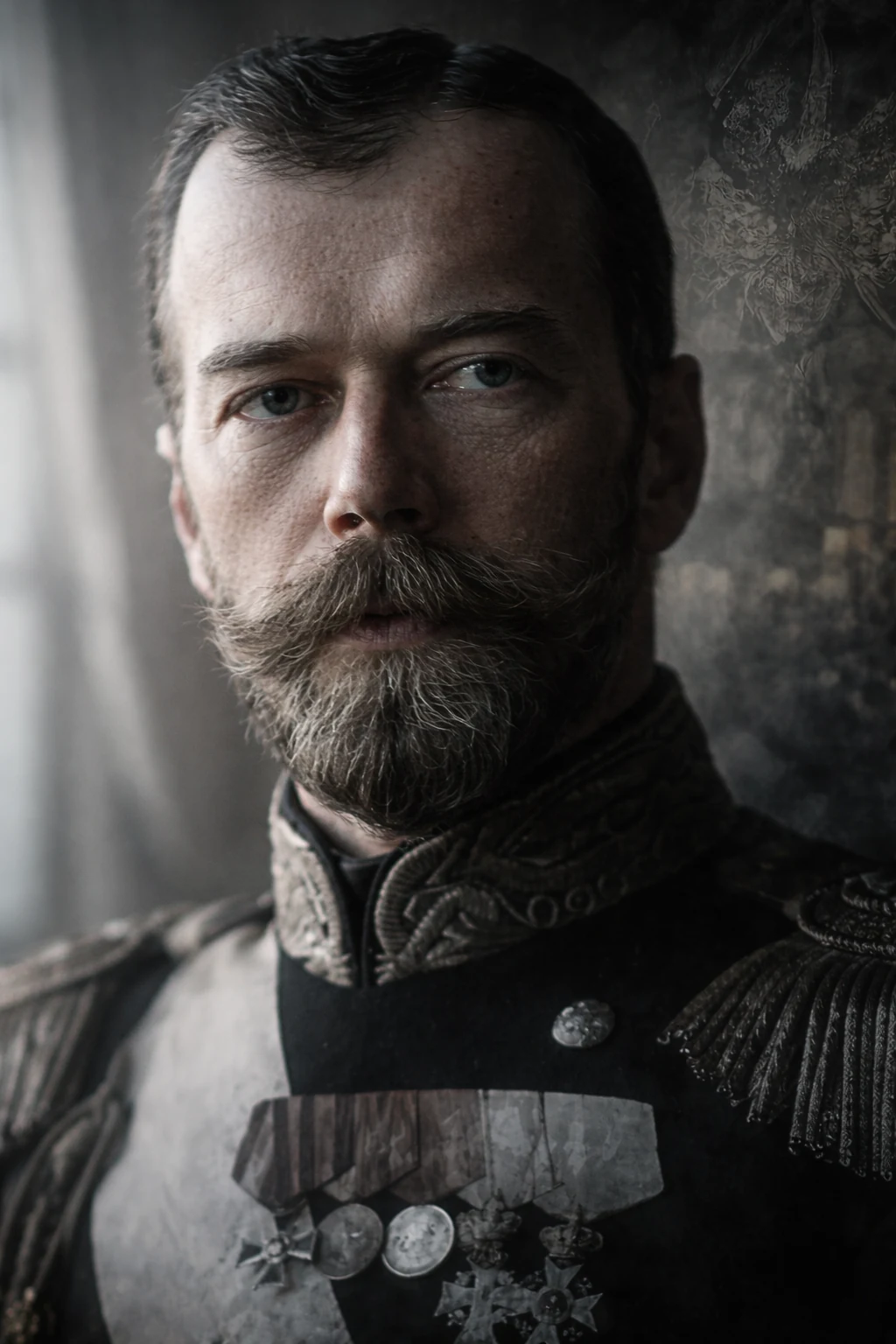
Nicholas II was neither the bloodthirsty monster portrayed by revolutionary propaganda nor the innocent saint later fashioned by monarchist nostalgia. He was something more uncomfortable: an affectionate man in private, deeply religious and convinced that preserving autocracy intact was a sacred duty. It was precisely this conviction that made him incapable of understanding the country he ruled.
His crown did not merely weigh more than his own life. It ultimately dragged his wife, his children and a dynasty more than three centuries old into a cellar in Yekaterinburg.
Nicholas II of Russia
The last tsar: power and family
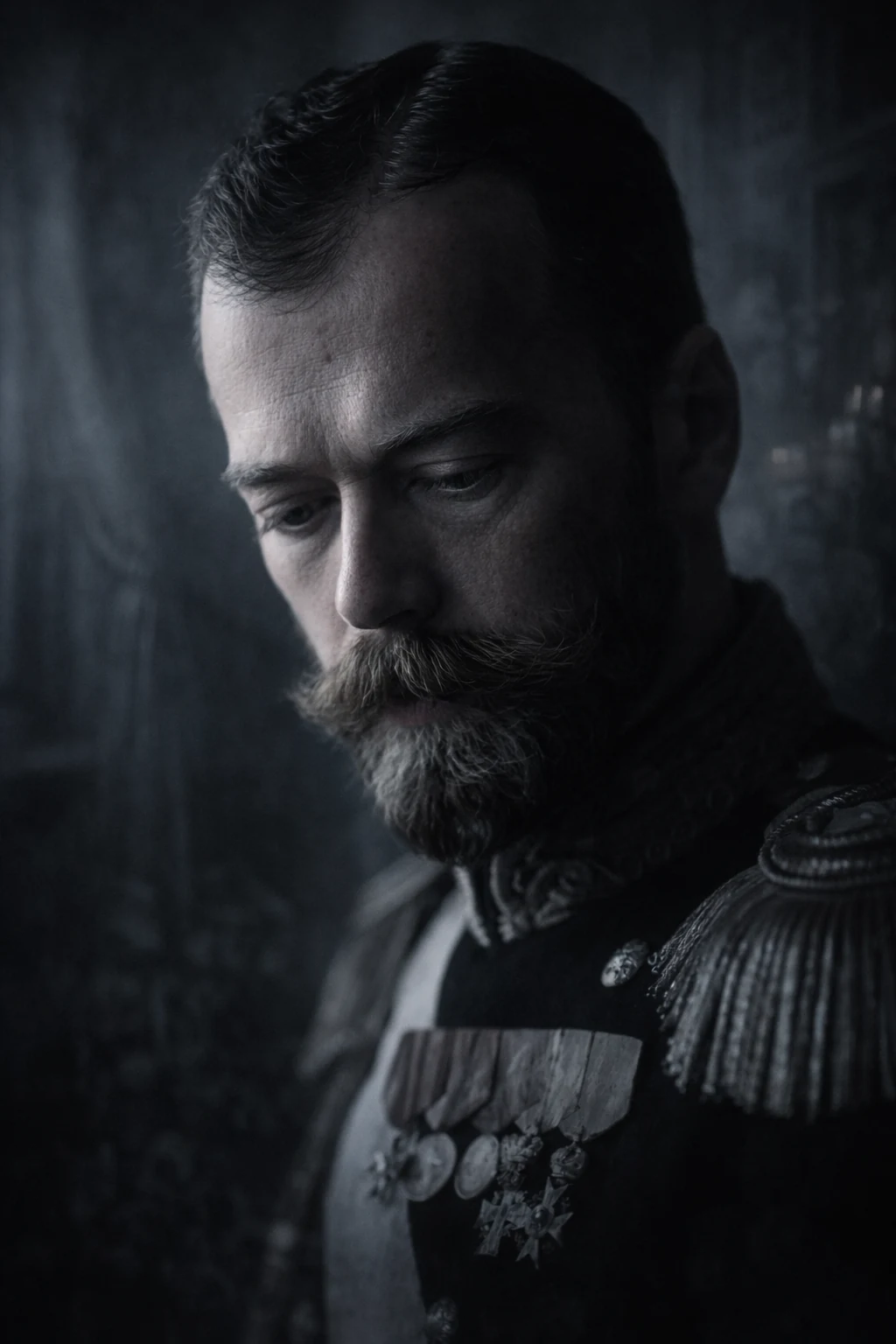
Nicholas II on his wedding day
Royal Collection Trust catalogues a portrait by Sergey Levitsky dated November 26, 1894, the day of Nicholas II’s wedding. The gelatin silver print carries the annotations “Nicky” and “Nov 14/26 1894 St Petersburg”: the two dates reflect the Julian and Gregorian calendars. The linked record documents the original photograph; the accompanying image here is an AI recreation, not a reproduction of that object.
An heir taught to obey
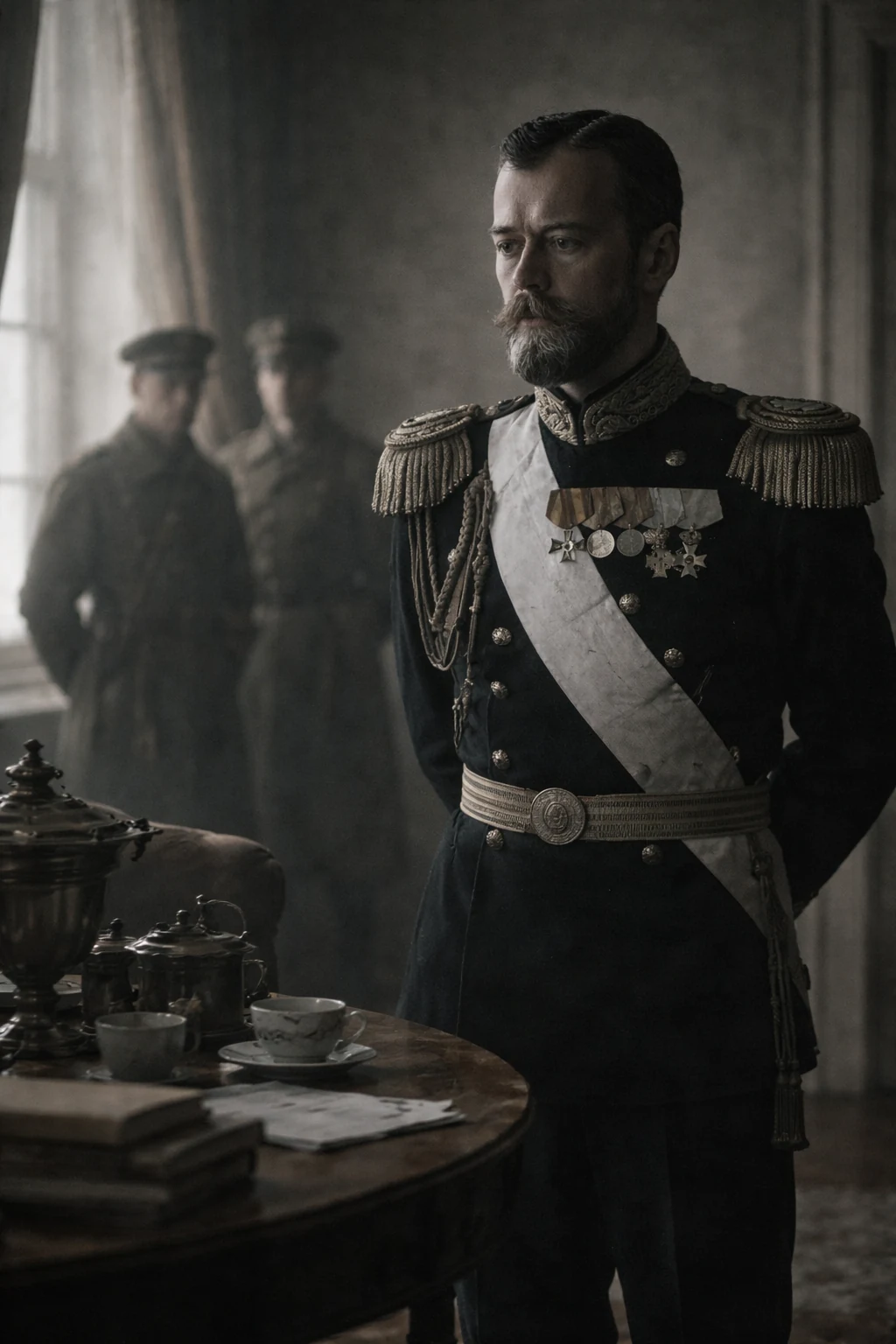
Nikolai Alexandrovich Romanov was born on May 18, 1868, at Tsarskoye Selo. He was the eldest son of the future Alexander III and Maria Feodorovna, born Princess Dagmar of Denmark. He received an extensive education in languages, history, law and military affairs, but gained little practical experience in government.
Alexander III believed that his son was still too young and naïve to be introduced to the workings of power. Nicholas was consequently excluded from many important decisions. When his father died unexpectedly in November 1894, the twenty-six-year-old heir suddenly found himself ruling one of the largest and most complicated empires in the world.
The familiar story that Nicholas wept and asked what would become of Russia comes from later recollections and cannot be verified word for word. It nevertheless captures a genuine truth: he did not feel prepared. Even so, he never doubted that absolute authority belonged to him by divine will (Lieven, 1993).
Only weeks after his accession, he married Princess Alix of Hesse, who entered the Russian Orthodox Church as Alexandra Feodorovna. Their affection was genuine and enduring. Their letters reveal a degree of intimacy uncommon in dynastic marriages. Yet that union also drew the tsar into an increasingly enclosed family circle that mistrusted the outside world.
The celebration that became a grave
Nicholas and Alexandra were crowned in Moscow in May 1896. As part of the festivities, food, beer and commemorative gifts were to be distributed at Khodynka Field. Hundreds of thousands of people gathered there. Rumors that there would not be enough gifts caused the crowd to surge across ground broken by ditches.
More than a thousand people were killed and many others injured. The tsar visited some of the victims and money was allocated to their families, but that same evening he attended a ball hosted by the French ambassador. His ministers feared that canceling the reception might be interpreted as a diplomatic insult. The decision was disastrous: it created an image of indifference that followed him throughout his reign (Wortman, 2013).
Khodynka did not prove that Nicholas was incapable of compassion. It demonstrated something politically more serious: when confronted by tragedy, he allowed protocol to make the decision for him.
A household bound by a secret
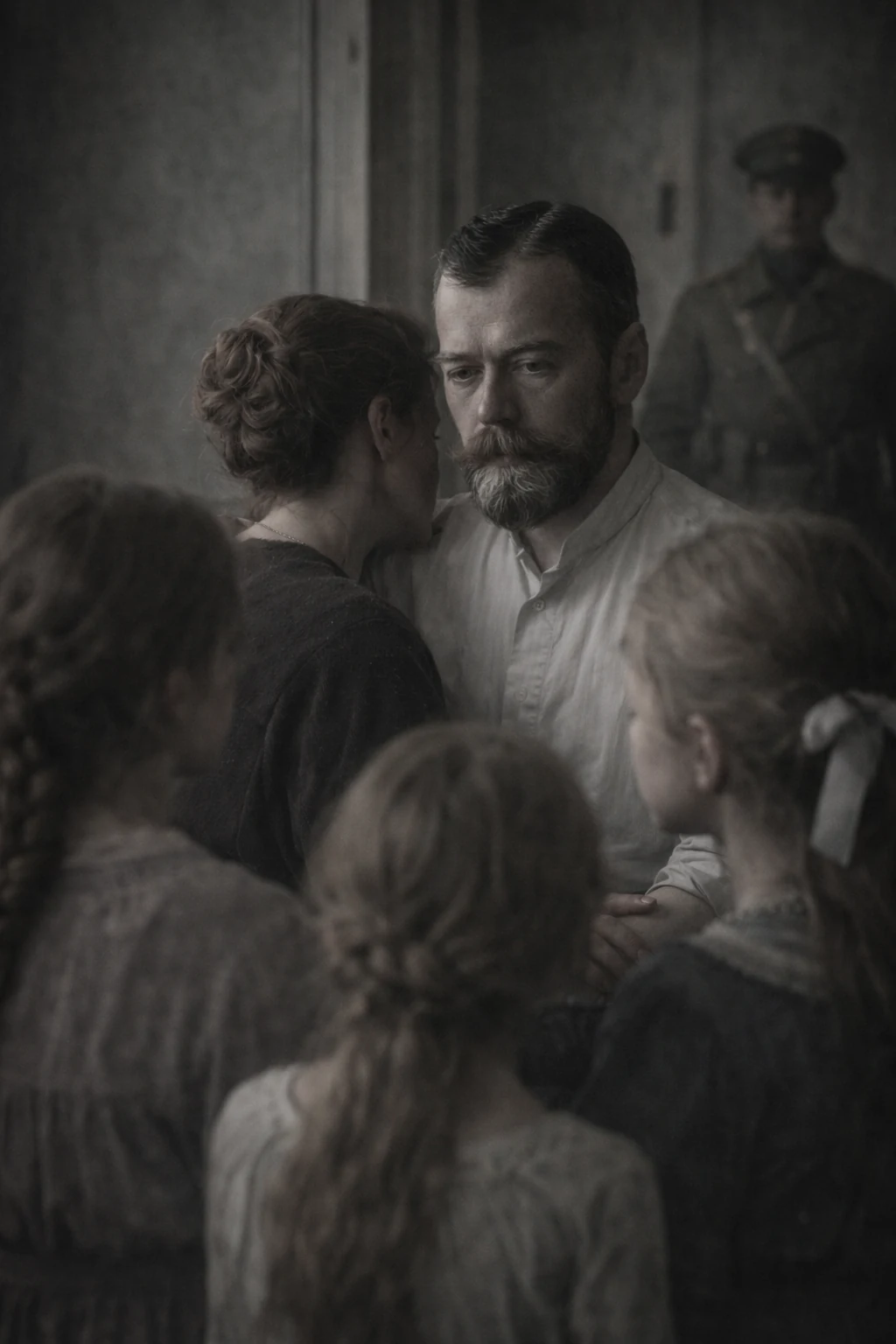
The imperial couple had five children: Olga, Tatiana, Maria, Anastasia and, finally, Tsarevich Alexei in 1904. The boy’s birth appeared to secure the succession, but it was soon discovered that he had hemophilia, an inherited disorder that prevents blood from clotting normally.
His condition was kept secret because revealing the heir’s fragility might destabilize the monarchy. Alexandra lived in terror of every fall or hemorrhage. It was in this setting that Grigori Rasputin appeared—a Siberian peasant and religious mystic who seemed able to calm the child during his attacks.
It is not known exactly why several of Rasputin’s interventions coincided with improvements. Reassuring the mother and child has been suggested as one possible explanation, but the mechanism of those improvements cannot be established with certainty. To Alexandra, however, the recoveries proved that God was working through him (Massie, 1967).
Rasputin’s political influence has been exaggerated by rumor, court enemies and sensational accounts. He did not secretly govern Russia, and there is no evidence that he had a sexual relationship with the empress. He did have access to the imperial family and made recommendations concerning appointments. Because Alexei’s illness could not be publicly discussed, the family could not explain why Rasputin was tolerated, allowing scandal to take the place of truth.
The “Little Father” and the gunfire
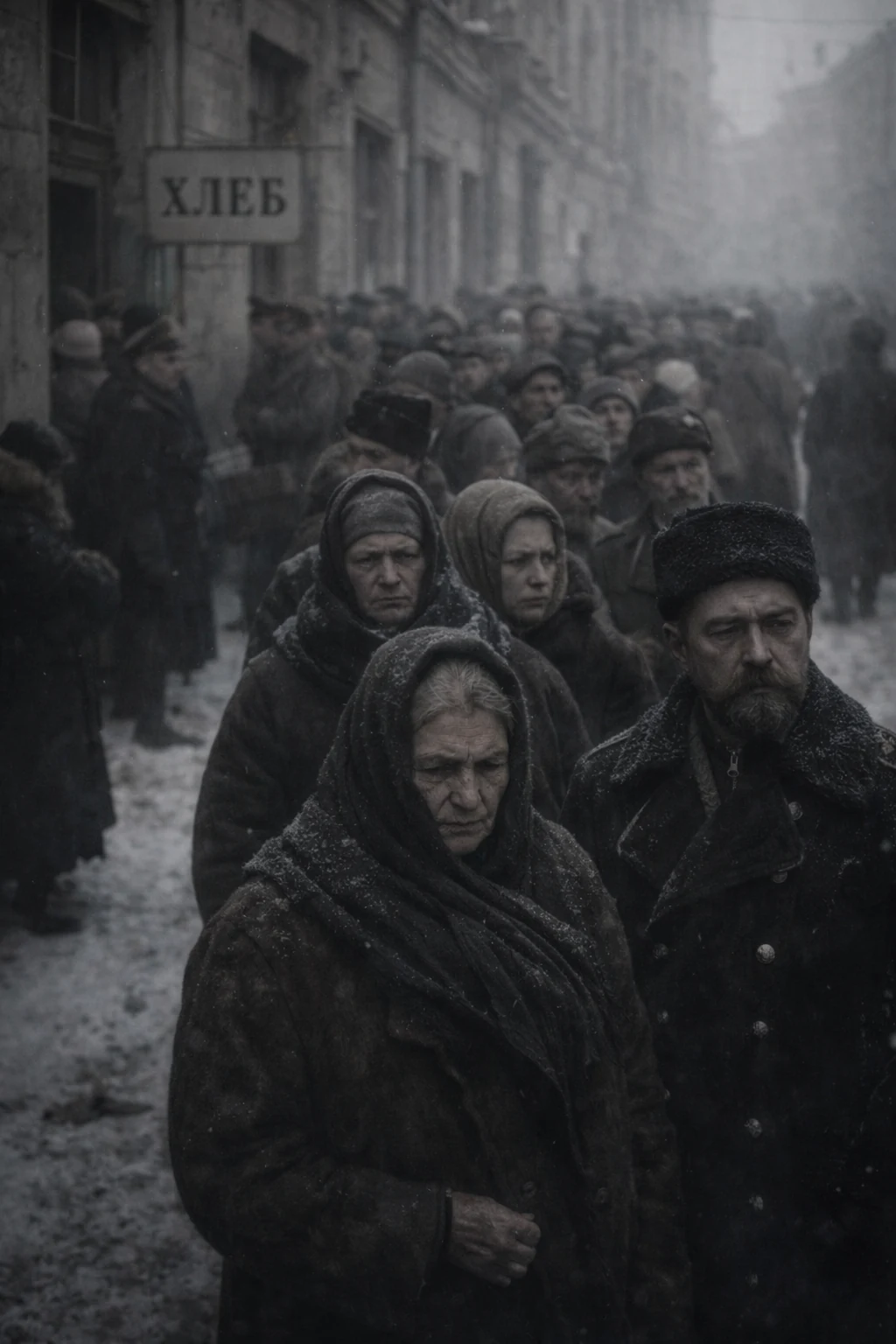
The Russo-Japanese War of 1904–1905 exposed the empire’s military and administrative weaknesses. Russia suffered humiliating defeats, including the destruction of much of its fleet at Tsushima. At home, harsh working conditions, rural poverty and the absence of meaningful political representation fed public anger.
On January 22, 1905, a crowd of workers led by the priest Georgy Gapon marched toward the Winter Palace to present a petition to the tsar. Many carried icons and portraits of Nicholas because they still trusted him as the people’s protective “Little Father.” Troops opened fire, killing and wounding hundreds.
Nicholas was not at the palace, and there is no conclusive evidence that he personally ordered the shooting. Yet as absolute sovereign he was responsible for the system that reacted in this way. Bloody Sunday destroyed the belief that the tsar would protect his subjects from the abuses of his officials (Ferro, 1991).
The 1905 Revolution forced Nicholas to sign the October Manifesto, promising civil liberties and a legislative assembly called the Duma. He regarded these concessions, however, as a temporary humiliation. The Fundamental Laws of 1906 reaffirmed his authority, and he dissolved the first two Dumas when their demands became unacceptable to him.
Russia ceased to be an entirely untouched autocracy, but it did not become a stable constitutional monarchy. Nicholas permitted enough change to disappoint absolutists and restricted it enough to frustrate reformers.
The war that made the tsar personally responsible
When the First World War began in 1914, Russia entered the conflict amid a European system of alliances, mobilizations and imperial rivalries. Nicholas was not solely responsible for the war, but neither was he able to prevent the crisis from escaping the governments that had created it.
In September 1915 he made one of his most dangerous decisions: he assumed personal command of the Russian army. Nicholas was not an accomplished strategist, and his presence at military headquarters did not substantially improve the conduct of the war. It did, however, attach every defeat, ammunition shortage and casualty list directly to his name (Imperial War Museums, 1964).
His absence from the capital left Alexandra more exposed to Rasputin’s advice and ministerial intrigue. Because the empress had been born in Germany, she was accused without evidence of assisting the enemy. Rasputin was murdered by a group of aristocrats in December 1916, but his death could not restore the monarchy’s reputation.
By early 1917, Russia was suffering enormous casualties, inflation and severe failures in transportation and distribution. Food existed in parts of the country, but the system could not deliver it reliably to the cities. In Petrograd, bread lines, strikes and demonstrations developed into an uprising. Once soldiers began joining the protesters, the regime lost its final instrument of authority.
Abdication and a father’s decision
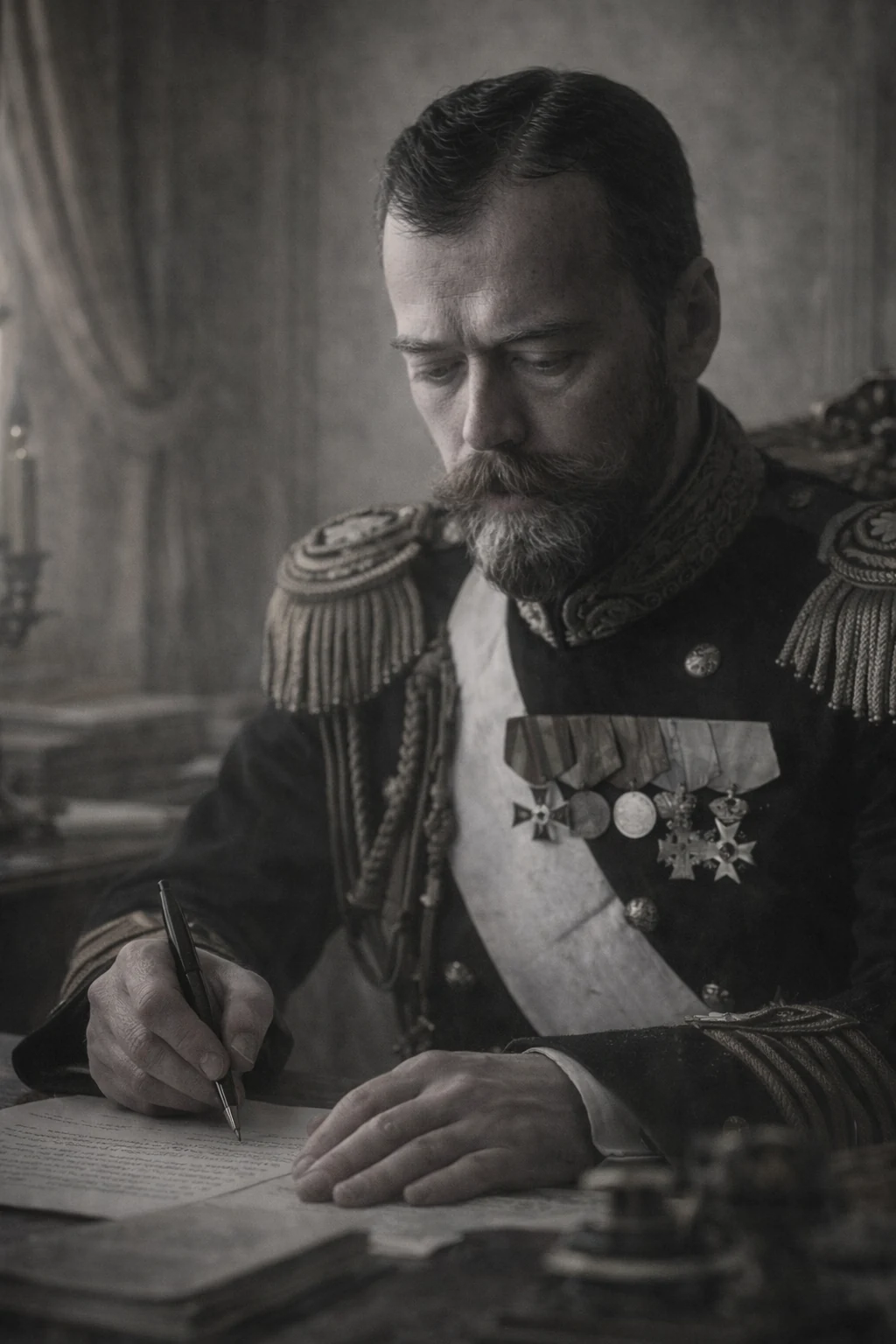
On March 15, 1917—March 2 under the Julian calendar then used in Russia—Nicholas abdicated at Pskov. He initially intended to surrender the throne to Alexei, with his brother Grand Duke Michael serving as regent. Doctors warned him that the sick child would probably have to live apart from his parents and that his health would remain extremely fragile.
Nicholas therefore changed the document. He abdicated both for himself and for his son, naming Michael as his successor. The decision was constitutionally questionable but humanly revealing. At the decisive moment, Nicholas chose to remain with Alexei rather than preserve the direct succession.
Michael declined to exercise power unless a future constituent assembly approved his accession. This effectively ended the Romanov monarchy (Steinberg & Khrustalev, 1995).
It is one of the less remembered facts of Nicholas’s downfall: he did not simply hand the crown to his brother. He first attempted to pass it to his son and then altered the abdication to avoid being separated from him. The man who had placed autocracy above Russia’s needs for years finally placed his family above the dynasty’s survival.
The house of special purpose
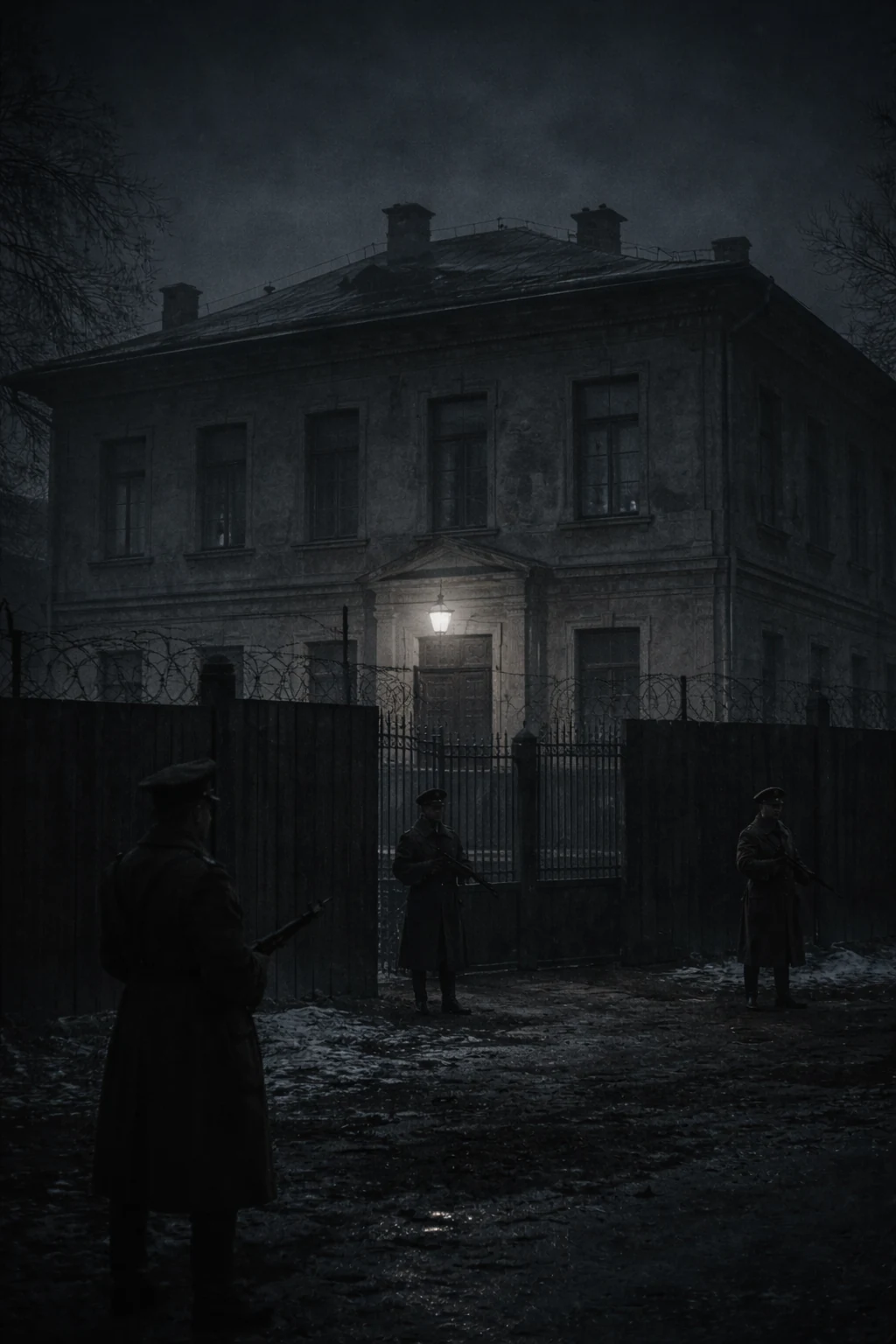
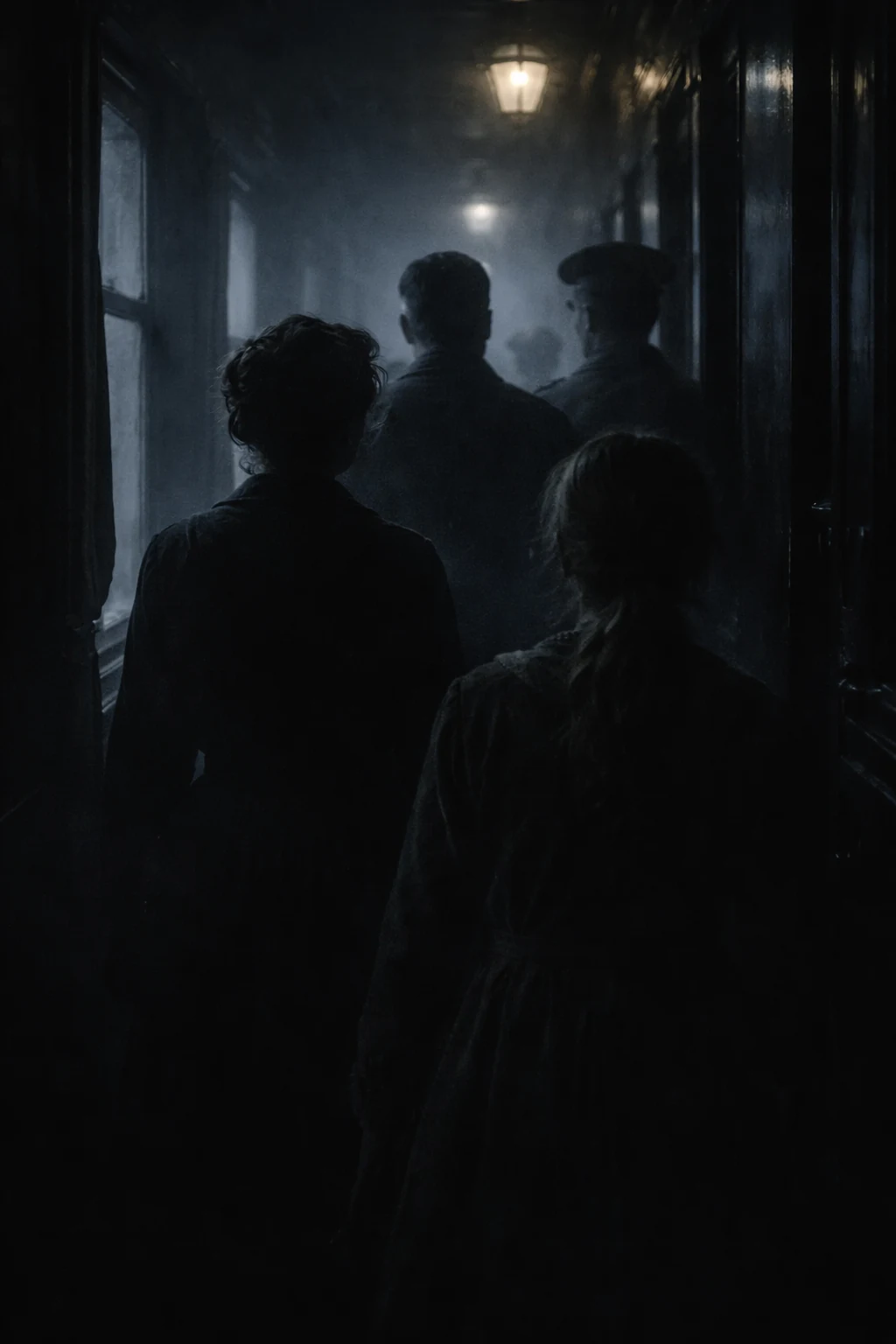
The Provisional Government held the family under guard at the Alexander Palace before transferring them to Tobolsk in Siberia. After the Bolsheviks seized power, Nicholas, Alexandra and their children were confined in the Ipatiev House in Yekaterinburg, which their guards called “the house of special purpose.”
During the night of July 16–17, 1918, the prisoners were taken to a cellar, supposedly for their protection during approaching unrest. Nicholas, Alexandra, Olga, Tatiana, Maria, Anastasia and Alexei were killed there, along with their physician Eugene Botkin and three servants.
The execution was directed by Yakov Yurovsky and authorized by Bolshevik authorities in the Urals as anti-Bolshevik forces approached the city. The extent of Lenin’s and Yakov Sverdlov’s direct involvement remains disputed because no conclusive written execution order from Moscow survives. To present the full chain of command as certain would go beyond the available evidence (Rappaport, 2008).
The bodies were concealed, while the new regime released incomplete information about the family’s fate.
The daughter who did not escape
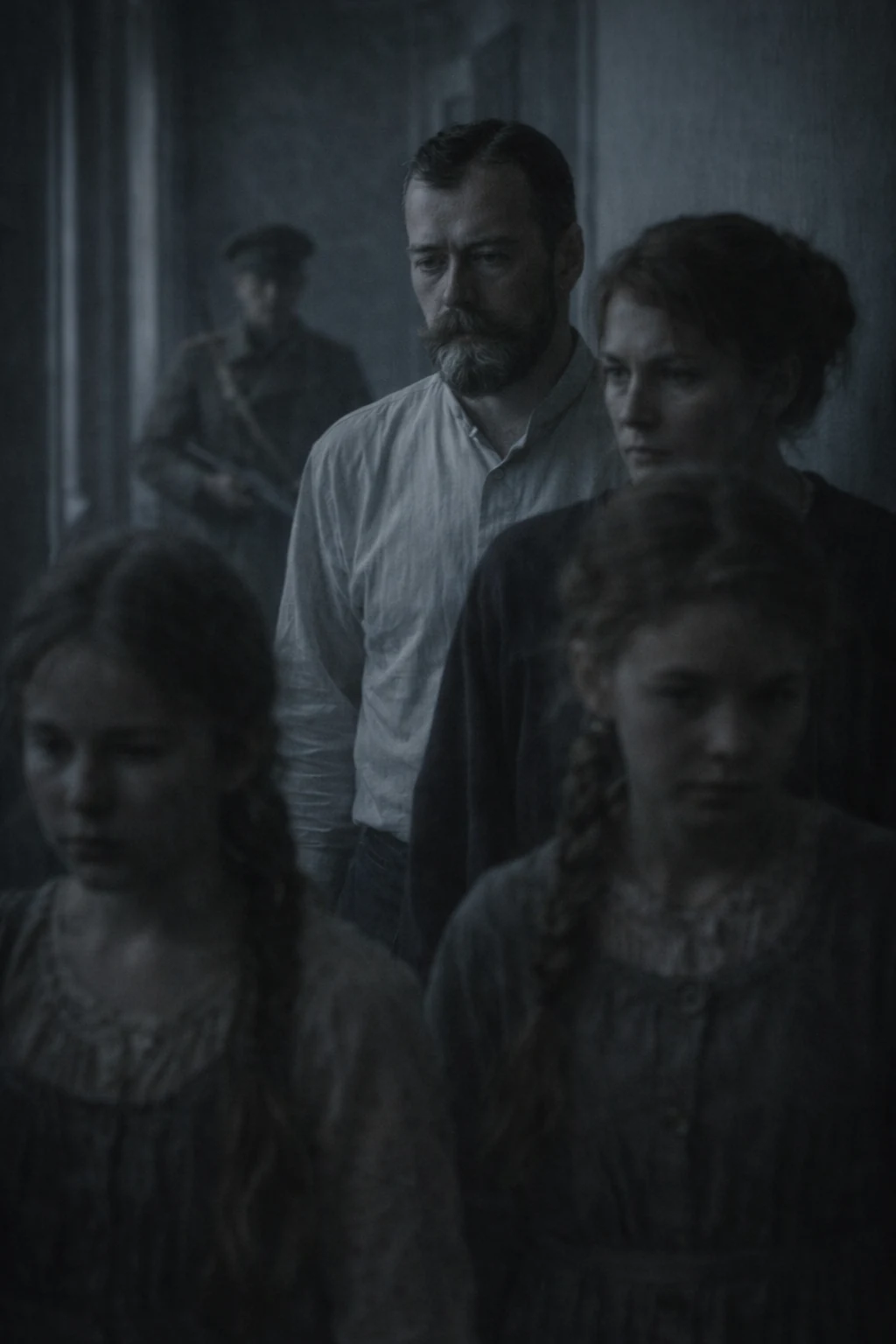
The secrecy allowed one of the twentieth century’s most persistent legends to flourish: that Anastasia might have survived. Dozens of women claimed to be the missing grand duchess. The most famous, Anna Anderson, maintained the identity for decades and convinced some people who had known the Romanovs.
In 1991, nine sets of remains were exhumed from a grave near Yekaterinburg. Investigators identified Nicholas, Alexandra, three daughters and four attendants. Because Alexei and one sister were missing, the legend appeared to retain a final possibility.
Additional remains were discovered in 2007. Genetic testing established that they belonged to a boy and a young woman related to the first group. Taken together, the evidence demonstrated beyond reasonable doubt that all five children of Nicholas and Alexandra died with their parents. No one escaped the cellar (Coble et al., 2009; Rogaev et al., 2009).
The man, the sovereign and the crown
In 2000, the Russian Orthodox Church canonized Nicholas and his family as passion-bearers: people who faced suffering and death with Christian humility. This designation did not declare his government righteous or identify him as a martyr killed specifically for defending religious doctrine.
Nicholas could be courteous, disciplined and deeply loving toward his family. He could also accept repression, disregard political warnings and cling to a conception of power that no longer matched Russia’s reality. Both portraits belong to the same man.
His tragedy was not simply that he lost the throne. It was that he believed surrendering authority would mean betraying God and his ancestors. By the time he understood that the crown could no longer be saved, the empire had already collapsed.
Nicholas II did not die because he was too weak to desire power. He died after proving too rigid to transform it.
References
- Coble, M. D., Loreille, O. M., Wadhams, M. J., Edson, S. M., Maynard, K., Meyer, C. E., Niederstätter, H., Berger, C., Berger, B., Falsetti, A. B., Gill, P., Parson, W., & Finelli, L. N. (2009). Mystery solved: The identification of the two missing Romanov children using DNA analysis. PLoS ONE, 4(3), e4838. View source
- Ferro, M. (1991). Nicholas II: Last of the Tsars. Oxford University Press.
- Imperial War Museums. (1964). The Great War 18: Fat Rodzianko has sent me some nonsense (Tsar Nicholas II) [Film catalogue record]. View source
- Lieven, D. (1993). Nicholas II: Emperor of All the Russias. John Murray.
- Massie, R. K. (1967). Nicholas and Alexandra. Atheneum.
- Rappaport, H. (2008). The last days of the Romanovs: Tragedy at Ekaterinburg. St. Martin’s Press.
- Rogaev, E. I., Grigorenko, A. P., Moliaka, Y. K., Faskhutdinova, G., Goltsov, A., Lahti, A., Hildebrandt, C., Kittler, E. L. W., & Morozova, I. (2009). Genomic identification in the historical case of the Nicholas II royal family. Proceedings of the National Academy of Sciences, 106(13), 5258–5263. View source
- Steinberg, M. D., & Khrustalev, V. M. (1995). The fall of the Romanovs: Political dreams and personal struggles in a time of revolution. Yale University Press.
- Wortman, R. S. (2013). Scenarios of power: Myth and ceremony in Russian monarchy. Princeton University Press. View source
- Royal Collection Trust. (n.d.). Nicholas II, Emperor of Russia (1868–1918) (RCIN 2926955). View source
More from this collection
Prince Leopold: Victoria’s Son Who Could Die from a Fall and Lived as a Prisoner of the Crown
Read story →
Genghis Khan: The Man Who Conquered the World but Could Not Govern His Own Legend
Read story →