In this storyOpen index
Winston Churchill: The Man Who Defied Hitler Without Escaping the Shadows of Empire
The leader who turned language into resistance against Hitler, yet never escaped the contradictions and victims of the empire he defended.
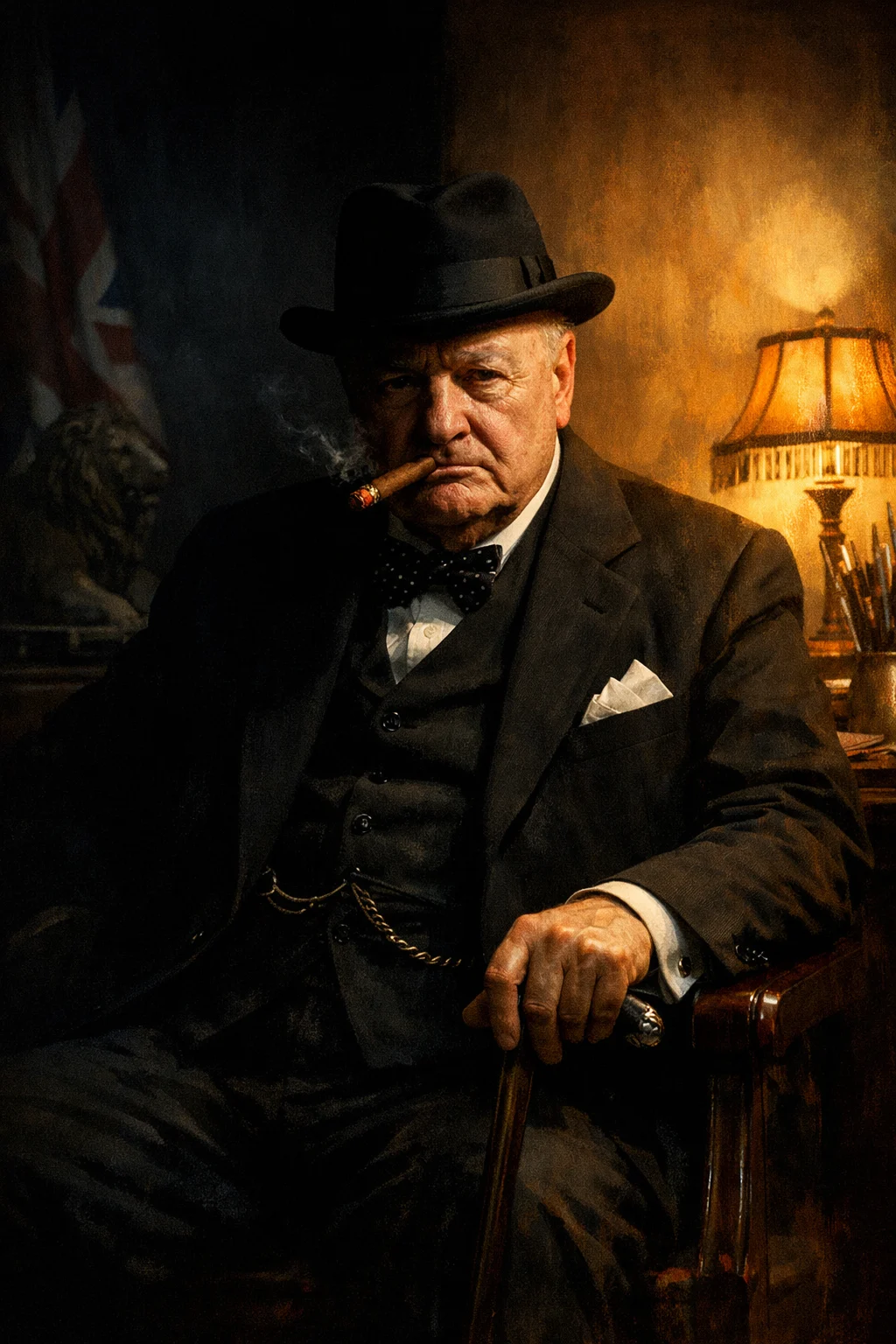
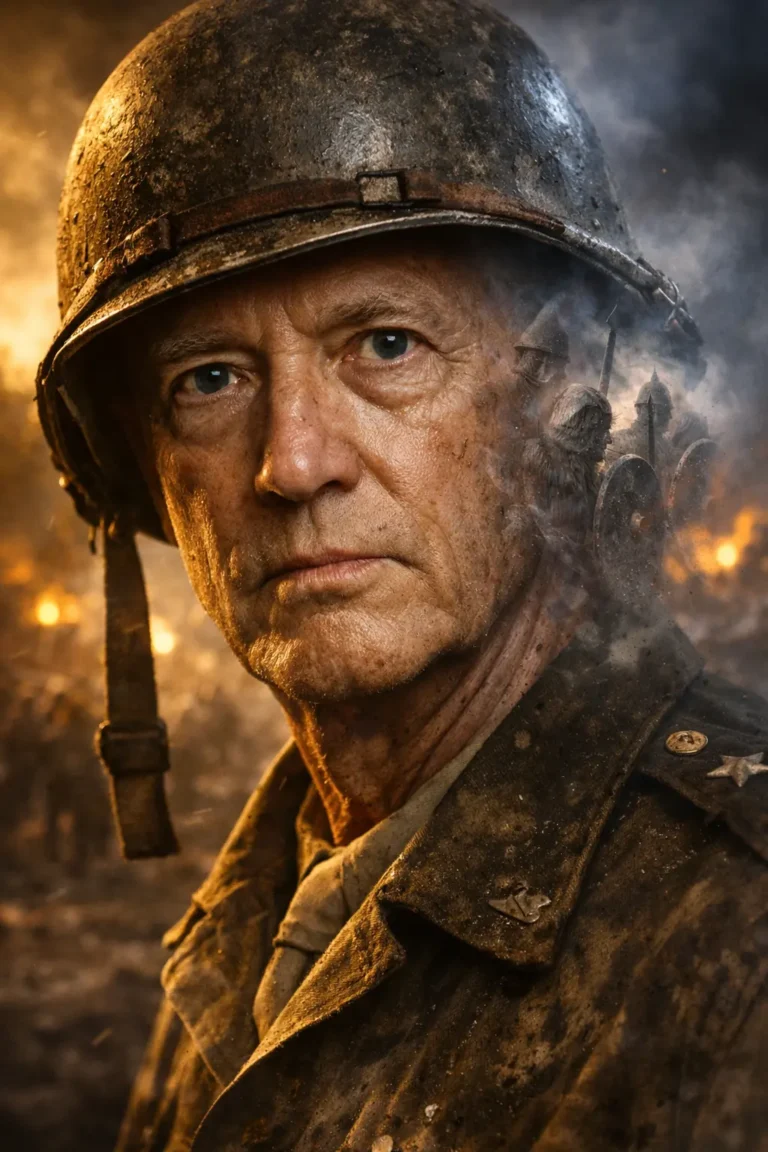
Featured historical fact: After the disaster at Gallipoli, Churchill lost his position in government. Instead of remaining protected in London, he requested active service on the Western Front and eventually commanded a battalion of the Royal Scots Fusiliers in the trenches of Belgium. He later returned to power, but the memory of the campaign followed him for the rest of his life.
Winston Churchill reached the defining moment of his life when many people believed his career already belonged to the past.
He was sixty-five, had changed political parties twice, carried responsibility for disastrous decisions, and had spent years warning about a Nazi Germany much of Britain’s political establishment preferred to appease.
In 1940, as France collapsed and Britain faced the possibility of standing alone against Hitler, Churchill turned language into a weapon of resistance. Yet the man who defended British freedom also defended an empire built upon inequality, expressed racist beliefs, and led a government whose actions during the Bengal famine remain subject to profound historical condemnation.
He was the leader his country needed during an extreme emergency.
He was also a man haunted by the costs of his ambition, the victims of his decisions, and the contradictions of the power he represented.
Winston Churchill: The Man Who Defied Hitler Without Escaping the Shadows of Empire
Discover this story on our YouTube channel.
A life told through places and turning points

Enter the archive
An authentic object preserved by a cultural institution brings us closer to the world behind this life.
- Collection
- Wikimedia Commons
- Rights
- Public domain
This image is available from the United States Library of Congress's Prints and Photographs division under the digital ID cph.3a49758.This tag does not indicate the copyright status of the attached work. A normal copyright tag is still required. See Commons:Licensing.
The child who wanted to be seen
Winston Leonard Spencer Churchill was born on November 30, 1874, at Blenheim Palace. He belonged to one of Britain’s best-known aristocratic families.
His father, Lord Randolph Churchill, was a Conservative politician whose brilliant career ended prematurely. His mother, Jennie Jerome, was born in the United States into a wealthy New York family.
Although raised amid privilege, Churchill did not describe an emotionally secure childhood. His parents were frequently absent, and the person closest to him was his nanny, Elizabeth Everest.
He did not excel in conventional education. He struggled with certain subjects and required several attempts to enter the Royal Military Academy at Sandhurst. There he found an environment better suited to his abilities and graduated in 1894.
Churchill desired action, recognition, and a story he could tell. Military life offered all three.
Turning war into opportunity
As a young officer and correspondent, he traveled to Cuba, India, Sudan, and South Africa. He participated in colonial campaigns and wrote reports for British newspapers.
On India’s northwest frontier, he fought during the Malakand campaign. In 1898, he took part in the Battle of Omdurman in Sudan, joining a cavalry charge and later producing an extensive history of the campaign.
His books and journalism demonstrated that he understood the value of controlling a narrative. He did not merely participate in events; he transformed them into literature and political capital.
During the Second Boer War, he was captured after the armored train on which he was traveling came under attack. He escaped from captivity in Pretoria and crossed a considerable distance to reach British-controlled territory.
The escape made him a national celebrity. Churchill had found the character he would portray for decades: the man who advanced precisely when others might have retreated.
His accounts of imperial war also revealed a lasting conviction. He believed in the superiority and historical mission of the British Empire, a worldview that would shape both his rise and his failures.
The politician who changed sides
Churchill entered Parliament as a Conservative in 1900. Four years later, he left the party and joined the Liberals, principally because he opposed protectionist trade policies.
Within Liberal governments, he held several positions and joined David Lloyd George and other reformers in establishing labor exchanges, social insurance, and certain workplace protections.
He was not simply a conservative imperialist. In some domestic matters, he supported reforms expanding the state’s role in addressing unemployment, illness, and poverty.
As home secretary, however, he became associated with labor conflicts and controversial episodes. His conduct during the Tonypandy miners’ dispute and his presence at the Siege of Sidney Street reinforced his reputation as an impulsive politician drawn toward the center of every crisis.
In 1911, he became First Lord of the Admiralty. He modernized parts of the Royal Navy, promoted its transition from coal to oil, and supported the development of new military technology.
The position placed him at the center of the war that began in 1914.
Gallipoli: the door that would not open
During the First World War, Churchill promoted an operation against the Ottoman Empire through the Dardanelles. The plan sought to force the straits, threaten Constantinople, and open a maritime route to Russia.
He was not solely responsible. The government, naval commanders, and military authorities all participated in the decisions. Churchill was nevertheless one of the operation’s most energetic advocates and became publicly identified with it.
The naval attack failed against mines and coastal defenses. Landings followed on the Gallipoli Peninsula. British, French, Australian, New Zealand, Indian, and other imperial forces became trapped in difficult positions against effective Ottoman resistance.
After months of fighting, disease, and immense casualties on both sides, the Allies withdrew.
The campaign transformed Mustafa Kemal, the future Atatürk, into an Ottoman hero and left a lasting wound in Australia and New Zealand. For Churchill, it was a political catastrophe.
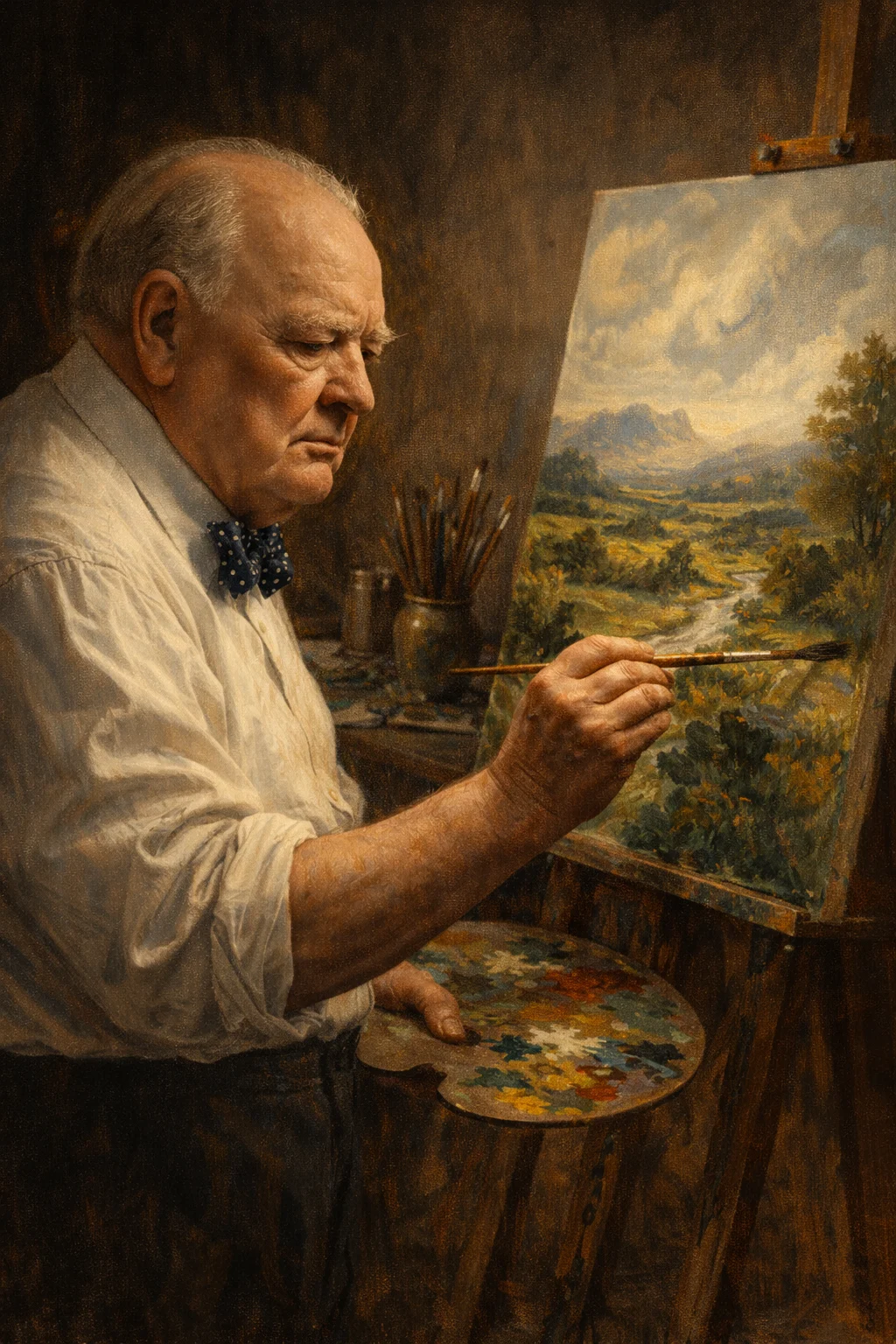
He was removed from the Admiralty and eventually resigned from the government. For a time, he turned to painting in search of an activity that could calm his agitation.
He did not, however, remain away from the war.
The former minister in the trenches
Churchill retained his military rank and decided to join the Army in France. After uncertainty over the command he would receive, he was appointed lieutenant colonel of the 6th Battalion, Royal Scots Fusiliers.
From January to May 1916, he lived near the front in Belgium.
The contrast was extraordinary. Months earlier, he had helped make decisions sending armies toward the Dardanelles. Now he shared trenches, bombardments, mud, and danger with soldiers directly exposed to the consequences of war.
His supporters presented his service as evidence of personal courage. His critics considered it a calculated attempt to rebuild his reputation. Both interpretations may contain some truth.
Churchill did not cease being ambitious when he put on a uniform. But he was not required to place himself so close to the front. He accepted a genuine risk when his political career appeared ruined.
Gallipoli never completely disappeared from his memory. It taught him that a strategy appearing brilliant upon a map could become a machine of suffering when geography, an enemy, and reality refused to obey.
The return to power
Churchill returned to government in 1917 as minister of munitions. He later held several other positions, including secretary of state for war and colonial secretary.
In 1924, he rejoined the Conservative Party and became chancellor of the Exchequer. During his tenure, Britain returned to the gold standard at a rate that damaged industrial competitiveness and contributed to severe economic pressure. The policy was widely criticized, and Churchill later recognized it as a mistake.
His conduct during the General Strike of 1926 strengthened his reputation for hostility toward organized labor. He played an active role in government propaganda and displayed little sympathy for the strikers.
During the following years, he remained outside the highest offices. The period became known as his “wilderness years,” although he was not entirely isolated. He remained a member of Parliament, wrote books, delivered speeches, and participated in public debate.
His positions formed a difficult mixture. He warned with growing accuracy about German rearmament and the danger posed by Hitler. At the same time, he fiercely opposed Indian independence and attacked Mahatma Gandhi with contemptuous language.
He could clearly identify a European tyranny while continuing to regard British rule over other peoples as legitimate.
The man who warned about Hitler
During the 1930s, Churchill used contacts, statistics, and sources inside government to publicize Germany’s military expansion. He called for Britain to rearm, particularly in the air.
He was not the only person warning about Nazi danger, and not every one of his predictions proved correct. His opposition to appeasement nevertheless gained credibility as Hitler dismantled the restrictions imposed after the First World War.
When the Second World War began in September 1939, Churchill returned to the Admiralty.
Britain’s campaign in Norway failed during the spring of 1940. Neville Chamberlain’s government lost sufficient support to continue, and on May 10 Churchill became prime minister.
That same day, Germany invaded Belgium, the Netherlands, and Luxembourg.
He did not inherit an hour of triumph. He inherited an advancing catastrophe.
The argument that might have changed the war
By late May 1940, Allied forces were surrounded and France was approaching collapse. Britain’s war cabinet discussed whether it should explore possible Italian mediation to learn Hitler’s terms.
Foreign Secretary Lord Halifax believed investigating that option might be prudent. Churchill feared that entering negotiations from a position of weakness would lead to the destruction of Britain’s ability to resist.
The situation was more complicated than the legend of one man standing alone against everyone. Decisions were debated by a coalition government and depended upon the Dunkirk evacuation, the French position, and the possibility of American support.
Churchill nevertheless played a decisive role. He argued that a negotiated peace under Nazi threat would not guarantee Britain’s independent survival.
The cabinet chose to continue the war.
At that moment, the country did not know whether the decision would lead to victory or invasion.
Words as a defensive line
Churchill’s speeches during 1940 did not promise a rapid victory. They spoke of blood, labor, tears, sweat, combat, and resistance.
Their power came precisely from refusing to deny the danger. He presented the conflict as a collective trial and transformed vulnerability into duty.
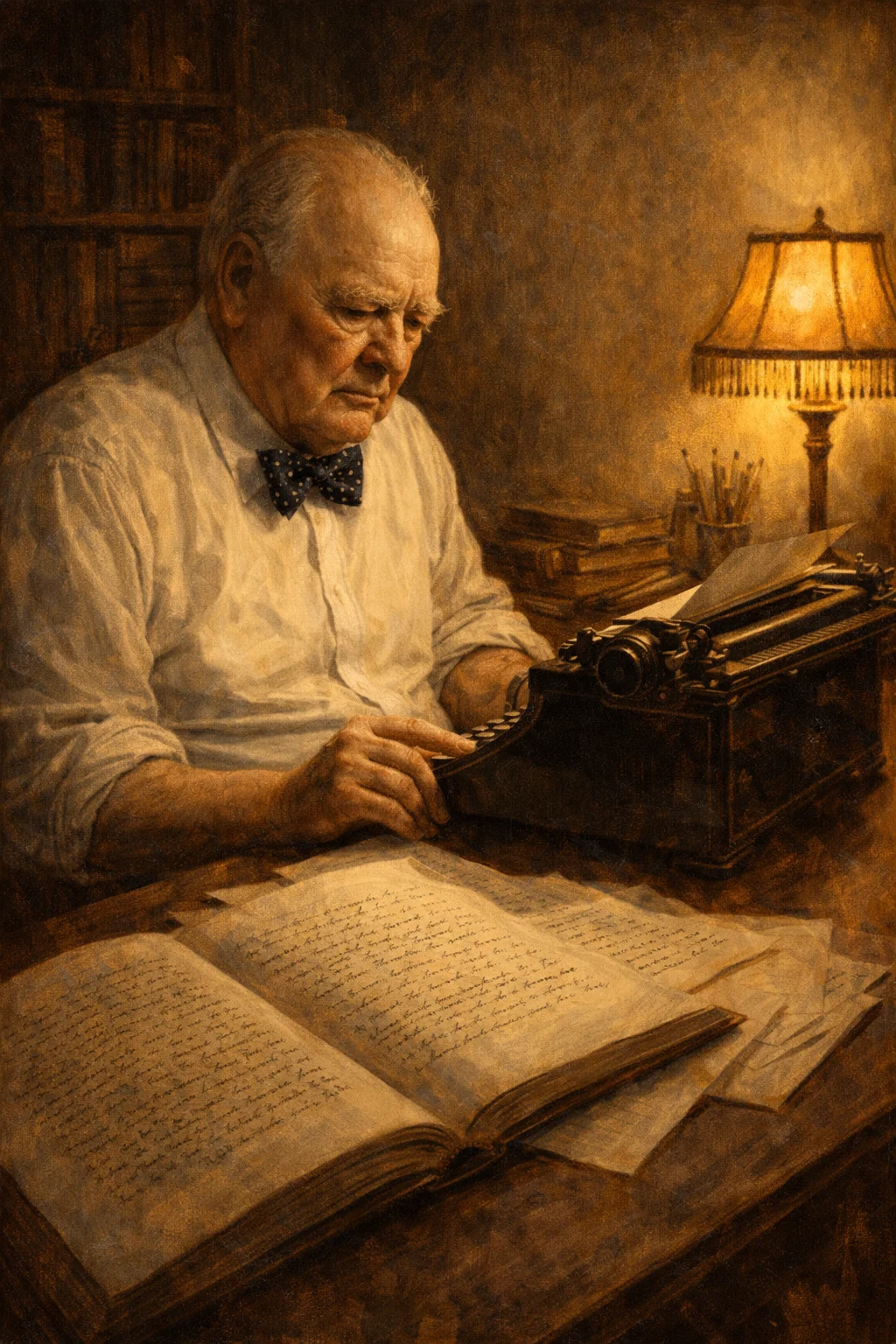
Churchill worked intensely on his speeches. He dictated, revised, arranged the rhythm of sentences, and marked the pauses. Although he appeared to speak spontaneously, many of his most famous expressions resulted from careful construction.
Not everyone heard some of his best-known parliamentary speeches directly on the radio. Extracts were delivered by announcers and reproduced in newspapers, and familiar recordings of certain speeches were made later.
The words nevertheless performed a real function. They gave moral structure to uncertainty and helped present resistance as a national choice rather than merely a government policy.
During the Battle of Britain and the Blitz, this ability made Churchill the face of a country refusing to surrender.
A war he could not win alone
The image of Churchill as a solitary savior conceals the war’s collective scale. Britain resisted through the work of pilots, sailors, soldiers, industrial workers, scientists, medical personnel, and civilians.
It also depended heavily upon its empire and allies. Millions from India, Africa, the Caribbean, Canada, Australia, New Zealand, and other regions served, produced food, or supported the wartime economy.
After Germany invaded the Soviet Union in 1941, the Red Army bore most of the ground war against Nazi Germany. Once the United States entered the conflict, its industrial and military power became decisive.
Churchill understood that British survival depended upon holding those alliances together. His relationship with Franklin D. Roosevelt was crucial, even as Britain became increasingly dependent. Cooperation with Joseph Stalin was necessary but filled with distrust.
The empire Churchill fought to preserve emerged from the war economically weakened. Victory would also accelerate its disappearance.
War from the air
Churchill’s leadership included decisions that continue to generate moral debate.
Britain developed a strategic bombing campaign against German cities. Its goals included destroying industry, transportation, housing, and the population’s ability to sustain the war.
Attacks such as the bombing of Dresden in February 1945 caused vast destruction and killed tens of thousands. Churchill had supported the aerial offensive, although he later expressed concern about the destruction of cities and attempted to distance himself from some of its results.
Historians continue to debate the campaign’s military effectiveness, necessity, and morality. Germany had launched a war of aggression and bombed cities across numerous countries, but that reality does not remove questions about the methods used to defeat it.
Power during wartime offered no entirely clean decisions. Churchill made some that were indispensable and others whose necessity remains contested.
Bengal: the shadow that cannot be ignored
In 1943, Bengal experienced a catastrophic famine. Millions died from starvation and associated diseases.
The crisis had several causes: the loss of rice imports from Burma, inflation, cyclone damage, crop disease, hoarding, distribution failures, colonial policy, and measures intended to prevent a possible Japanese invasion from finding food and transportation.
Churchill did not create the famine by himself, and historians continue debating the precise weight of each factor. His government, however, prioritized military requirements and other imperial reserves while requests for food imports into India were reduced, delayed, or rejected during critical periods.
His deeply contemptuous attitudes toward Indians and his hostility to the independence movement are also well documented. Those views influenced the environment in which policy decisions were made.
Larger amounts of relief began arriving in 1944 and coordination improved, but the death toll was already enormous.
Bengal fractures the image of Churchill as a universal defender of liberty. The freedom he defended so eloquently for Britain was not one he was prepared to recognize equally for colonized peoples.
Victory and electoral defeat
Germany surrendered in May 1945. Churchill had achieved the victory with which his name would forever be associated.
Two months later, British voters removed his government from power.
The Labour Party won the election with a program centered on housing, employment, social security, and reconstruction. Many citizens admired Churchill as a wartime leader but believed Clement Attlee and Labour were better prepared to build the peace.
Churchill received the defeat bitterly. He had to leave the Potsdam Conference and be replaced by Attlee while the victorious powers negotiated Europe’s future.
The episode demonstrated a democratic truth sometimes obscured by his legend: leading a nation through its greatest danger did not grant him a permanent right to govern it.
The return and the concealed body
In 1946, Churchill delivered his speech in Fulton, Missouri, popularizing the expression “Iron Curtain” to describe Europe’s division under Soviet influence.
He returned as prime minister in 1951. His second government was less dramatic and marked by declining health, the Cold War, and the effort to preserve a global influence Britain no longer possessed to the same degree.
In 1953, he suffered a serious stroke while still in office. The news was carefully concealed from the public, and Churchill partially recovered before returning to work.
That same year, he received the Nobel Prize in Literature for his historical and biographical writing and his oratory. It was not the Nobel Peace Prize, as is sometimes claimed.
He retired as prime minister in 1955, although he remained in Parliament until 1964.
The “black dog” and the construction of a myth
Churchill has frequently been associated with the phrase “black dog” to describe periods of depression. The image was popularized especially through the memoirs of his physician, Lord Moran.
Historians, however, debate the frequency and severity of those episodes and the reliability of some of Moran’s published claims. A precise modern diagnosis cannot responsibly be made from scattered phrases and retrospective testimony.
Churchill undoubtedly experienced periods of despondency, anxiety, and exhaustion. He used writing, painting, and work to organize his energy and temporarily escape political pressure.
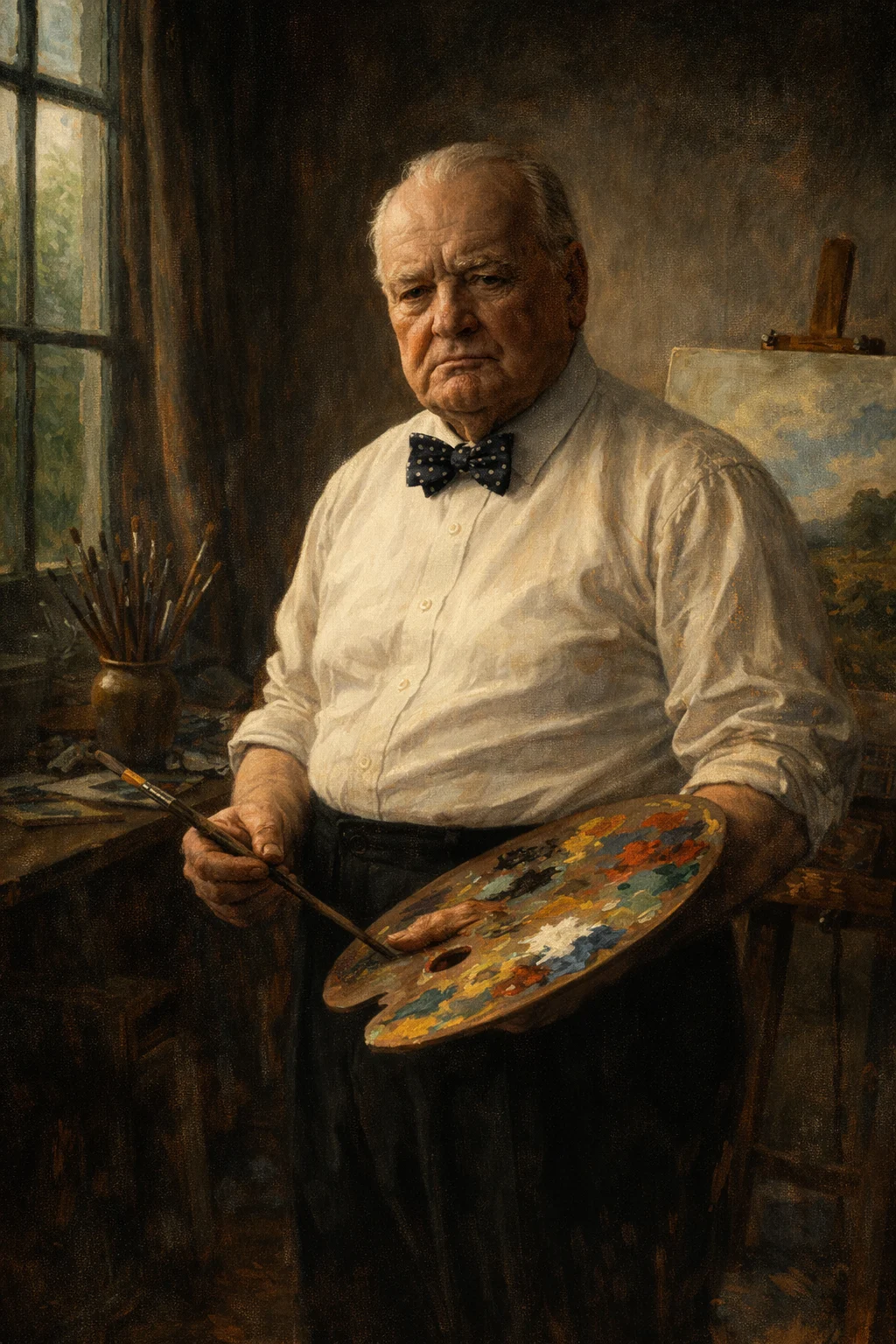
He produced hundreds of paintings during his lifetime. The activity he began pursuing seriously after Gallipoli became more than a hobby: it was a space in which he could control the size of the canvas, the colors, and the result.
In politics and war, none of those things obeyed him completely.
The funeral of an empire
Winston Churchill died on January 24, 1965, at the age of ninety, after suffering another stroke.
He received a state funeral, an exceptional honor for someone outside the royal family. Representatives of numerous countries attended, and crowds lined the route.
As his coffin traveled along the Thames, dockside cranes lowered their arms in salute. The scene appeared to farewell not only a man but also the imperial Britain that had defined his understanding of the world.
Churchill survived Gallipoli, economic mistakes, changes of party, and years of isolation. In 1940, he found the moment for which his entire life seemed to have prepared him.
His refusal to accept peace under Hitler’s domination was essential. His ability to describe danger without surrendering to it helped sustain Britain when defeat remained possible.
His greatness does not erase Bengal, his racism, his defense of colonialism, or the lives consumed by decisions made inside protected government rooms.
Churchill understood the evil of Nazism more clearly than many of his contemporaries. He never understood with equal clarity the harm caused by the empire he loved.
Power allowed him to become the voice of a nation.
His ghosts came from all those people that voice was unwilling to recognize as equals.
Sources and further reading
References
Churchill Archives Centre. (n.d.). The Churchill papers. University of Cambridge. https://archives.chu.cam.ac.uk/collections/churchill-papers/
Gilbert, M. (1991). Churchill: A life. Henry Holt and Company.
Jenkins, R. (2001). Churchill: A biography. Macmillan.
Mukerjee, M. (2010). Churchill’s secret war: The British Empire and the ravaging of India during World War II. Basic Books.
Ó Gráda, C. (2015). Eating people is wrong, and other essays on famine, its past, and its future. Princeton University Press.
Roberts, A. (2018). Churchill: Walking with destiny. Viking.
Toye, R. (2010). Churchill’s empire: The world that made him and the world he made. Henry Holt and Company.
United Kingdom Parliament. (n.d.). Winston Churchill. https://www.parliament.uk/about/living-heritage/transformingsociety/private-lives/yourcountry/overview/churchill/