In this storyOpen index
Louis XIV: The King Who Turned His Own Life into an Endless Ceremony
Louis XIV turned his body, schedule, and Versailles into instruments of power, yet even the crown could not protect him from decline, war, and loss.
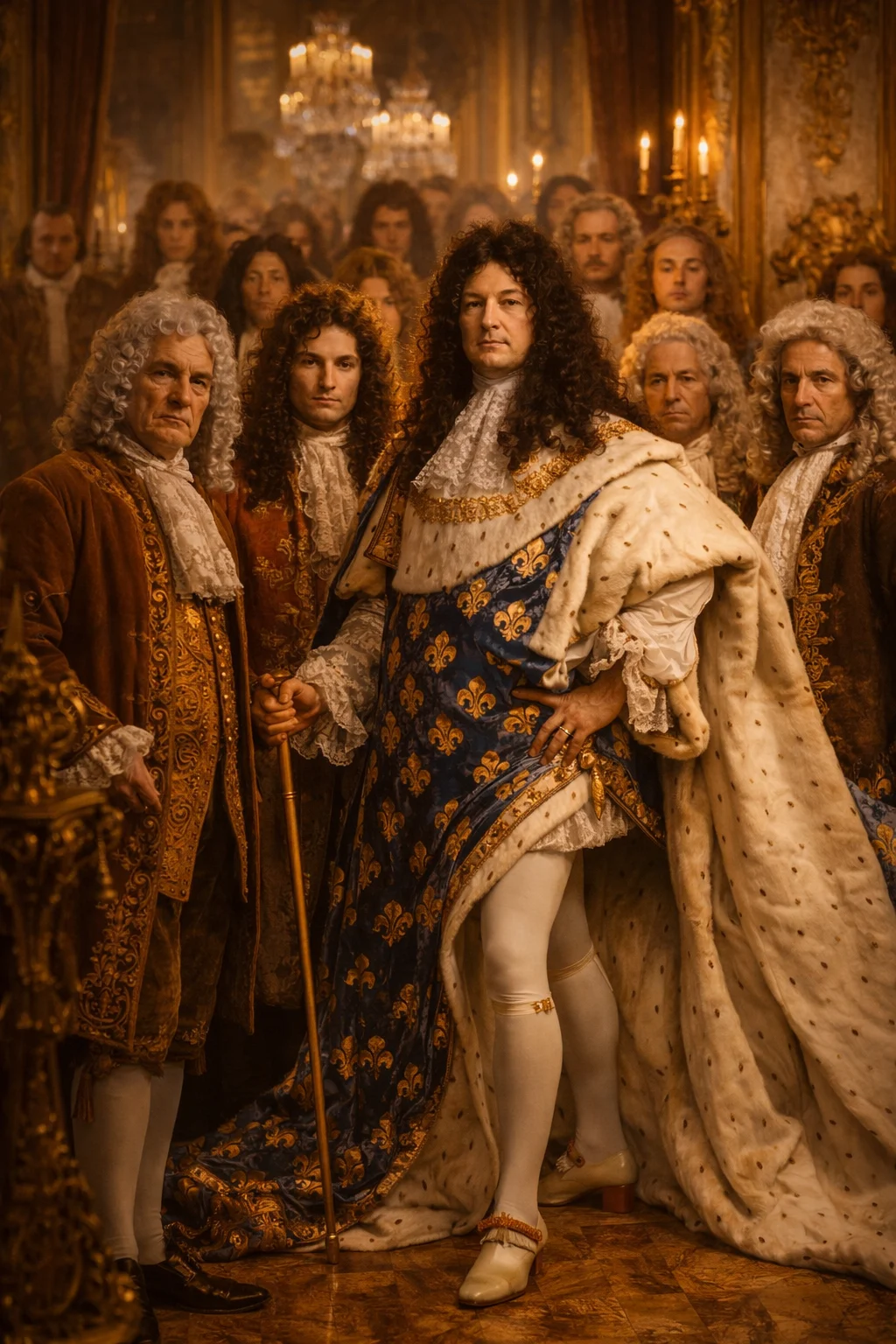
Featured historical fact: In 1686, Louis XIV underwent a dangerous operation to treat an anal fistula. Neither anesthesia nor modern infection control existed. His surgeon, Charles-François Félix, designed special instruments and practiced the technique on other patients before operating on the king. The procedure’s success increased the prestige of French surgery.
For more than seventy years, France had the same king.
Louis XIV transformed his face, his schedule, and even the ritual of getting out of bed into instruments of government. He built Versailles, gathered the nobility there, and turned court life into a performance organized around his person.
His power appeared limitless. Yet the man who controlled who could enter his bedroom could not control his own body, his family’s succession, or the consequences of the wars fought in his name.
The crown raised him above everyone. It also imprisoned him within a character from whom he could never rest.
Louis XIV: The King Who Turned His Own Life into an Endless Ceremony
Discover this story on our YouTube channel.
A life told through places and turning points

Enter the archive
An authentic object preserved by a cultural institution brings us closer to the world behind this life.
- Collection
- Wikimedia Commons
- Rights
- Public domain
wartburg.edu[dead link]
A four-year-old king
Louis-Dieudonné de France was born on September 5, 1638, at the Château de Saint-Germain-en-Laye. His parents, Louis XIII and Anne of Austria, had been married for more than twenty years without producing a surviving male heir.
His birth was presented as an act of divine favor. That was why he received the additional name Dieudonné: “God-given.”
Louis XIII died in 1643. His four-year-old son became Louis XIV. Anne of Austria assumed the regency and entrusted much of the government to Cardinal Jules Mazarin.
The king’s childhood was marked by the Fronde, a series of rebellions between 1648 and 1653. Members of the nobility, magistrates, and urban groups challenged the Crown’s authority and the government’s financial policies.
During one episode, the royal family had to flee Paris. On another occasion, demonstrators entered the palace to verify that the young king was actually there. Louis remained in bed as strangers passed through his room.
Those experiences do not explain his entire later reign, but they left a profound impression. He learned that the capital could turn against the monarchy and that great nobles were not merely servants. They could become rivals.
The young man who decided to rule
Mazarin directed affairs of state while Louis matured. The cardinal died in March 1661, and senior officials expected the king to appoint a new chief minister.
Louis announced that he would govern personally.
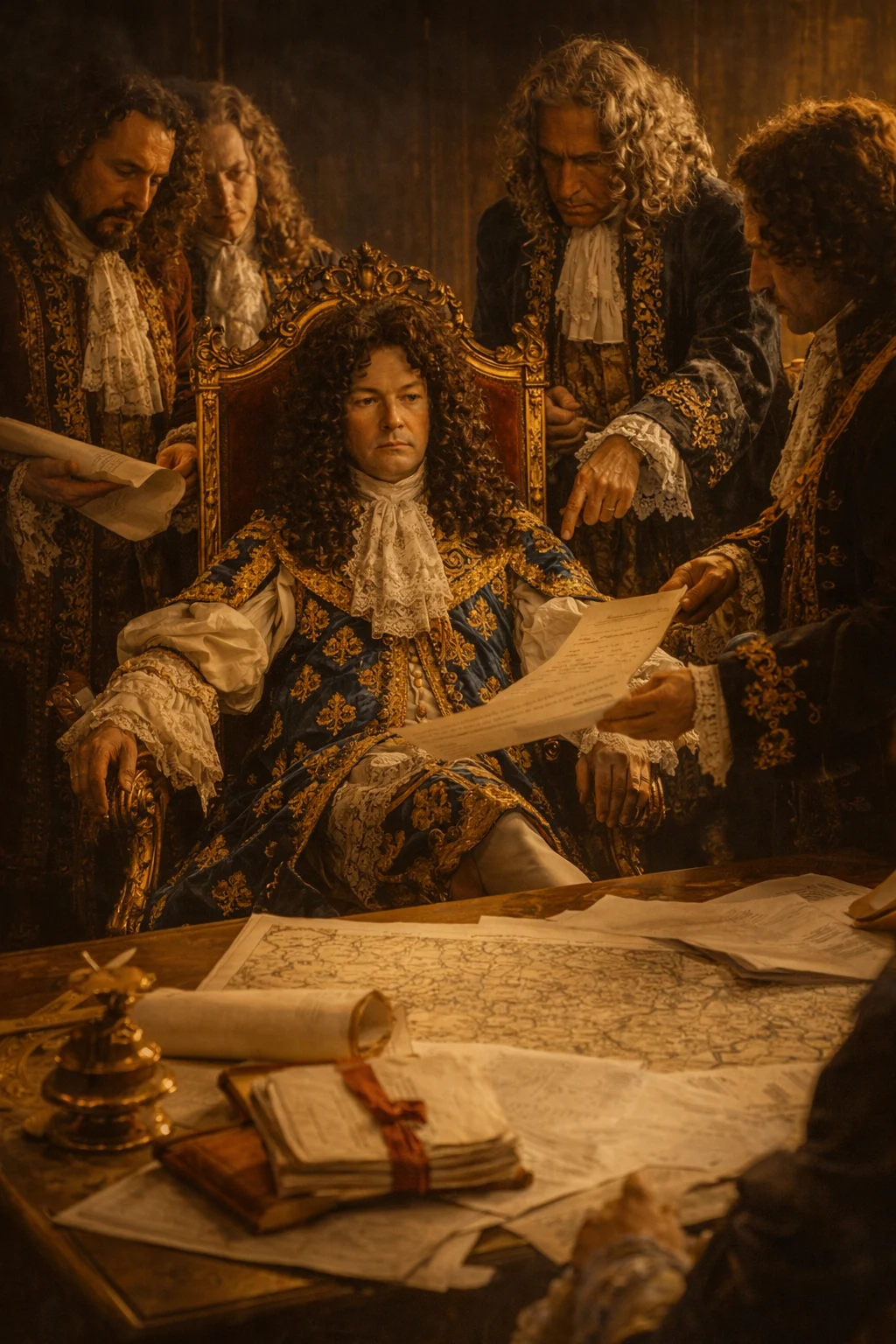
He was twenty-two. From that point forward, he required important matters to pass through his hands. He surrounded himself with capable administrators, including Jean-Baptiste Colbert in finance and commerce, François-Michel Le Tellier de Louvois in military organization, and Hugues de Lionne in diplomacy.
Louis XIV did not govern entirely alone. France was too large and its institutions too complicated to depend upon one man. Councils, ministers, intendants, courts, and provincial authorities continued performing essential functions.
The king nevertheless concentrated final decisions and deliberately promoted the image that all authority flowed from him.
The famous statement “I am the State” effectively summarizes that image, but there is no reliable documentation that Louis XIV ever spoke those words. They were probably attributed to him later.
Reality was more complicated than the quotation. He was not the entire state, but he worked to ensure that no political force could ignore him.
The sun as a political instrument
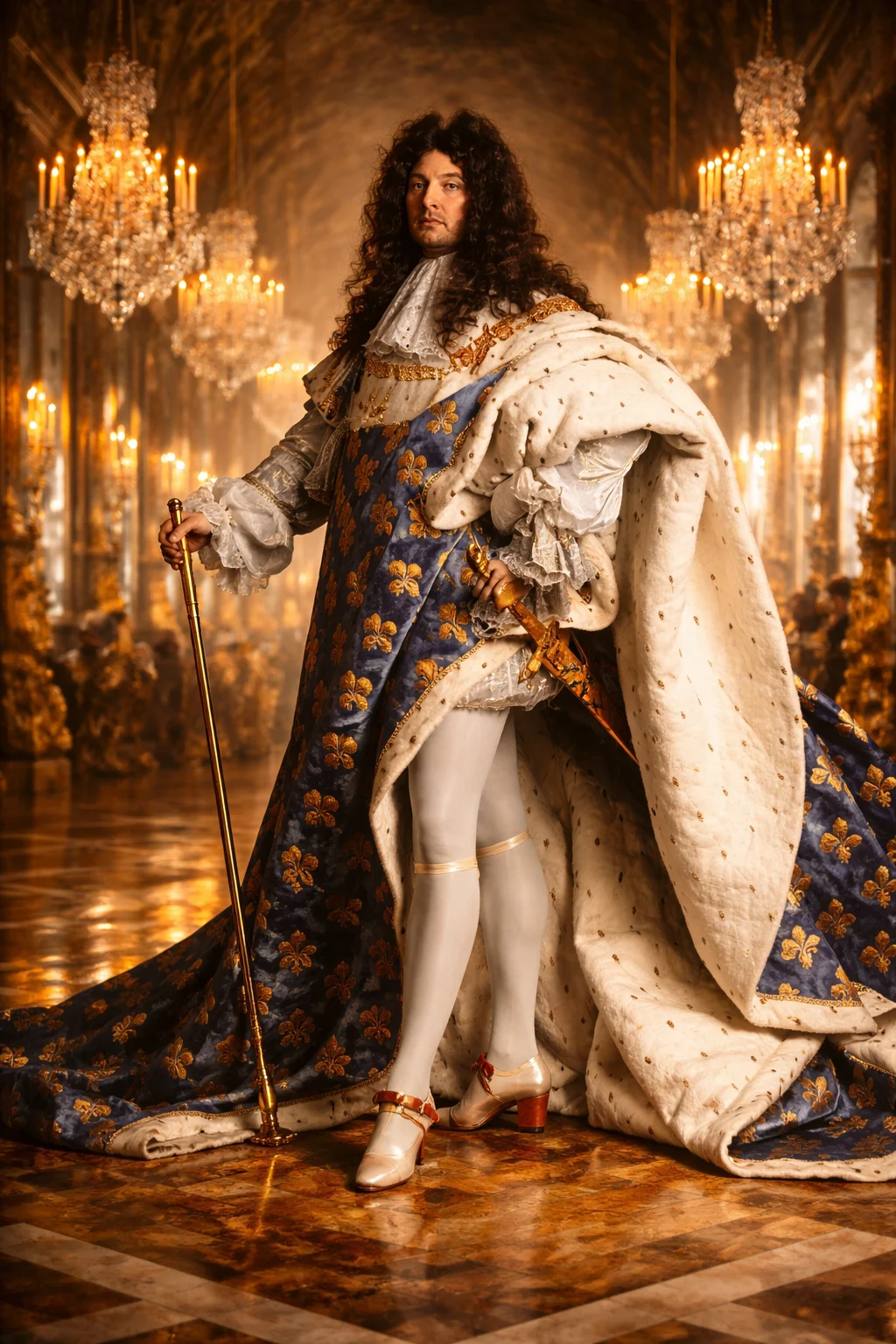
Louis adopted the Sun as his emblem. Apollo, associated with light, order, and the arts, provided the ideal image for a monarchy around which every other body was expected to revolve.
This produced the title “the Sun King.”
It was not merely personal vanity. In an age without photography, television, or instantaneous communication, power required symbols. Portraits, medals, tapestries, ceremonies, buildings, and performances carried the sovereign’s presence to people who would never see him in person.
Louis supported writers, composers, painters, and architects. His reign included figures such as Molière, Jean Racine, Jean-Baptiste Lully, Charles Le Brun, and André Le Nôtre.
Royal academies sought to regulate the arts, sciences, and language. Culture became a form of international prestige but also a tool for presenting the king as the source of French order and greatness.
Even military victories were transformed into paintings, inscriptions, and monuments. Government did not merely exercise power. It continually represented it.
Versailles: palace and instrument of control
The hunting lodge built by Louis XIII at Versailles was transformed by his son into an enormous palace complex. Construction continued for decades and consumed immense quantities of money, material, and human labor.
In 1682, Louis XIV officially transferred his court and government to Versailles.
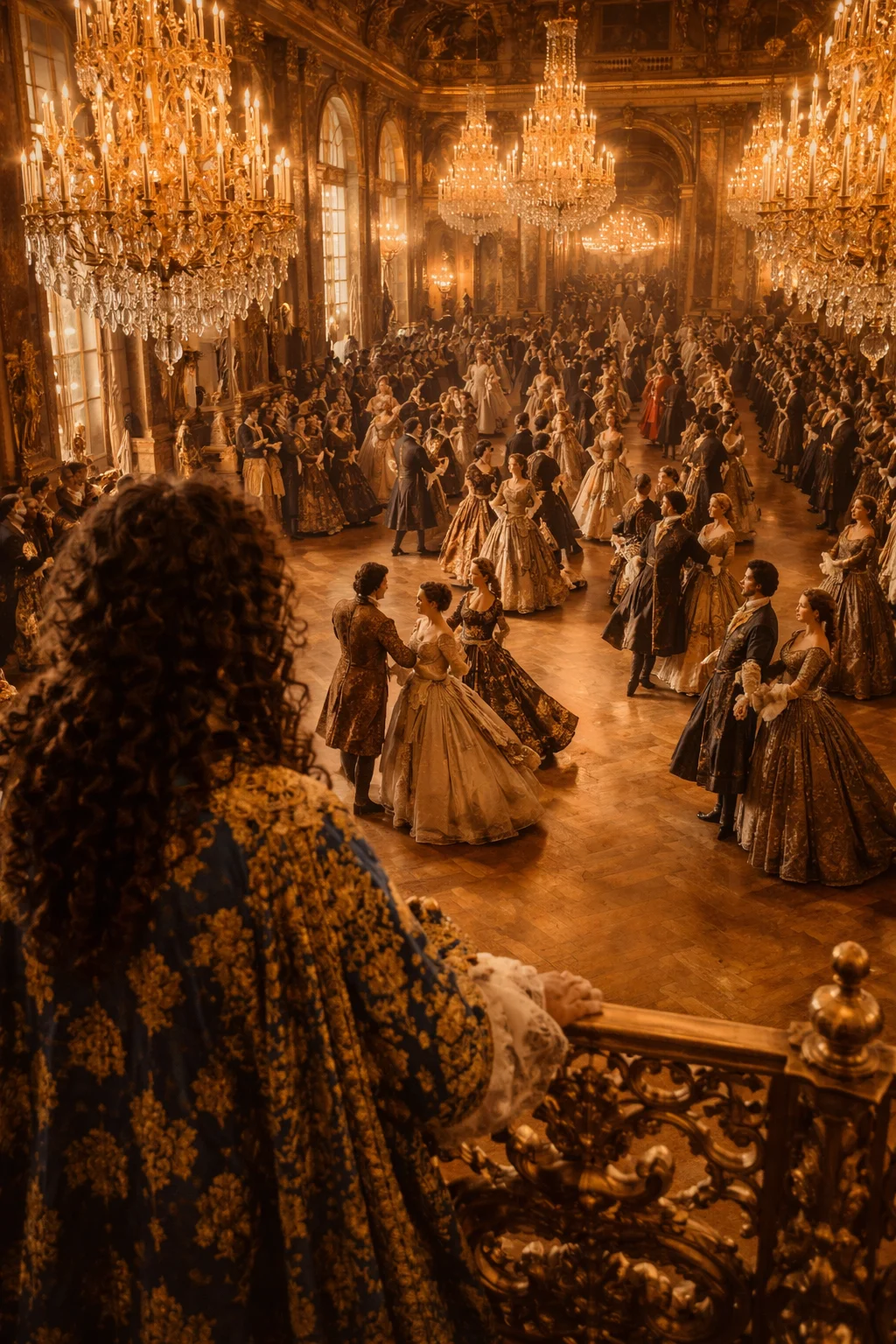
The palace was a residence, an administrative office, and a political stage. Thousands of courtiers, officials, servants, soldiers, and visitors circulated through its rooms and gardens.
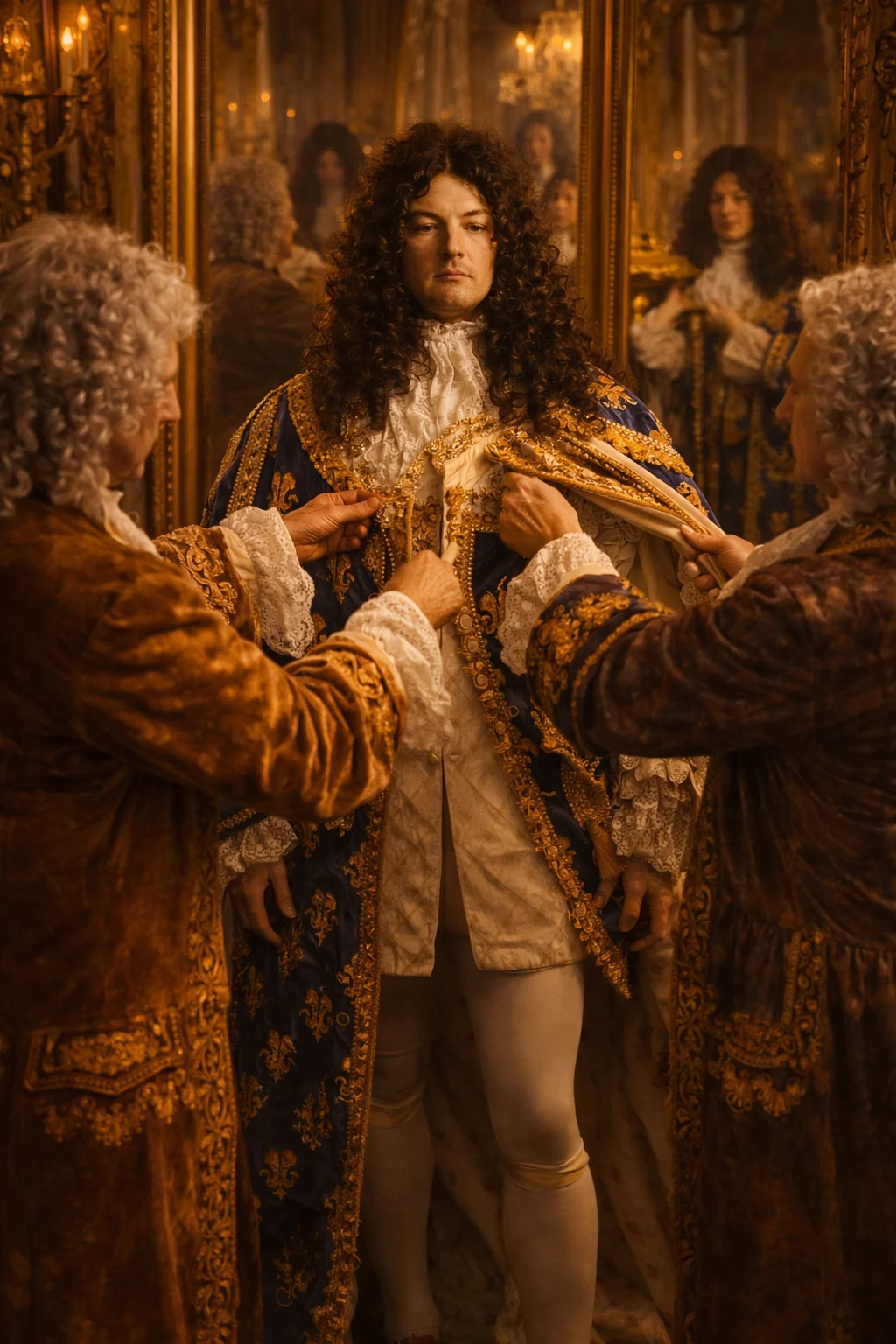
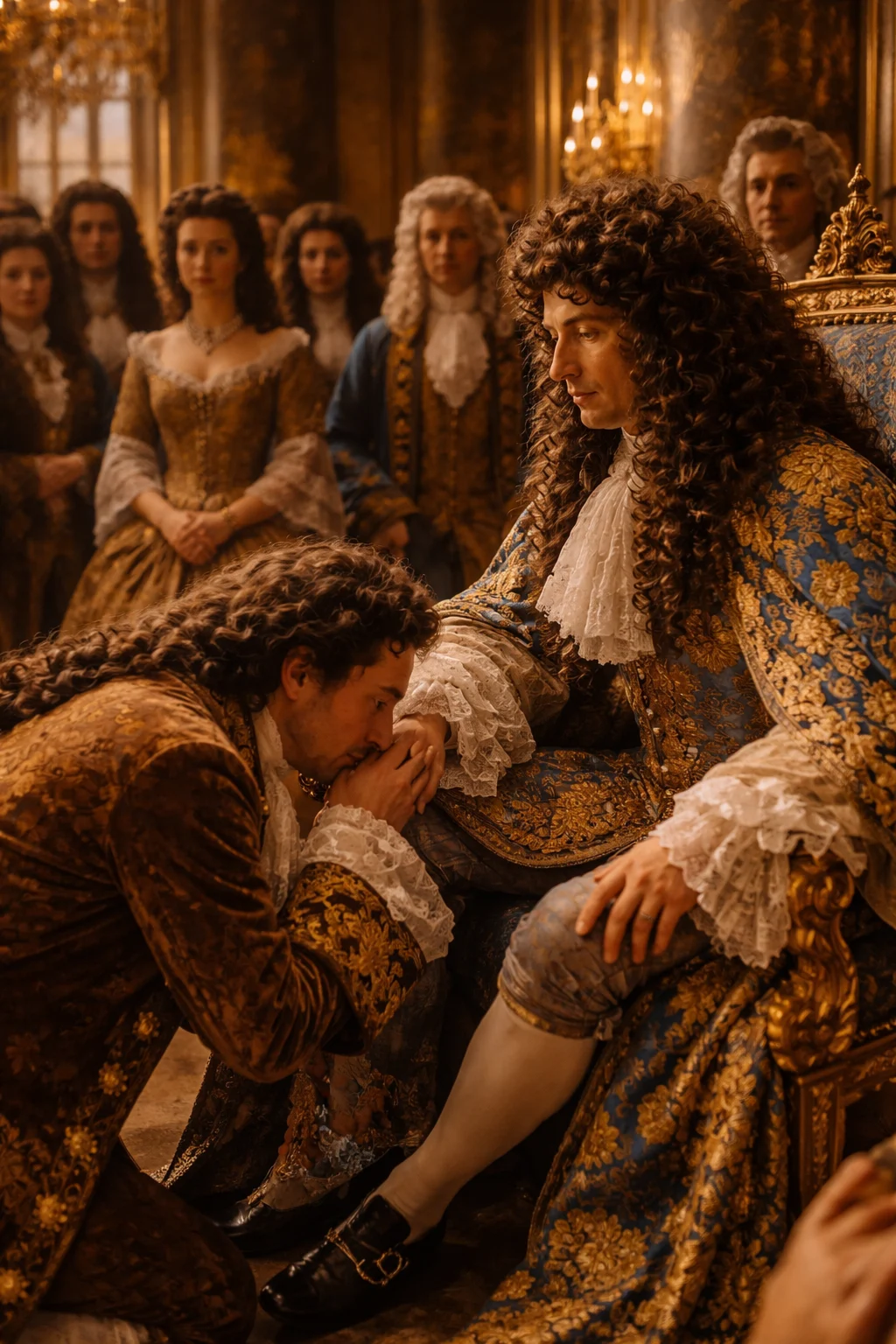
Etiquette determined who could witness the king awakening, hand him an item of clothing, attend his meals, or hold a candle before he retired. Apparently trivial actions became coveted privileges.
For nobles, living at Versailles could mean leaving their own territories and spending fortunes on clothes, apartments, celebrations, and gifts. Proximity to the king offered pensions, offices, and favors, but required constant competition.
Louis did not eliminate noble power. He reorganized it around access to his person.
Versailles also imprisoned him. His day was regulated from waking until night. Eating, praying, dressing, and walking were public actions. The man repeatedly disappeared behind the monarch.
The king’s body belonged to the state
Louis XIV was portrayed as a vigorous sovereign capable of riding, dancing, and accompanying military campaigns. In reality, he experienced numerous medical problems, including fevers, dental infections, gout, pain, abscesses, and treatments that could be almost as damaging as the illnesses.
Court physicians recorded his bowel movements, perspiration, appetite, and other bodily functions. His health was not a private matter. If the king became ill, the administration, diplomacy, and succession could enter a crisis.
In 1686, he developed a painful anal fistula. Initial treatments with ointments and compresses failed. The king found it difficult to sit, walk, or ride.
Physicians and surgeons argued over the correct response. Surgery still occupied an inferior position to academic medicine, and an operation could cause hemorrhage, infection, or death.
Charles-François Félix de Tassy, the king’s chief surgeon, studied the problem for months. He designed a curved scalpel and other specialized instruments. Before operating on the monarch, he practiced similar procedures on patients in Parisian hospitals—people whose suffering almost completely disappeared from the official celebration that followed.
The great operation
The surgery took place at Versailles on November 18, 1686.
There was no anesthesia. Louis remained conscious while Félix opened and treated the fistula. Several physicians and courtiers were present because the monarchy’s continuity depended upon a successful outcome.
The initial procedure succeeded, although recovery was prolonged and required additional treatment and incisions.
The court transformed the recovery into propaganda. Religious services and musical celebrations were held, while Félix’s reputation grew. The surgeon received money, property, and recognition.
The operation also helped raise the professional status of surgery. If the king’s body could be entrusted to a surgeon, the field could no longer be dismissed simply as an inferior manual craft.
The story may resemble a medical curiosity, but it reveals Versailles’s fundamental inequality. The king’s pain mobilized doctors, instruments, money, and public ceremonies. The patients used to perfect the technique remained almost entirely anonymous.
The search for religious unity
Louis XIV believed political unity required a common religion. France remained overwhelmingly Catholic, but the Edict of Nantes, issued by Henry IV in 1598, had granted certain protections and rights to French Protestants known as Huguenots.
During Louis’s reign, those freedoms were progressively restricted. Authorities closed Protestant churches and schools, limited access to professions, and quartered soldiers inside Huguenot homes to pressure families into conversion.
In 1685, the king revoked the Edict of Nantes through the Edict of Fontainebleau.
Protestant worship was prohibited, and thousands fled secretly to England, the Dutch Republic, the German states, and other territories. France lost artisans, merchants, soldiers, and professionals, while families that remained faced forced conversion, imprisonment, or separation.
The decision was celebrated by Catholic elements of the court. It would eventually be recognized as one of the gravest mistakes of his reign.
The Sun King had confused uniformity with unity.
The Black Code and colonial empire
The monarchy also issued the Code noir for the French colonies in 1685.
The document regulated slavery, imposed Catholicism, restricted the lives of enslaved people, and legally recognized brutal punishments. Although it established certain obligations for slaveholders, its essential purpose was to organize and protect a system based upon the hereditary enslavement of human beings.
The ordinance was developed within the royal administration and promulgated under Louis XIV’s authority. Any assessment of his legacy must therefore include not only Versailles, artistic patronage, and administrative reform but also colonial expansion and institutionalized racial violence.
The monarchy’s solar image illuminated certain spaces while deliberately concealing others.
A reign built through war
Louis XIV pursued more secure borders, dynastic prestige, and European dominance. France possessed a large population, an increasingly organized army, and resources capable of supporting major campaigns.
His reign included the War of Devolution, the Franco-Dutch War, the Nine Years’ War, and the War of the Spanish Succession.
Some campaigns expanded France’s borders and consolidated territory. Engineers such as Sébastien Le Prestre de Vauban created a network of fortifications that transformed the kingdom’s defenses.
The wars, however, became increasingly long and costly. Taxes rose, debt expanded, and rural populations bore the burden of recruitment, requisitions, and destruction.
Climate crises and failed harvests in 1693–1694 and 1709 intensified the suffering. Hunger and disease caused enormous mortality while the monarchy continued financing armies.
Louis could examine maps and discuss troop movements inside his councils. For most of his subjects, war meant taxation, lost harvests, and relatives who did not return.
The cost of turning life into spectacle
Louis XIV’s private life was also governed by dynastic requirements. In 1660, he married Maria Theresa of Spain, daughter of King Philip IV. The union formed part of the diplomatic settlement ending a long war between France and Spain.
Louis maintained numerous extramarital relationships. His most famous mistresses included Louise de La Vallière and Madame de Montespan. Several of his children born outside marriage were legitimized and granted titles.
After Maria Theresa’s death in 1683, the king probably entered a secret marriage with Madame de Maintenon, although no official document survives to establish every detail.
The court observed his affections, births, and disputes as political matters. A mistress could promote ministers, secure offices for a family, or alter alliances within the palace.
Louis had made his existence the center of the system. Almost nothing in it could remain truly private.
The Crown loses its heirs
For most of his life, the succession appeared secure. Louis had a surviving legitimate son, known as the Grand Dauphin, as well as grandsons and great-grandsons.
Then, within a few years, the family began disappearing.
The Grand Dauphin died in 1711. The following year, the Duke of Burgundy, principal heir to the Crown, died, along with his wife Marie Adélaïde of Savoy and one of their sons. Disease passed through the royal family with devastating speed.
The dynasty’s future came to rest upon a small child, the Duke of Anjou, Louis XIV’s great-grandson. That child would become Louis XV.
The king who had attempted to organize Europe through marriages, treaties, and wars could not protect his own family from the epidemics and mortality of his time.
By the end of his life, he was surrounded by portraits of dead heirs.
The leg that began turning black
In August 1715, Louis developed severe pain in one leg. His physicians initially diagnosed sciatica. Dark spots appeared, however, and it became clear that he was suffering from gangrene.
The king continued performing some of his duties while he could. He received ministers, said farewell to members of the court, and gave instructions concerning the future Louis XV.
No treatment could effectively stop the infection. An amputation would have been extraordinarily dangerous for a seventy-six-year-old man and offered no guarantee of survival.
Louis XIV died at Versailles on September 1, 1715, four days before his seventy-seventh birthday.
He had reigned for seventy-two years and 110 days, one of the longest independently verified sovereign reigns in European history.
After the Sun King
Louis’s body was taken to the Basilica of Saint-Denis, the traditional burial place of French monarchs. The magnificence of the funeral could not conceal the kingdom’s financial exhaustion or the relief some members of the population felt at the end of such a long reign.
During the French Revolution, his tomb was opened in 1793 along with those of other monarchs. His remains were removed and placed in a common grave. Decades later, the recovered bones were deposited together in the Saint-Denis ossuary because individual bodies could no longer be reliably separated.
The man who had turned his identity into a monument ended mixed among other dead.
His legacy remains divided. Louis XIV strengthened the administration, made France a dominant power, and sponsored some of Europe’s greatest artistic achievements. He also persecuted religious minorities, codified colonial slavery, and forced his subjects to bear the cost of prolonged wars.
Versailles survives as a demonstration of beauty, discipline, and ambition. It also reveals how much labor, money, and suffering could be concentrated around a single man.
Louis XIV’s crown appeared to be made of gold.
In reality, it consisted of ceremonies that never ended, wars demanding new taxes, relatives who kept dying, and a body belonging to the state.
He became the Sun King because he made everyone revolve around him.
His tragedy was discovering that he could not escape that orbit either.
References
Bluche, F. (1990). Louis XIV (M. Greengrass, Trans.). Franklin Watts.
Burke, P. (1992). The fabrication of Louis XIV. Yale University Press.
Château de Versailles. (n.d.). Louis XIV. https://en.chateauversailles.fr/discover/history/great-characters/louis-xiv
Fraser, A. (2006). Love and Louis XIV: The women in the life of the Sun King. Weidenfeld & Nicolson.
Jones, C. (2002). The great nation: France from Louis XV to Napoleon, 1715–99. Columbia University Press.
Lynn, J. A. (1999). The wars of Louis XIV, 1667–1714. Longman.
Perez, S. (2007). La santé de Louis XIV: Une biohistoire du Roi-Soleil. Champ Vallon.
Saint-Simon, L. de R. (1967). Historical memoirs of the Duc de Saint-Simon (L. Norton, Ed. & Trans.). Hamish Hamilton.
More from this collection

Genghis Khan: The Man Who Conquered the World but Could Not Govern His Own Legend
Read story →
Catherine the Great: The Foreign Empress Who Conquered Russia and Was Condemned by an Obscene Lie
Read story →