
In this storyOpen index
Garrett Morgan: The Inventor Who Had to Hide His Face to Save Lives
A hood for breathing through smoke and a pause to prevent collisions: Morgan’s inventions saved lives while racism tried to hide his name.
Garrett Morgan designed equipment to protect people who might never have purchased an invention from him if they had known its creator was Black. To demonstrate one of his devices, he had to conceal his identity, employ a white salesman, and present himself to audiences as a supposed Native American assistant.
Even so, Morgan’s solutions eventually entered fire departments, tunnels, and American streets. His protective hood made it possible to breathe for a limited period in smoke-filled spaces, while his traffic signal introduced a pause intended to prevent automobiles, carriages, bicycles, and pedestrians from entering an intersection simultaneously.
Morgan did not invent the first gas mask or the first traffic signal. His equally remarkable achievement was improving existing technologies with practical, marketable ideas. He did so with limited formal schooling in a society that repeatedly attempted to separate his intelligence from the color of his skin.
Garrett Morgan: inventing to save lives
A life between the workshop, tunnel, and street
Enter the archive
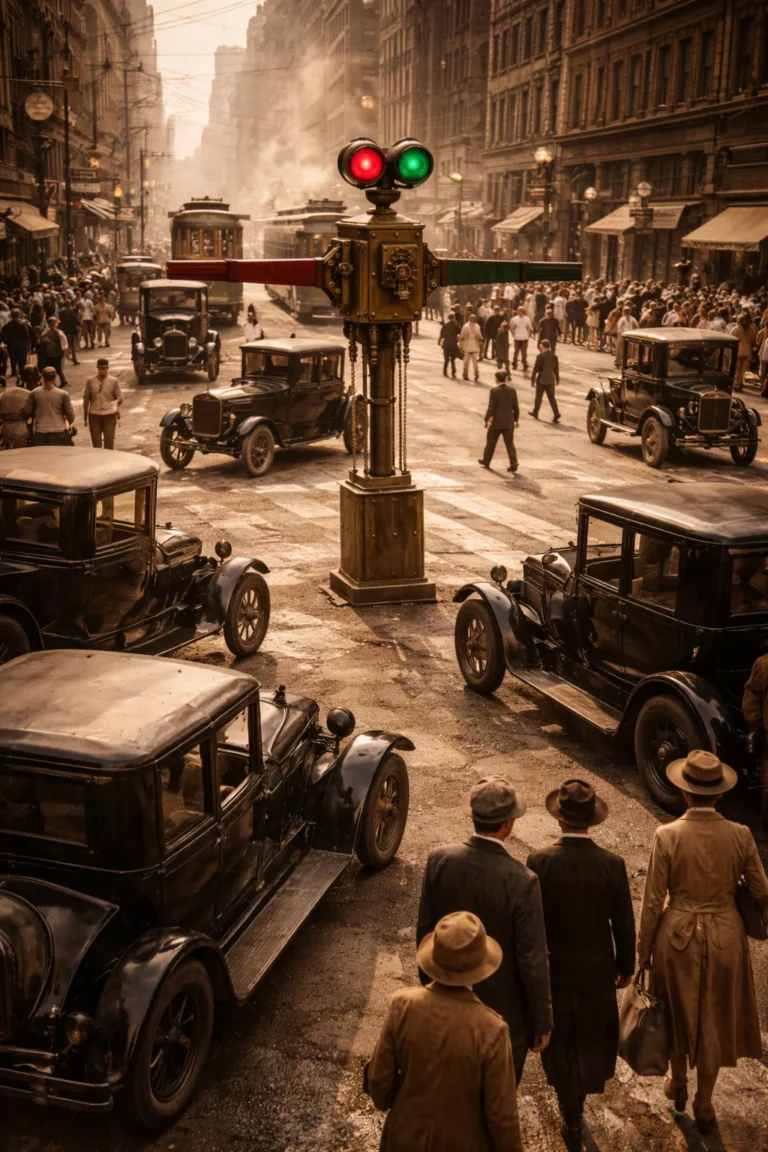
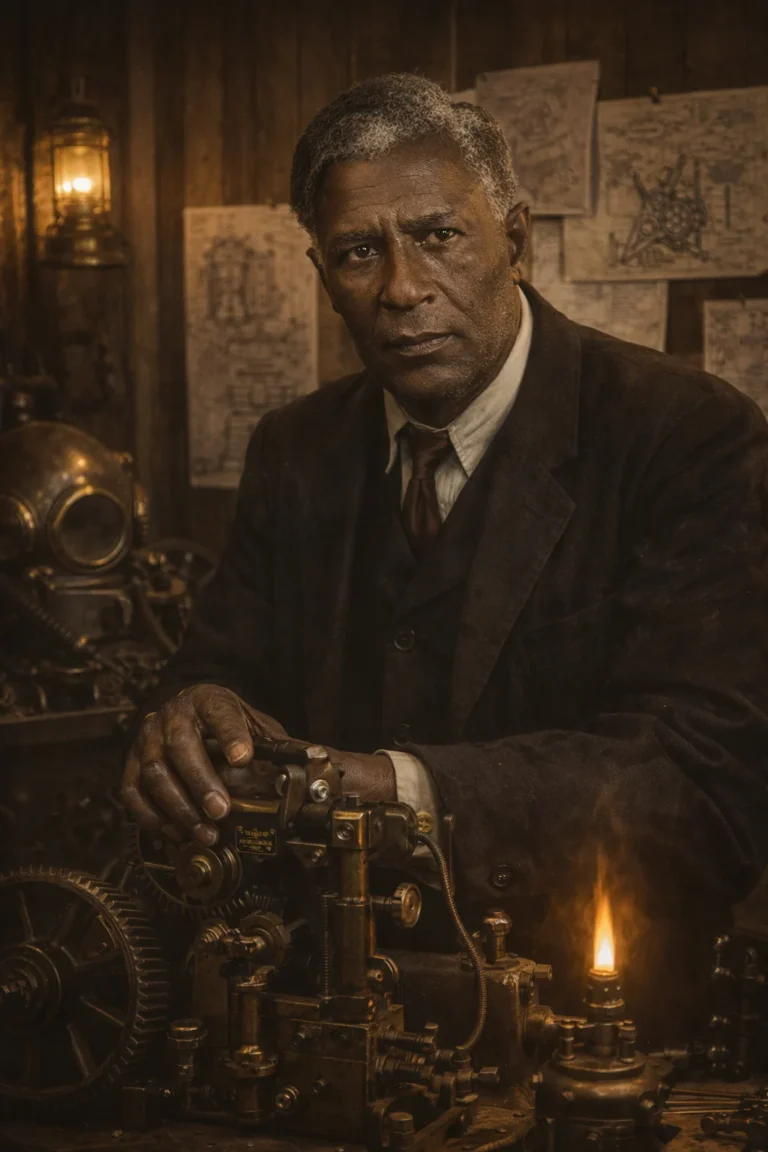
The Federal Highway Administration reproduces the patent drawing of Morgan’s T-shaped traffic signal. The feature image is a reconstruction, not the original drawing.
AI-generated visual reconstruction; not a historical document.
An Interrupted Education and an Unbroken Curiosity
Garrett Augustus Morgan was born near Paris, Kentucky, on March 4, 1877. His father, Sydney Morgan, and his mother, Eliza Reed, had lived with the direct consequences of slavery and racial discrimination. Garrett grew up in a large family and attended school for approximately six years.
As a teenager, he left Kentucky and moved to Cincinnati. There he worked as a domestic servant and used part of his wages to pay for private lessons. The decision revealed a quality that remained with him throughout his life: when institutional education was unavailable, he found another way to learn.
In 1895, Morgan settled in Cleveland, a rapidly expanding industrial city. He found work repairing sewing machines. The job required him to understand gears, tensions, needles, and mechanisms capable of bringing an entire workshop’s production to a halt.
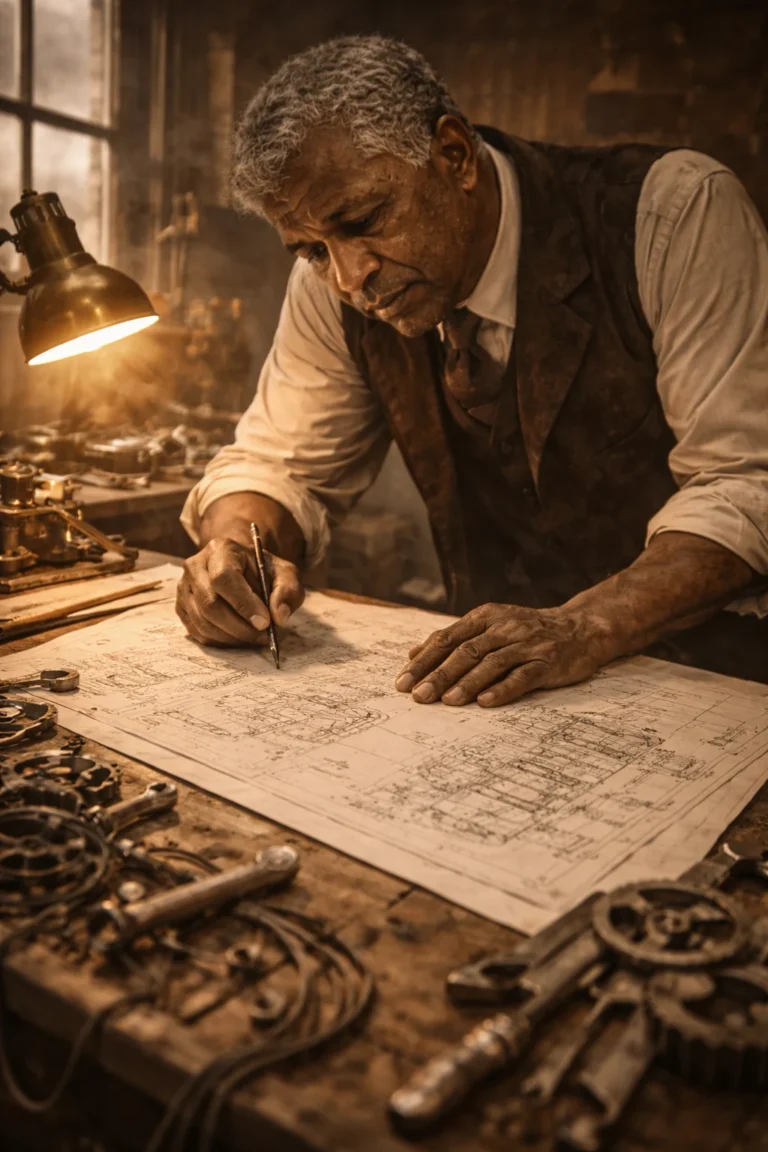
Morgan had not studied engineering, but he possessed the inventor’s essential ability: he could observe a problem, dismantle it mentally, and reconstruct it in a more effective form.
From Repairman to Entrepreneur
His experience with sewing machines allowed Morgan to open a repair shop of his own. He later established a clothing-manufacturing business that employed dozens of workers.
During those years, he met Mary Anne Hasek, a seamstress from a Bohemian immigrant family. They married in 1908 and developed a partnership that was both personal and commercial. Their interracial relationship provoked hostility. According to family testimony collected by the United States Patent and Trademark Office, Morgan’s employer ordered him either to end the relationship or leave his job. Morgan left, and Mary soon followed (United States Patent and Trademark Office, 2023).
Together they developed several businesses, including a clothing shop and a line of hair-care products marketed to African American consumers. Advertisements for the G. A. Morgan Hair Refining Company used Morgan’s name and image because its customers were primarily Black.
The situation changed when he attempted to sell safety equipment to public departments controlled by white purchasers.
Breathing Near the Floor
Industrial fires were a constant threat in the early twentieth century. Factories were filled with wood, cloth, cotton fibers, chemicals, and poorly ventilated spaces. When fire broke out, many victims died not directly from flames but from inhaling smoke and toxic fumes.
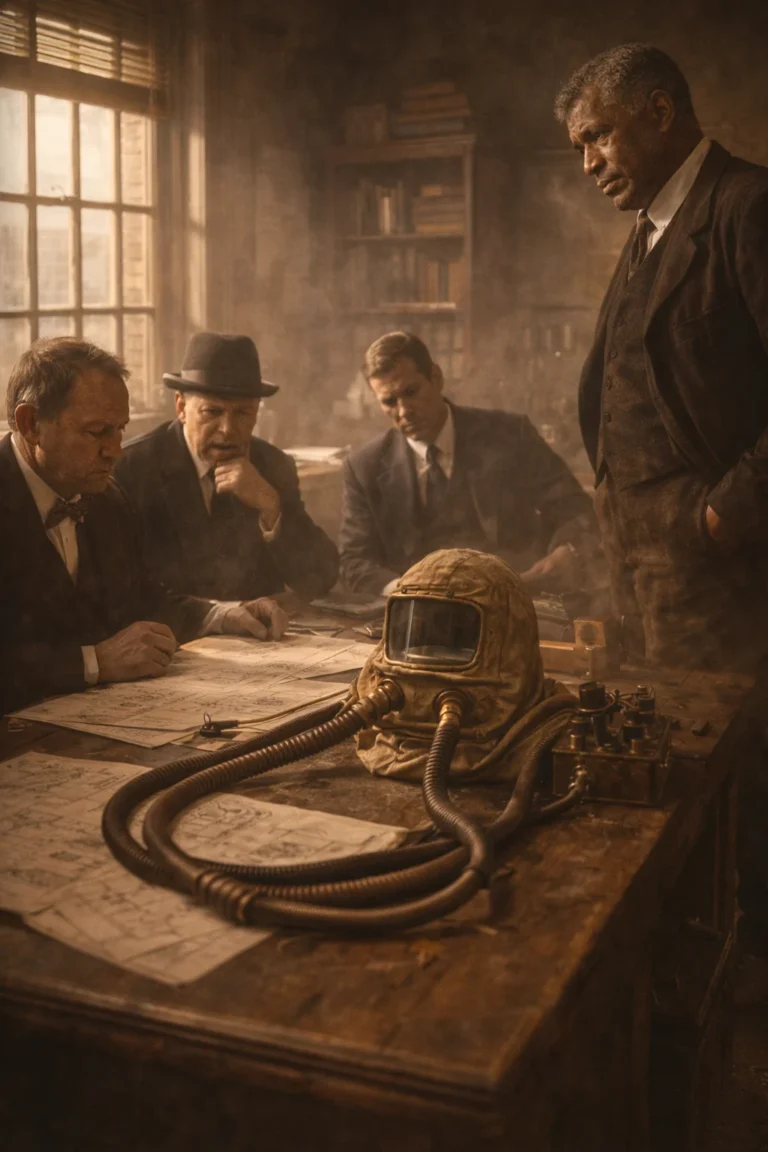
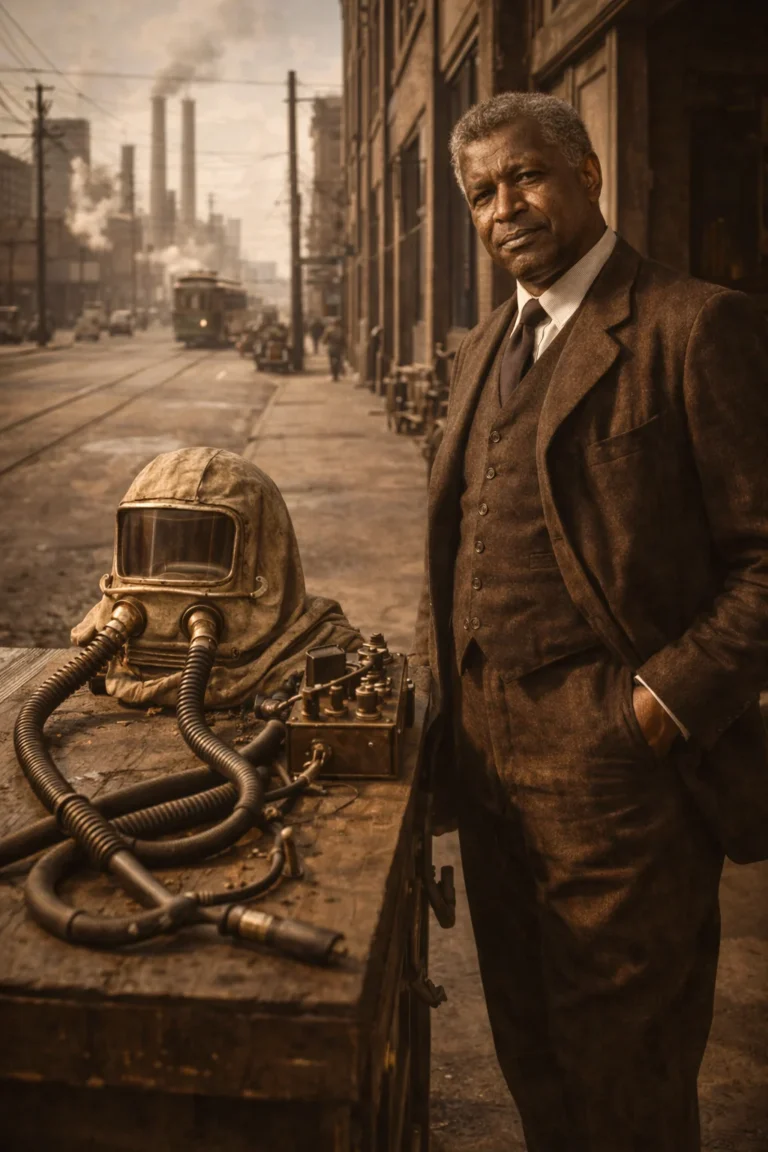
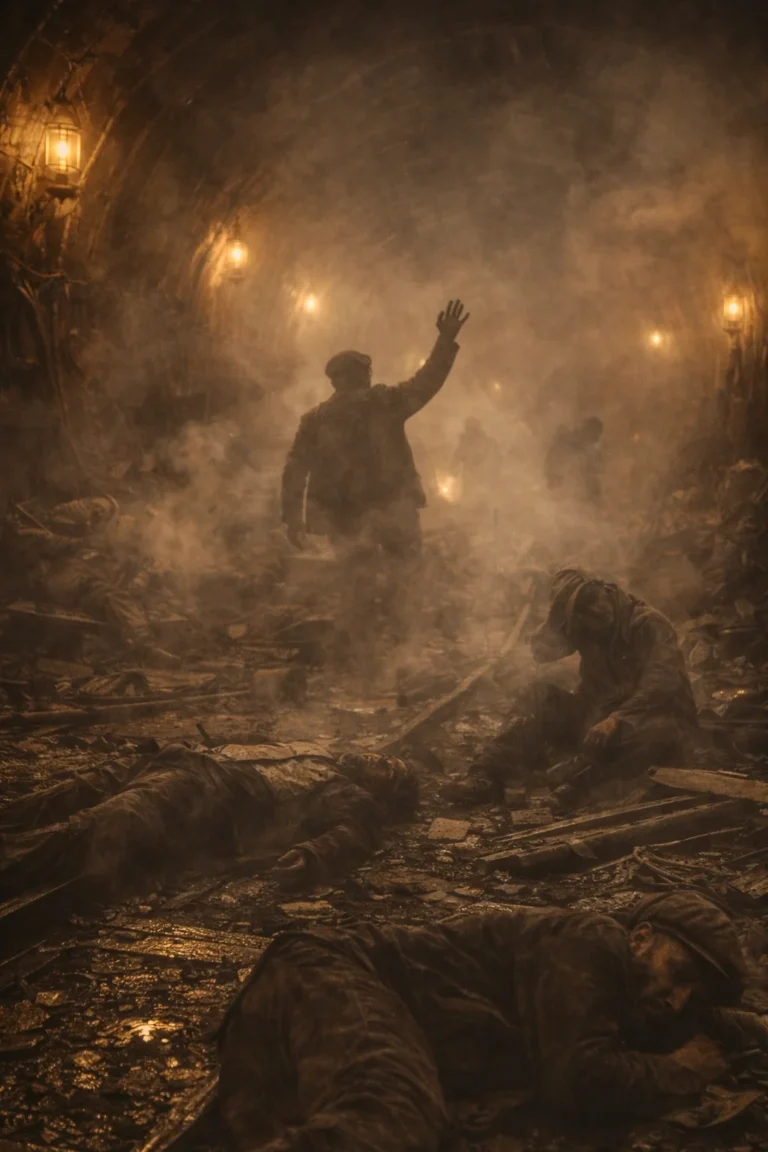
Morgan understood a simple principle: in certain fires, relatively breathable air remains near the floor while hot smoke rises. He designed a hood that covered the head and was connected to tubes extending toward the lower layers of air. A valve helped remove contaminated air accumulating inside the hood.
In 1914, Morgan received two patents for this “breathing device”: U.S. Patent Nos. 1,090,936 and 1,113,675. His invention was a protective smoke hood, not a fully self-contained military gas mask. It carried no oxygen tank, and its effectiveness depended upon relatively clean air remaining near the floor or an opening (United States Patent and Trademark Office, 2023).
This distinction does not diminish its importance. The hood was lightweight, comparatively inexpensive, and allowed firefighters or workers to enter dangerous environments for a limited time when breathing without protection might prove fatal.
The Inventor Who Had to Disappear
Morgan created the National Safety Device Company to market his hood. He soon discovered that some white fire chiefs and officials refused to purchase equipment invented by an African American.
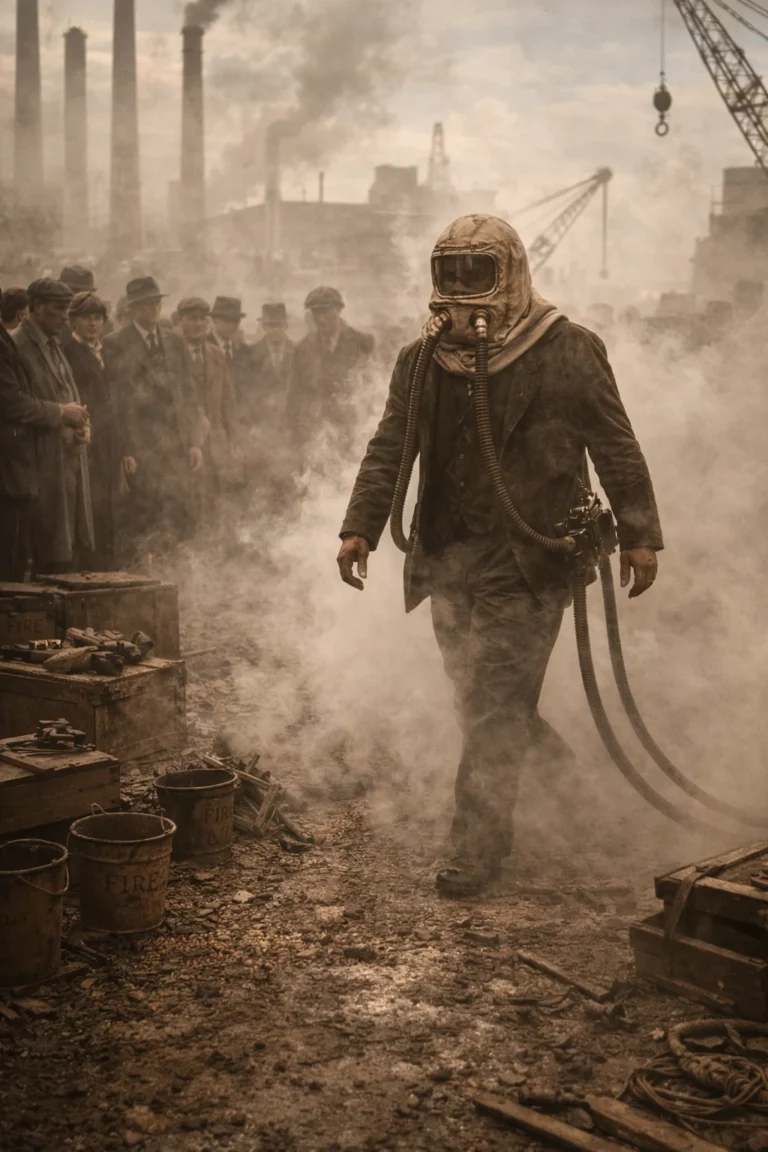
His solution was painfully ingenious. He placed prominent white businessmen on the company’s letterhead and employed a white man to present the product. During some demonstrations, Morgan concealed his identity under the name “Big Chief Mason,” supposedly a Native American assistant.
The alleged assistant entered a tent or enclosure filled with smoke while wearing the hood. Audiences watched him remain inside for several minutes and return without losing consciousness. The man risking his body to demonstrate the invention was its actual creator, but the commercial system required him to pretend he was someone else (United States Patent and Trademark Office, 2023).
The strategy worked. Fire departments began purchasing the hood, which received awards at safety exhibitions. Morgan had managed to sell his intelligence by publicly separating it from his face.
The Tunnel Beneath Lake Erie
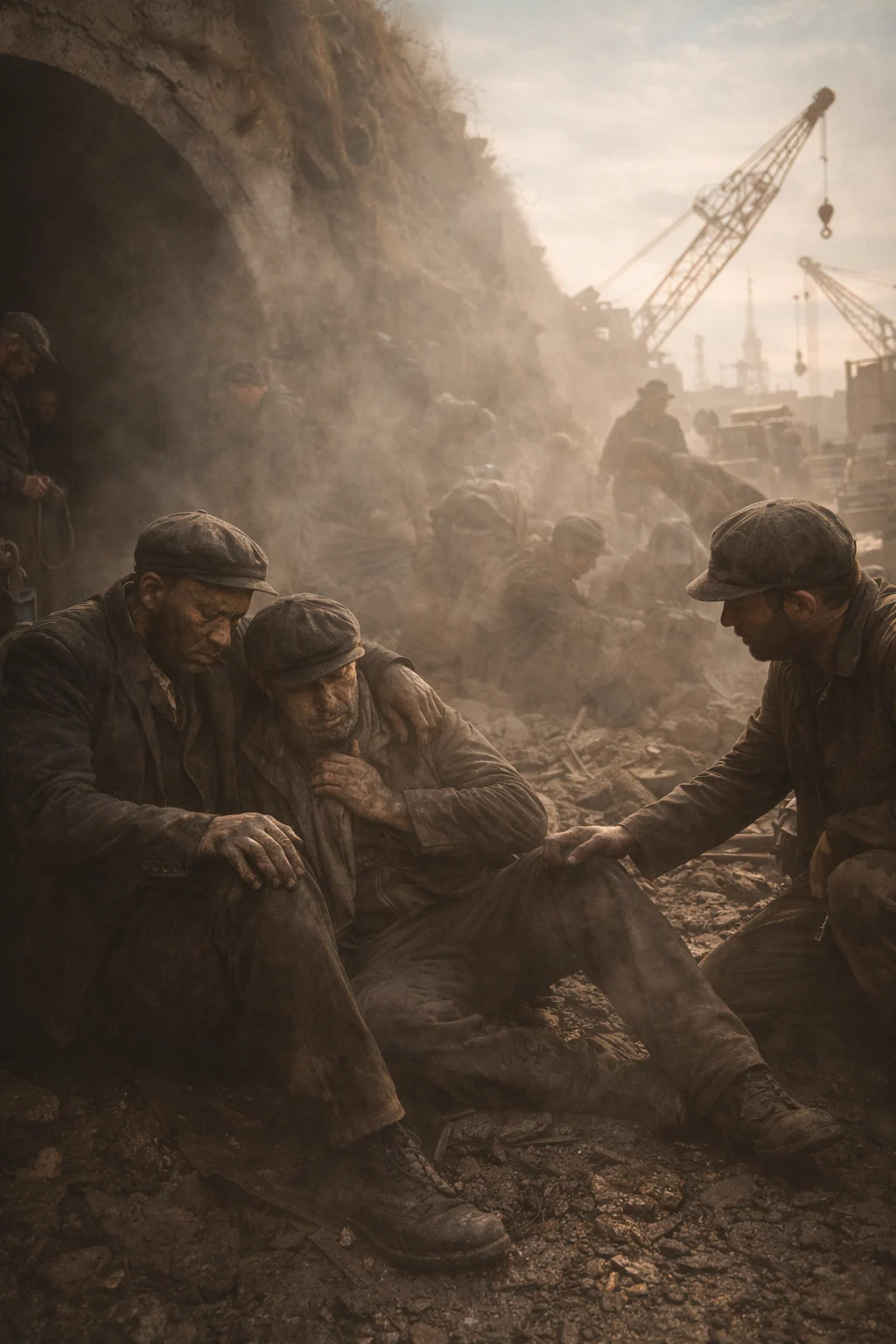
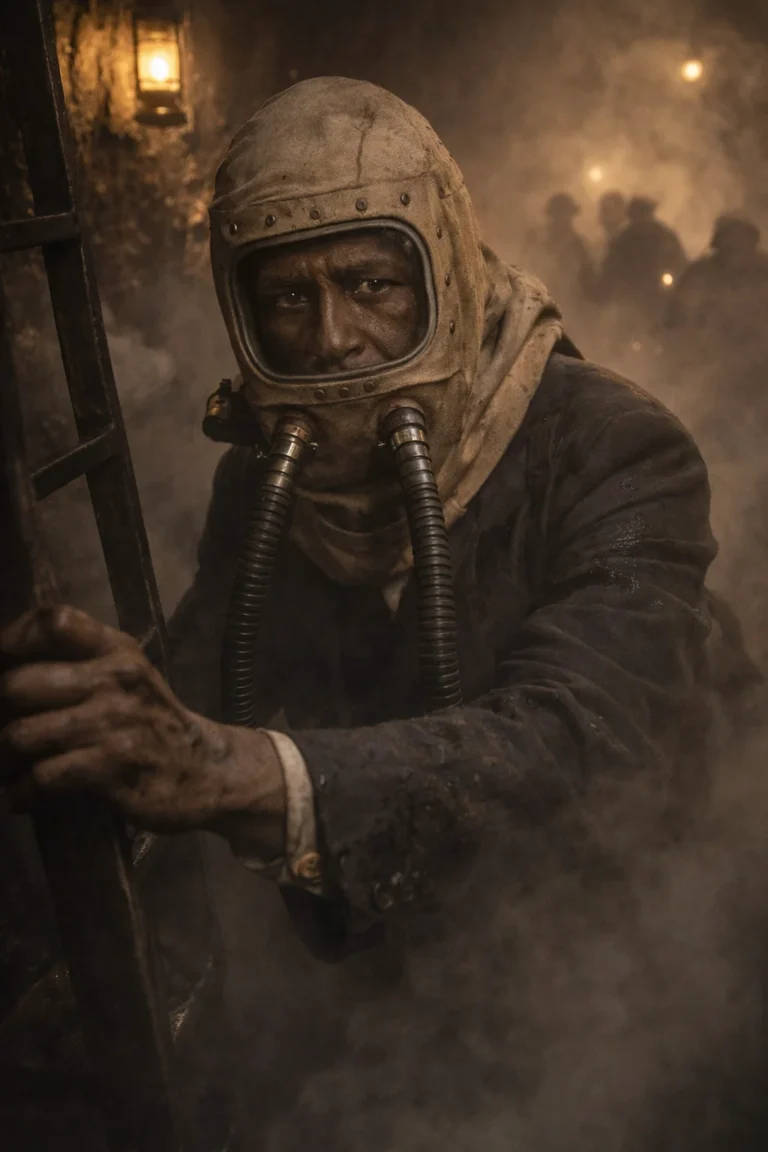
On July 25, 1916, a gas explosion struck a tunnel being constructed beneath Lake Erie to improve Cleveland’s water supply. Workers were trapped underground. The first teams attempting to reach them were overcome by smoke, dust, and fumes, and some rescuers also died.
Police requested Garrett Morgan’s assistance. He arrived with his brother Frank and brought several protective hoods.
Using the device, Morgan and other members of the rescue party repeatedly descended into the tunnel. Historical accounts do not always agree on the exact number of people directly rescued by the brothers, but the United States Patent and Trademark Office reports that the third rescue team succeeded in retrieving eight trapped workers (United States Patent and Trademark Office, 2023).
Photographs showed Morgan emerging from the tunnel while helping carry a victim. He could no longer remain hidden behind the character used during commercial demonstrations.
The rescue exposed both the effectiveness of his invention and the racism of the period.
A Hero They Tried to Erase
Some of Cleveland’s leading newspapers minimized Morgan’s participation or failed to mention it. African American publications, by contrast, emphasized his bravery and the performance of his hood.
Cleveland’s mayor knew about Morgan’s role and congratulated him when he returned from the tunnel. Morgan nevertheless believed that the official recognition given to other participants failed to acknowledge his contribution. In a letter to the mayor, he wrote that although he was not highly educated, he possessed a doctorate from “the school of hard knocks and cruel treatment” (United States Patent and Trademark Office, 2023).
The episode even affected sales of the device. Some purchasers canceled orders after discovering that its inventor was Black. Equipment that had demonstrated its value by saving lives became less acceptable to certain customers once they could connect it to Morgan’s face.
This is one of the lesser-known episodes of his career: he did not have to struggle only to create the technology. He also had to struggle against people who preferred risking lives to acknowledging the ability of an African American inventor.
The Businessman Who Built a Public Voice
Morgan did more than patent useful objects. He participated in community organizations and supported the economic and political advancement of Cleveland’s Black population.
In 1920, he founded the weekly newspaper Cleveland Call. It covered local news, business, politics, and issues that the major newspapers ignored or presented through openly racist perspectives. Through later ownership changes and mergers, its legacy continued in the Cleveland Call and Post, an important institution in Ohio’s African American press.
Morgan also supported civic organizations, worked with the National Association for the Advancement of Colored People, and unsuccessfully ran for Cleveland City Council in 1931.
For him, invention and civic participation followed the same logic: identify a danger that society had accepted as inevitable and attempt to change it.
A Street with No Time to Stop
During the early twentieth century, American streets became dangerously complicated. Automobiles, streetcars, bicycles, pedestrians, and horse-drawn vehicles shared intersections designed for much slower movement.
Traffic signals existed before Morgan developed his device. London had installed a manually operated signal in 1868. In the United States, James Hoge patented an electric traffic-control system, and William Potts designed a three-color signal in Detroit around 1920.
It is therefore historically inaccurate to say that Garrett Morgan “invented the traffic light.”
His specific contribution was a mechanical T-shaped signal with three positions. In addition to allowing or stopping movement from particular directions, it could halt traffic temporarily in every direction. This pause cleared the intersection before authorizing a new movement (McShane, 1999).
Morgan had identified a problem that remains essential: it is not enough to tell one direction to move immediately after stopping the other. A period of safety must exist between them.
The Signal That Did Not Contain a Yellow Light
Morgan received U.S. Patent No. 1,475,024 on November 20, 1923. His patent explained that the intermediate position could help prevent accidents caused by drivers who were too eager to move as soon as permission was given (National Inventors Hall of Fame, n.d.).
Morgan is frequently credited with inventing the yellow light. The claim oversimplifies his design. His device was mechanical, operated by a hand crank, and did not necessarily use a yellow lamp like a modern traffic signal. Its innovation was the caution function: stopping traffic in every direction before allowing another stream to proceed.
That interval performed a task similar to the one later served by the yellow phase. Morgan helped establish the principle that traffic required a transition rather than an instantaneous change.
General Electric purchased the patent rights for $40,000, a considerable amount at the time. Morgan’s mechanical device, however, did not literally become the universal system installed at every intersection. Modern electric three-color signals evolved through the work of several inventors, engineers, and municipalities.
Morgan’s place in that history is not that of a solitary creator but of an innovator who introduced an especially valuable safety solution.
Inventing from the Margins
Morgan continued developing products. He worked on combs and hair treatments, mechanical components, and a cigarette intended to extinguish itself before starting a fire. In 1956, he received one of his final patents for a hair-modifying comb.
His businesses enabled him to purchase a home, an automobile, and a degree of financial stability—remarkable accomplishments for a Black entrepreneur during segregation. Economic success, however, did not protect him from discrimination.
Morgan developed glaucoma in his later years and lost much of his sight. He died in Cleveland on July 27, 1963, only weeks before the March on Washington. He was eighty-six.
In 2005, he was inducted into the National Inventors Hall of Fame for his contributions to respiratory protection and traffic control (National Inventors Hall of Fame, n.d.).
The Pause That Still Protects Us
Garrett Morgan’s legacy is often reduced to two objects: a hood and a traffic signal. His contribution was broader.
He understood that a useful solution did not have to appear technologically spectacular. The hood took advantage of cleaner air found near the floor. The signal introduced a few seconds of complete stillness to prevent the movement of one street from colliding with another.
Both ideas shared the same philosophy: survival can depend upon finding a small pocket of air or a brief moment of waiting.
Morgan did not work in a major laboratory or receive a university education. He repaired machines, observed accidents, operated businesses, published a newspaper, and learned to navigate a market willing to use his inventions while rejecting his identity.
He did not invent every device later legend attributed to him. He accomplished something more historically solid: he examined incomplete technologies and found the missing element that could make them safer.
Whenever an intersection pauses before authorizing a new movement, a part of Morgan’s idea survives. It is a brief, almost invisible interval created by a man who spent his life struggling to make the world stop and recognize who he was.
References
- Federal Highway Administration. (n.d.). Safer stop and go: Garrett Morgan’s traffic signal legacy. https://highways.dot.gov/highway-history/general-highway-history/safer-stop-and-go-garrett-morgans-traffic-signal-legacy
- McShane, C. (1999). Down the asphalt path: The automobile and the American city. Columbia University Press.
- National Inventors Hall of Fame. (n.d.). Garrett Morgan. https://www.invent.org/inductees/garrett-morgan
- National Park Service. (2009). Garrett Morgan: An uncommon inventor. https://www.nps.gov/brvb/learn/news/garrettmorgan.htm
- Sluby, P. C. (2004). The inventive spirit of African Americans: Patented ingenuity. Praeger.
- United States Patent and Trademark Office. (2023). Of courage and caution. https://www.uspto.gov/learning-and-resources/journeys-innovation/historical-stories/courage-and-caution
- United States Patent No. 1,090,936. (1914). Breathing device. United States Patent Office.
- United States Patent No. 1,475,024. (1923). Traffic signal. United States Patent Office.
More from this collection
Willis Carrier: The Man Who Tried to Control Humidity and Ended Up Changing the Map of the World
Read story →
Mary Anderson: The Woman Who Invented the Windshield Wiper and Watched Her Patent Expire Before the Automobile Needed It
Read story →