
In this storyOpen index
Franz Kafka: The Man Who Asked to Be Erased and Ended Up Naming a Way of Existing
Franz Kafka: the lawyer who protected workers, the tensions behind his writing, and the manuscripts Max Brod saved from destruction.
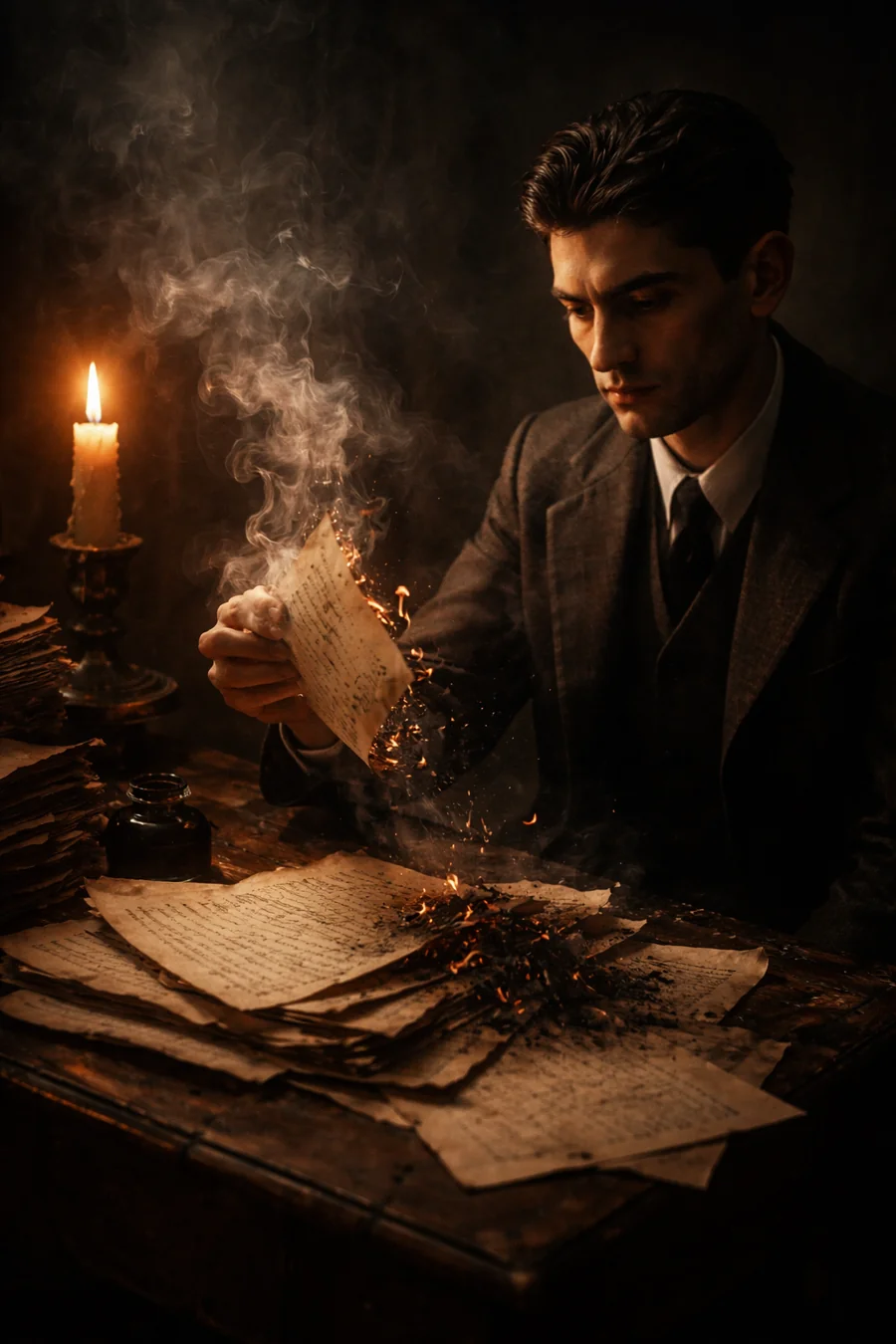
Franz Kafka wanted much of his work to disappear with him. In two notes addressed to his friend Max Brod, he requested that his manuscripts, diaries, letters, and drawings be destroyed unread.
Brod disobeyed.
Because of that betrayal—or that final act of loyalty—The Trial, The Castle, Amerika, numerous stories, diaries, and notebooks survived. The writer who doubted almost everything, especially himself, became one of the central figures of modern literature.
Kafka never witnessed the extent of his influence. He died in 1924 at the age of forty, when he was still known only within a relatively small literary circle. A century later, his surname is used to describe situations in which rules exist but no one can understand them, authority is everywhere yet impossible to reach, and an individual begins to suspect that he is being judged for a crime he cannot identify.
The most Kafkaesque thing about Kafka was that he attempted to escape his own work and failed.
Franz Kafka
A life told between the office and the written page
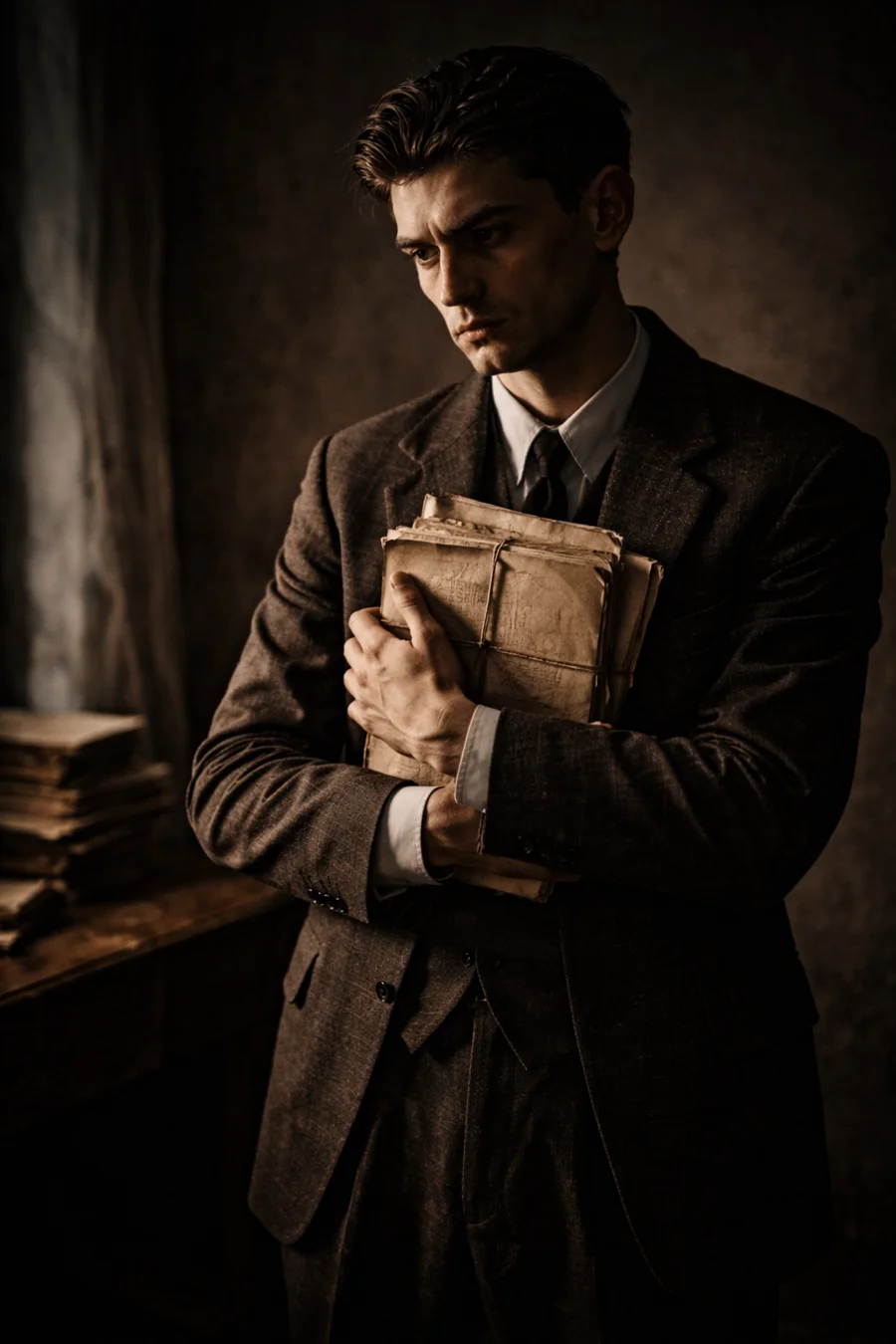
The instructions Max Brod disobeyed
The National Library of Israel catalogs two handwritten notes by Kafka, dated 1921 and 1922, instructing Brod to destroy his papers. The destruction orders themselves survived. The image is an AI recreation; the link leads to the archival record, not a reproduction of the manuscript depicted in this scene.
A German-Speaking Jew from Prague
Franz Kafka was born in Prague on July 3, 1883, when the city formed part of the Austro-Hungarian Empire. He grew up in a German-speaking Jewish family in a city whose population was predominantly Czech. His life and writing developed at the intersection of those languages, communities, and traditions.
His father, Hermann Kafka, had risen from rural poverty to become a prosperous merchant. He was energetic, authoritarian, and proud of his success. Kafka’s mother, Julie Löwy, came from a more educated family and worked long hours in the family business. Franz was the eldest of six children. His two brothers died in infancy, while his sisters Gabriele, Valerie, and Ottilie would be murdered decades later during the Holocaust.
His relationship with Hermann profoundly shaped Kafka’s image of himself. He saw his father as physically imposing, self-assured, and able to occupy the world without asking permission. In contrast, Franz felt weak, indecisive, and guilty.
In 1919, he wrote the long Letter to His Father, more than one hundred handwritten pages in which he attempted to explain the fear, shame, and sense of inadequacy that had dominated their relationship. The letter never became an effective dialogue with its intended recipient.
The letter should not be treated as a complete explanation of all Kafka’s fiction. He transformed a much wider range of family, religious, social, and professional experiences. Nevertheless, the figure of a powerful and inaccessible authority capable of producing guilt without clearly explaining the offense recurs throughout his work.
The Lawyer Who Did Not Want to Practice Law
Kafka attended German-language schools in Prague and entered the German Karl-Ferdinand University in 1901. He briefly tried chemistry and attended courses in art history and literature before settling on law. The degree offered a respectable career and allowed him to postpone a final decision about his future.
He received his doctorate in 1906 and completed a year of legal training. He then began working for the Italian insurance company Assicurazioni Generali. The long hours left him almost no time to write. In 1908, he obtained a position at the Workers’ Accident Insurance Institute for the Kingdom of Bohemia, where he remained for fourteen years (Franz Kafka Museum, n.d.-a).
His new workday generally ended in the early afternoon. He could then return home, rest, and write at night.
The division was never easy. Kafka felt that the office consumed the energy he needed for literature. At the same time, he depended on his salary and performed his duties with an efficiency that contradicts the popular image of a clerk destroyed by his own incompetence.
He was not an insignificant functionary lost among papers. He was a capable lawyer who rose through the institution.
The Little-Known Fact: Kafka Protected Real Workers
Kafka’s writing is often associated with incomprehensible offices, endless files, and officials incapable of helping anyone. It is therefore surprising that his daily employment was connected to a very practical objective: reducing industrial accidents and securing compensation for injured workers.
Kafka examined industrial operations, classified risks, prepared reports, and represented the institute in disputes with employers. His responsibilities brought him into contact with textile factories, quarries, construction sites, and workshops where machinery could maim or kill.
He also participated in prevention campaigns and helped prepare technical documents concerning industrial safety. In 1913, he traveled to Vienna with an institute director to attend a conference on rescue methods and accident prevention (Franz Kafka Museum, n.d.-b).
There is no reliable evidence that Kafka invented the safety helmet, a claim that is frequently repeated. His actual contribution was less spectacular and more thoroughly documented: through his administrative work, he helped improve risk classification and protective measures in dangerous industries.
His superiors valued his intelligence, clarity, and ability to negotiate. He was promoted several times and eventually reached the rank of senior secretary. During the First World War, he was not sent into military service because the institute considered his work essential.
This aspect of his life complicates the caricature of a man incapable of existing outside literature. Kafka complained bitterly about office work, yet performed it conscientiously. He knew bureaucracy from the inside and understood that it could be absurd while still being necessary to protect real people.
That may be why his novels are so convincing. They were not written by someone imagining administration from a distance but by a professional who understood its language, hierarchies, and capacity to determine an individual’s fate through a document.
The Night He Found His Voice
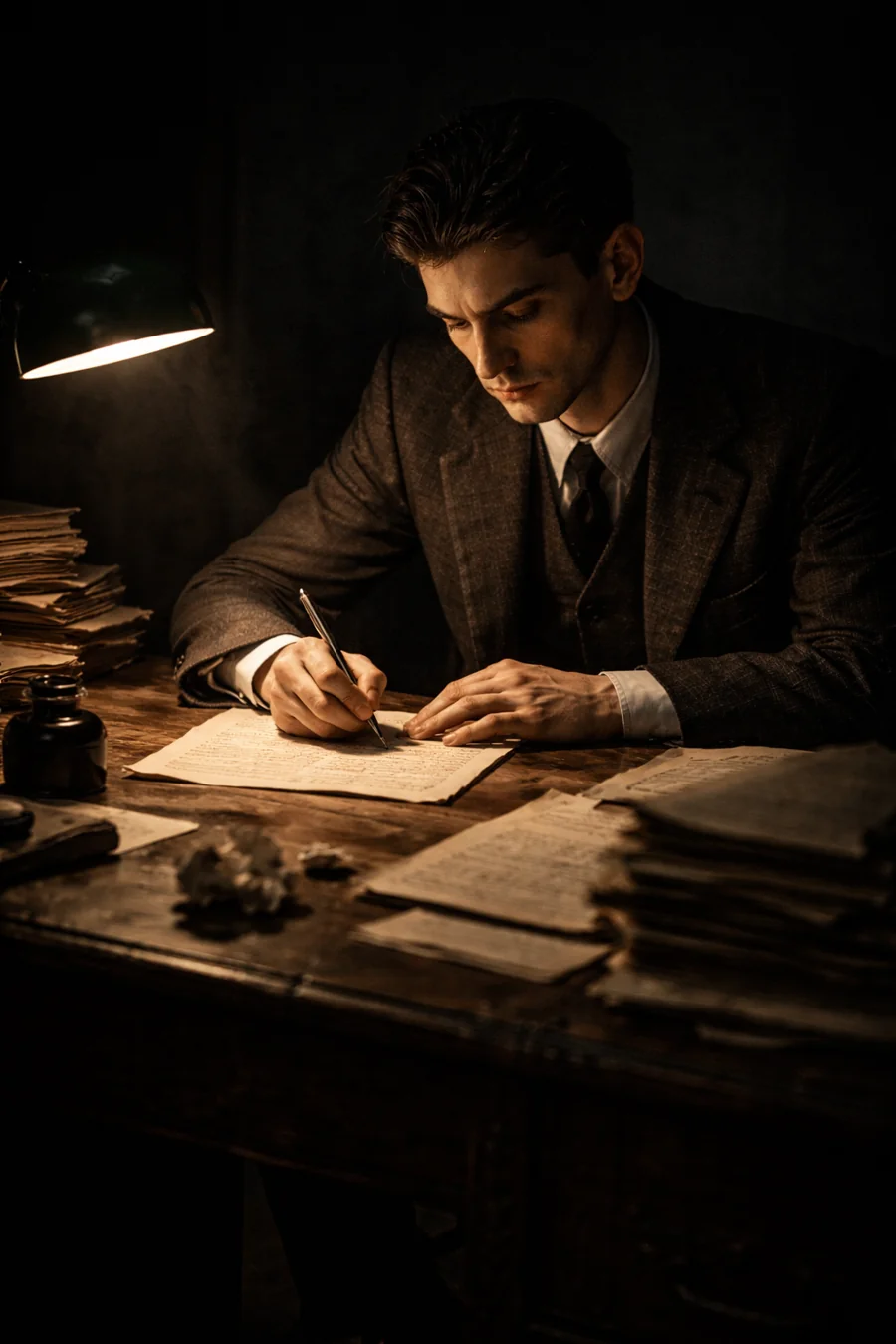
Kafka had written from an early age, but for years he destroyed texts he considered unsatisfactory. His decisive moment came during the night of September 22–23, 1912.
He sat down to write at approximately ten in the evening and, barely leaving the table, completed The Judgment by six the next morning. He had written the entire story in a single session. In his diary, he described the experience as a complete opening of body and soul.
The story concerns a young businessman condemned by his father to death by drowning. In only a few pages, it contains several elements that would define Kafka’s writing: an unexpected accusation, a family authority assuming judicial dimensions, and a sentence accepted by someone unable to understand it.
For Kafka, that night confirmed that writing was not a hobby. It was the form of existence to which he had to surrender completely.
A few weeks later, he began The Metamorphosis. Its opening sentence introduces Gregor Samsa, a traveling salesman who awakens transformed into a monstrous creature. What is extraordinary is not only the transformation but the speed with which Gregor begins worrying about being late for work and explaining his absence.
Horror enters the bedroom, but employment obligations remain waiting outside the door.
Felice Bauer and the Impossible Marriage

In August 1912, Kafka met Felice Bauer at Max Brod’s home. She lived and worked in Berlin, and their relationship developed mainly through letters. Kafka could write to her several times a day, analyze every response, and transform any silence into a threat.
They became engaged twice and separated twice.
Kafka desired marriage, intimacy, and family life. At the same time, he feared that those very things would destroy the solitude required for writing. In his letters, Felice became recipient, judge, promise of normality, and imagined obstacle.
The problem was not simply an absence of love. Kafka seemed unable to accept a life that required surrendering either of his contradictory needs. He wanted to belong and remain alone. He wished to become a husband without giving up entire nights of writing. His letters reveal that conflict, although they do not provide a definitive explanation of his entire private life.
In 1914, during a meeting at a Berlin hotel, Felice and others close to her confronted him about his correspondence and conduct. Kafka later described the encounter as a tribunal. Soon afterward, he began writing The Trial, in which Josef K. is arrested without being clearly informed of the crime he has allegedly committed.
It would be simplistic to claim that the breakup “created” the novel. Their chronological proximity invites an exploration of the relationship between experience and fiction, without reducing the novel to a single cause.
Writing to Escape and Finding Himself Again
Kafka published relatively little during his lifetime. His books included Contemplation, The Stoker, The Metamorphosis, The Judgment, In the Penal Colony, and A Country Doctor. He revised obsessively and could delay or abandon texts that others considered complete.
His three novels remained unfinished.
Amerika, a title later imposed by Brod, begins with a young man sent to the United States after a family scandal. The Trial follows a man trapped by a court whose authority he never understands. The Castle presents a land surveyor attempting to gain access to an administration that appears nearby yet remains infinitely remote.
His characters are constantly moving but seldom arrive. They seek explanations that produce further questions. They try to obey rules that change just as they believe they have understood them.
Even so, reducing Kafka to despair removes an essential part of his writing: its humor. He read his work aloud to friends, and on some occasions everyone ended up laughing. The situations are terrible, but they also contain a comic logic: officials who speak for pages without clarifying anything, messengers who never reach their destinations, and defendants who cooperate with the systems destroying them.
Kafka’s world is not only dark. It is also ridiculous.
Tuberculosis
In August 1917, Kafka suffered a pulmonary hemorrhage. He was soon diagnosed with tuberculosis, for which no effective treatment yet existed.
He spent extended periods recovering in the countryside, particularly with his sister Ottla at Zürau. The illness temporarily removed him from office work but also made the independent life he had repeatedly postponed increasingly impossible.
His engagement to Felice Bauer ended permanently. He later began an intense relationship with Czech journalist and translator Milena Jesenská, who translated some of his writings into Czech. Milena was married, and much of the relationship again unfolded through letters.
In 1922, as his health deteriorated, Kafka retired from the Workers’ Accident Insurance Institute. Even after retirement, he had to send the institute a monthly confirmation that he was still alive in order to continue receiving his pension—a bureaucratic procedure that seems to have been invented by Kafka himself (Franz Kafka Museum, n.d.-c).
Dora Diamant and Life Outside Prague
In 1923, he met Dora Diamant, a young woman from a Hasidic Jewish family. With her, Kafka decided to establish a shared life outside Prague.
The couple settled in Berlin. Kafka studied Hebrew, deepened his engagement with Jewish culture, and imagined the possibility of living in Palestine. Despite German inflation and the progression of his illness, these months represented a brief form of independence.
Dora later recalled that Kafka retained his humor, invented stories, and displayed particular gentleness with children. The image of a permanently gloomy man does not fully match the memories of those who knew him.
Tuberculosis eventually spread to his larynx. Speaking and swallowing became excruciatingly painful. Kafka returned to Prague and was then admitted to a sanatorium in Kierling, near Vienna.
Dora and his friend, medical student Robert Klopstock, remained with him. Unable to eat properly, he weakened and died on June 3, 1924.
He died during the final stage of tuberculosis that had severely affected his larynx. He was forty years old.
The Papers That Were Supposed to Burn
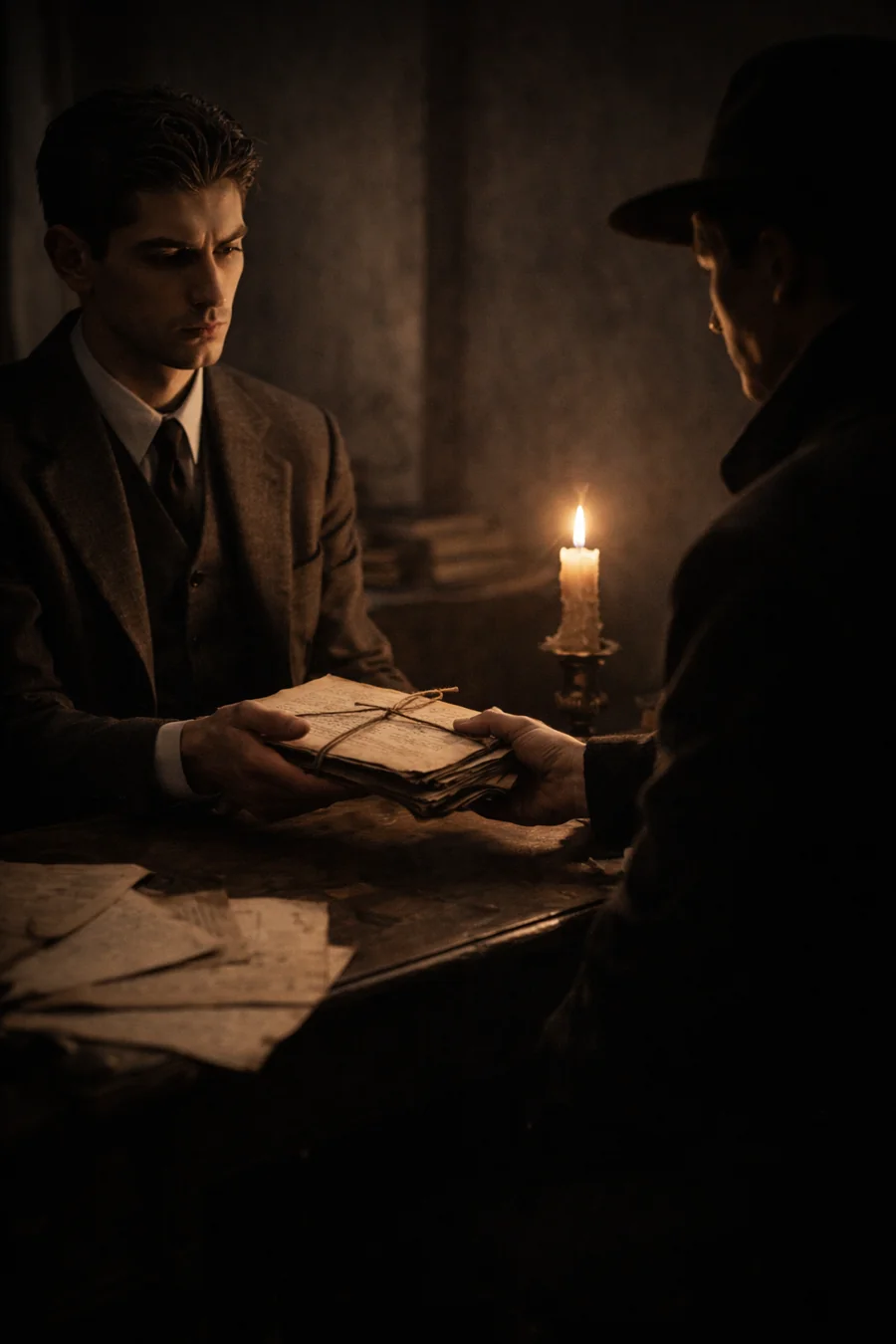
Kafka had personally burned some of his writing, and according to Max Brod’s testimony, Dora Diamant destroyed several notebooks at Kafka’s request. Much of the work, however, remained in Brod’s possession.
In 1921 and 1922, Kafka wrote two notes asking Brod to destroy his manuscripts, drawings, diaries, and letters after his death. In the second note, he exempted certain published texts from destruction, without thereby asking for them to be reprinted (National Library of Israel, n.d.).
Brod knew about these instructions before Kafka’s death and had warned him that he would not obey. After his friend died, he organized and published the unfinished novels. The Trial appeared in 1925, The Castle in 1926, and Amerika in 1927.
Brod’s intervention saved the work, but it also influenced how Kafka was read. He arranged chapters, selected titles, and presented Kafka through a spiritual and religious perspective that later scholarship has substantially revised.
In 1939, as the Nazis prepared to complete their occupation of Czechoslovakia, Brod left Prague for Palestine carrying a suitcase containing Kafka’s manuscripts. Work once intended for burning escaped a Europe in which Jewish books were being burned and Kafka’s three sisters would be murdered (National Library of Israel, n.d.).
The documents were eventually dispersed among archives in Oxford, Marbach, and Jerusalem. Their later history involved sales, bank vaults, and prolonged legal disputes over who had the right to possess them.
Even after death, Kafka became trapped inside a bureaucratic process concerning his own identity.
The Writer Who Could Not Escape Himself
Kafka attempted to satisfy his family, maintain a respectable occupation, marry, and live a life acceptable to the bourgeois society of his era. He also tried to write as if none of those obligations existed.
He never managed to choose completely between the two worlds.
That tension offers one way of reading his literature. His protagonists want to enter and escape at the same time. They seek recognition from authorities that ignore them and then fear the moment when they are finally observed. They want to prove their innocence without knowing what accusation they must answer.
Kafka could not escape the categories surrounding him either: a German-language writer in a predominantly Czech city, a Jew within a Christian culture, a writer inside an office, and an adult son before a father who continued to make him feel small.
Yet he turned those fractures into language so precise that it described experiences that did not yet possess a name.
Today, we call a form Kafkaesque when it leads to another form, an office Kafkaesque when it demands a document that the same office refuses to provide, an accusation Kafkaesque when no visible crime exists, and a technology Kafkaesque when it makes decisions without explaining them.
Kafka asked for numerous writings to be destroyed. He left no single explanation that allows that decision to be reduced to the unfinished state of his novels.
Max Brod chose to preserve and publish them, even against his friend’s stated wishes.
Kafka could not escape himself. Nor could he prevent the rest of the world from eventually finding itself inside him.
References
- Bodleian Libraries. (2023, December 6). Kafka: Making of an Icon. University of Oxford. View source
- Franz Kafka Museum. (n.d.-a). The Workers’ Accident Insurance Institute. View source
- Franz Kafka Museum. (n.d.-b). Foreign holiday trips and stays at sanatoria. View source
- Franz Kafka Museum. (n.d.-c). Paths to recovery. View source
- Franz Kafka Museum. (n.d.). Felice Bauer. View source
- National Library of Israel. (n.d.). Franz Kafka. View source
- National Library of Israel. (n.d.). Franz Kafkas Nachlassverfügungen (Testamente), 1921–1922. Max Brod Archive. View source
- Kafka, F. (1912). Diary entry, September 23. University of Washington, course material. View source