
In this storyOpen index
Franz Schubert: The Musician Who Composed as Though Time Were Chasing Him
Through songs, forgotten manuscripts, and one late concert, Schubert composed with an urgency made more poignant by his short life.
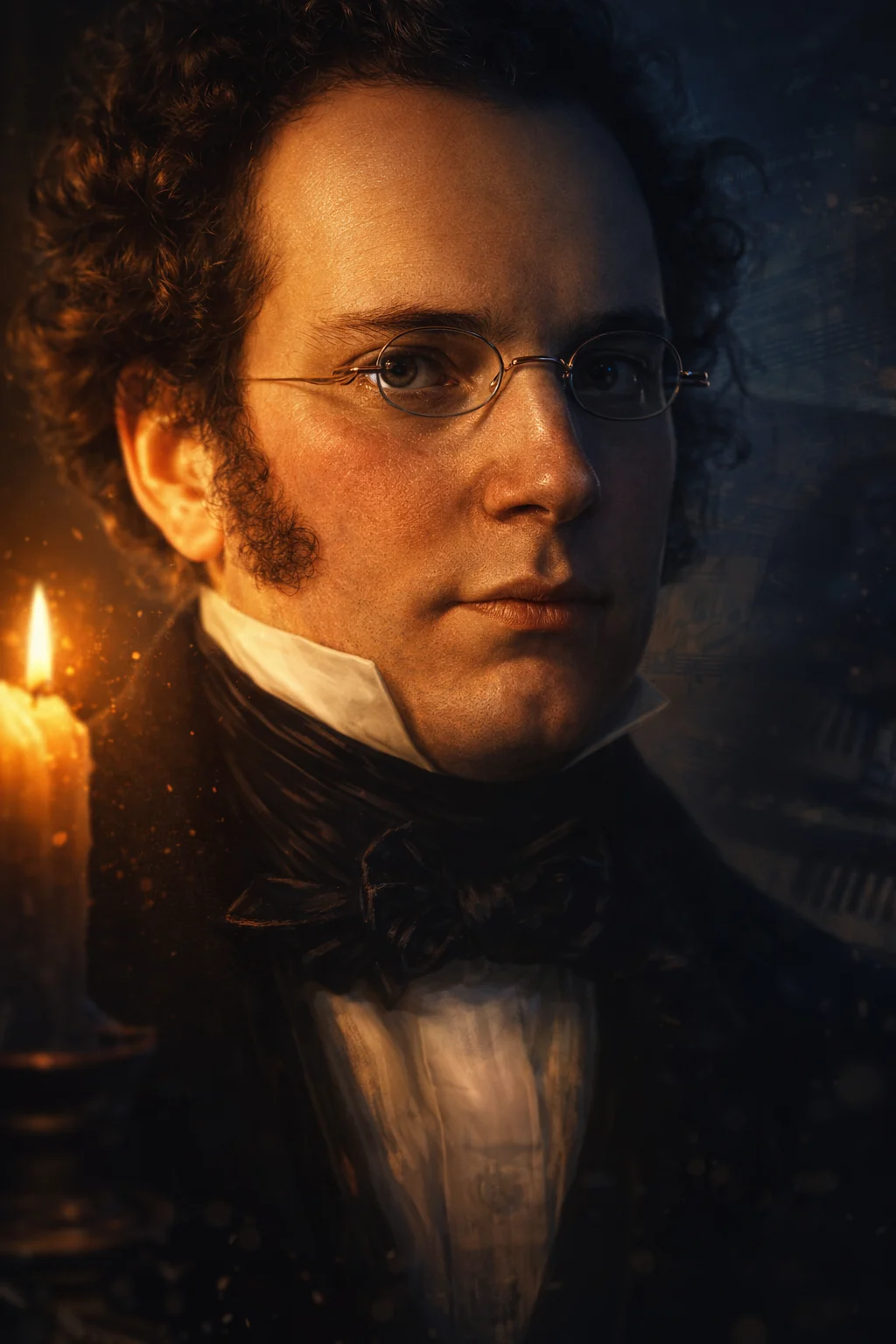
Franz Schubert wrote music with the urgency of someone who seemed to sense that he would not live long. He died at thirty-one, yet left more than six hundred songs, nine symphonies according to the traditional numbering, chamber music, sonatas, choral works, masses, and a remarkable body of music for piano four hands.
He was not the completely unknown artist later created by Romantic legend. He had influential friends, some of his songs circulated widely, and during his final year he presented a financially successful concert. Yet he never achieved Beethoven’s public stature during his lifetime. Many of his major works remained unperformed, theaters rejected his operas, and publishers selected only the pieces they believed they could sell.
Schubert inhabited a cruel borderland: he was admired by those who knew him and simultaneously ignored by much of the world that would eventually revere him.
Franz Schubert: music against time
A life among Vienna, music, and manuscripts
Enter the archive
The Morgan Library & Museum holds an autograph manuscript of Winterreise dated February 1827. This feature image is a visual reconstruction, not a photograph of the manuscript.
AI-generated visual reconstruction; not a photograph of the historical document.
The Schoolmaster’s Son
Franz Peter Schubert was born on January 31, 1797, in Himmelpfortgrund, then a suburb of Vienna. His father, Franz Theodor Schubert, operated a parish school. His mother, Elisabeth Vietz, had worked as a cook before marriage. The couple had fourteen children, although many died in infancy, a common tragedy in an era of high childhood mortality (Gibbs, 2000).
Music formed part of family life. His father taught him violin, his brother Ignaz gave him piano lessons, and the organist Michael Holzer instructed him in singing, organ, and musical theory. The boy’s ability soon exceeded the resources of his earliest teachers.
In 1808, Schubert earned a position as a chorister in the imperial chapel and entered the Stadtkonvikt, a prestigious Viennese boarding school. There he played in the student orchestra, encountered the symphonies of Haydn, Mozart, and Beethoven, and studied with Antonio Salieri, one of the city’s most respected musical figures.
The popular portrayal of Salieri as Mozart’s murderous enemy has obscured his genuine importance as a teacher. For Schubert, he was not a villain but a mentor who recognized his ability and helped develop his vocal and dramatic writing.
Teaching While Music Filled His Mind
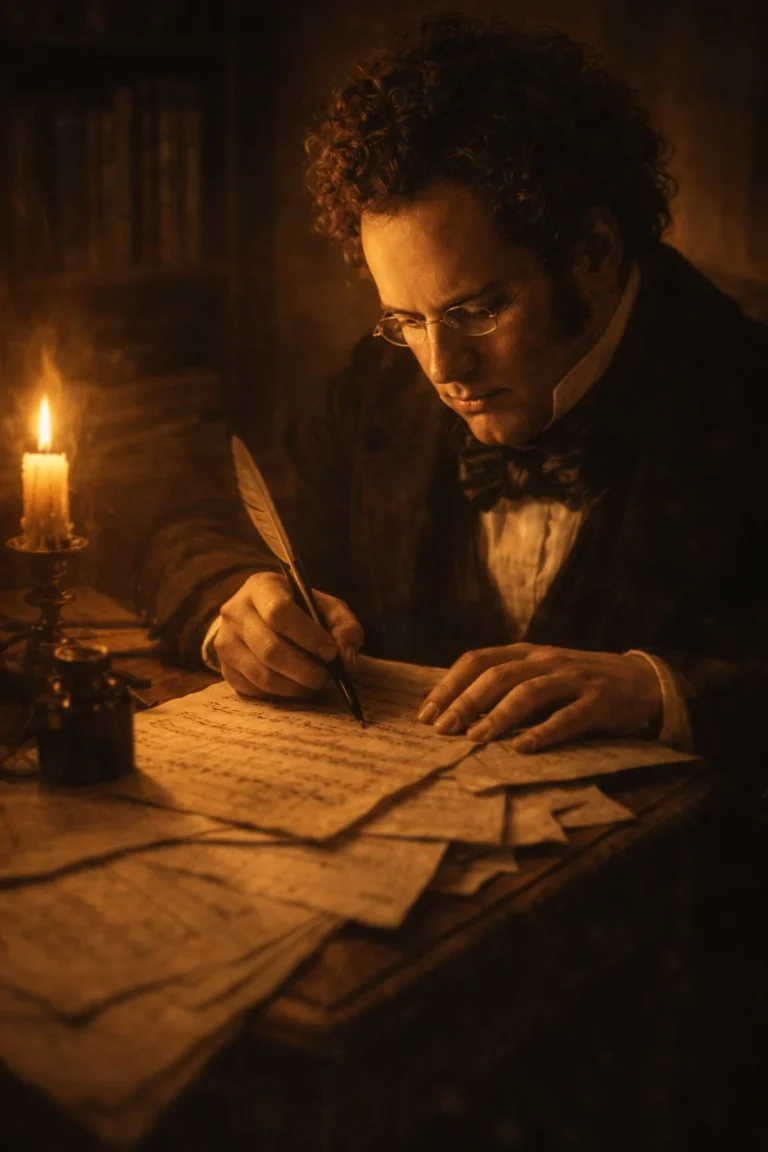
After his changing voice ended his years as a chorister, Schubert returned to the family home. To avoid military service and secure an income, he began working as an assistant in his father’s school.
He found teaching frustrating. He had to supervise large numbers of children while his mind remained occupied by musical ideas. During these years, he composed with extraordinary speed.
In 1814, he wrote Gretchen am Spinnrade—Gretchen at the Spinning Wheel—based on a poem by Goethe. The piano accompaniment evokes the wheel’s relentless turning, while the vocal line expresses the heroine’s desire and emotional agitation. The song does not merely accompany a poem; it turns Gretchen’s thoughts into musical motion.
During 1815, Schubert produced an almost unbelievable quantity of music, including more than 140 songs, as well as symphonies, sacred pieces, and works for the stage. Some songs were written in a single day. His speed did not necessarily mean carelessness. He revised, reorganized, and reused material when he considered it necessary (Newbould, 1997).
He appeared to compose not because he possessed unlimited time, but because he feared losing everything he heard within himself.
The Erlking Who Transformed Song
Among Schubert’s youthful works was Erlkönig, based on Goethe’s ballad. In only a few minutes, one singer must portray the narrator, a father, his terrified child, and the supernatural being attempting to lure him away. The piano sustains an almost uninterrupted gallop that drives the story toward its conclusion.
Schubert was eighteen when he composed the first version in 1815. His friends attempted to send a collection of his songs to Goethe, but the poet did not respond. Schubert’s intensely dramatic musical conception may have been too far removed from the more restrained approach Goethe preferred for settings of his poetry (Gibbs, 2000).
The irony is unmistakable: one of history’s greatest song composers transformed Goethe’s poetry into immortal music, yet the writer never publicly acknowledged his achievement.
When Erlkönig was published in 1821, it became one of Schubert’s earliest important successes. His friend Leopold von Sonnleithner and other admirers helped finance the edition through subscriptions because commercial publishers still hesitated to invest in him.
The Evenings That Took His Name
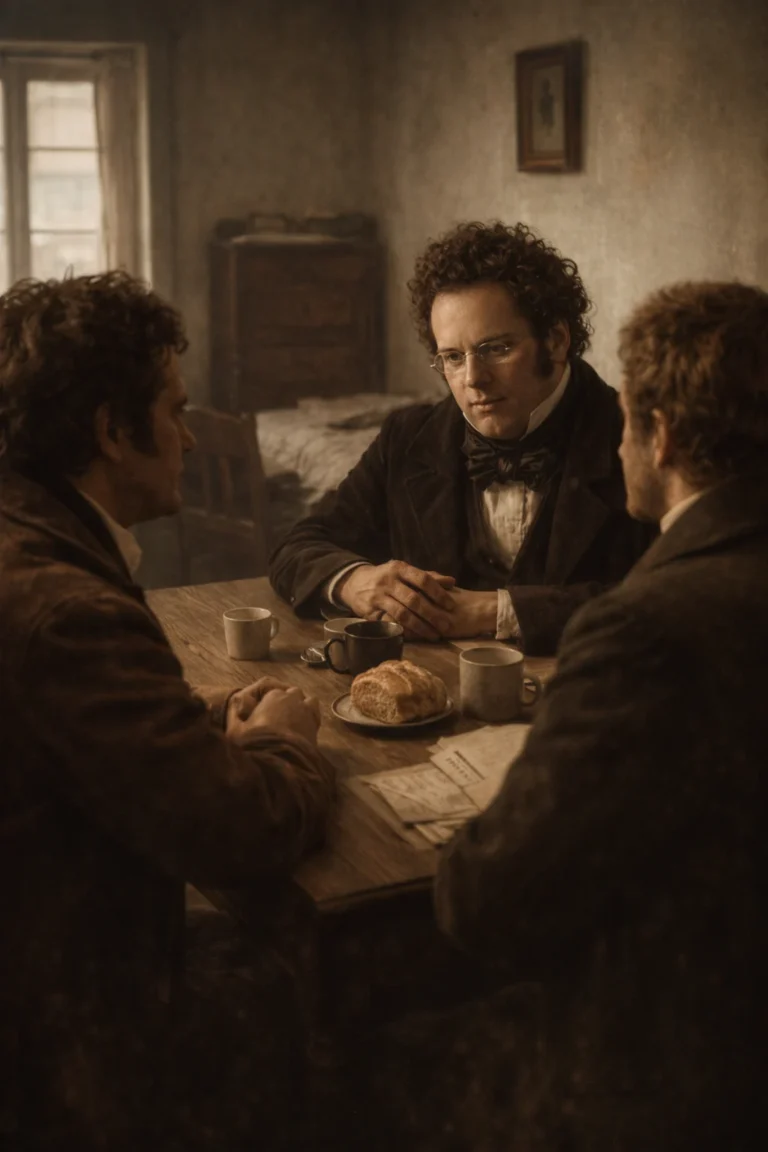
For much of his adult life, Schubert had no stable residence. He stayed with friends, moved between lodgings, and depended upon a social network that supplied rooms, meals, contacts, and performers.
A circle of poets, civil servants, painters, students, and musicians formed around him. At private gatherings, they performed his songs, piano works, and chamber music. These evenings eventually became known as Schubertiads.
The baritone Johann Michael Vogl played an essential role in spreading Schubert’s songs. Vogl was considerably older and already enjoyed an established theatrical reputation. Together they traveled to several towns and introduced the songs to audiences unlikely to have encountered them through official concert institutions.
The Schubertiads were neither identical events nor an organized institution. Some were intimate domestic gatherings; others attracted dozens of guests. The later image of Schubert permanently seated at the piano among cheerful friends also simplifies reality. The circle offered support, but it could not guarantee him financial security or institutional recognition.
The Composer Rejected by the Theater
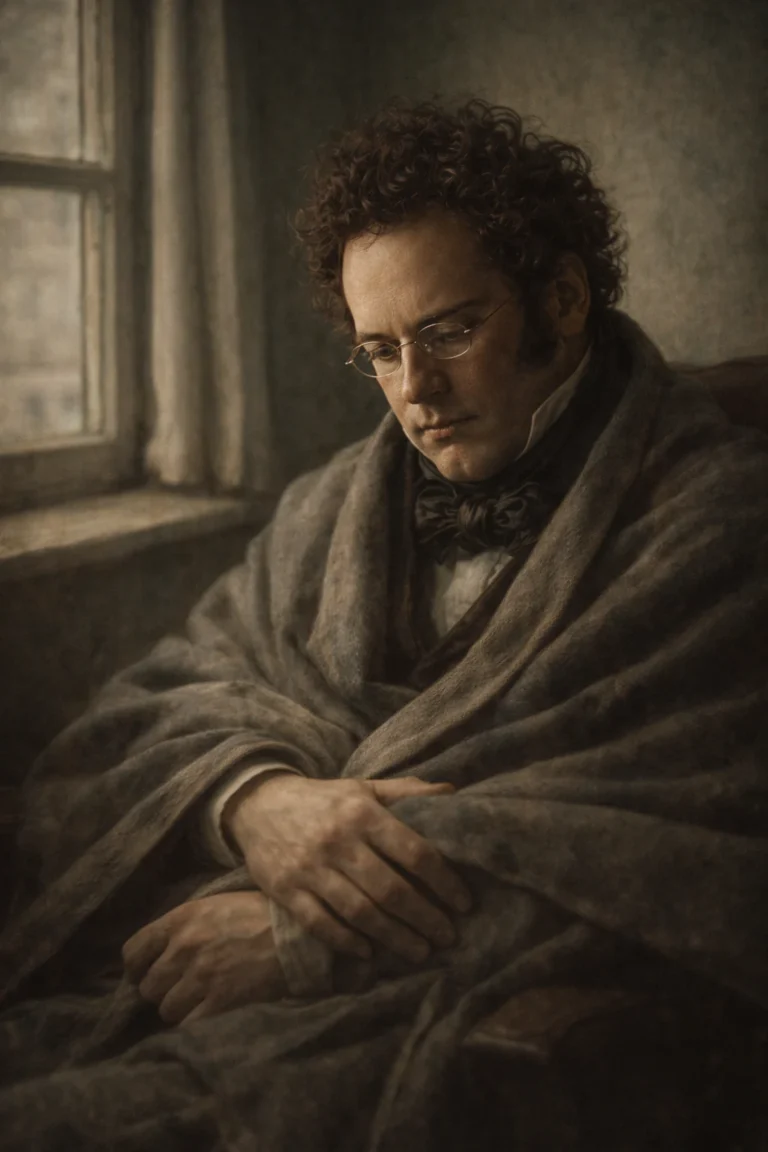
Schubert wanted to succeed in opera. The stage offered prestige, income, and access to a much larger audience than private musical gatherings.
He composed operas and incidental music but failed to establish himself in the theater. Some projects remained incomplete, while others were rejected or received only limited performances. Viennese taste was dominated in part by the enormous success of Gioachino Rossini, whose operas offered the kind of clarity and theatrical effectiveness that managers considered commercially reliable.
Schubert’s problem was not a lack of dramatic imagination. His songs demonstrate the opposite. Sustaining extended theatrical action, however, required different skills as well as access to theaters, effective librettos, and favorable commercial decisions.
While failing in the genre that might have made him a public celebrity, Schubert was revolutionizing another that many still considered minor: the German Lied.
The Illness That Changed His Life
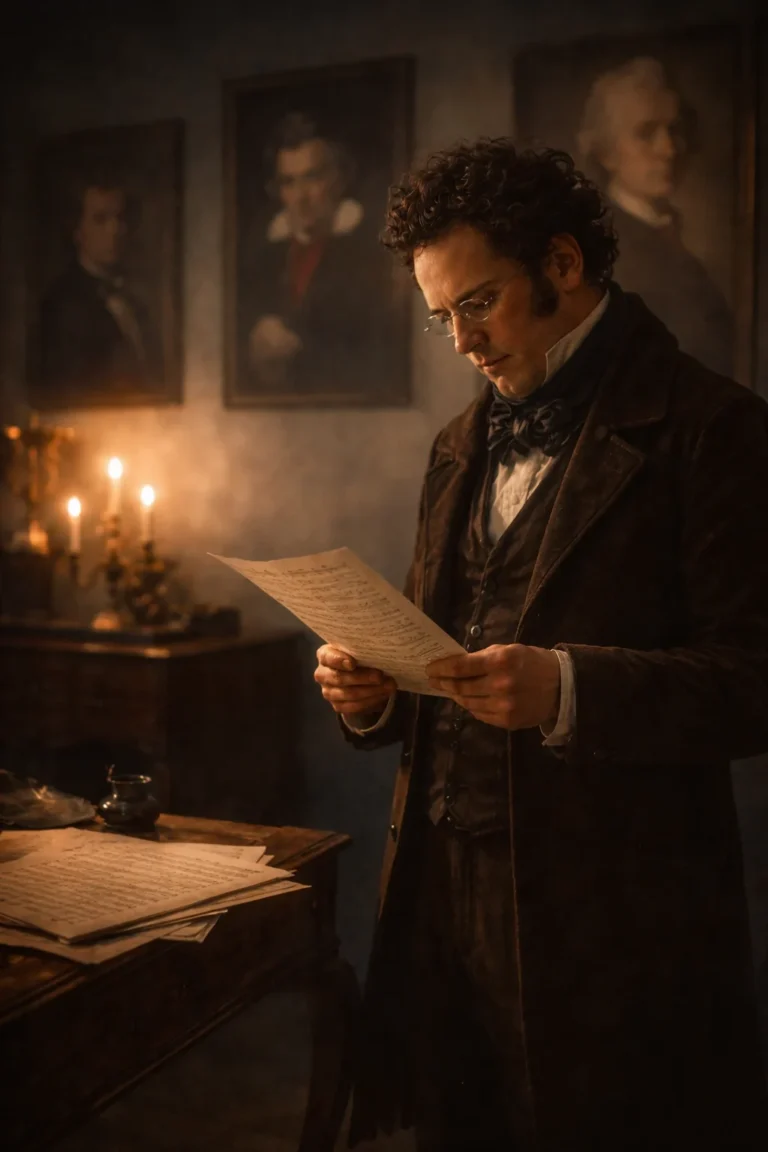
In late 1822 or early 1823, Schubert probably contracted syphilis. The documents do not provide a complete clinical diagnosis, but references from his friends, his hospitalization, and treatments customary at the time have led many biographers to accept that conclusion (Gibbs, 2000; Solomon, 1989).
The disease was incurable and surrounded by social shame. Mercury treatments could produce additional toxic effects. Schubert experienced periods of weakness, skin eruptions, pain, and depression.
In an 1824 letter, he described himself as the most unhappy and miserable man in the world, someone whose health would never recover and whose hopes had been destroyed. Nevertheless, he continued composing.
It would be misleading to explain all his later music as the product of illness. His works are not medical records. Yet the awareness of fragility, estrangement, and death acquired particular intensity in song cycles such as Die schöne Müllerin and Winterreise.
In Winterreise, composed in 1827 to poems by Wilhelm Müller, a traveler leaves at night after losing love. He crosses snow, empty roads, memories, and hallucinations before encountering a solitary hurdy-gurdy player. There is no final reconciliation. The journey continues after hope appears to have been exhausted.
The Symphony Left in a Drawer
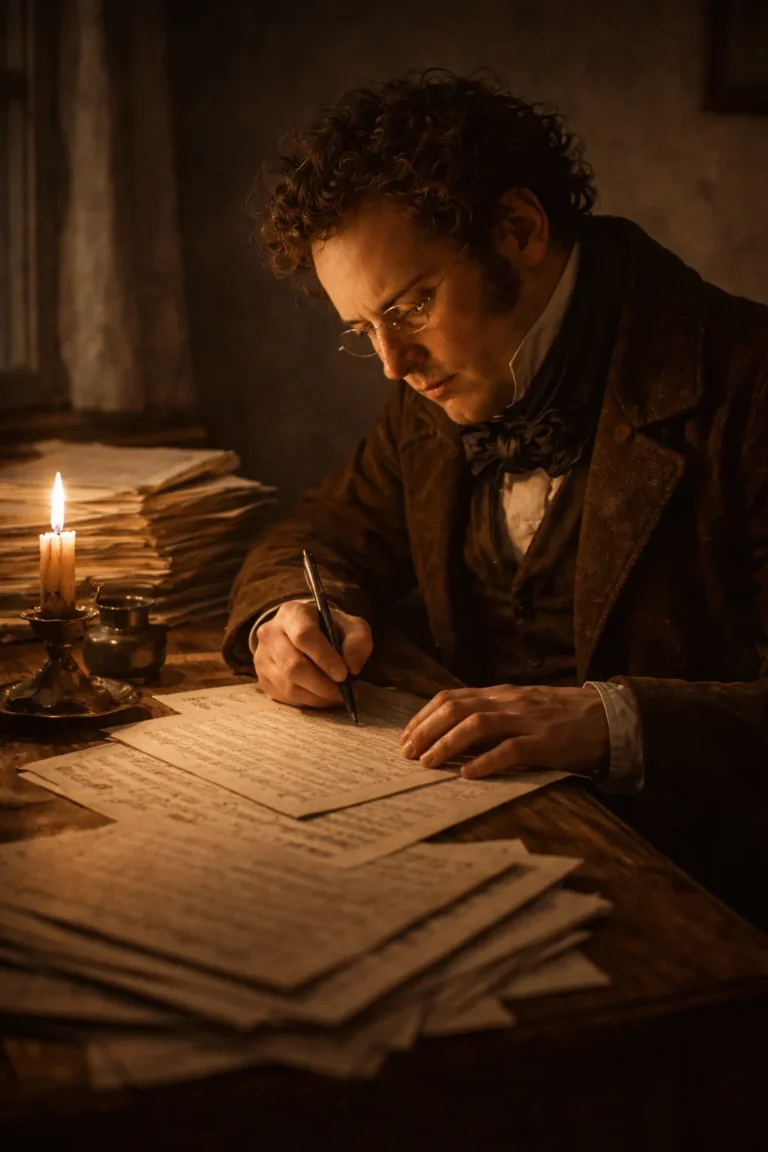
In 1822, Schubert began a symphony in B minor. He completed two movements and left part of a third in sketch form. It is now known as the Unfinished Symphony.
The composer gave the manuscript to Josef Hüttenbrenner, a representative of a Graz musical society that had elected Schubert an honorary member. The score remained with the Hüttenbrenner family for more than four decades.
Schubert did not retrieve it, prepare the two movements for publication, or apparently hear an orchestral performance. Only in 1865, thirty-seven years after his death, did the conductor Johann Herbeck persuade Anselm Hüttenbrenner to reveal the manuscript. The symphony received its premiere in Vienna that year (Newbould, 1997).
No one knows with certainty why Schubert abandoned it. Technical, personal, and aesthetic explanations have all been proposed, but none can be proven. What remains extraordinary is that one of the most recognizable symphonies in the repertory spent decades hidden among private papers.
In Beethoven’s Shadow
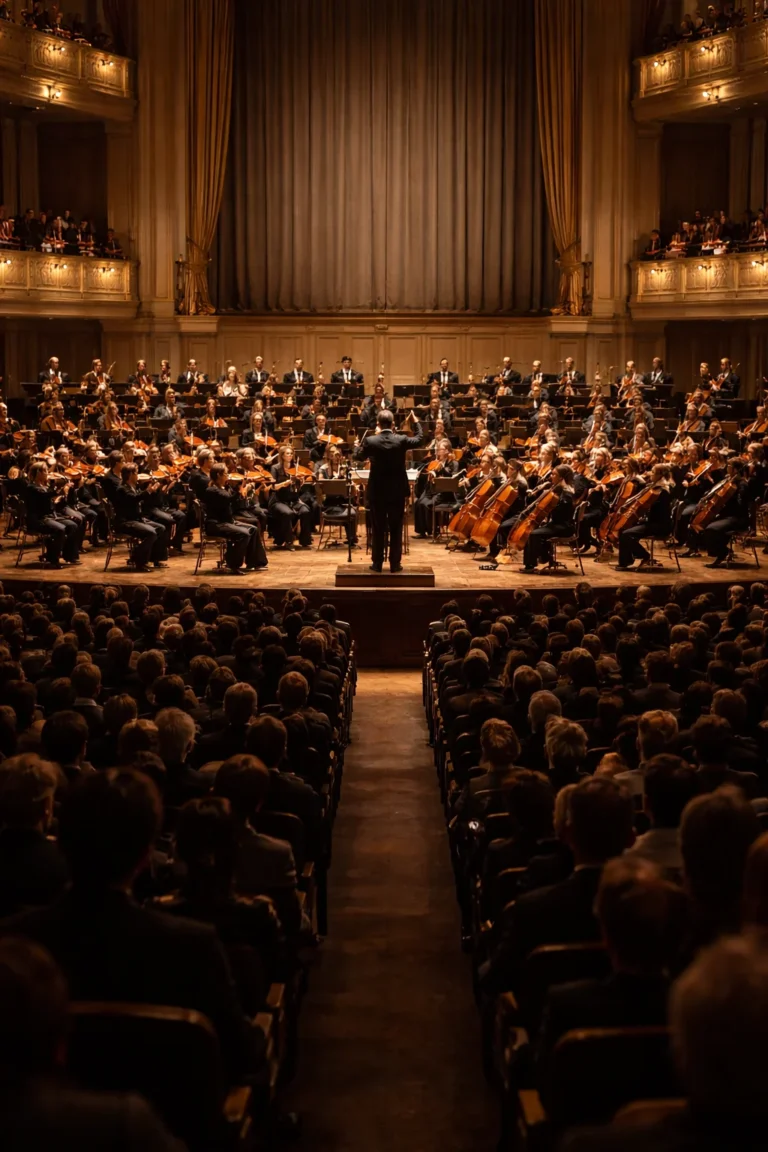
Schubert lived in Beethoven’s Vienna, but he belonged to a younger generation and a different social world. He admired the older composer profoundly and regarded him as an almost unreachable figure.
Stories of their meetings grew more elaborate over time. Schubert may have visited Beethoven during his final illness, and Beethoven may have examined some of his songs, but the details preserved in later testimonies cannot all be securely verified.
What is documented is that Schubert served as a torchbearer at Beethoven’s funeral in March 1827. Thousands followed the procession. For Schubert, the master’s death represented both a loss and a realization that he had to find his own place within Viennese music (Deutsch, 1946).
One year later, Schubert was buried near Beethoven in Währing Cemetery. Decades afterward, both composers’ remains were transferred to Vienna’s Central Cemetery.
The Concert That Contradicts the Legend
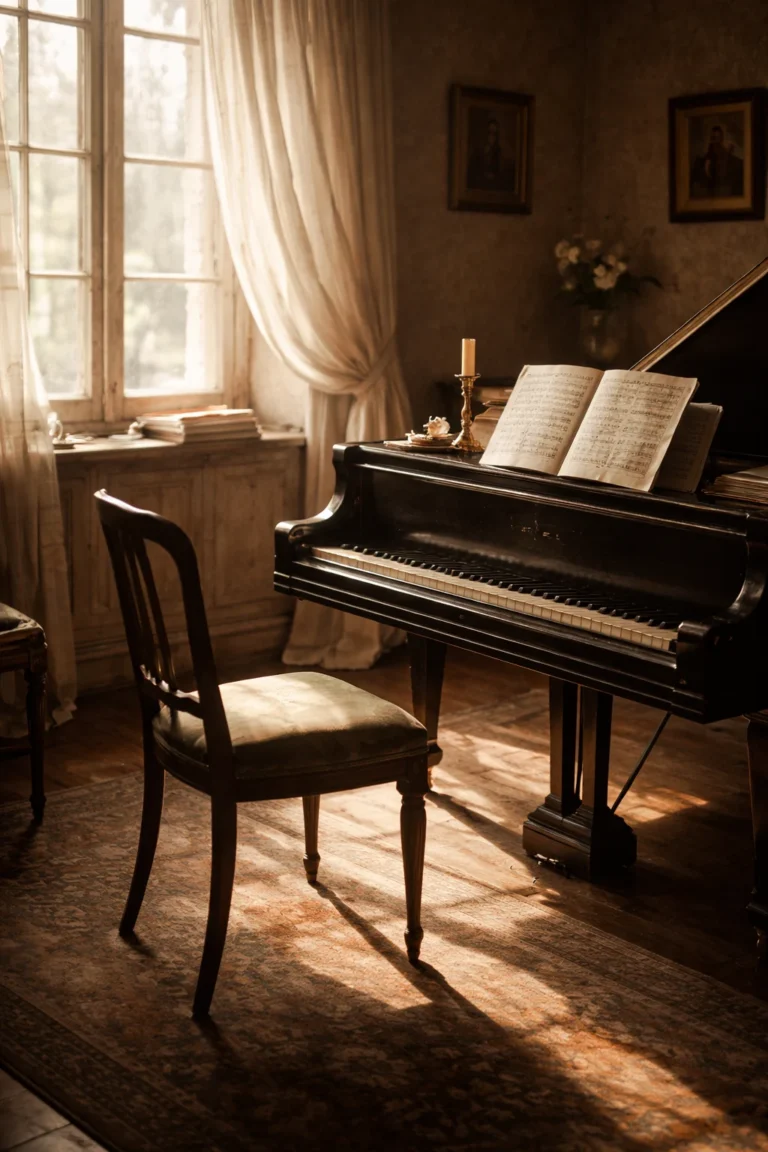
It is often claimed that Schubert never experienced applause or success during his lifetime. That image is too absolute.
On March 26, 1828, exactly one year after Beethoven’s death, he organized a concert devoted entirely to his own music. The program included vocal and chamber works, and the evening produced substantial profits.
It was the first and only major public concert devoted exclusively to his compositions during his life. It attracted less newspaper coverage than might have been expected because Vienna was then fascinated by performances from the violinist Niccolò Paganini.
The concert demonstrates that Schubert was not completely unknown. He had performers, admirers, and a growing audience. The tragedy was that recognition began to consolidate precisely as his health and time were running out.
The Final Year
During 1828, Schubert worked with extraordinary energy. He composed his final three piano sonatas, the String Quintet in C major, songs later published as Schwanengesang, and other works of remarkable depth.
In the autumn, he moved into the home of his brother Ferdinand, possibly because doctors considered that part of Vienna healthier. Fever, weakness, and digestive problems soon appeared. During his final days, Schubert experienced episodes of delirium.
He died on November 19, 1828, at the age of thirty-one. The official diagnosis was typhoid fever, but the precise cause remains debated. Syphilis and the treatments he received may have weakened his body, while an acute infection could have precipitated his death. Simply stating that “Schubert died of syphilis” removes an uncertainty that the surviving evidence cannot fully resolve (Gibbs, 2000).
Extreme poverty is also part of the legend. Schubert frequently suffered financial difficulties and depended upon his friends, but he earned money from publishers, concerts, and commissions. He did not die entirely abandoned or unknown. He died before obtaining the stability and prestige his work deserved.
The Symphony Schumann Found
A second story of survival unfolded ten years after Schubert’s death. In 1838, Robert Schumann visited the composer’s brother Ferdinand in Vienna and examined the manuscripts he had preserved.
Among them, Schumann found an extensive symphony in C major. Impressed by it, he encouraged Ferdinand to send the score to Leipzig, where Felix Mendelssohn conducted its premiere in March 1839. The work became known as the Great C Major Symphony.
The episode is commonly summarized by saying that Schumann “discovered” the symphony, although Ferdinand knew of its existence and played a decisive role in preserving it. What matters is that the work had not entered the repertoire during Schubert’s lifetime and might have remained forgotten without this chain of custodians, musicians, and conductors (Newbould, 1997).
Schubert’s music survived because friends and relatives preserved manuscripts that established institutions had not considered a priority.
Music After Silence
Schubert left approximately one thousand catalogued compositions. He transformed the Lied by making the voice and piano equal participants in a miniature drama. The accompaniment could represent a spinning wheel, a galloping horse, moving water, the wind, or a state of mind that words alone could not express.
He also expanded chamber music and gave the piano a kind of intimacy that influenced Schumann, Liszt, Brahms, and countless later composers. His melodies can sound spontaneous, but beneath them are unexpected harmonic shifts capable of carrying listeners from safety into unease within a few measures.
Schubert lived among friends yet wrote some of the loneliest music of the nineteenth century. He experienced admiration but never heard many of his most important works. He achieved genuine public success but died before he could transform it into a stable career.
He did not compose from a single abyss. He wrote from several: illness, financial uncertainty, theatrical rejection, Beethoven’s shadow, and the awareness that time might close without warning.
Perhaps that is why sorrow in Schubert’s music is never motionless. In Schubert, even grief walks. And as it walks, it sings.
References
- Deutsch, O. E. (1946). Schubert: A documentary biography. J. M. Dent & Sons.
- Gibbs, C. H. (Ed.). (2000). The Cambridge companion to Schubert. Cambridge University Press.
- Library of Congress. (n.d.). Franz Schubert: A guide to resources at the Library of Congress. https://guides.loc.gov/schubert
- Newbould, B. (1997). Schubert: The music and the man. University of California Press.
- Solomon, M. (1989). Franz Schubert and the peacocks of Benvenuto Cellini. 19th-Century Music, 12(3), 193–206. https://doi.org/10.2307/746501
- The Morgan Library & Museum. (n.d.). Winterreise: Autograph manuscript, 1827 Feb. https://www.themorgan.org/music-manuscripts-and-printed-music/115668
More from this collection

Antonio Lucio Vivaldi: The Red Priest Who Made Storms Resound and Died in Silence
Read story →
Mozart: The Man Who Survived the Child Prodigy
Read story →