In this storyOpen index
Claude Monet: The Painter Who Kept Searching for Light as He Began to Lose It
The artist who taught the world to observe changing light continued painting as his own eyes began transforming color.
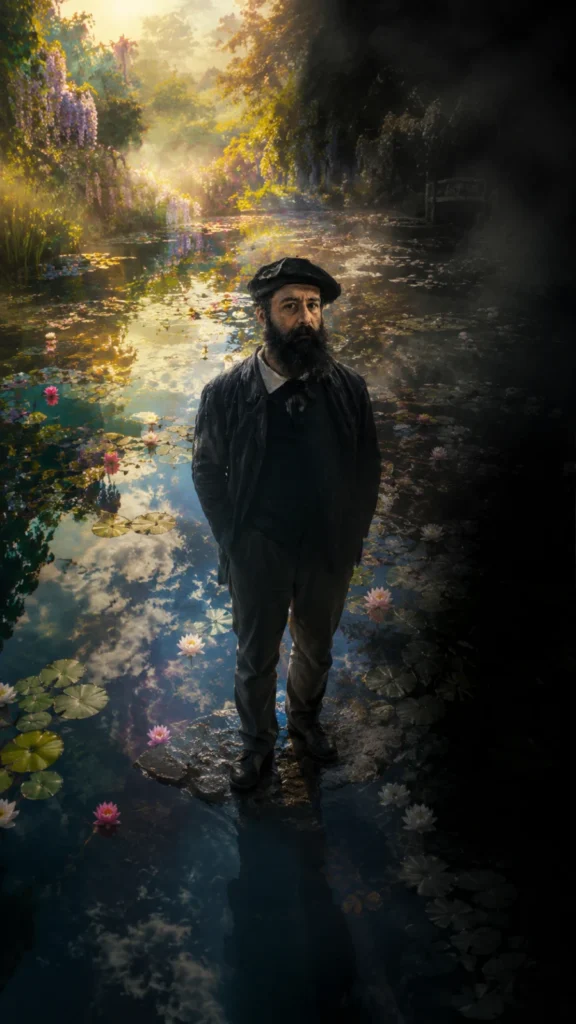
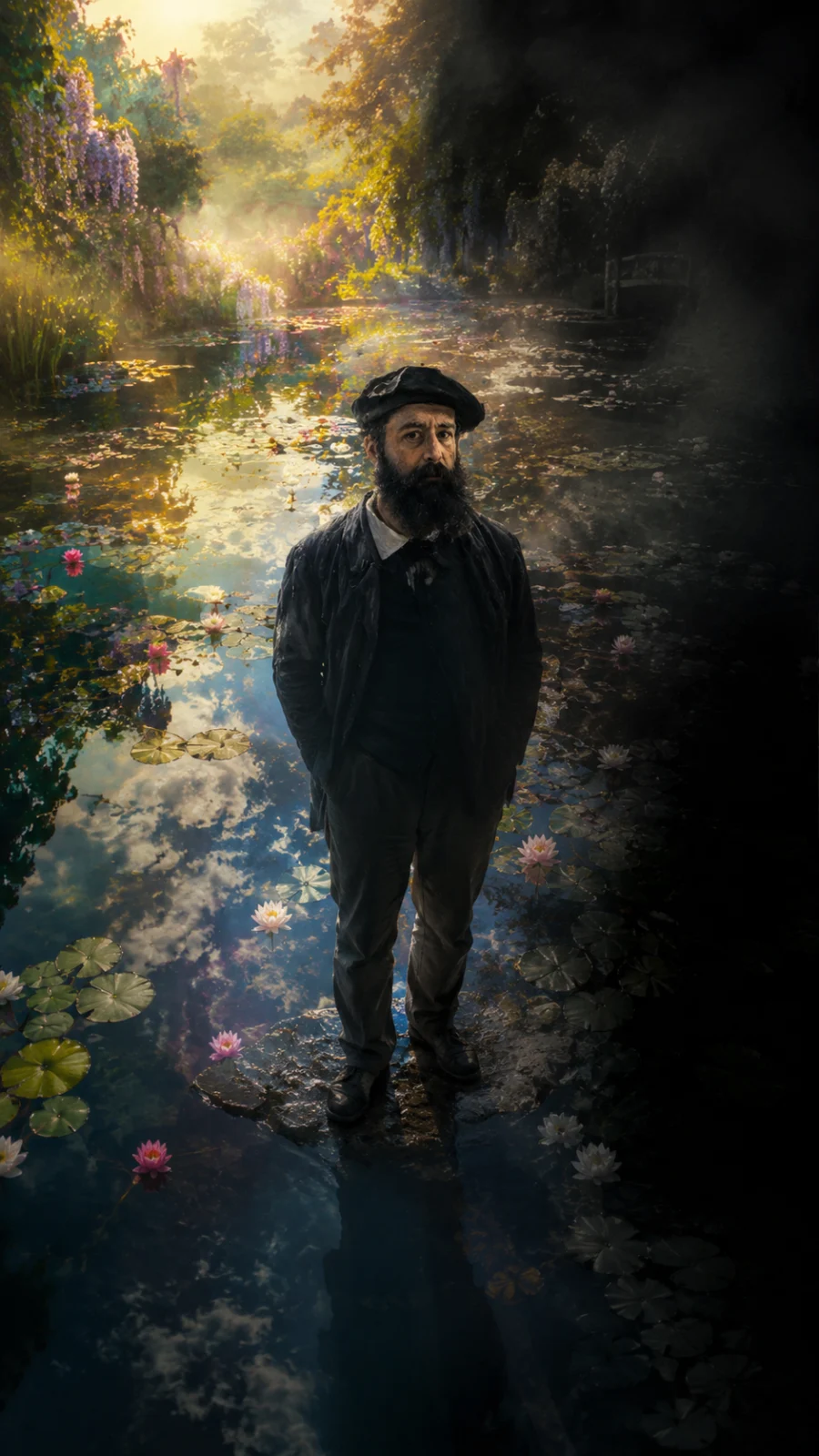
Claude Monet spent much of his life attempting to paint something that never remained still: light. He watched it change across water, buildings, snow, fog, and fields. He painted the same subjects repeatedly because, to him, no scene was ever exactly the same twice.
During his final years, however, something disturbing happened. The eyes with which he had revolutionized painting began to develop cataracts. Blues gradually disappeared from his perception, contours became indistinct, and the world acquired yellowish and reddish tones.
The man who had taught others how to look could no longer completely trust what he saw.
Still, he continued painting.
Claude Monet: painting light as his sight began to fail
Discover this story on our YouTube channel.
A life told through places and turning points

Enter the archive
An authentic object preserved by a cultural institution brings us closer to the world behind this life.
- Collection
- Wikimedia Commons
- Rights
- Public domain
JwFZ8s09sSc0Gg at Google Cultural Institute maximum zoom level
The Young Man Who Was Paid to Mock Adults
Oscar-Claude Monet was born in Paris on November 14, 1840, but grew up in Le Havre, a port city in Normandy. His father worked in the maritime supply trade and expected his son eventually to enter the family business.
Monet had other plans.
As a teenager, he began drawing caricatures of merchants, teachers, and neighbors. He displayed them in the window of a local shop and charged money for them. Before becoming a landscape painter, he was known for exaggerating noses, expressions, and personal flaws with a quick, irreverent line.
The same shop displayed landscapes by Eugène Boudin. Monet considered them uninteresting and initially avoided meeting the painter. When he finally agreed to accompany Boudin outdoors, his understanding of art changed.
Boudin taught him that the sky, sea, and clouds should not be reconstructed solely inside a studio. They had to be observed directly and painted quickly before the light changed.
Monet later said that Boudin had opened his eyes and enabled him truly to understand nature.

Algeria and the Discovery of Color
In 1861, Monet was called into military service and sent to Algeria. The intense light and colors of North Africa made a profound impression on him. Years later, he recalled that the beginnings of his future investigations as a painter could be found there.
His military service was supposed to last seven years, but illness brought him back to France. An aunt agreed to help secure his discharge on the condition that he formally study art.
In Paris, he met other young painters, including Pierre-Auguste Renoir, Alfred Sisley, and Frédéric Bazille. They shared a dissatisfaction with academic instruction. They preferred contemporary landscapes, railway stations, cafés, promenades, and ordinary people to the mythological and historical subjects favored by official institutions.
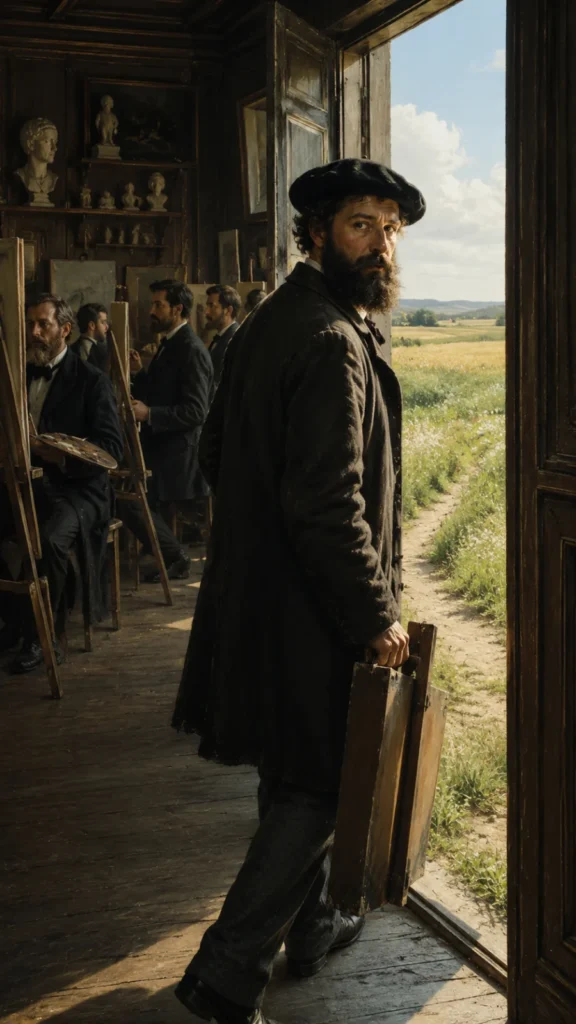
The development of portable paint tubes made it easier for them to leave the studio. Monet took this possibility to an extreme. He worked on beaches, in gardens, fields, and beside rivers, exposed to wind and changing weather.
He was not trying to copy every object precisely. He wanted to record the immediate experience of seeing it.
Camille and the Years of Poverty
During the 1860s, Monet met Camille Doncieux, who became his model, companion, and eventually his wife. She appears in several of his important early works, often as an elegant figure integrated into the landscape.
Their relationship intensified Monet’s conflict with his family, who disapproved of Camille. For years, the couple experienced severe financial hardship. Monet depended on friends, collectors, and loans while his paintings were rejected or attracted little attention.
The familiar image of the successful artist surrounded by his garden can conceal those years of debt, relocation, and desperation. Monet later stated that during a crisis in 1868 he threw himself into the Seine, although he survived. The episode is known primarily through his own account, and historians have noted the difficulty of reconstructing it precisely.
When the Franco-Prussian War began in 1870, Monet moved with Camille to London. There he studied the work of John Constable and J. M. W. Turner, whose treatment of atmosphere and fog reinforced many of his own artistic interests. He also met the dealer Paul Durand-Ruel, who would later become essential to the promotion and sale of Impressionist art.
The Painting That Named a Revolution
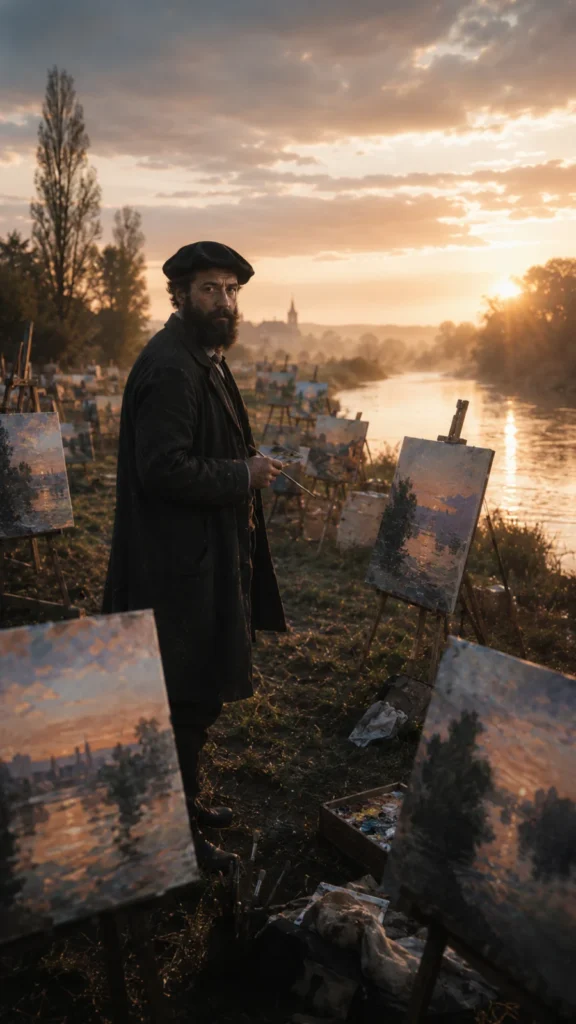
In 1874, Monet and a group of artists organized an independent exhibition in the former Paris studio of the photographer Nadar. They wanted to show their work without depending on the jury of the official Salon.
Monet exhibited a view of the harbor at Le Havre. An orange sun rose through the mist, with boats and reflections formed from visible strokes of paint. When asked to provide a title for the catalogue, he called it Impression, Sunrise.
The critic Louis Leroy used the word to ridicule the exhibition. He suggested that the works were unfinished impressions rather than completed paintings. “Impressionists,” a term born as an insult, eventually became the name of the movement.
Monet did not create Impressionism alone. Berthe Morisot, Camille Pissarro, Renoir, Edgar Degas, Sisley, and other artists made essential contributions. Monet, however, pursued one of its central ideas with extraordinary persistence: visible reality changes with light, and painting therefore also represents the passage of time.
Painting the Same Thing to Prove Everything Changes
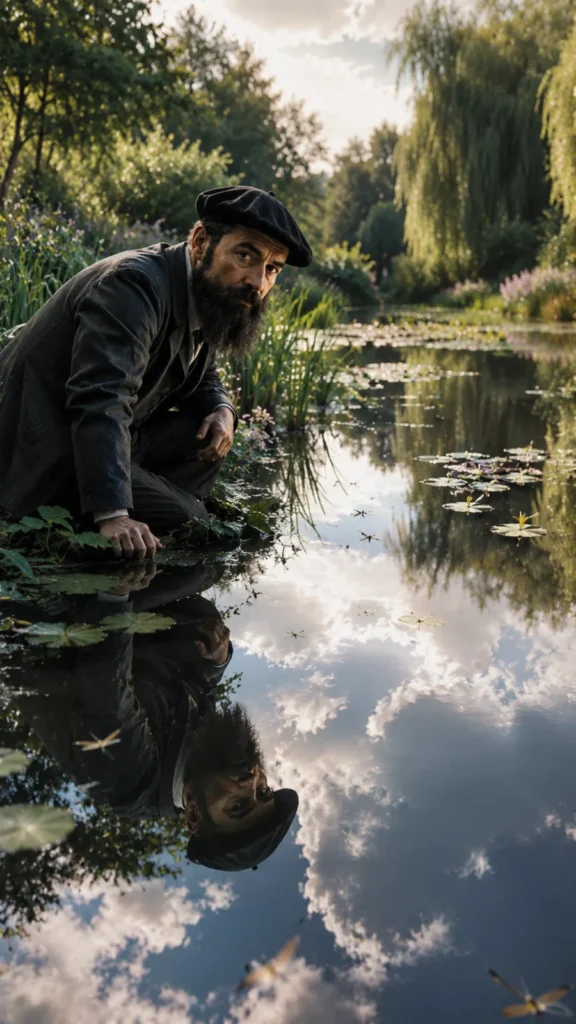
During the 1890s, Monet began working systematically in series. He painted haystacks, poplar trees, Rouen Cathedral, and later the Houses of Parliament in London.
He did not necessarily complete every painting in front of its subject. He could begin several canvases outdoors and finish or alter them in the studio. He changed canvases whenever the sunlight, fog, or atmosphere shifted.
The objects remained in approximately the same location, but the paintings were never identical. A façade could appear blue at dawn, golden at midday, or nearly dissolve in fog. Monet demonstrated that color was not a fixed property of an object. It depended upon the surrounding atmosphere, the hour, and the observer.
His method anticipated questions that would become central to modern art. The subject was no longer merely a cathedral or a field. The true subject was perception.
The Garden He Built So He Could Paint It
In 1883, Monet settled with his family in Giverny. He initially rented the property and later purchased it after his paintings began selling successfully.
He did not simply discover a landscape there. He designed one.
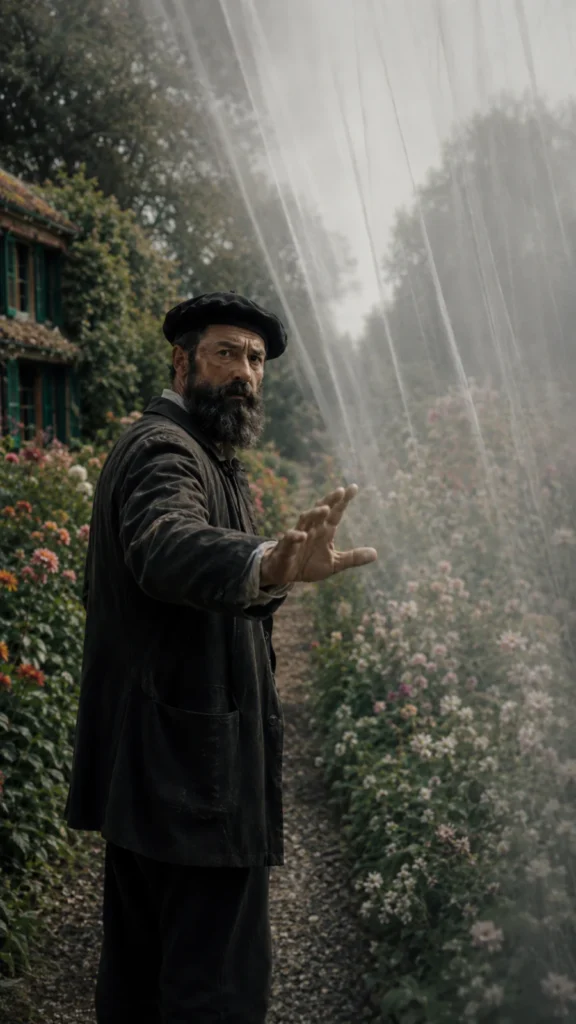
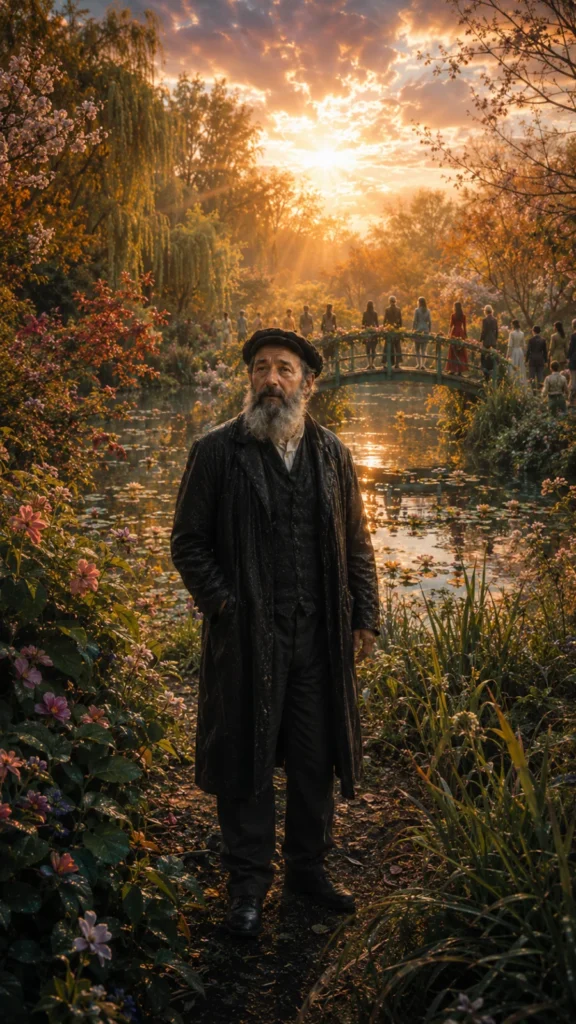
Monet arranged flower beds according to color combinations, planted numerous varieties, and obtained permission to divert part of a stream. He created a pond, installed a Japanese-inspired bridge, and cultivated water lilies. Some exotic varieties concerned neighbors who feared they might contaminate the water.
The Giverny garden was a living artwork constructed to produce new possibilities of observation. Monet became gardener, stage designer, and painter at once. He altered nature and then studied how light altered what he had created.
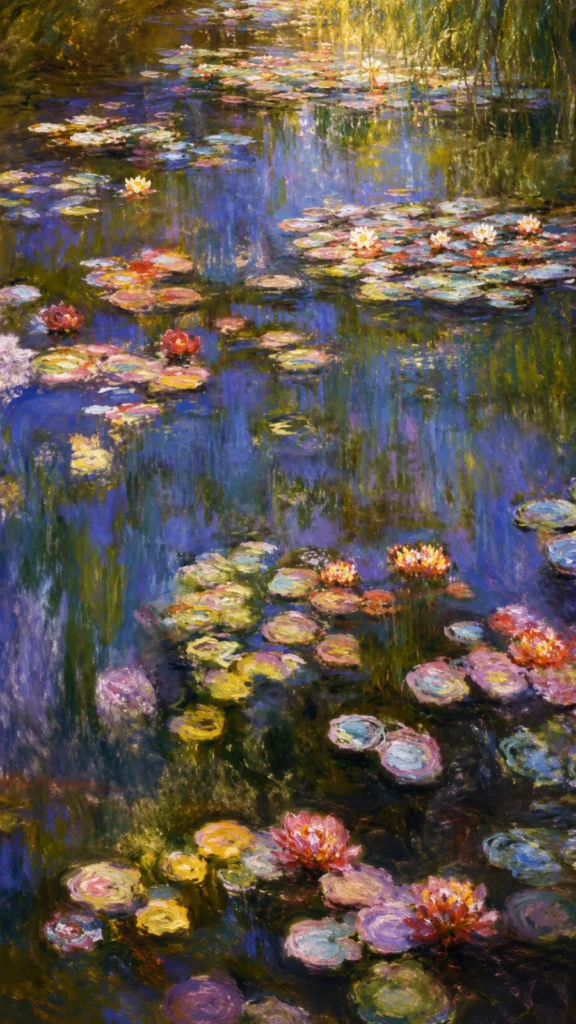
Water lilies occupied him for more than two decades. Gradually, horizons, banks, and traditional spatial references disappeared from the paintings. Only water, plants, reflected clouds, and a surface on which sky and pond seemed to merge remained.
Without intending to abandon nature, Monet moved toward abstraction.
When His Eyes Began Changing Color
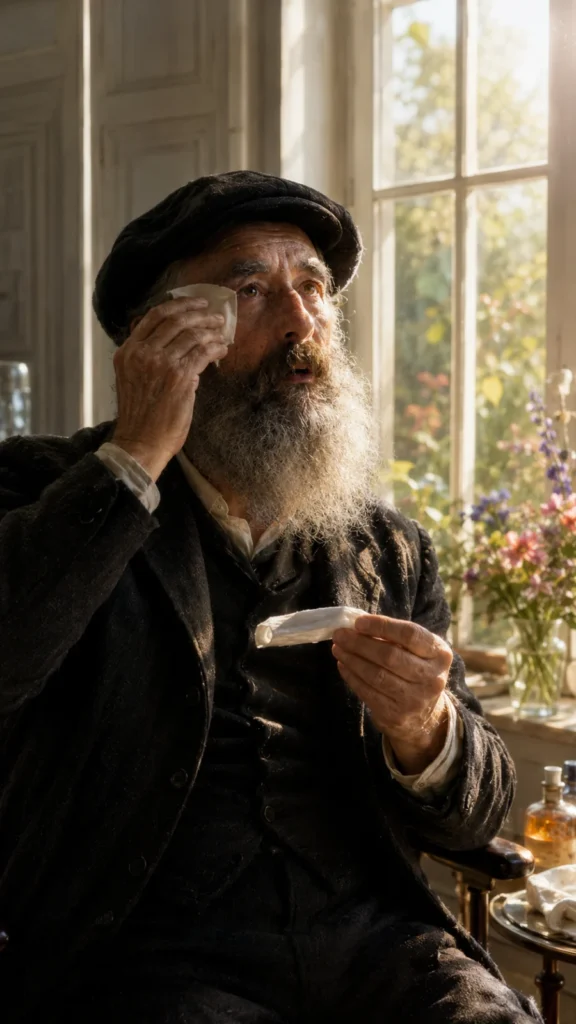
Monet was diagnosed with cataracts in both eyes in 1912. The condition progressed and altered his perception.
Cataracts do not produce precisely the same experience in every person, but they can reduce sharpness, darken vision, and filter colors. In Monet’s case, medical records and his letters allow part of the deterioration to be traced. He struggled to distinguish cooler tones, while reds, browns, and yellows became increasingly prominent in some paintings.
It would nevertheless be misleading to explain all his late work as an accidental consequence of disease. Monet had spent decades simplifying forms, investigating reflections, and challenging traditional depth. Cataracts affected his sight, but they did not independently create his artistic language.
The painter distrusted surgery and delayed treatment. He became furious when he confused colors and reportedly identified paints by the position of their tubes or by reading their labels. In 1923, he finally agreed to surgery on his right eye.
Recovery was difficult. He experienced visual disturbances and needed specially tinted lenses. Gradually, he regained a better perception of cooler colors. Some earlier works then appeared excessively reddish to him. He retouched several canvases and destroyed others he considered unsuccessful.
The artist was not only relearning how to see. He was also confronting images created when his own eyes had shown him a different world.
A Monument Without Heroes or Battles
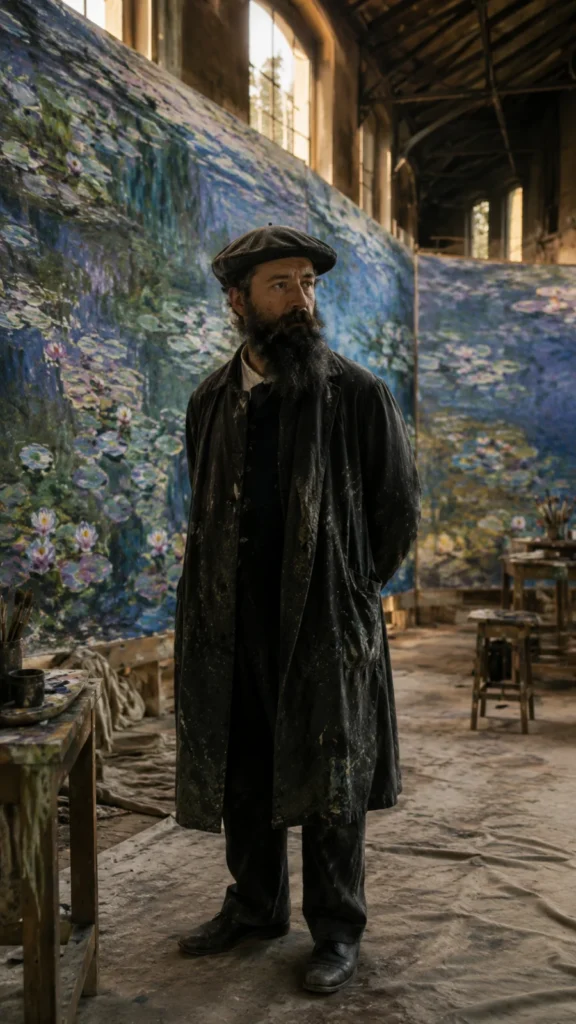
During the First World War, Monet worked on enormous water-lily compositions. Following the 1918 armistice, he offered a monumental series to the French state as a symbol of peace. His friend Georges Clemenceau, the former French prime minister, encouraged him to complete the project.
Monet designed immense panels intended to surround the viewer. There was no single focal point, narrative, or central figure. The public was to be enveloped by water, reflections, and vegetation.
The painter died at Giverny on December 5, 1926. He was eighty-six. The large decorations were installed in the Musée de l’Orangerie and opened to the public in 1927, several months after his death.
Inside two oval rooms, eight compositions form a continuous landscape. The viewer no longer observes the pond from outside. It seems possible to enter it.
The Artist Who Changed the Act of Looking
Monet did not teach the world that objects had no form. He demonstrated that no form could be entirely separated from light, atmosphere, and time.
His brushstrokes, initially criticized for appearing unfinished, required the viewer’s eye to participate. Seen closely, the surface might resemble an accumulation of colors. From a certain distance, those colors became fog, water, trees, or buildings.
Even as his eyesight began to fail, Monet continued investigating what it meant to see. His illness did not erase his work. It introduced a new uncertainty into a lifelong exploration of perception’s fragility.
He spent his life painting how the world changed before his eyes.
In the end, he also had to paint how his own eyes changed before the world.
References
- Gordon, R., & Forge, A. (1983). Monet. Harry N. Abrams.
- Gruener, A. (2015). The effect of cataracts and cataract surgery on Claude Monet. British Journal of General Practice, 65(634), 265. https://doi.org/10.3399/bjgp15X684949
- House, J. (1986). Monet: Nature into art. Yale University Press.
- Marmor, M. F. (2006). Ophthalmology and art: Simulation of Monet’s cataracts and Degas’ retinal disease. Archives of Ophthalmology, 124(12), 1764–1769. https://doi.org/10.1001/archopht.124.12.1764
- Musée de l’Orangerie. (n.d.). The Water Lilies: The setting of a masterpiece.
- Tucker, P. H. (1995). Claude Monet: Life and art. Yale University Press.
- Wildenstein, D. (1996). Monet: Catalogue raisonné. Taschen.
More from this collection
Artemisia Gentileschi: The Painter Who Made Women the Protagonists of Their Own Stories
Read story →
Pablo Picasso: The Man Who Shattered the Way We See
Read story →