In this storyOpen index
Hieronymus Bosch: The Painter Who Turned Sin into a Universe
Behind Bosch’s impossible creatures lies a world of faith, ambition, and moral questions. Explore the painter, his patrons, and the mysteries of his surviving works.
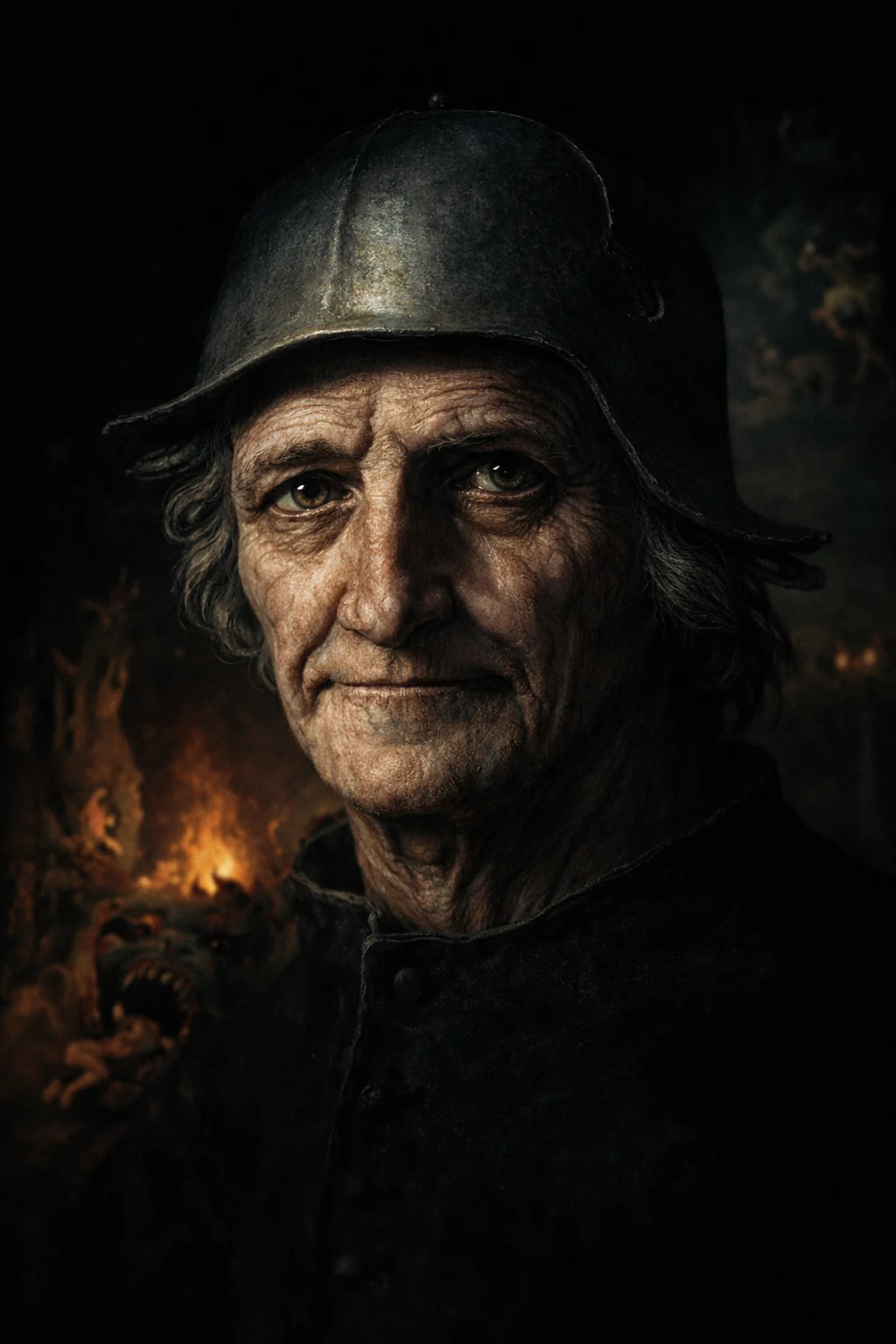
Four centuries before Surrealism, a painter filled his pictures with flying fish, people imprisoned inside fruit, musical instruments transformed into machines of punishment, and creatures assembled from pieces of animals, objects, and human bodies.
His real name was Jheronimus van Aken, but he signed some of his works Jheronimus Bosch.
His imagination was so unsettling that later generations attempted to explain it through hallucinogenic drugs, secret societies, heresy, and mental illness. No solid documentary evidence supports those theories. Bosch was not a modern artist accidentally born in the Middle Ages. He was a man deeply integrated into the Christian society of his time who carried the visual language of temptation, sin, and punishment into territories no other painter explored in quite the same way.
He did not invent medieval monsters, but he made them appear to belong to an entire world.
Hieronymus Bosch
Between the painter and the mystery
The Garden of Earthly Delights
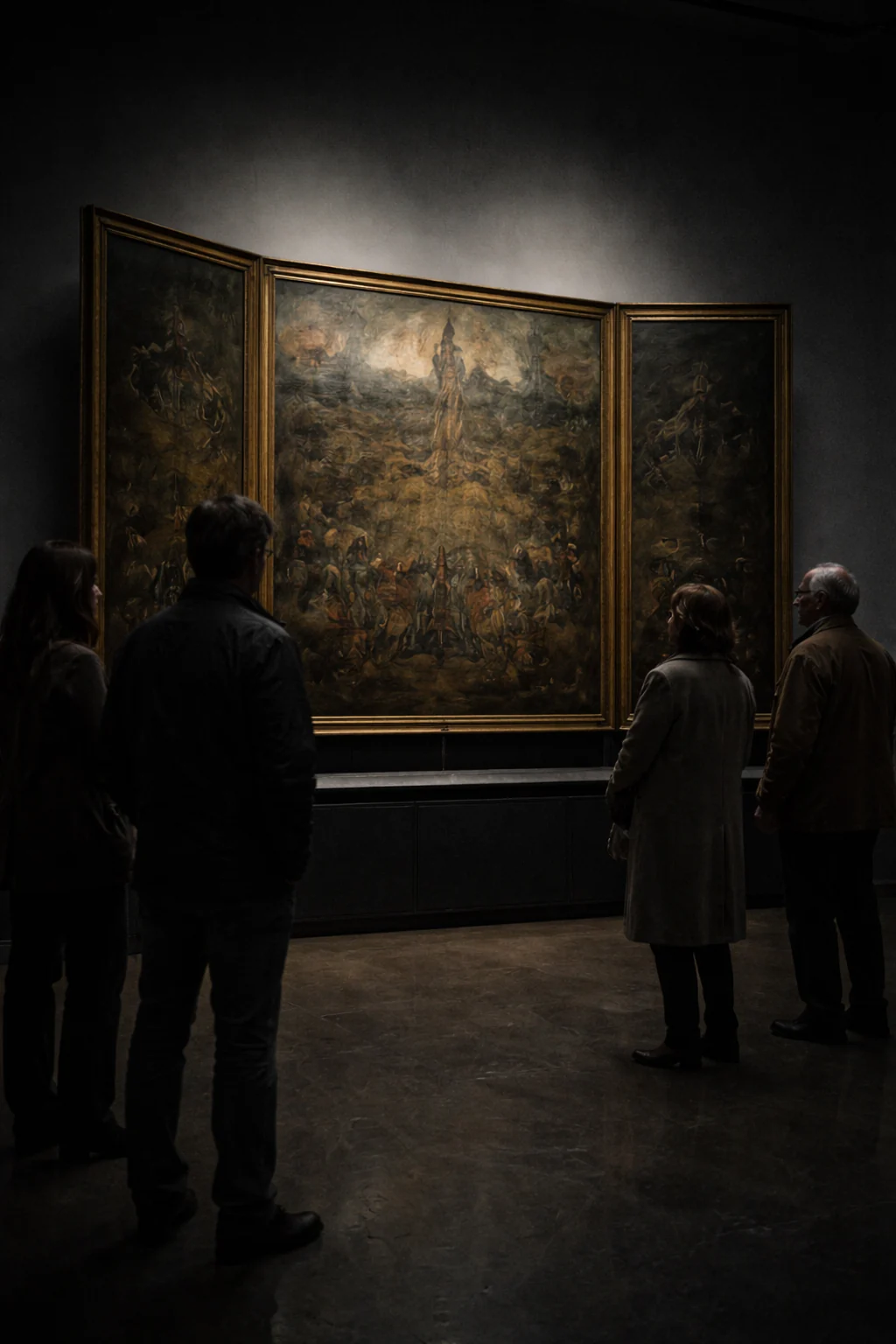
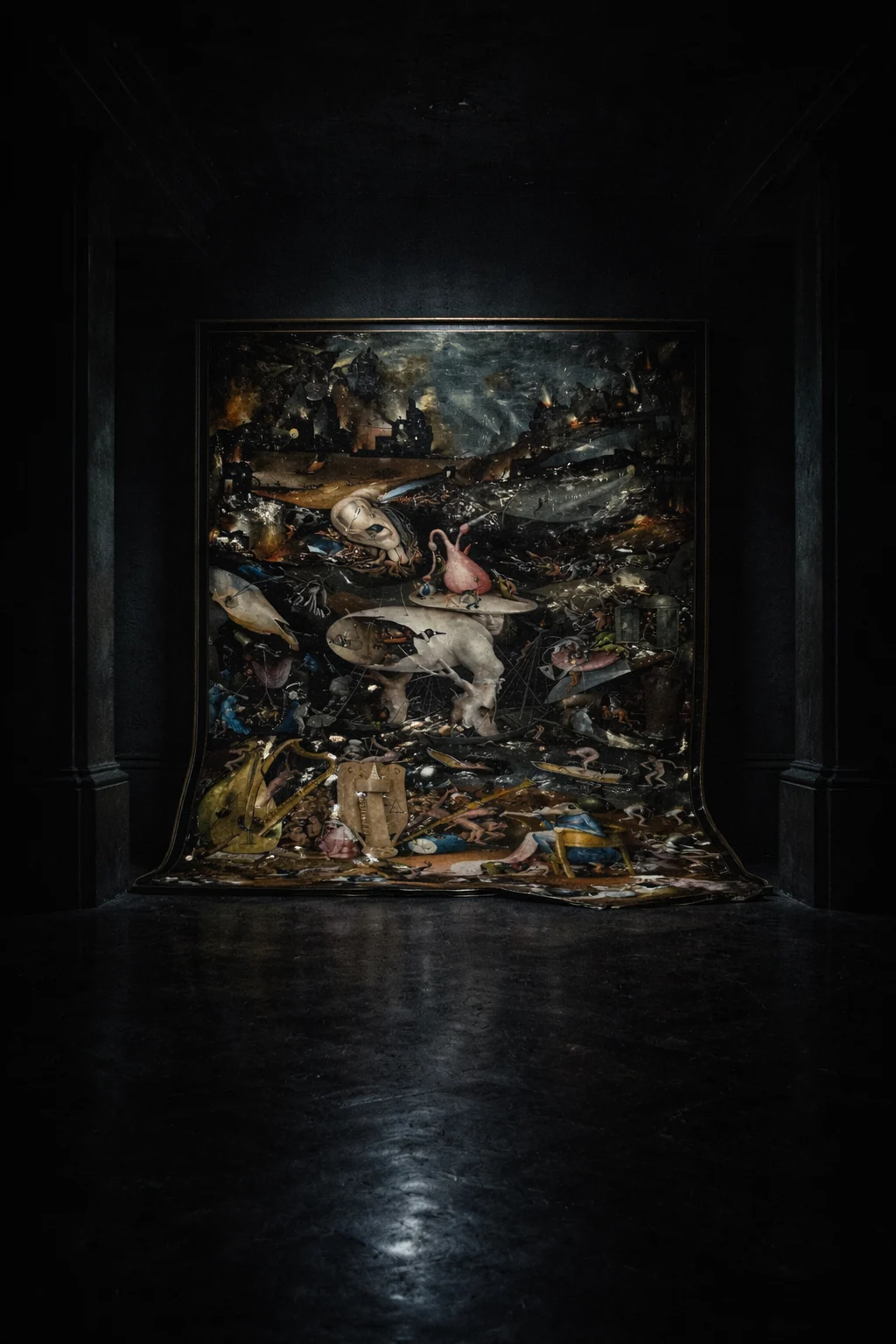
The Museo del Prado’s collection record allows readers to explore The Garden of Earthly Delights and consult the museum’s account of its history, provenance and symbolism. It provides a starting point for examining the triptych’s details and distinguishing the surviving work from later interpretations. This card’s image is an AI recreation; the link leads to the original work in the museum’s collection.
A Life Hidden Behind a Name
Bosch was probably born around 1450 in ’s-Hertogenbosch, a prosperous city in the Duchy of Brabant, now part of the Netherlands. He took his artistic name from that city: “Bosch” is an abbreviated form of its name.
His family name was van Aken, possibly reflecting an earlier connection with Aachen. He belonged to an extensive dynasty of painters. His father, Anthonius van Aken, his brothers, several uncles, and other relatives practiced the profession. Painting was not a vocation he pursued against his family’s wishes; it was the family business, and he probably trained in the van Aken workshop (Museo Nacional del Prado, n.d.-a).
This evidence contradicts the romantic image of a completely isolated genius. Bosch developed an extraordinarily personal style, but he did so within the systems of apprenticeship, collaboration, and artisanal production typical of his time.
Very few documents survive from his early life. His exact birth date, the identity of his principal teacher, and the moment he began producing independent work remain uncertain. Even the chronology of many paintings is debated because none is dated and only a few carry his signature.
The man who painted worlds overflowing with detail left a biography filled with empty spaces.
The Fire We Cannot Turn into an Explanation
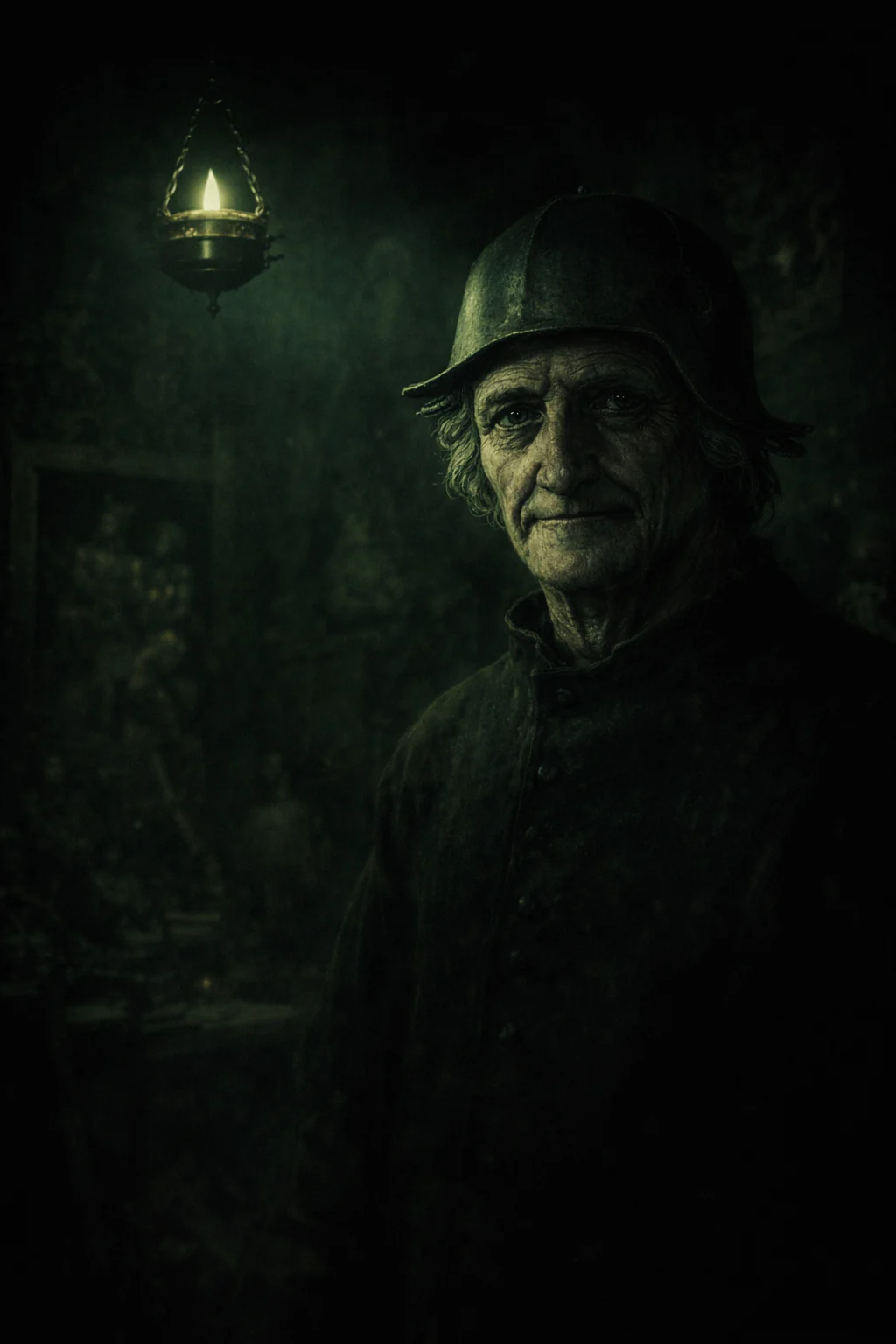
In 1463, when Bosch was probably a child or adolescent, a major fire devastated part of the city in ’s-Hertogenbosch. The event frequently appears in accounts attempting to explain the burning cities represented in some of his hell scenes.
He may have witnessed the fire or heard stories about its consequences for years afterward. However, no statement by Bosch directly connects the disaster with his paintings.
Historical fact and interpretation must remain separate.
Burning cities were common features in medieval representations of hell and biblical destruction. The actual fire in ’s-Hertogenbosch may have entered Bosch’s visual memory, but claiming that it created his infernal visions would turn an attractive possibility into an unsupported certainty.
Bosch remains fascinating partly because documents cannot reconstruct much of his inner world.
A Marriage That Changed His Social Position
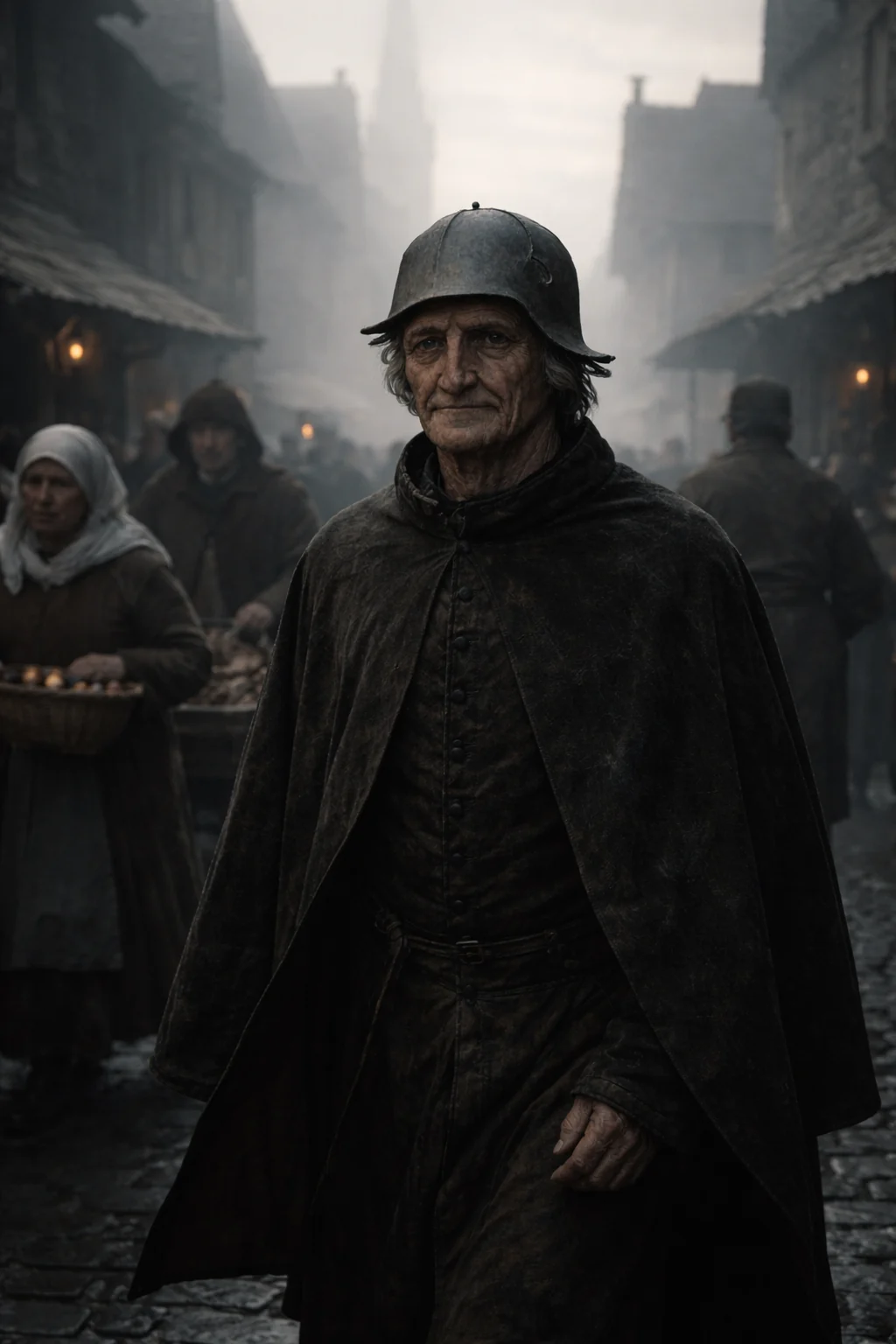
Between 1477 and 1481, Bosch married Aleid van de Meervenne, a woman from a prosperous family. She brought property and financial resources into the marriage.
The union significantly improved the painter’s economic position. Later tax records indicate that Bosch became one of the wealthier citizens of ’s-Hertogenbosch. Financial independence may have allowed him to accept selected commissions and develop complex compositions without relying exclusively on routine production (Vlaamse Kunstcollectie, n.d.).
Bosch was therefore not an impoverished outsider rejected by society. He lived in a prominent house on the marketplace, received commissions from important clients, and was eventually described as a famous painter.
His disturbing vision did not necessarily originate at society’s margins. It developed at the center of an orderly community.
The Painter in a Religious Brotherhood
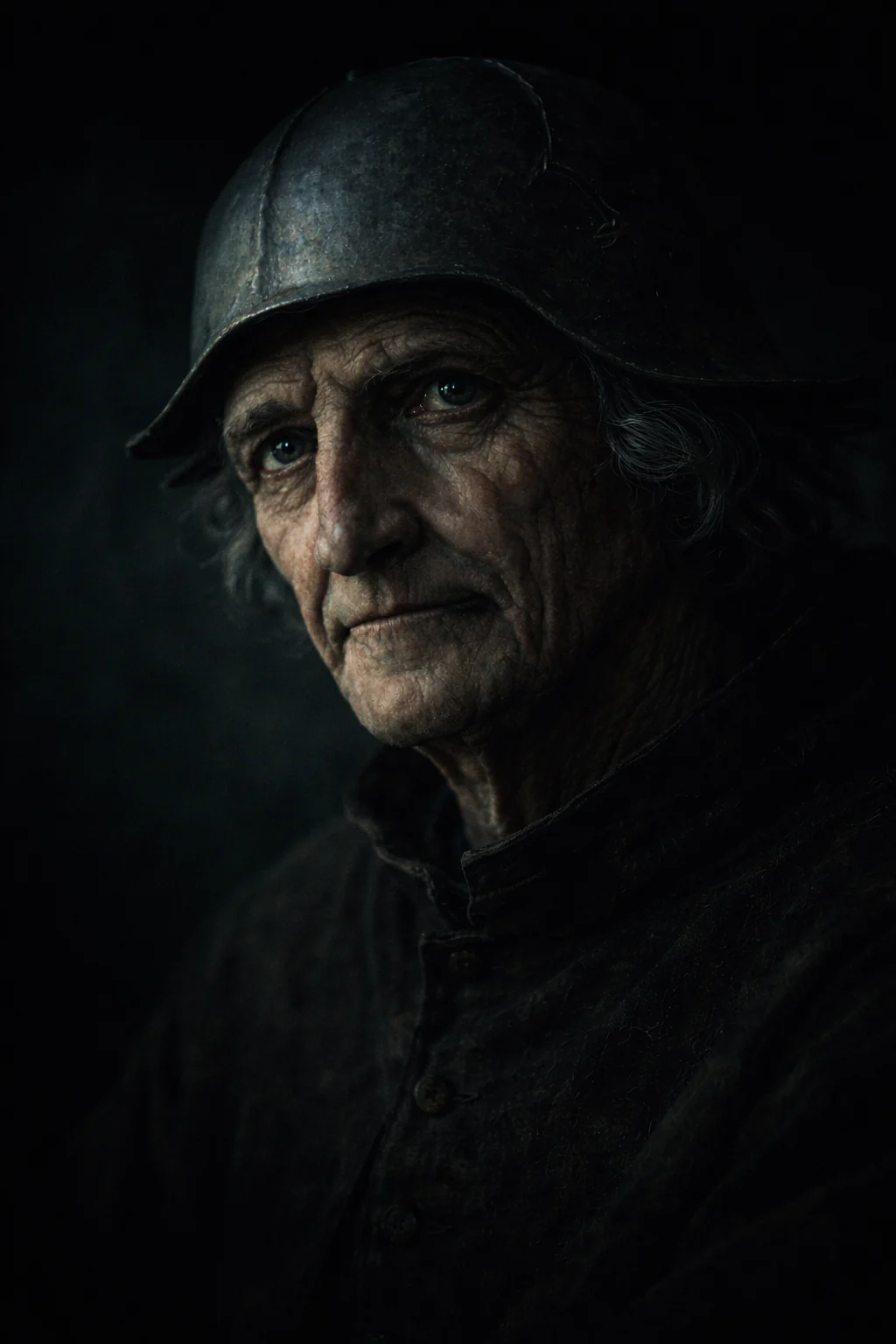
In 1486 or 1487, Bosch became a member of the Illustrious Brotherhood of Our Blessed Lady, a prestigious religious association devoted to the Virgin Mary. The Brotherhood included clergy, nobles, and influential townspeople and maintained a chapel in St John’s Church.
Bosch designed and painted works for the organization, attended its meetings, and received members in his own home. Its administrative records are among the principal sources for reconstructing his life.
Membership does not prove that all his ideas were conventional, but it makes theories portraying him as a secret member of a heretical sect considerably less plausible.
No contemporary evidence shows that he was prosecuted for heresy, accused of witchcraft, or expelled from the Christian community. On the contrary, he belonged to a respected religious organization and worked for clients connected with nobility and the court (Museo Nacional del Prado, 2016).
Bosch could imagine monsters without believing they physically existed. His task was to turn invisible moral concepts into unforgettable images.
The World as a Cartload of Hay
In The Haywain Triptych, Bosch portrayed humanity struggling around an enormous load of hay. Kings, clergy, peasants, and criminals attempt to seize their portion while demonic creatures pull the wagon toward hell.
The image draws upon an idea familiar in Netherlandish culture: the world resembles a haystack from which everyone tries to take as much as possible. Hay possesses little lasting value and soon disappears, yet human ambition turns it into a cause of deception, violence, and damnation.
Bosch transformed proverbs, sermons, songs, religious imagery, and popular expressions into visible scenes. Rather than presenting sin as an abstract word, he showed how it operated.
His paintings rewarded slow observation. A viewer could recognize the general religious lesson while discovering jokes, sayings, sexual warnings, and grotesque details.
Meaning did not reside in a single symbol. It accumulated like a crowd.
The Garden We Still Cannot Completely Read
The Garden of Earthly Delights, now in the Museo del Prado, is Bosch’s most famous and enigmatic work. The triptych was probably created between 1490 and 1500, although its precise dating remains disputed.
When closed, its exterior panels show the world inside a transparent sphere, still nearly empty during Creation. When opened, the triptych presents a sequence moving from Paradise through a central landscape filled with pleasure and ending in a nocturnal hell.
In the left panel, God presents Eve to Adam. In the center, hundreds of nude figures interact among enormous fruit, real animals, and imaginary creatures. On the right, pleasure has become punishment: musical instruments torment bodies, buildings burn, and a strange tree-man surveys the destruction.
The central panel has generated conflicting interpretations. Some scholars have regarded it as the paradise humanity might have enjoyed without the Fall. Others understand it as a condemnation of lust and the fleeting character of pleasure.
The Prado interprets its inhabitants as people who believe they occupy a lovers’ paradise but move inevitably toward the punishment depicted in the right panel. The attractive but perishable fruit may symbolize the brevity of earthly gratification (Museo Nacional del Prado, n.d.-b).
There is no universally accepted explanation for every figure. That resistance to definitive interpretation is part of the work’s power.
Bosch created a moral painting that also functions as a machine for producing questions.
A Triptych for a Courtly Setting
Its triptych format may suggest that The Garden of Earthly Delights was an altarpiece intended for a church. Its content, provenance, and scale, however, indicate that it was probably created for a palace and the private contemplation of a courtly elite.
The work was connected early in its history with the House of Nassau. Its possible patron was Engelbert II of Nassau or his nephew and heir, Henry III. Both belonged to political and cultural circles capable of appreciating a complex composition designed to provoke discussion and interpretation.
A visitor saw it in the Nassau palace in Brussels in 1517, shortly after Bosch’s death. Decades later, it was confiscated during the campaigns of the Duke of Alba. Philip II purchased it in 1591 and sent it to El Escorial in 1593. During the twentieth century, it moved to the Museo del Prado, where it remains on permanent loan from Spain’s Patrimonio Nacional (Museo Nacional del Prado, n.d.-b).
This history disproves another simplification: the painting was not a recently rediscovered work that had remained unappreciated. From an early date, it belonged to some of Europe’s most powerful families.
The Hell Where Music Becomes Punishment
Bosch’s hell is not merely a place of fire. It is an inversion of human activity.
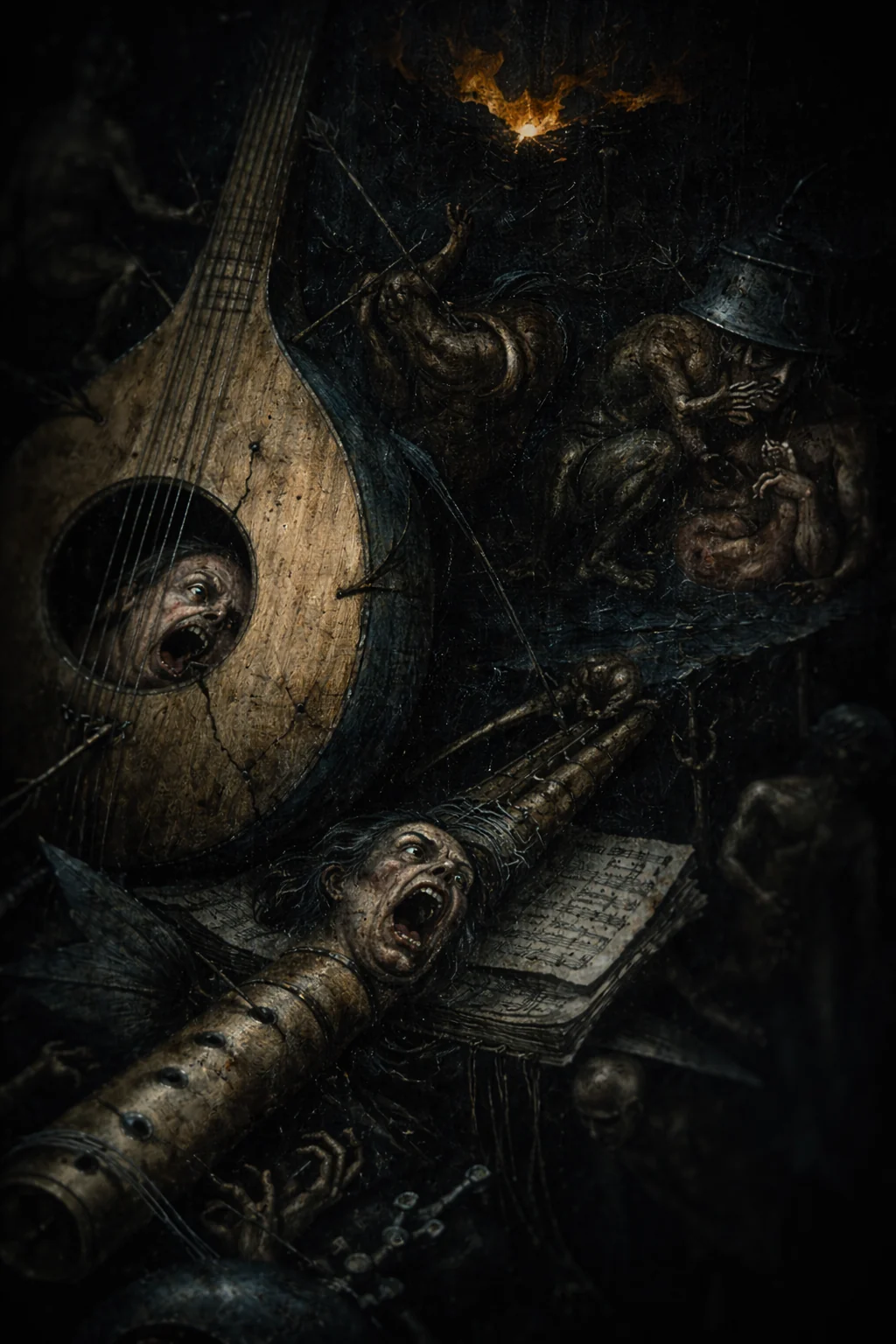
In the right panel of The Garden of Earthly Delights, instruments including a lute, harp, and hurdy-gurdy acquire monstrous proportions. Bodies are crushed, bound, or pierced by them. Music, normally associated with harmony and pleasure, becomes an instrument of punishment.
A short musical score appears on the buttocks of one figure. Centuries later, modern musicians attempted to perform it. We do not know whether Bosch intended to depict playable music or used the notes as part of the visual joke.
Elsewhere stands the so-called tree-man: a melancholy face attached to a hollow body made from a broken tree trunk balanced upon two boats. His identity remains disputed. Some writers have proposed that he is a self-portrait of Bosch, but no evidence confirms the suggestion.
The desire to assign an exact answer to every creature is understandable. Yet many symbols may have supported several associations even for the original audience. Bosch did not construct an illustrated dictionary. He created an environment of moral instability.
A Royal Commission and an Unidentified Painting
One of the lesser-known facts of Bosch’s career appears in a record from September 1504.
Philip the Handsome, Duke of Burgundy and future king of Castile, authorized an advance payment to “Jeronimus van Aken, called Bosch” for a large triptych of the Last Judgment. The document specified that its wings were to represent Paradise and Hell.
It is one of the key documents recording his activity as a painter. It demonstrates that, by 1504, his reputation had reached the Habsburg court.
The commissioned painting, however, has not been securely identified.
Several Last Judgment triptychs have been connected with Bosch, particularly one preserved in Vienna, but their dimensions do not clearly match those recorded in the document. Scholars cannot confirm that any surviving work is the royal commission. It is not even certain that Bosch completed it before Philip’s unexpected death in 1506 (Rijksmuseum, n.d.).
The document preserves the commission, but it does not securely identify a surviving painting.
That absence summarizes the Bosch paradox: we know his images better than we know his history.
Hallucinations, Drugs, or Heresy?
The strangeness of Bosch’s creatures has produced theories claiming that he consumed hallucinogenic substances, experienced psychotic episodes, practiced alchemy, or belonged to clandestine religious groups.
Such ideas appeal to modern audiences, but they lack sufficient documentary support.
Hybrid creatures already appeared in manuscripts, church carvings, bestiaries, proverbs, and images of hell. Bosch did not need drugs to encounter them. His originality consisted of combining existing traditions through an exceptional visual imagination.
Nor can he accurately be called a Surrealist in a historical sense. Surrealism emerged four centuries later and responded to modern concepts of the unconscious, dreams, and automatic creation. The admiration of Surrealist artists for Bosch does not make the medieval painter an early member of their movement.
Understanding his historical context does not make his work less strange. It makes his achievement more impressive. Using materials available within his own culture, he created something that still appears impossible.
A Workshop Behind the Genius
For centuries, numerous paintings containing monsters and fantastic scenes were attributed to Bosch. The popularity of his style produced imitators, copies, and works made by followers.
Between 2010 and 2015, the Bosch Research and Conservation Project examined most of the paintings and drawings associated with him. Researchers used imaging techniques and material studies to examine the works and their underlying drawings.
The project reassessed attributions to the master, his workshop, and his followers; its conclusions do not constitute a final consensus. Attribution continues to generate debate because the modern concept of individual authorship does not always correspond neatly with the operation of a sixteenth-century workshop (Rijksmuseum, n.d.).
Beneath some painted surfaces, technical analysis revealed compositional changes and spontaneous drawing. Bosch did not merely copy a fully resolved design. He invented and corrected as he worked.
Technology has allowed modern viewers to see a layer his original audience could never observe: the thought process underneath the paint.
The Death of a Famous Painter
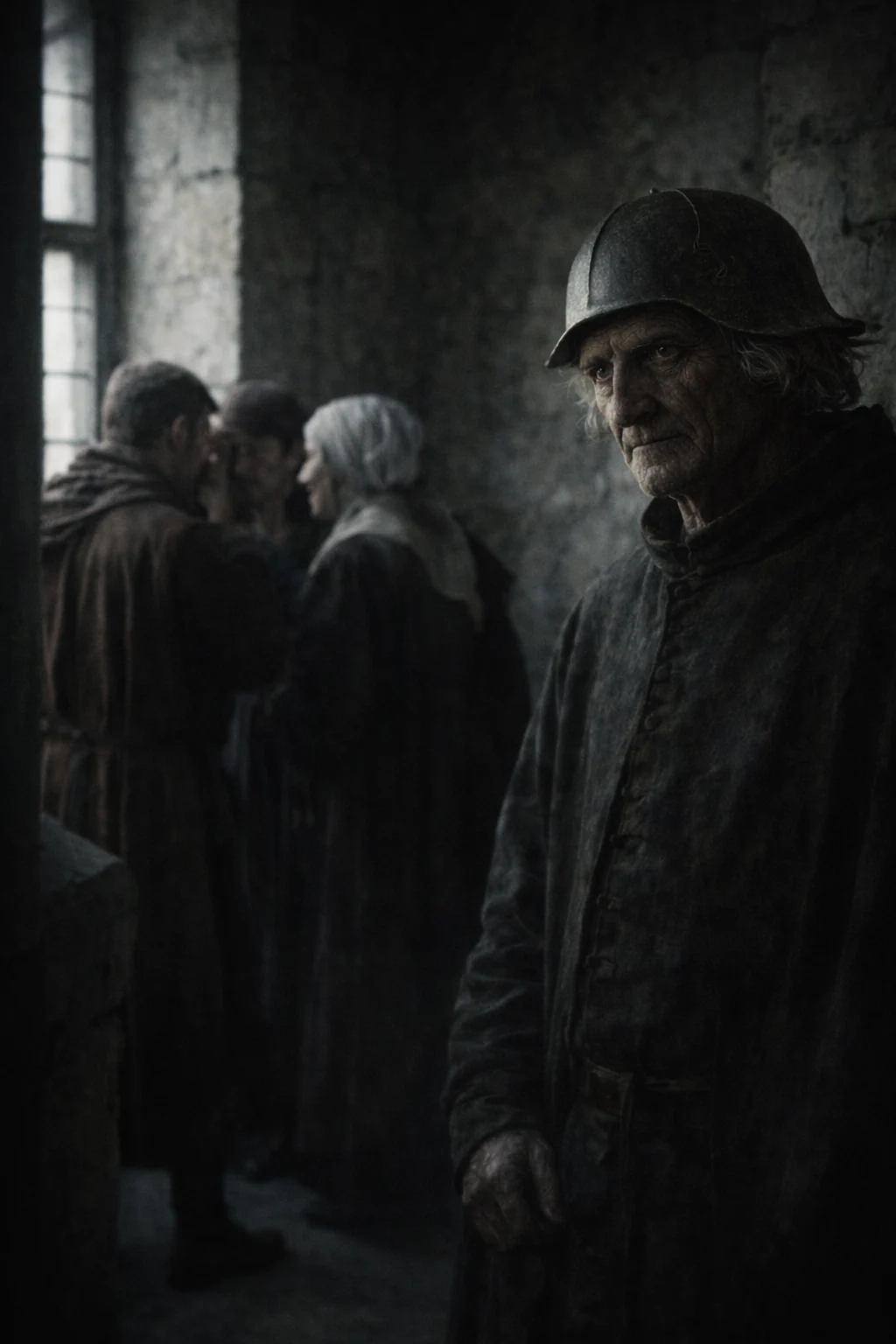
The precise date of Bosch’s death is unknown. Records of the Brotherhood of Our Blessed Lady state that a solemn memorial Mass for “Jeronimus van Aken, painter” was held on August 9, 1516. He must have died shortly before.
The service included priests, a deacon, subdeacon, organist, and choir, reflecting the position he had achieved within the community. A later source described him as a “very famous” painter (Museo Nacional del Prado, n.d.-a).
Bosch left no treatise explaining his symbols. No surviving letters describe his intentions. His works entered princely collections, were copied, and acquired new meanings in different cultures.
Philip II, a deeply Catholic monarch, assembled several of them. Centuries later, psychoanalysts, Surrealists, musicians, filmmakers, and designers discovered images among Bosch’s creatures that appeared to speak to their own eras.
Every generation has attempted to make him one of its own.
The Artist Who Changed the Way We See
Before Bosch, the margins of medieval manuscripts and church carvings were already populated with demons and impossible animals. Depictions of the Last Judgment contained punishment, flames, and tormented bodies.
His innovation was not the invention of this vocabulary but the unprecedented density he gave it.
Bosch forced viewers to travel mentally across the painted surface. No single center explains everything. The eye jumps from one figure to another, discovers a tiny scene, returns to a creature seen earlier, and realizes it had misunderstood what it was looking at.
His paintings turn observation into a form of moral examination. The viewer searches for monsters and eventually encounters human behavior.
That is why his creatures have not grown old. They do not represent only a medieval fear of hell. They embody desire, greed, cruelty, foolishness, and the ease with which human beings transform pleasure into destruction.
Hieronymus Bosch changed the way we see because he understood that an image could attract and condemn at the same time.
First, he invites us to move closer.
Then he forces us to recognize that the monsters were never very far from us.
References
- Museo Nacional del Prado. (2016). Bosch: The 5th centenary exhibition. View source
- Museo Nacional del Prado. (n.d.-a). Hieronymus Bosch. View source
- Museo Nacional del Prado. (n.d.-b). The Garden of Earthly Delights Triptych. View source
- Rijksmuseum. (n.d.). The Temptation of St Anthony [Collection catalogue; biography of Jheronimus Bosch]. View source
- Vlaamse Kunstcollectie. (n.d.). Jheronimus Bosch. View source