In this storyOpen index
Frida Kahlo: The Body That Refused to Disappear
Frida Kahlo turned the body, identity, and Mexican culture into a language of her own. Explore her life and the story behind The Frame.
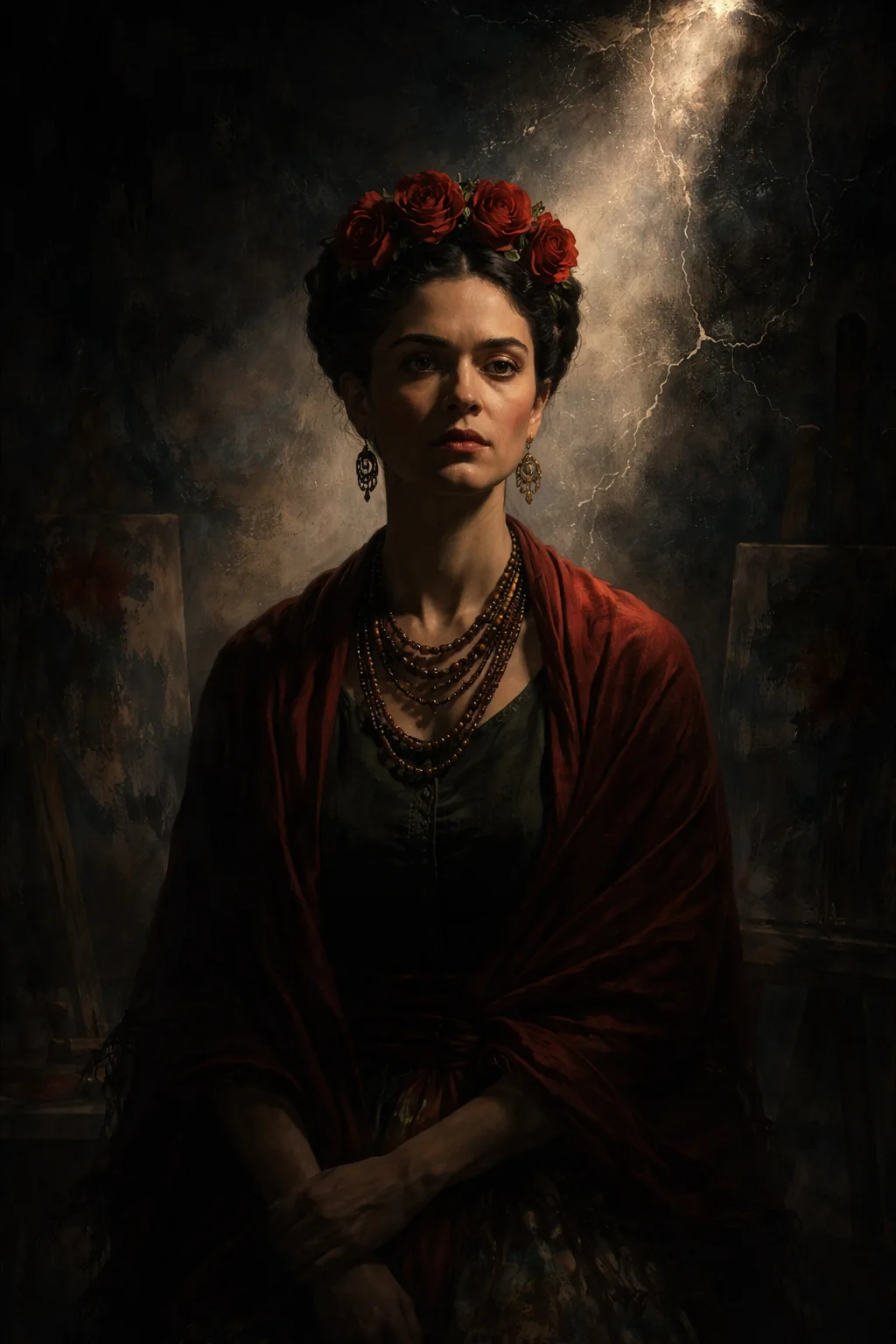
Frida Kahlo did not paint pain to make it beautiful. She painted it because her body had become a territory that doctors, lovers, ideologies, and illnesses repeatedly attempted to define for her.
For much of her life, she wore orthopedic corsets, underwent operations, and endured long periods of immobility. Yet she does not appear in her paintings as a passive victim. She looks directly outward with a firm and deliberately constructed gaze, as though every self-portrait were a declaration of ownership: this face, this body, and this history still belong to me.
In time, that image became a symbol reproduced on shirts, mugs, and advertisements. Behind the celebrity, however, stands a more uncomfortable and complex artist: a woman who turned her anatomy into a pictorial language and understood, long before becoming an icon, that she could also invent herself.
Frida Kahlo
A life told between body and canvas
The Frame: self-portrait and folk art
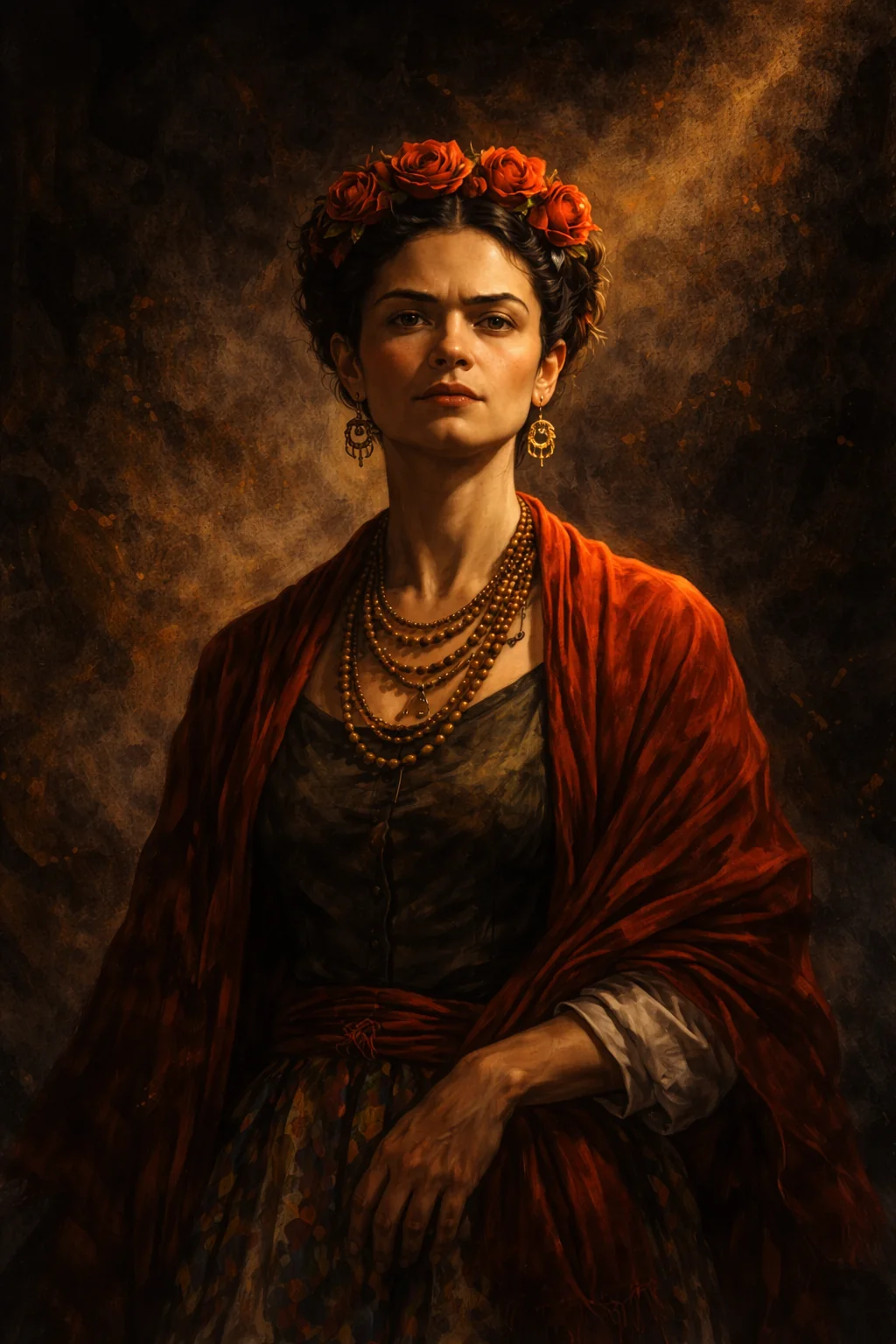
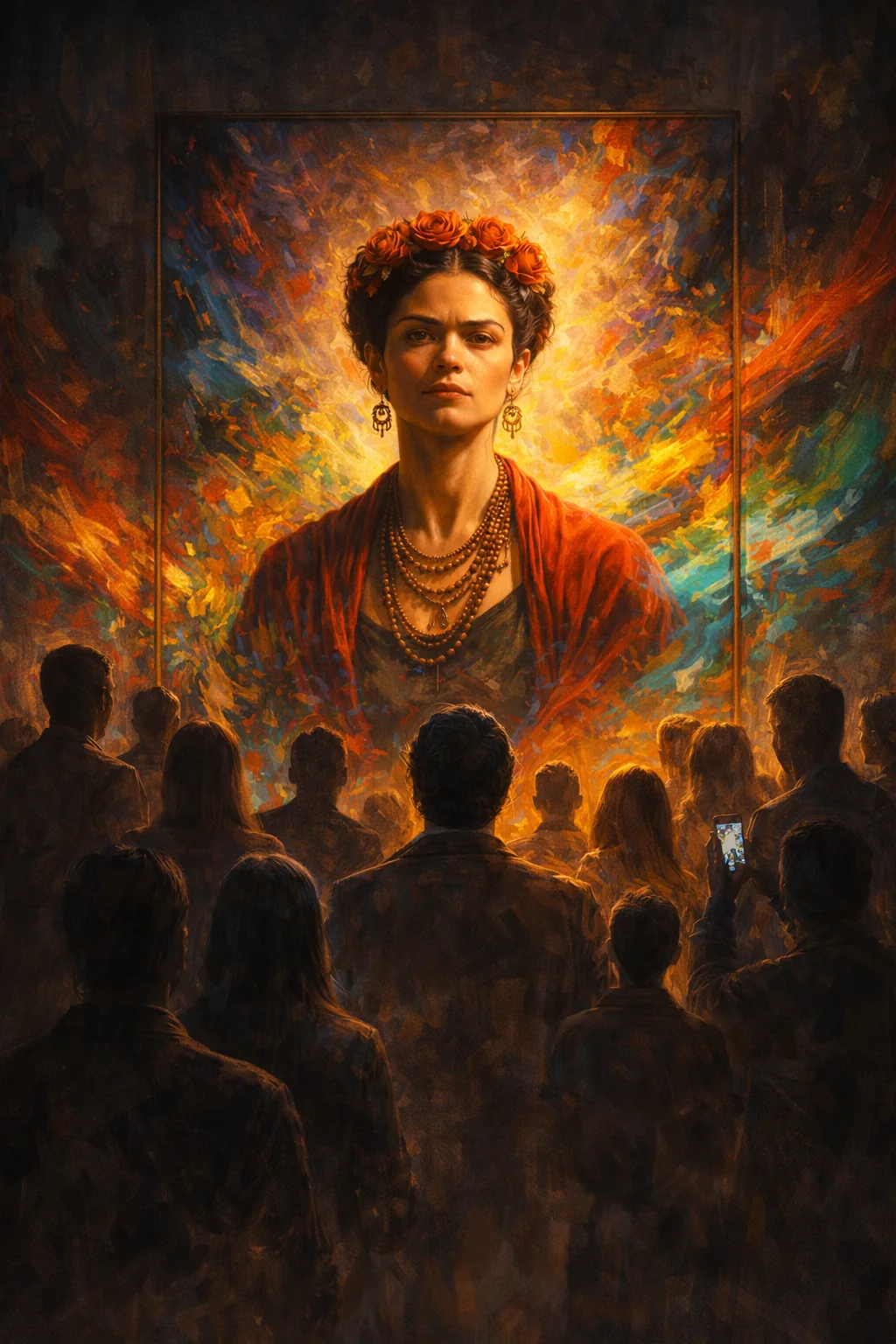
Painted around 1938 and purchased by the French state in 1939, this self-portrait on aluminum is combined with glass decorated by craftspeople in Juquila, Mexico. Consult the record and original image at the Centre Pompidou. This card’s portrait is an AI illustration, not a reproduction of The Frame.
The Girl Who Learned to Conceal One Leg
Magdalena Carmen Frida Kahlo Calderón was born on July 6, 1907, in Coyoacán, then a town on the outskirts of Mexico City. She was the daughter of Guillermo Kahlo, a German-born photographer, and Matilde Calderón, a Mexican woman of Indigenous and Spanish ancestry.
At the age of six, she contracted polio. The disease left her right leg thinner and weaker than the left. Other children mocked the way she walked, and Frida learned to conceal the difference beneath trousers, thick socks, and, later, long skirts.
Her father encouraged her to undertake forms of physical exercise considered unusual for a girl at the time: swimming, cycling, and playing sports. He also taught her to observe through a camera. Guillermo Kahlo photographed buildings, interiors, and monuments with almost architectural precision. Frida grew up watching faces, poses, and spaces being arranged before they were fixed in an image.
That quiet education would prove essential. Many years later, her self-portraits would seem spontaneous and confessional, but they were carefully composed. Frida did not merely reveal who she was; she decided how she wanted to be seen.
A Student Who Intended to Become a Doctor
In 1922, she entered Mexico’s prestigious National Preparatory School. She was among a still limited number of female students and planned to study medicine. She was interested in anatomy and the natural sciences—knowledge that would later reappear in transformed form as exposed hearts, broken columns, blood vessels, and opened bodies.
She also joined an irreverent student circle known as Los Cachuchas. Its members debated politics, literature, and the changes sweeping Mexico after the Revolution. There Frida developed the provocative intelligence and dark humor she would retain throughout her life.
On September 17, 1925, when she was eighteen, the bus in which she was traveling collided with a streetcar. Frida suffered devastating injuries to her spine, pelvis, leg, and foot. A metal handrail pierced her pelvic region. She survived, but the accident marked the beginning of decades of pain, treatments, relapses, and operations (Museo Frida Kahlo, n.d.).
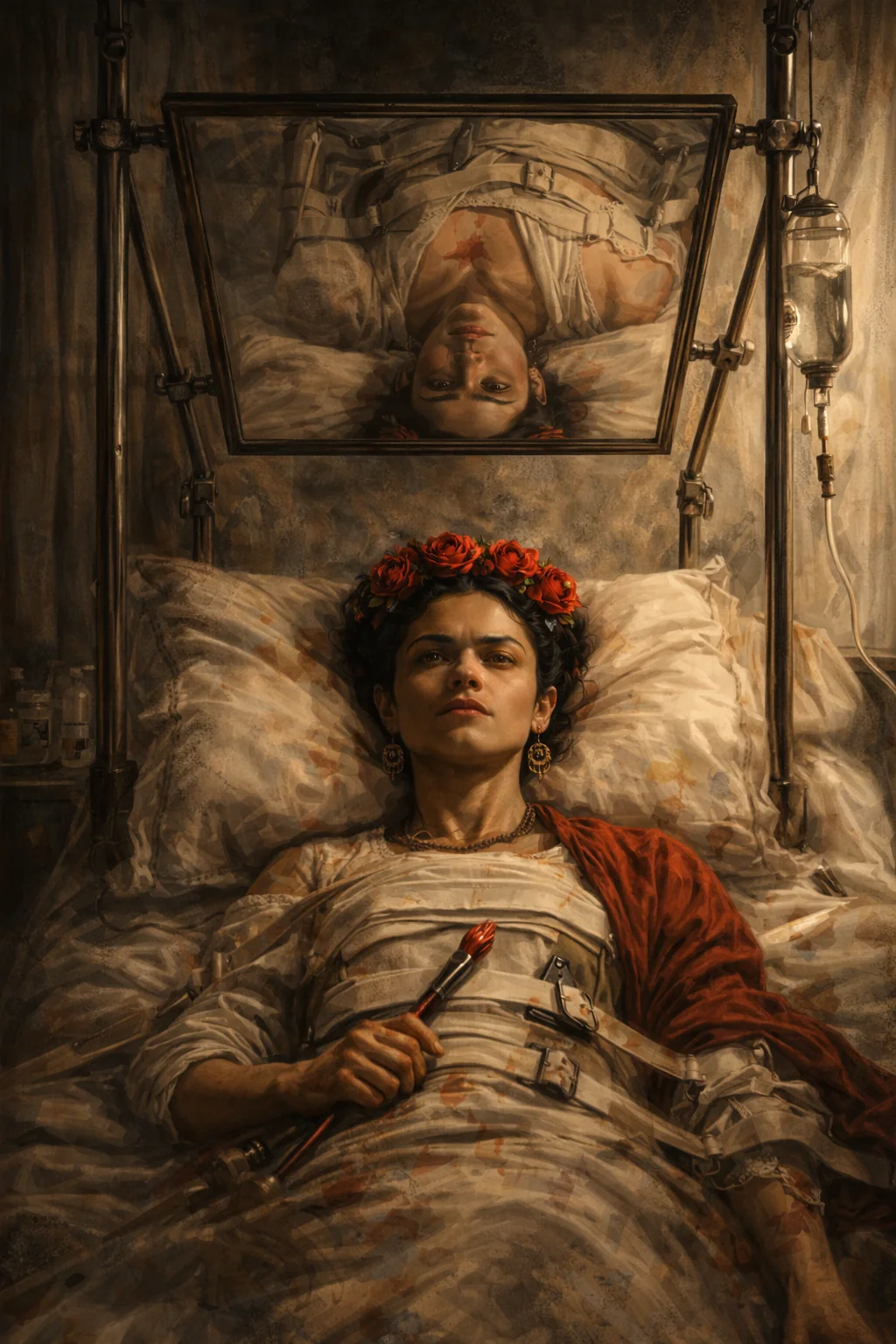
The story is often presented as the precise moment when “the painter was born.” Reality was less tidy. Frida already drew and had grown up surrounded by images through her father’s work. Nevertheless, her convalescence made painting a central occupation. Her family adapted an easel so she could paint while lying down and placed a mirror above her bed.
Unable to move freely, she began working with the territory closest to her: her own face.
Painting Herself So She Would Not Become a Diagnosis
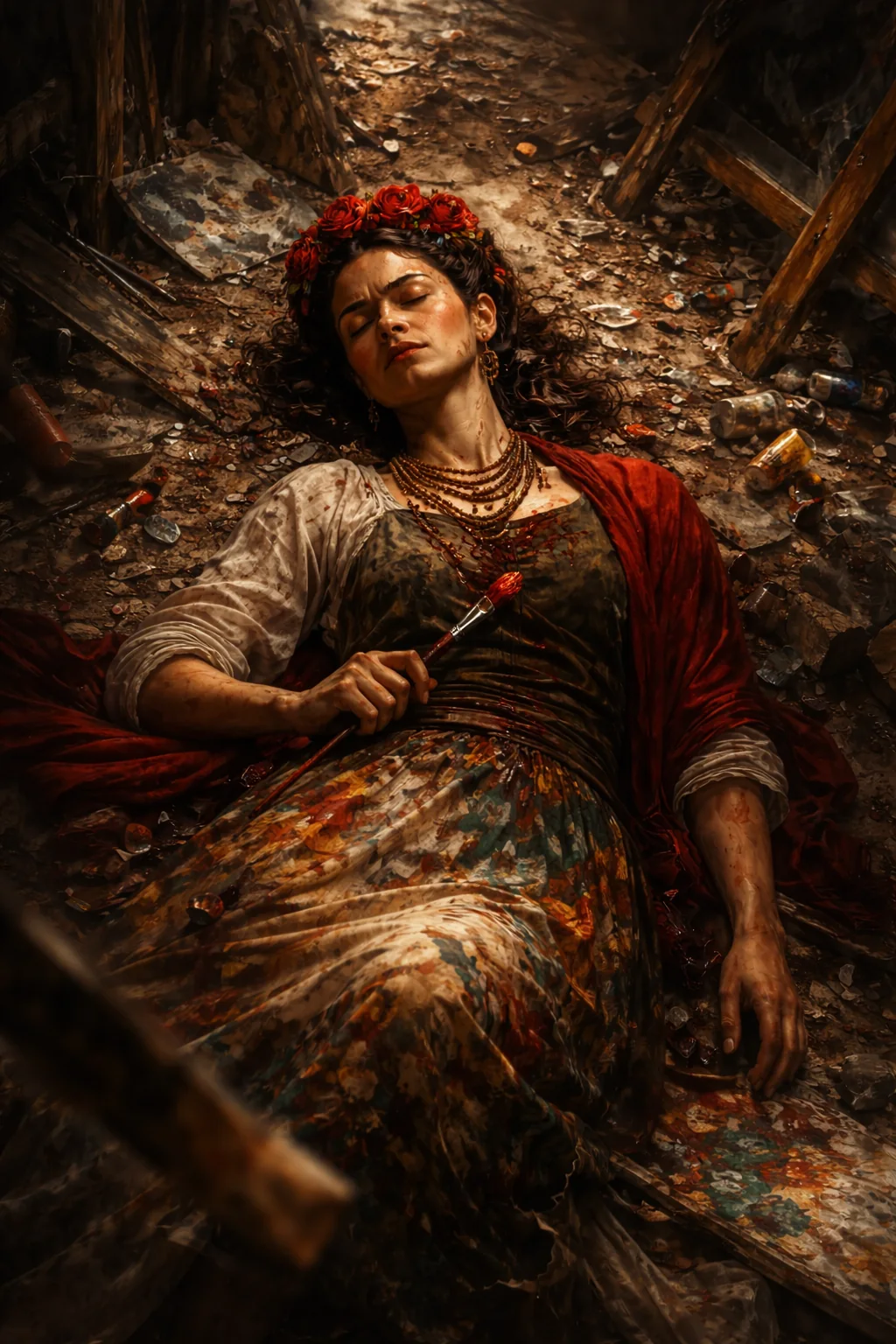
Self-portraiture occupies a central place in Frida’s work. The repetition of her face was not mere narcissism. Her body was constantly changing through illness, operations, and medical treatments. Painting it allowed her to examine it, reclaim it, and give it a continuity that medicine could not guarantee.
Anatomy and emotion merge in her work. In Henry Ford Hospital, she portrayed the loss of a pregnancy without concealing blood or physical vulnerability. In The Broken Column, her torso is split open and held together by a brace, while a shattered Ionic column occupies the place of her spine. In The Two Fridas, two versions of the artist remain connected by an artery.
These images are not illustrated medical records. Kahlo altered proportions and combined religious symbols, medical objects, plants, animals, and elements of Mexican popular culture. She transformed private experiences into scenes that could be read as physical pain, loss, identity, desire, and resistance.
Nor did she quietly accept the interpretations others imposed on her art. André Breton, one of the central figures of Surrealism, saw her paintings as a natural expression of the movement. Kahlo rejected that explanation. She maintained that she did not paint dreams but her own reality. She participated in exhibitions associated with Surrealism while maintaining a critical relationship with that label.
Diego Rivera: Love, Education, and Destruction
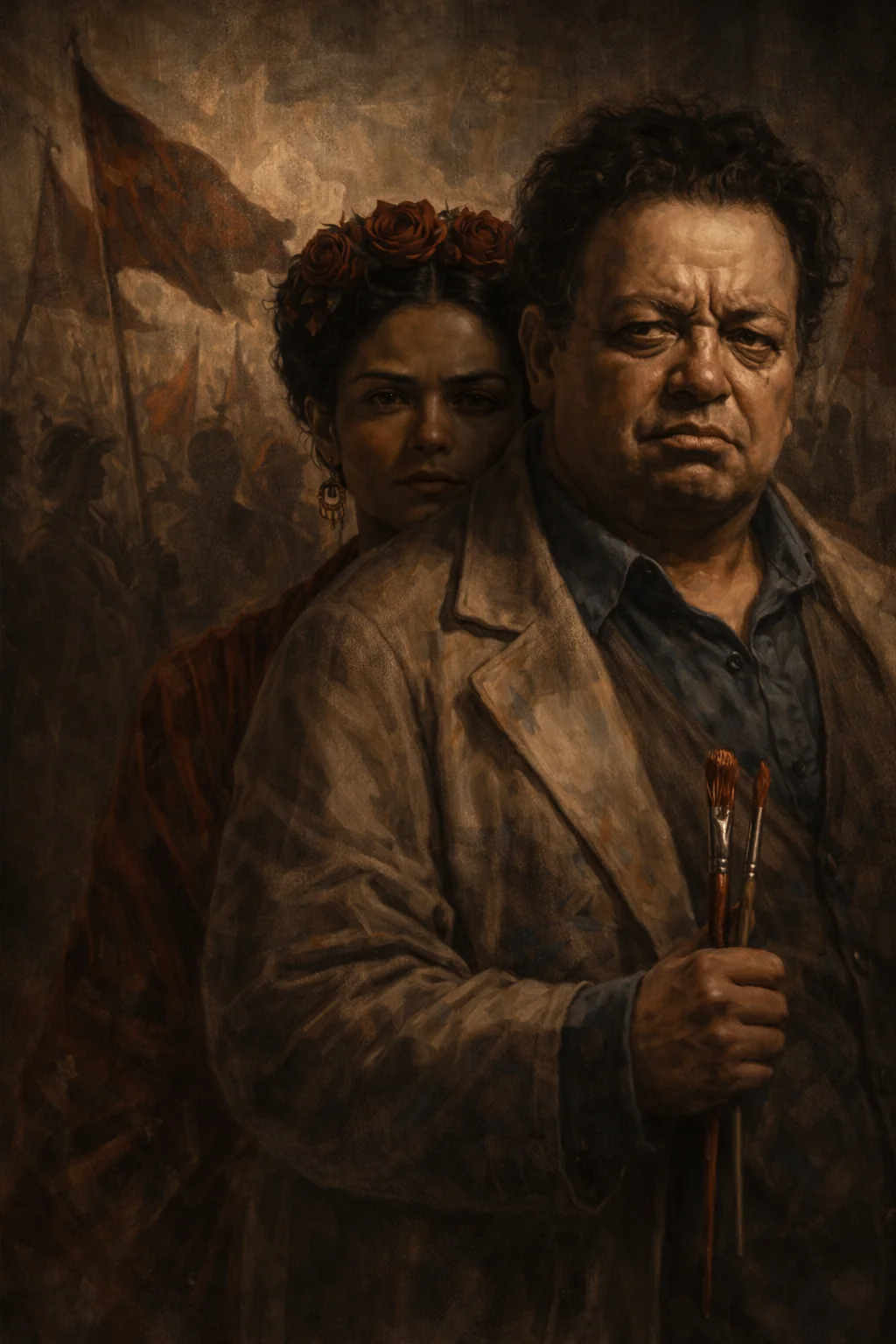
Frida first encountered Diego Rivera while he was painting a mural at the National Preparatory School. Years later, she showed him her work and asked for an honest judgment of her talent. Rivera encouraged her to continue.
They married in 1929. She was twenty-two; he was forty-two. Rivera was already a celebrated muralist, physically imposing and politically influential.
Their relationship was intellectually fertile and emotionally devastating. They lived in Mexico and the United States, shared political commitments, and both had numerous extramarital relationships. Frida had male and female lovers. Diego became involved with Cristina Kahlo, Frida’s younger sister. That betrayal inflicted a particularly deep wound.
They divorced in 1939 and remarried in 1940. In Self-Portrait with Cropped Hair, painted after the divorce, Frida appears in a man’s suit, surrounded by severed hair and holding scissors. The image can be read beyond romantic separation: a woman removes some of the attributes for which she had been desired and reconstructs herself outside them (Museum of Modern Art, n.d.).
Diego was essential to her life, but reducing Kahlo’s work to her husband’s betrayals would repeat the imbalance against which she struggled. Frida was not only the woman Rivera wounded. She was an artist who learned to use even that wound without allowing anyone else to sign the result.
The Conscious Construction of Frida
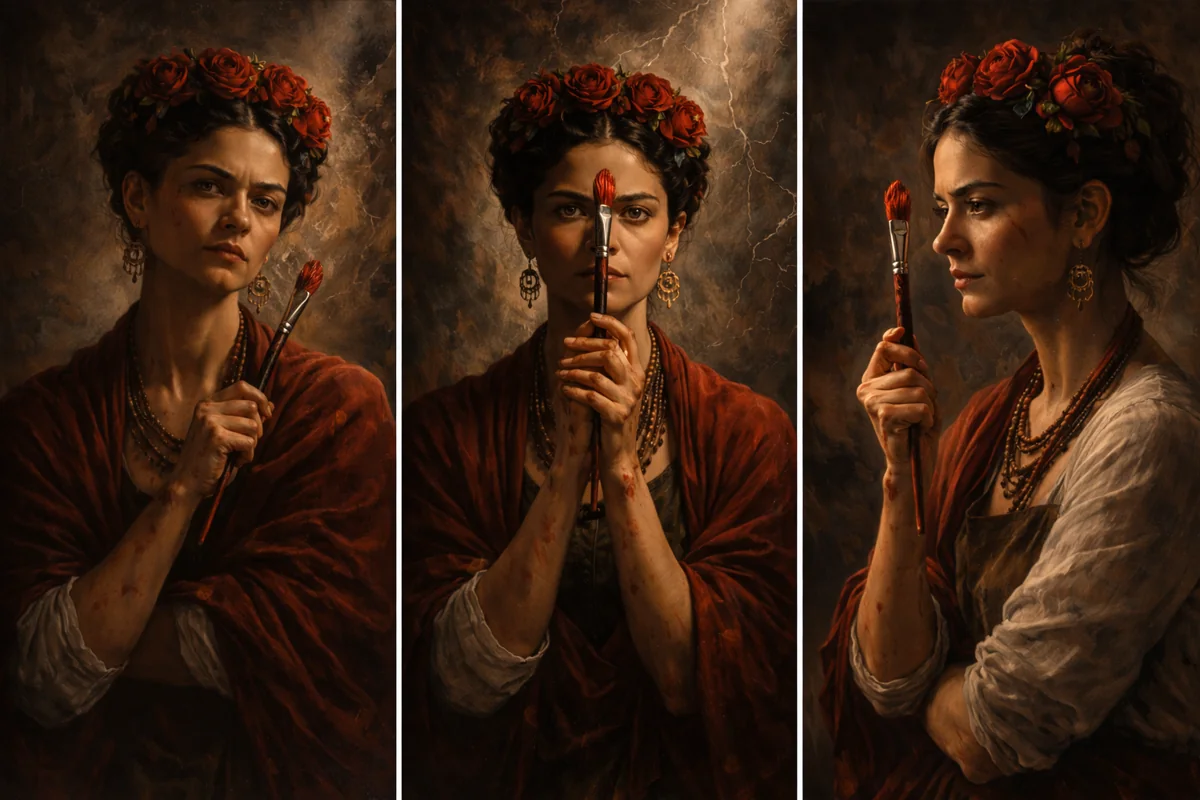
Kahlo understood the power of appearance. Her Tehuana-inspired dresses, flowered hairstyles, pre-Hispanic jewelry, and continuous eyebrow created an immediately recognizable image.
This visual identity expressed Mexican pride and an affinity with Indigenous cultures, but it also served personal purposes. Long skirts concealed the difference between her legs and, later, various orthopedic devices. Blouses and shawls drew attention toward the upper part of her body. Her clothing was simultaneously cultural expression, physical strategy, and artistic construction.
Frida also symbolically altered her own birth date. Although she was born in 1907, she sometimes claimed to have been born in 1910, the year the Mexican Revolution began. This was not simply a biographical error. She wanted to associate her life with the birth of modern Mexico, as if she and the country had emerged from the same historical rupture.
This helps explain her self-portraits. Kahlo did not wait for the world to decide what her body meant. She created a public version of herself through painting, clothing, photography, and narrative.
New York, Paris, and a Difficult Independence
In 1938, Kahlo held a solo exhibition at New York’s Julien Levy Gallery. She sold several paintings and began to receive recognition independently of Diego Rivera. The following year, she traveled to Paris at André Breton’s invitation.
The Paris experience was frustrating. Kahlo encountered disorganization, delays, and a vision of Mexican art that she considered superficial. She distrusted many European Surrealists, whom she regarded as overly concerned with theories and internal scandals.
Nevertheless, the visit produced a historic event. In 1939, the French state purchased her self-portrait The Frame, now part of the Centre Pompidou collection. The museum record documents that acquisition, an important step in her international recognition (Centre Pompidou, n.d.).
The Frame: A Self-Portrait Within a Handcrafted Object
At first glance, The Frame appears to be a work created entirely by Kahlo. Her face is surrounded by flowers, birds, and intense colors that recall both a devotional object and a popular Mexican mirror.
Its decorative structure has a different origin from the portrait itself.
She painted the central portrait on a sheet of aluminum, but the floral ornamentation surrounding it belongs to a Mexican handcrafted frame made using a decorative technique applied to glass. Kahlo inserted her self-portrait into that preexisting object, combining two pieces of different origins into a single artwork (Centre Pompidou, n.d.).
The method reveals something fundamental about her art. Frida did not work in isolation from Mexican material culture. She borrowed from ex-votos, popular devotional paintings, toys, crafts, and household objects, transforming them without completely erasing their origins.
In The Frame, her face appears inside a small altar. She is no longer merely a woman being portrayed; she becomes an image presented as relic, icon, and object of contemplation. Decades before the market turned her face into a global brand, Kahlo was already consciously exploring its transformation into a symbol.
Politics, Contradictions, and a House Open to Exile
Kahlo was a committed communist, although her relationship with the Mexican Communist Party included both breaks and reconciliations. Her politics appeared in her public life and in some of her final paintings.
Frida and Diego helped secure asylum in Mexico for Leon Trotsky and his wife, Natalia Sedova. The couple lived for a time at the Blue House, where Trotsky and Kahlo had a brief affair. Frida dedicated a self-portrait to him in 1937; it is preserved at the National Museum of Women in the Arts (n.d.).
Her later sympathy for Stalinism is one of the more troubling contradictions in her life. Modern iconography often presents Kahlo as a symbol of individual freedom, but her political positions do not always fit comfortably within that image. Acknowledging this does not diminish her artistic significance; it prevents her from being reduced to a figure without contradictions.
The Exhibition She Attended in a Bed
In April 1953, photographer Lola Álvarez Bravo organized the first solo exhibition of Kahlo’s work held in Mexico during the artist’s lifetime. Her health had deteriorated so severely that doctors forbade her to attend.
Frida refused to remain absent.
She arrived by ambulance and participated from a bed installed inside the gallery. The scene can be read as an assertion of presence: the exhibition space adapted to her physical needs. The show opened on April 13 and was her only solo exhibition in Mexico during her lifetime (Museo Frida Kahlo, n.d.).
A few months later, medical complications forced doctors to amputate her right leg below the knee. The loss deepened her depression and further restricted her mobility, although she continued painting and participating in political activities.
Frida Kahlo died at the Blue House on July 13, 1954, at the age of forty-seven. Her health had been deteriorating for years (Museo Frida Kahlo, n.d.).
The Woman Behind the Icon
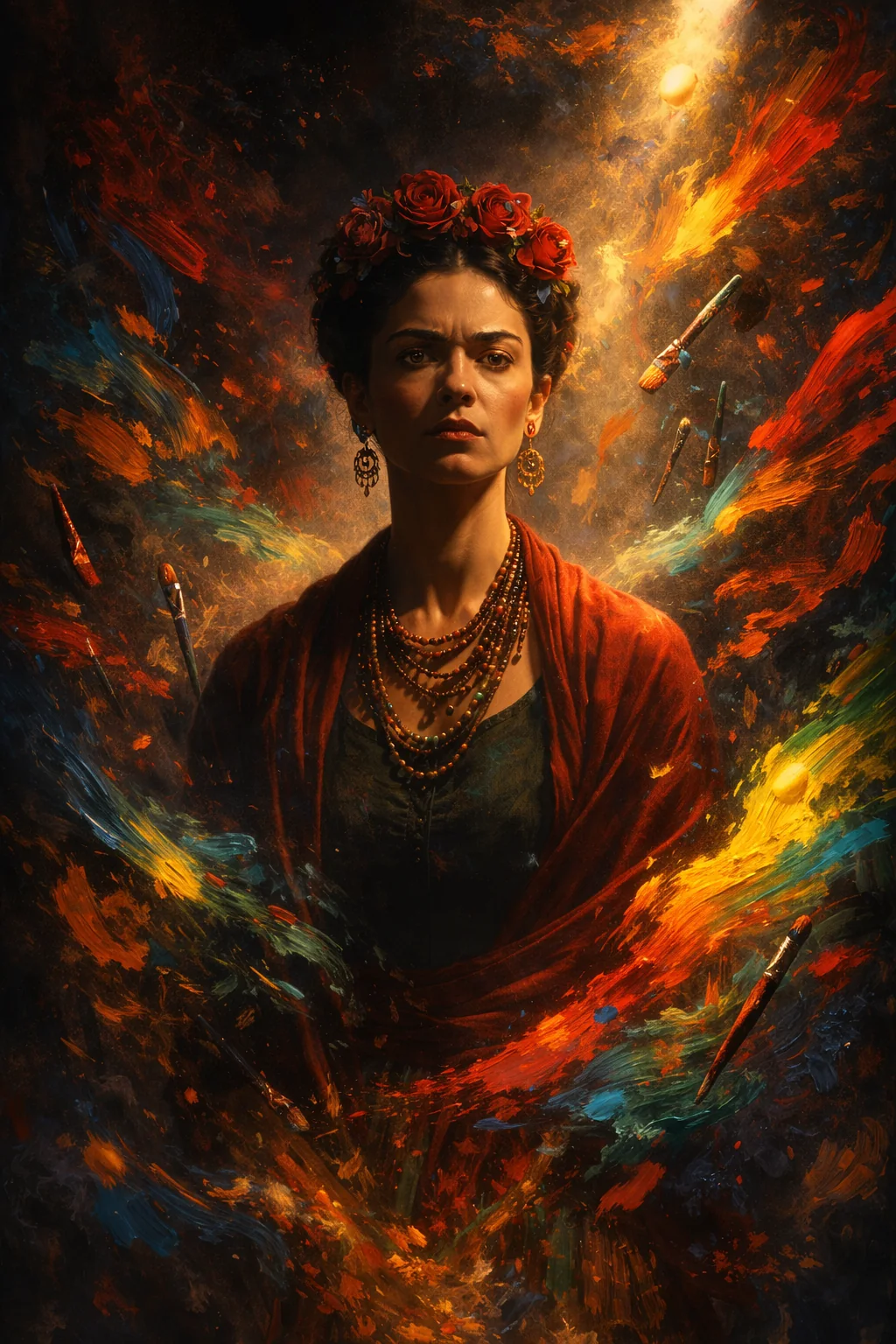
Frida Kahlo’s posthumous popularity has produced a contradiction. It allowed an artist long overshadowed by Diego Rivera to achieve worldwide recognition. But it also simplified her life into an easily consumed story about pain, love, and overcoming adversity.
Her paintings are more difficult than that version suggests.
They contain the female body without idealization, disability without sentimentality, reproductive loss, sexual ambiguity, cultural identity, and the power to construct one’s own image. Kahlo did not conceal her wounds, but neither did she allow them to become the only things that defined her.
The force of her self-portraits does not come simply from the fact that she suffered. Many people suffer without becoming artists. Her achievement was finding a visual form for something that seemed impossible to share: the experience of inhabiting a body that could be a prison, a laboratory, a political stage, and a work of art at the same time.
Frida Kahlo burned within, but she did not paint the ashes.
She painted the fire while it was still burning.
References
- Centre Pompidou. (n.d.). The Frame (Le cadre), [1938]. Ficha de colección / Collection record. View source
- Museo Frida Kahlo. (n.d.). Frida Kahlo: vida y obra. Cronología documental / Documentary chronology. View source
- Museum of Modern Art. (n.d.). Frida Kahlo. Self-Portrait with Cropped Hair. 1940. Audio de colección / Collection audio. View source
- National Museum of Women in the Arts. (n.d.). Self-Portrait Dedicated to Leon Trotsky. View source
- Victoria and Albert Museum. (2024, April 17). Unlocking Frida Kahlo’s wardrobe. View source
More from this collection
Amedeo Modigliani: Empty Eyes, Illness and the Legend of the Cursed Artist
Read story →
Francisco de Goya: The Painter Who Heard the Noise of His Age After Becoming Deaf
Read story →