In this storyOpen index
Caravaggio: The Knight Expelled Before His Own Masterpiece
The Order of Malta made him a knight to benefit from his extraordinary talent. Less than five months later, it publicly expelled him before the monumental painting he had created.
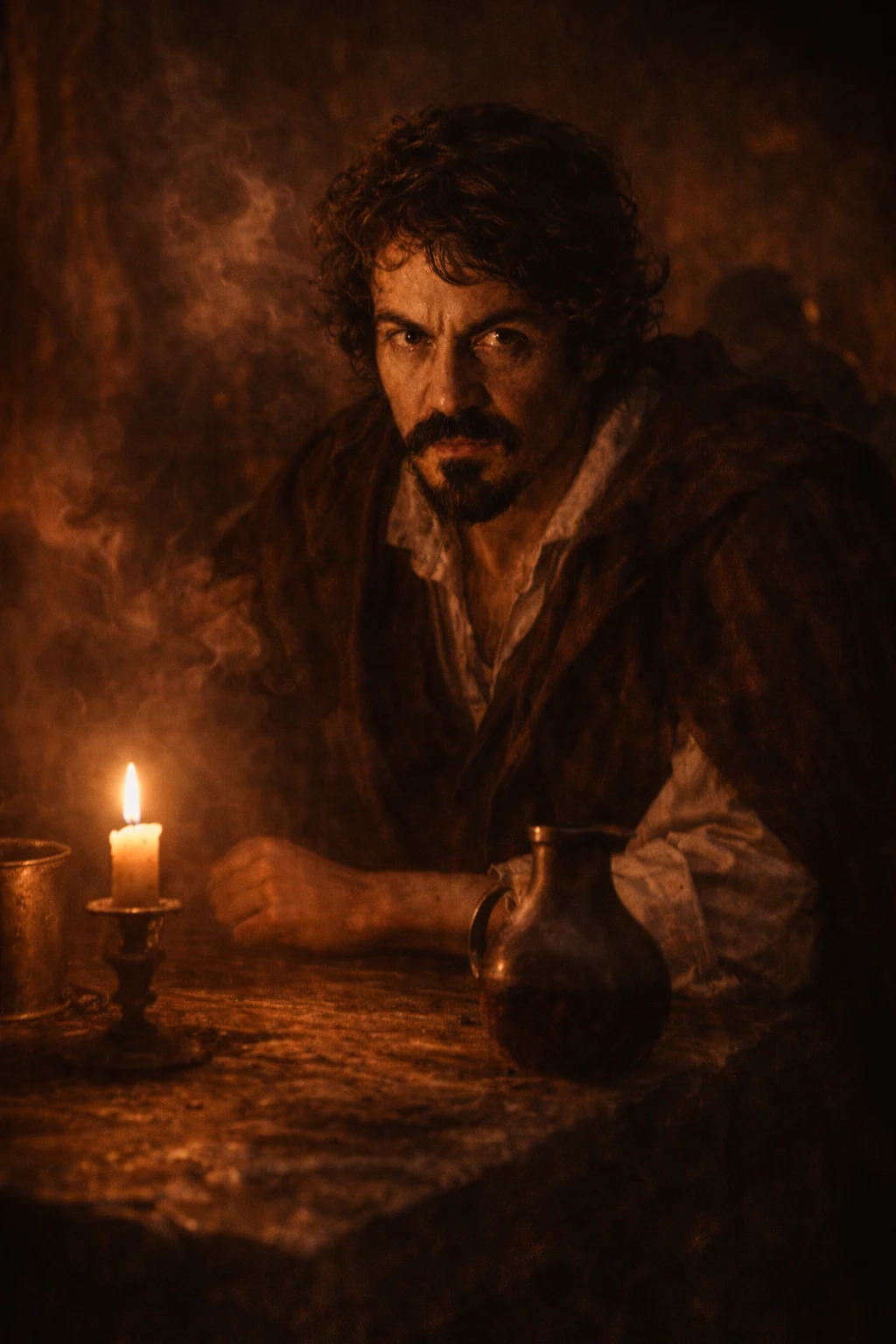
The Order of Malta made him a knight in recognition of his extraordinary talent. Less than five months later, it publicly expelled him as an unworthy man. The ceremony took place before the monumental painting he had created for the Order, while Caravaggio, once again a fugitive, had already escaped from the island.
Caravaggio on video
Discover this story on our YouTube channel.
A life told through places and turning points

Enter the archive
An authentic object preserved by a cultural institution brings us closer to the world behind this life.
- Collection
- The Metropolitan Museum of Art
- Rights
- Public Domain / Open Access
Gift of Herman and Lila Shickman, and Purchase, Lila Acheson Wallace Gift, 1997
Caravaggio’s True Origins
Michelangelo Merisi was born in Milan, probably on September 29, 1571, and baptized the following day. For centuries, he was believed to have been born in the small Lombard town of Caravaggio, where his family originated and whose name eventually became his own. The discovery of his baptismal record in 2007 established his connection by birth to Milan (Art UK, n.d.).
His childhood unfolded under the threat of epidemics and conflict. In 1576, a severe outbreak of plague struck Milan and forced his family to relocate. His father died not long afterward, and Caravaggio also lost other relatives during those years.
At 13, he began an apprenticeship with Simone Peterzano, a painter working within the Lombard artistic tradition. This training may have introduced him to northern Italian naturalism and the study of light, although very little is known about Caravaggio’s earliest work (J. Paul Getty Museum, n.d.).
Around 1592, he settled in Rome, the artistic center of Catholic Europe. His first years there were difficult. He worked in other artists’ studios, painted flowers and fruit, and produced small scenes for the private market. Works such as Boy Bitten by a Lizard, Bacchus, and The Cardsharps offered something unusual: figures taken from everyday life, precisely observed objects, and actions suspended at their most dramatic moment.
Saints With Dirty Feet
Caravaggio’s fortunes changed when Cardinal Francesco Maria del Monte recognized his talent and welcomed him into his circle. Through the cardinal’s protection, the painter obtained contacts, accommodation, and public commissions. Between 1599 and 1600, he created The Calling of Saint Matthew and The Martyrdom of Saint Matthew for the Contarelli Chapel in the Roman church of San Luigi dei Francesi. His fame grew rapidly (National Gallery, n.d.-a).
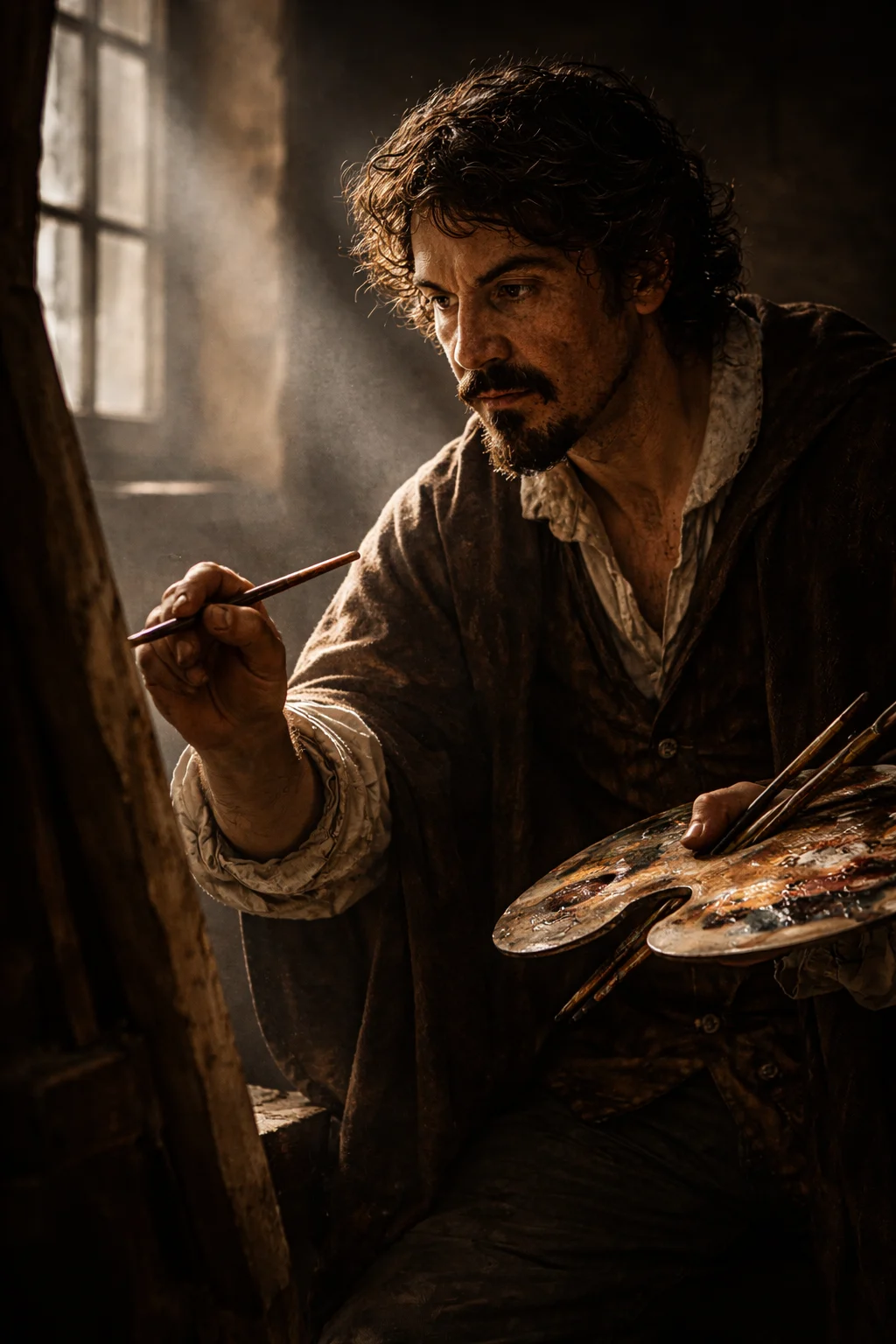
Caravaggio did not idealize religious figures according to conventional models. He used ordinary people as models and represented aging bodies, weathered faces, and dirty feet. His saints appeared to inhabit the same physical world as the viewer.
Neither did he necessarily fill his scenes with monumental architecture or celestial landscapes. He reduced the setting, pushed his figures toward the front of the canvas, and illuminated them with intense light emerging from darkness. This method, related to chiaroscuro but driven toward extreme contrasts, gave his paintings a theatrical force.
It has often been claimed that Caravaggio never made preparatory drawings. That statement requires qualification. No surviving drawing can be securely attributed to him, and technical studies indicate that he frequently worked directly on the canvas, marking certain positions through incisions. This does not mean that he painted without planning; rather, he developed the composition on the painted surface itself (Christiansen, 2003).
Several works intended for churches caused controversy. Some initial versions were rejected because their figures were considered indecorous or insufficiently idealized. Those rejections did not mean that Rome generally despised his art. Caravaggio had powerful collectors and continued to receive prestigious commissions.
A Life Recorded in Court Documents
Judicial records reveal that the painter became involved in numerous disputes. He was questioned or arrested for carrying weapons without authorization, insulting officials, wounding other people, and participating in fights. In one famous incident, he threw a plate of artichokes at a waiter after arguing about how they had been cooked.
On May 28, 1606, a confrontation ended with the death of Ranuccio Tomassoni. The fight has traditionally been attributed to a disagreement over a ball game or a debt, but its precise cause remains disputed. Caravaggio was also wounded and fled Rome.
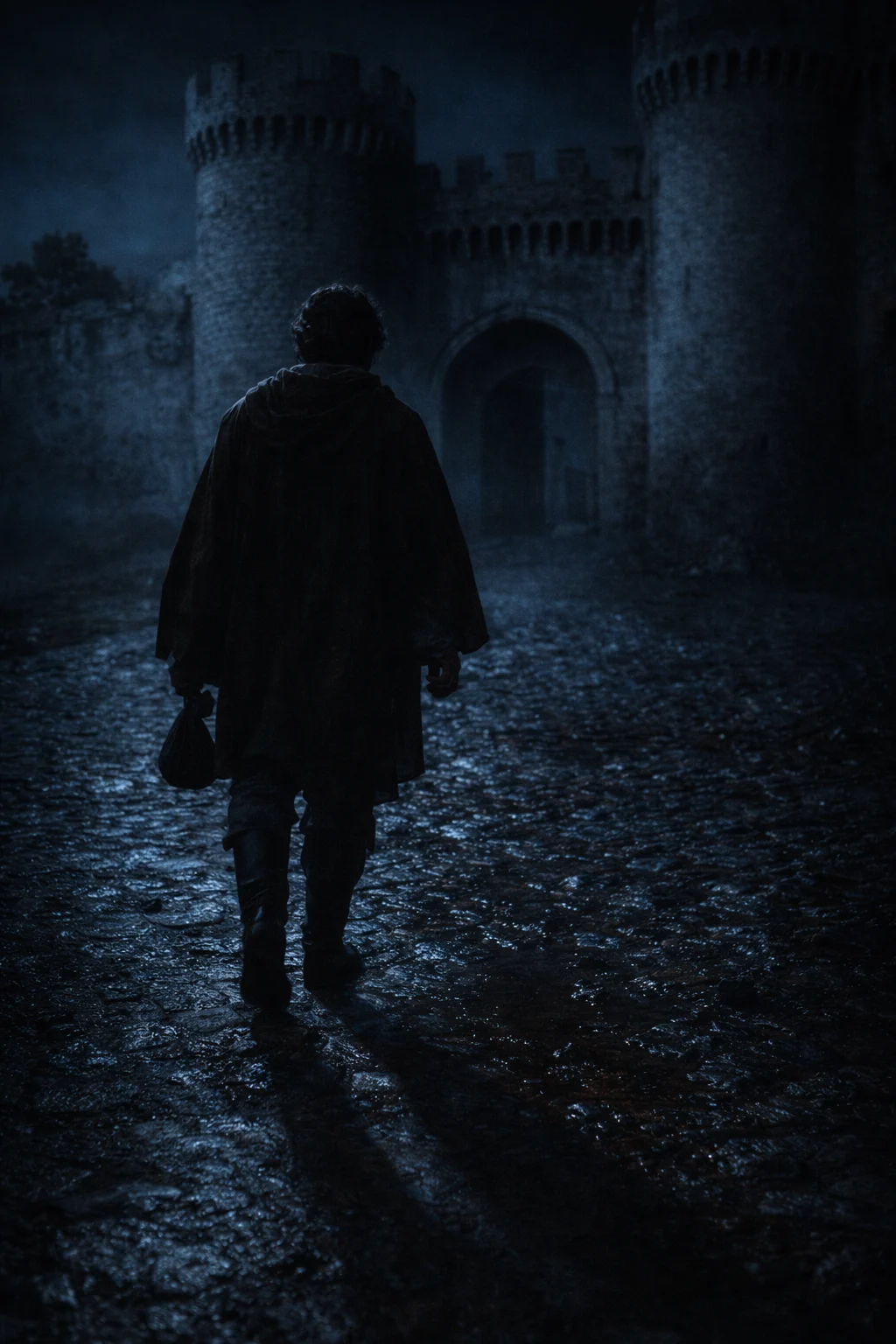
The authorities issued a bando capitale against him, a sentence that exposed him to severe punishment if captured. From that point onward, his travels through southern Italy were motivated both by the search for commissions and by his attempts to obtain a papal pardon (National Gallery, n.d.-a).
He first took refuge in territories belonging to the Colonna family and then traveled to Naples, which was outside Rome’s direct jurisdiction. He remained a celebrated artist there and received significant commissions. His compositions, however, became darker and their spaces increasingly empty.
The Knight of Malta
In July 1607, Caravaggio arrived in Malta, headquarters of the Order of Saint John. Becoming a knight could improve his social standing and help him secure a pardon for Tomassoni’s death. Grand Master Alof de Wignacourt knew about his past but obtained the papal authorization required for his admission.
On July 14, 1608, Caravaggio was received as a Knight of Obedience. For the Order, he painted portraits, Saint Jerome Writing, and his largest work: The Beheading of Saint John the Baptist, intended for the oratory of St John’s Co-Cathedral in Valletta (St John’s Co-Cathedral Foundation, n.d.).
The painting measures approximately 3.6 by 5.2 meters. The action occupies only part of the enormous space, while darkness and emptiness intensify the silence of the scene. Near the blood flowing from the saint’s neck appears the inscription “f. Michelangelo.” It is the only known painting Caravaggio signed, although the precise meaning and interpretation of that signature continue to be examined (Heritage Malta, 2026).
His new position lasted only a short time. In August 1608, Caravaggio participated in another fight in which several knights were wounded. He was arrested and imprisoned in Fort Saint Angelo. Before standing trial, he escaped from what was considered an extremely secure fortress and fled Malta.
Expelled Before the Painting He Had Signed
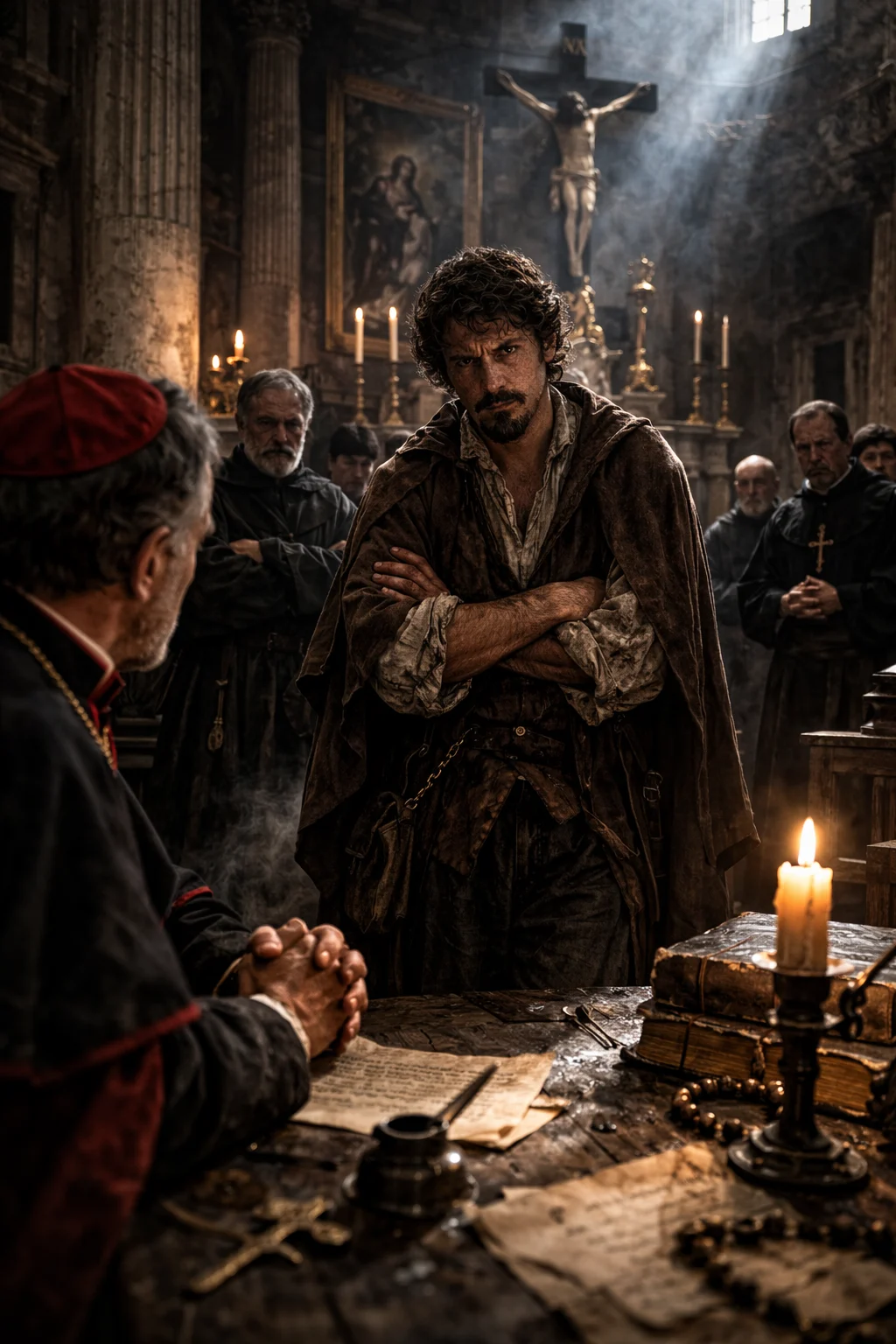
On December 1, 1608, the Order’s Public Assembly gathered in the Oratory of Saint John. Caravaggio was not present; he had escaped weeks earlier. Standing before The Beheading of Saint John the Baptist, the knights formally expelled him and declared him cast out of the institution “like a rotten and fetid limb” (St John’s Co-Cathedral Foundation, n.d.).
The scene contains an extraordinary historical irony. The Order condemned the man’s conduct while assembled before a work demonstrating the magnitude of his talent. Caravaggio lost the status of knight, but his painting continued to occupy one of the most important places in the church.
The Order could expel the man, but it could not remove the masterpiece he had left in its oratory.
After escaping, he traveled through Sicily and worked in Syracuse, Messina, and Palermo. In 1609, he returned to Naples, where he suffered a violent attack that left him seriously injured. Some reports even announced, incorrectly, that he had been killed.
Despite being pursued and repeatedly displaced, he continued to paint. His final works contain isolated figures, muted colors, and spaces dominated by darkness. In The Martyrdom of Saint Ursula, generally regarded as his last painting, Caravaggio included his own face among the witnesses to the event (National Gallery, 2024).
A Death Still Surrounded by Uncertainty
In July 1610, while his supporters negotiated a pardon that could allow him to return to Rome, Caravaggio traveled north carrying several paintings. During the journey, he was briefly detained, and the vessel transporting some of his possessions continued without him.
He attempted to recover the boat but became ill and died in Porto Ercole on July 18, 1610. He was 38 years old. The surviving historical evidence does not establish his cause of death with complete certainty. Fever, infection, the consequences of earlier injuries, and other possibilities have been proposed, but none should be presented as definitively proven (National Gallery, n.d.-a).
Caravaggio established no formal school and left no organized group of pupils. Nevertheless, his influence spread throughout Europe. Orazio Gentileschi, Artemisia Gentileschi, Jusepe de Ribera, Georges de La Tour, and the Utrecht Caravaggists adopted different elements of his naturalism and dramatic lighting. His influence can also be recognized indirectly in Velázquez, Rembrandt, and numerous later artists (Christiansen, 2003).
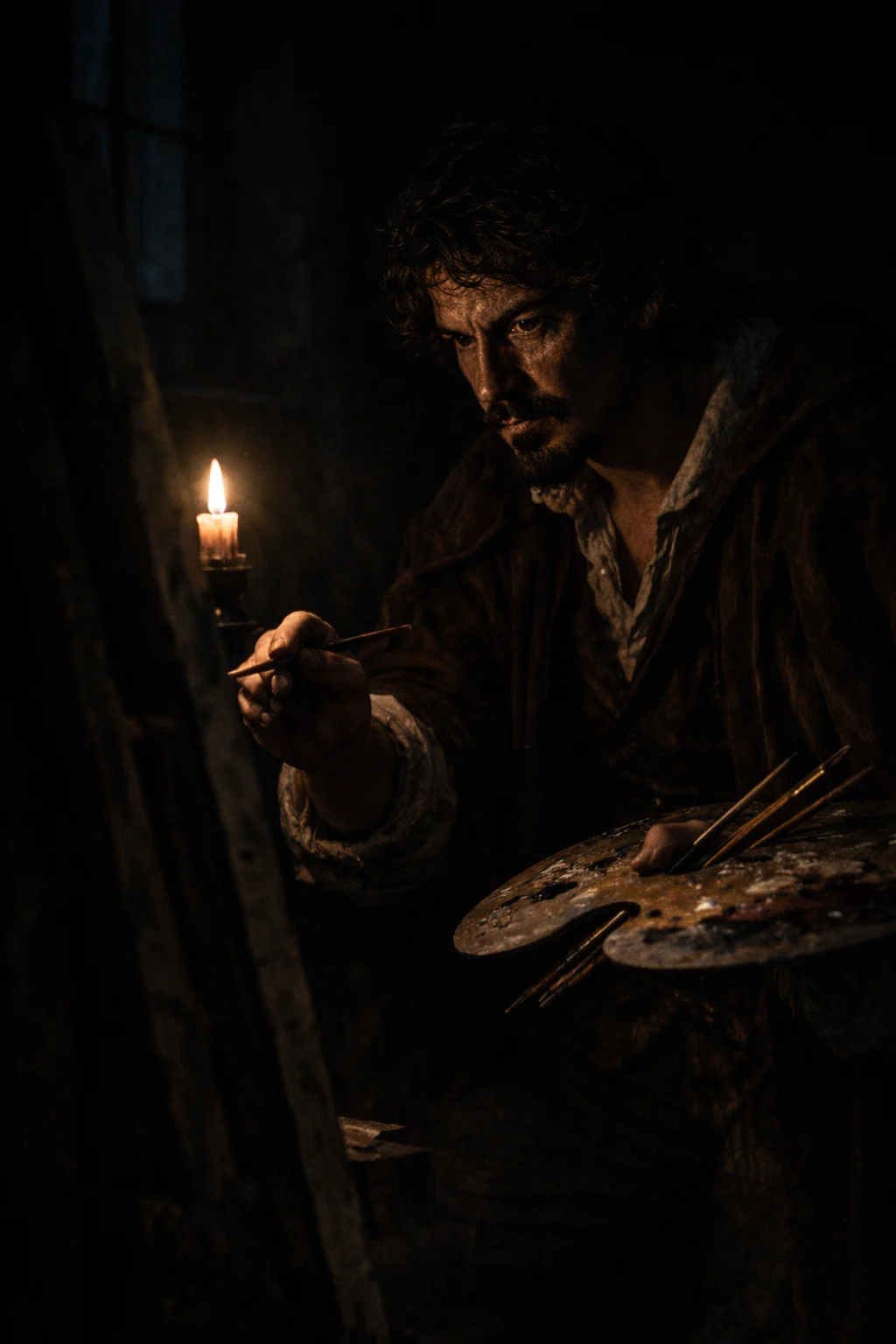
His violent life should not be used to explain every painting mechanically. Caravaggio was more than an artist controlled by his temper. He transformed religious painting by eliminating the distance between the sacred and the everyday. His saints could have wrinkles, wounds, and dirty feet because they belonged to the same world as the people looking at them.
The Order of Malta could remove his name from its list of knights, but it could not remove the painting he had left in its oratory. More than four centuries later, his expulsion is remembered precisely because it took place before the only work he chose to sign.
References
- Art UK. (n.d.). Caravaggio, 1571–1610.
- Christiansen, K. (2003, October). Caravaggio (Michelangelo Merisi) (1571–1610) and his followers. The Metropolitan Museum of Art.
- Heritage Malta. (2026). Museums by Candlelight Valletta.
- J. Paul Getty Museum. (n.d.). Caravaggio, Michelangelo Merisi da.
- National Gallery. (2024). The last Caravaggio.
- National Gallery. (n.d.-a). Michelangelo Merisi da Caravaggio: 1571–1610.
- St John’s Co-Cathedral Foundation. (n.d.). Caravaggio.
More from this collection
Francisco de Goya: The Painter Who Heard the Noise of His Age After Becoming Deaf
Read story →
Egon Schiele: The Painter Who Watched a Judge Burn His Drawing
Read story →