
In this storyOpen index
Mozart: The Man Who Survived the Child Prodigy
Fame began before he could choose it. Between courts, debts, and legends, Mozart tried to live as a free musician.
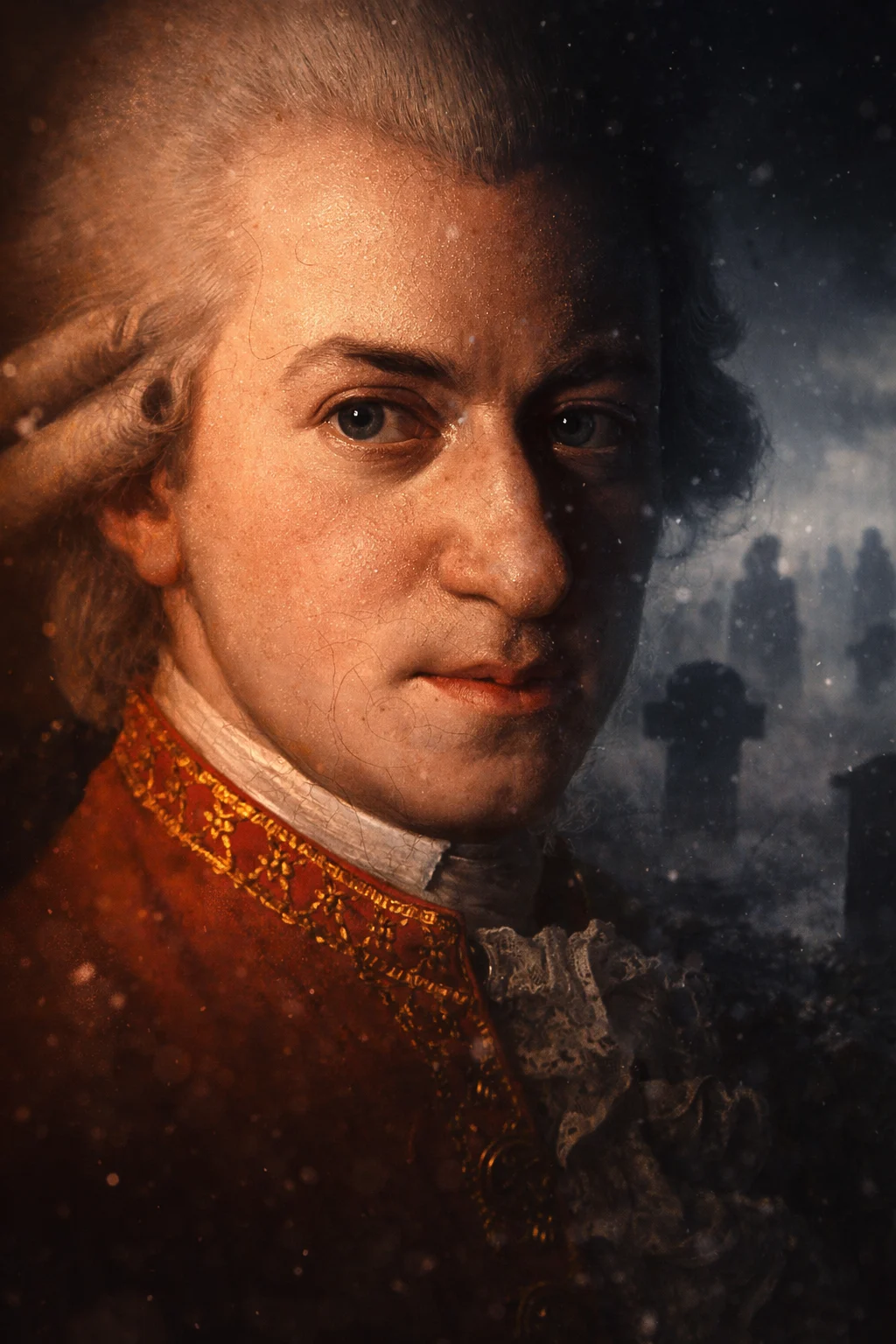
Wolfgang Amadeus Mozart did not approach the abyss through a single fall. He always lived near several: exhaustion, financial dependence, the need for approval, professional uncertainty, and a fame that began before he was old enough to decide what to do with it. Posterity transformed him into an almost supernatural figure: the child who composed without effort, the irresponsible adult who squandered his fortune, and the dying genius who wrote his own Requiem while a rival prepared his death.
The real story is less perfect and, for that very reason, more human.
Mozart on video
Discover this story on our YouTube channel.
A life told through places and decisive moments
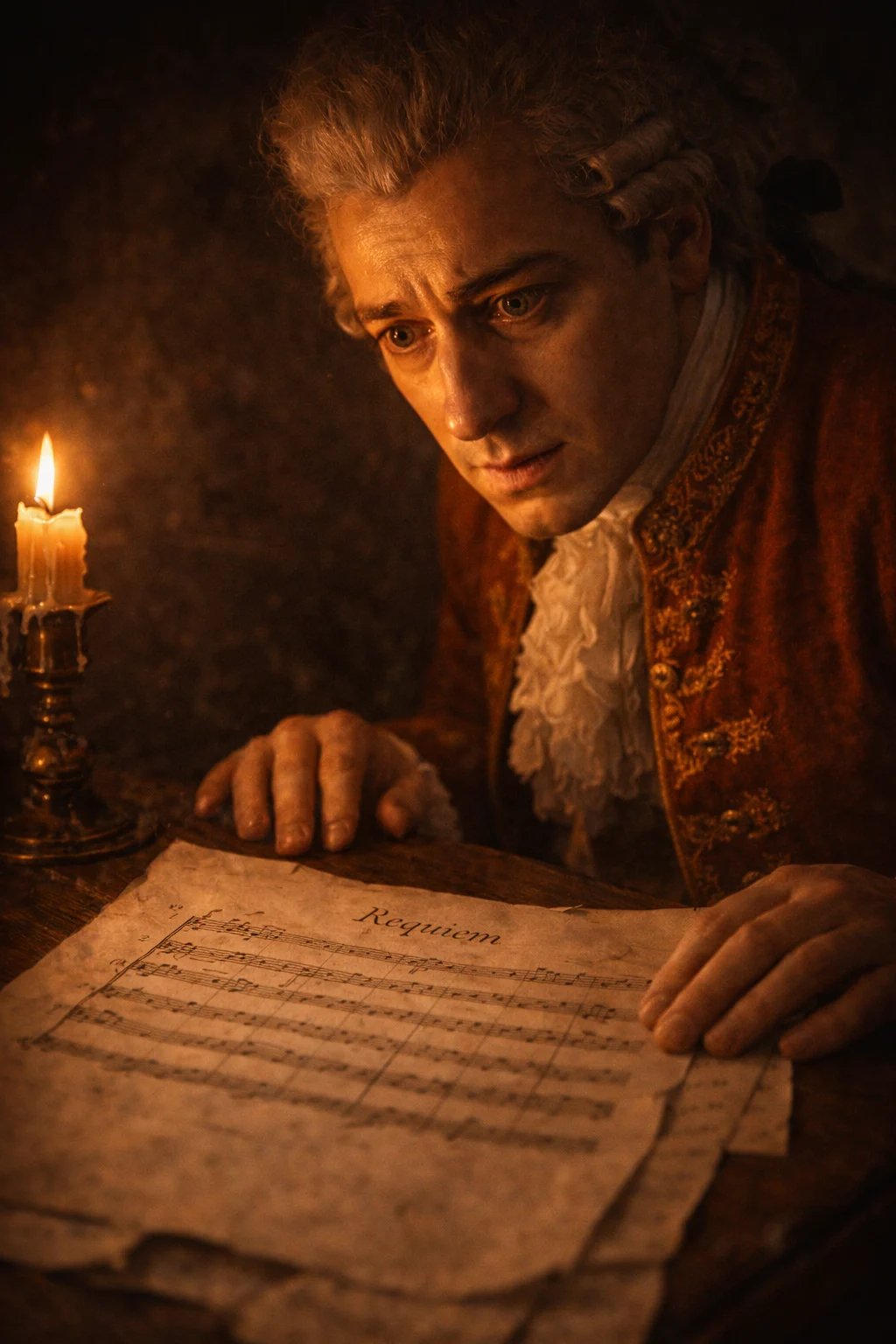
Enter the archive
The Austrian National Library preserves the autograph Requiem manuscript, where the Lacrimosa stops after eight measures written by Mozart.
- Collection
- Music Collection
- Institution
- Austrian National Library
Institutional record from the Austrian National Library.
A Child Displayed Before Europe
Mozart was born in Salzburg on January 27, 1756. He was the seventh child of Leopold Mozart and Anna Maria Pertl, although only he and his sister Maria Anna—known as Nannerl—survived childhood. Leopold, a violinist, composer, and teacher employed by the Salzburg court, recognized the extraordinary musical abilities of both children at a very early age (Solomon, 1995).
Mozart began playing keyboard instruments while still very young and soon attempted to compose. His talent, however, did not emerge in a vacuum. Leopold organized his education with extraordinary discipline, corrected his first scores, and turned his training into practical experience at the courts of Europe. Between 1763 and 1766, the family traveled through cities including Munich, Paris, London, Brussels, and Amsterdam, presenting the children before nobles and monarchs (Gutman, 1999).
Those journeys broadened Mozart’s musical world. He heard different styles, met important composers, and learned to write for varied audiences. In London, he encountered Johann Christian Bach, son of Johann Sebastian Bach, whose music influenced his development. Yet the tours also meant uncomfortable travel, illness, and the constant obligation to perform.
The image of the child prodigy concealed a less radiant reality: Mozart grew up under observation, turned into living proof of his father’s teaching abilities. His childhood was extraordinary, but it can hardly be described as free.
The Musician Who Refused to Obey
As a young man, Mozart worked for the prince-archbishop of Salzburg. Their relationship became increasingly hostile. Mozart wanted to be recognized as a major composer, not treated as a servant expected to provide music on command. The court hierarchies of the eighteenth century, however, demanded obedience even from the most brilliant artists.
The confrontation reached its climax in 1781, when Mozart broke with Archbishop Colloredo’s service and decided to establish himself in Vienna as an independent musician. It was a risky choice. At a time when many composers depended on churches or courts, Mozart attempted to support himself through concerts, commissions, private lessons, and publications (Eisen et al., 2006).
His first years in Vienna brought considerable success. His piano concerts attracted a substantial public, while his operas displayed an exceptional ability to transform human emotion into music. In The Marriage of Figaro, Don Giovanni, and Così fan tutte, created with the librettist Lorenzo Da Ponte, the characters are not merely comic figures or idealized aristocrats. They desire, lie, fear, seduce, and fail.
Mozart could make music reveal what his characters were trying to conceal.
Marriage, Work, and Financial Trouble
In 1782, he married Constanze Weber despite Leopold’s opposition. The couple had six children, only two of whom survived into adulthood. Their letters reveal a marriage marked by affection, domestic worries, temporary separations, and frequent money problems (Solomon, 1995).
Mozart earned substantial sums during certain periods, especially in the mid-1780s. Describing him simply as an impoverished artist is therefore misleading. His difficulty came from unstable income combined with high expenses and the absence of a well-paid permanent position. Letters requesting loans from his friend and fellow Freemason Michael Puchberg document moments of genuine financial pressure (Deutsch, 1965).
He also lived in an economically fragile society. The Habsburg monarchy’s war against the Ottoman Empire affected Vienna’s cultural life, reduced the number of aristocratic families present in the city, and weakened the market for private concerts. His difficulties cannot be attributed solely to an alleged personal inability to manage money.
Mozart’s abyss was partly that of the independent artist before a modern structure existed to protect him.
A Little-Known Episode: Mozart and the Forbidden Music
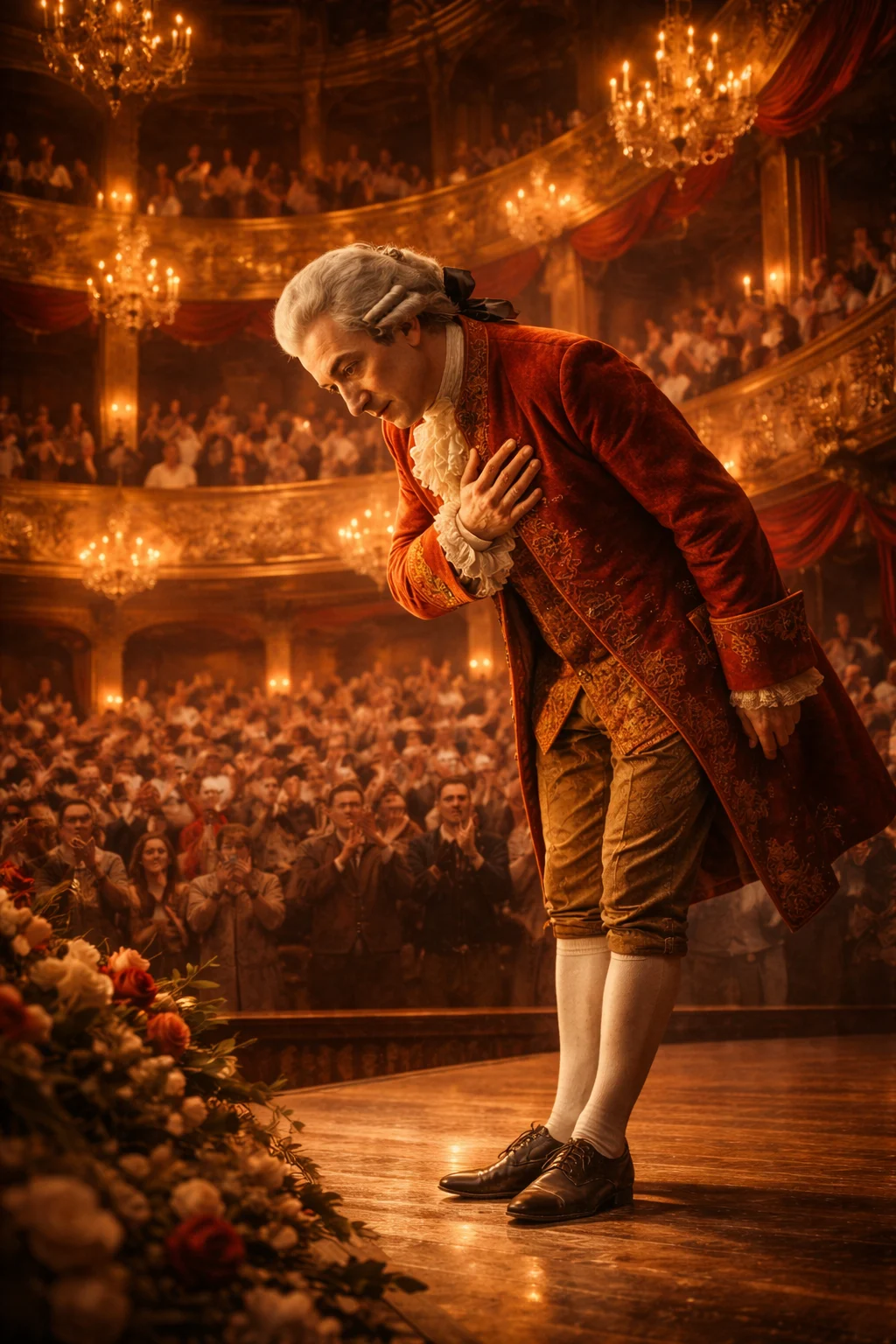
In 1770, when he was fourteen, Mozart visited Rome and heard Gregorio Allegri’s Miserere in the Sistine Chapel. The work was closely guarded for use in Vatican ceremonies, and its scores did not circulate freely. According to the account transmitted by his father, Mozart returned to his lodgings and wrote the music down from memory; he later heard it again and corrected a few details (Gutman, 1999).
Over time, the episode was embellished until the score was said to be protected under threat of excommunication and Mozart portrayed as having heroically stolen a Vatican secret. The truth is more restrained: other copies existed, and there is no solid evidence that the young composer was threatened with ecclesiastical punishment.
The achievement needs no such exaggeration. Even without the legend, the episode demonstrates his astonishing auditory memory and his ability to grasp a complex composition after very few hearings. Soon afterward, Pope Clement XIV awarded him the Order of the Golden Spur—not as a punishment, but as an honor.

Salieri Did Not Murder Him
One of the most persistent legends claims that Antonio Salieri, jealous of Mozart, poisoned him. No convincing historical evidence supports the accusation. The two composers competed within Vienna’s musical world, but there is also evidence of professional respect. In one of his last letters, Mozart reported that Salieri had attended a performance of The Magic Flute and had responded enthusiastically (Deutsch, 1965).
The murder story took shape after both men were dead. Alexander Pushkin turned it into drama in Mozart and Salieri, and during the twentieth century it was popularized by Peter Shaffer’s play Amadeus and its film adaptation. They are powerful works of art, but they are not historical testimony.
Mozart’s final illness cannot be diagnosed with certainty either. Accounts mention fever, pain, vomiting, and severe bodily swelling. Numerous causes—from infections to kidney disorders—have been proposed, but the surviving information does not permit a definitive conclusion (Eisen et al., 2006).
Mozart died in Vienna on December 5, 1791. He was thirty-five years old.
The Requiem and the Faceless Messenger
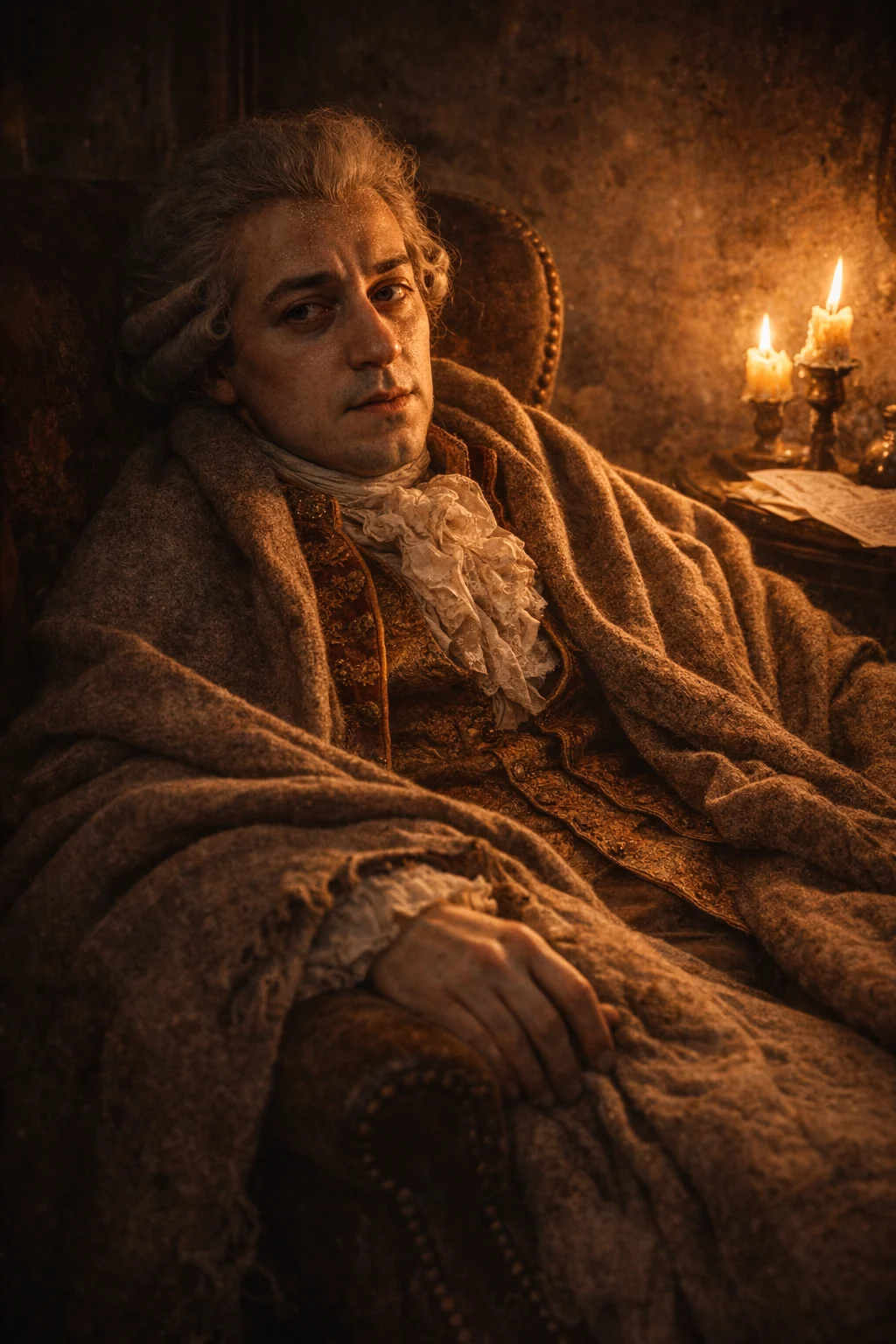
During his final months, Mozart received an anonymous commission to compose a Mass for the dead. The client was Count Franz von Walsegg, who wanted to commemorate his deceased wife and had a habit of presenting commissioned works as his own. The intermediary’s anonymity helped create the legend of a mysterious messenger who seemed to announce death.
Mozart, already ill, may have come to believe that he was writing the Requiem for himself. However, descriptions of this obsession derive mainly from later recollections and must be treated cautiously (Wolff, 1994).
The composer died before completing the work. Constanze needed to collect the remainder of the commission, so she sought someone to finish it. Joseph Eybler first worked on the manuscript, and Franz Xaver Süssmayr later prepared the completed version most frequently performed today. Mozart had fully finished the Introitus and left other sections at different stages of development; in the autograph manuscript, the celebrated Lacrimosa stops after its first eight measures (Wolff, 1994).
The Requiem heard today is therefore not exclusively his. It is a work crossed by his death and by other musicians’ attempts to imagine how he might have continued.

He Was Not Buried in a Pauper’s Grave
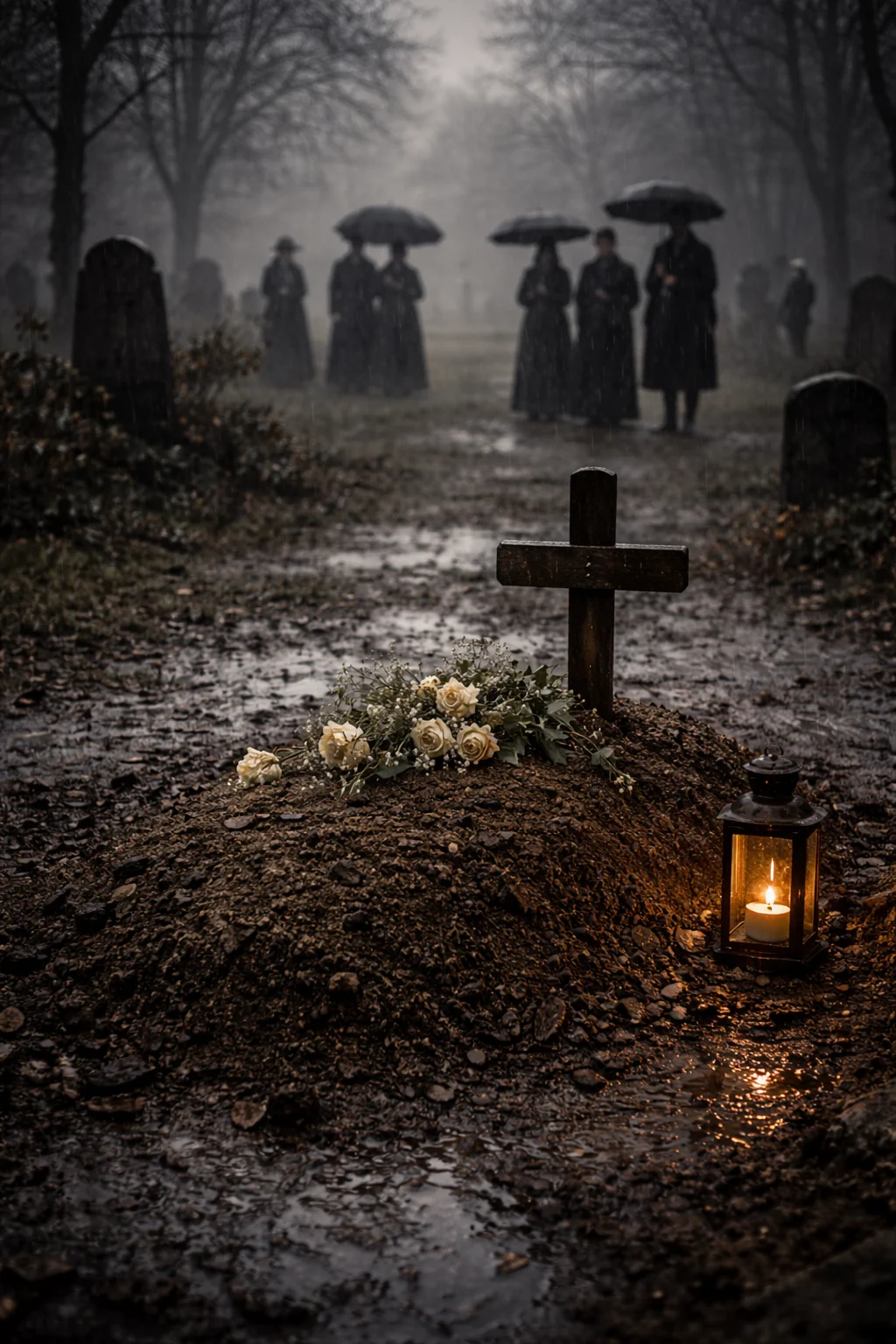
Mozart was not thrown into a mass grave because he was too poor to receive a proper burial. He was interred at St. Marx Cemetery according to the funerary practices established in Vienna during the reign of Joseph II. He received a simple individual burial within a communal plot, but without a permanent marker; as a result, the exact location of his remains was later lost (Eisen et al., 2006).
The absence of a grand funeral encouraged the growth of a Romantic image: the genius abandoned by a city incapable of understanding him. Mozart was experiencing financial problems, and his death produced limited public commotion compared with his later fame, but he was not buried as an anonymous beggar.
The truth is more unsettling: even a known and admired man could physically disappear beneath the ordinary customs of his time.
Music at the Edge of Silence
In 1791, the final year of his life, Mozart was not a creatively exhausted man. He composed La clemenza di Tito, The Magic Flute, the Clarinet Concerto, and a substantial portion of the Requiem. His professional situation showed signs of recovery, and The Magic Flute was receiving a favorable response when he became ill (Heartz, 2009).
This changes the meaning of his tragedy. Mozart did not die after running out of ideas, but while opening new possibilities. His final works combine simplicity and complexity, humor and solemnity, tradition and experimentation. They seem effortless to the ear, despite being constructed with extraordinary precision.
Mozart was a prodigy, but not a miraculous creature who wrote at heaven’s dictation. He was a tireless worker who studied, revised, absorbed influences, and learned to transform the musical rules of his age. Behind the ease perceived by the listener lie years of discipline, travel, negotiation, and discarded pages.
He lived on the edge of the abyss because he attempted to be free within a society that still regarded the musician as a servant. Because he experienced celebrity before he could build an identity of his own. Because every new concert, commission, or opera had to become a means of survival.
His Requiem remained unfinished, but his life does not need to be completed by legend. The music is enough to reveal what matters: a mortal man who managed to give sound to emotions we still recognize as our own.

References
Deutsch, O. E. (1965). Mozart: A documentary biography (E. Blom, P. Branscombe, & J. Noble, Trans.). Stanford University Press.
Eisen, C., Keefe, S. P., & Sadie, S. (Eds.). (2006). The Cambridge Mozart encyclopedia. Cambridge University Press.
Gutman, R. W. (1999). Mozart: A cultural biography. Harcourt Brace.
Heartz, D. (2009). Mozart, Haydn and early Beethoven, 1781–1802. W. W. Norton & Company.
Solomon, M. (1995). Mozart: A life. HarperCollins.
Stafford, W. (1991). The Mozart myths: A critical reassessment. Stanford University Press.
Wolff, C. (1994). Mozart’s Requiem: Historical and analytical studies, documents, score. University of California Press.
More from this collection

Antonio Lucio Vivaldi: The Red Priest Who Made Storms Resound and Died in Silence
Read story →
Franz Schubert: The Musician Who Composed as Though Time Were Chasing Him
Read story →