In this storyOpen index
Miguel de Cervantes: The Captive Who Tried to Leave for America Before Creating Don Quixote
He survived Lepanto, five years of captivity, and four failed escapes. He then tried to leave for America; the rejection changed literary history.
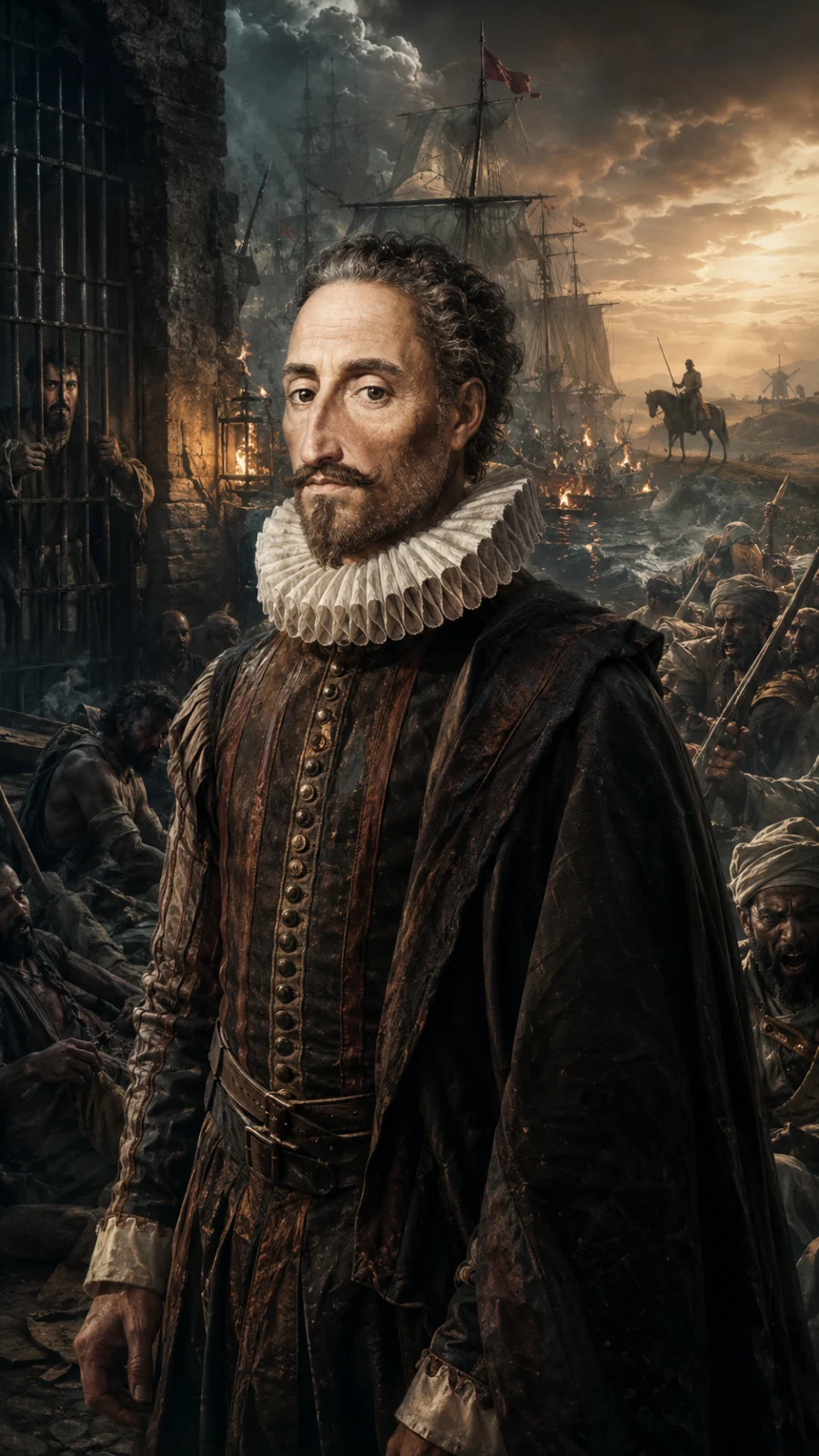
Before writing the novel that would transform Western literature, he asked to leave Spain and begin another life in America. He applied for one of several administrative posts available in the overseas territories. He had spent years searching for stability after surviving a naval battle, five years of captivity, four escape attempts, and a literary career that barely allowed him to support himself.
The application was rejected. In the document’s margin, an official noted that he should seek some occupation in Spain suited to his merits.
Miguel de Cervantes remained there. He continued working as a tax collector, passed through prison again, and, when already more than fifty years old, began publishing the story of a man who likewise refused to accept the place the world had assigned him.
Had that application of 1590 been approved, Cervantes might have ended his life as an official in Cartagena de Indias, Guatemala, Colombia, or Upper Peru. Don Quixote, as we know it, might never have existed (De Armas Wilson, 2000; Sliwa, 2000).
Miguel de Cervantes on video
Discover this story on our YouTube channel.
A life told through places and decisive moments
Enter the archive
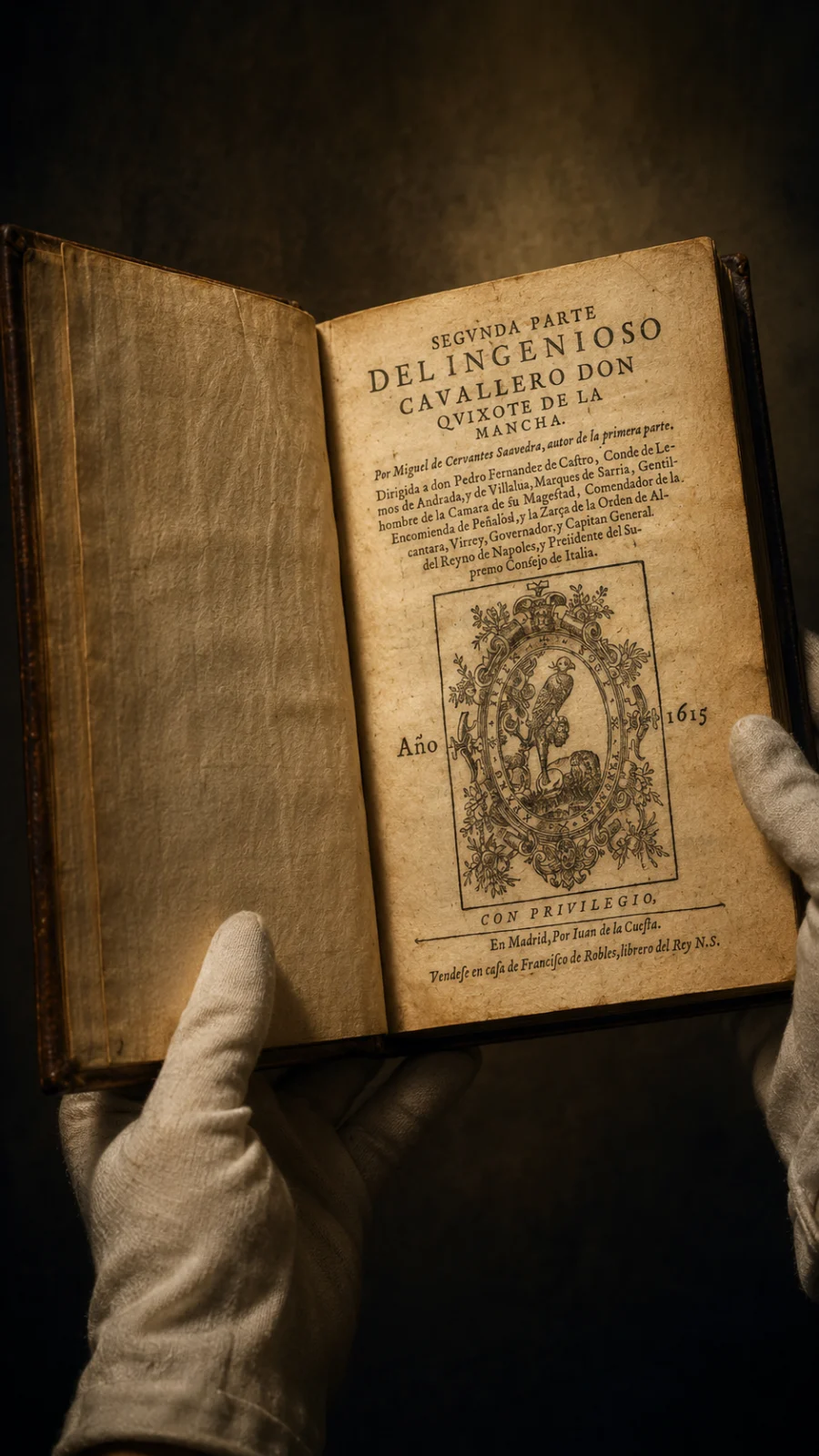
The National Library of Spain preserves and digitizes copies of the first edition of Don Quixote, printed in Madrid in 1605.
- Collection
- Hispanic Digital Library
- Institution
- National Library of Spain
Copy digitized by the National Library of Spain.
A birth whose precise date is unknown
Miguel de Cervantes Saavedra was born in Alcalá de Henares in 1547. He was baptized on October 9, but no document survives confirming the exact date of his birth. September 29, the feast of Saint Michael, has traditionally been proposed, although it remains an assumption (Canavaggio, 1990).
His father was Rodrigo de Cervantes, a barber-surgeon who frequently experienced financial difficulties, and his mother was Leonor de Cortinas. The family repeatedly moved through cities including Valladolid, Córdoba, Seville, and Madrid. That instability accompanied Cervantes from childhood and may have allowed him to encounter different social environments in sixteenth-century Spain.
No complete academic record makes it possible to reconstruct his entire education. He probably studied under humanist teachers and became associated in Madrid with Juan López de Hoyos, who published several of his poems in 1569. Soon afterward, Cervantes left Spain and appeared in Rome in the service of Cardinal Giulio Acquaviva (Canavaggio, 1990).
A judicial document issued in 1569 ordered the arrest of a Miguel de Cervantes accused of wounding Antonio de Sigura in a duel. Many biographers consider him to have been the future writer, although the identification cannot be proved beyond doubt. If correct, his departure for Italy began not as a literary adventure but as an attempt to avoid punishment (McCrory, 2002).
Lepanto and the hand he never lost
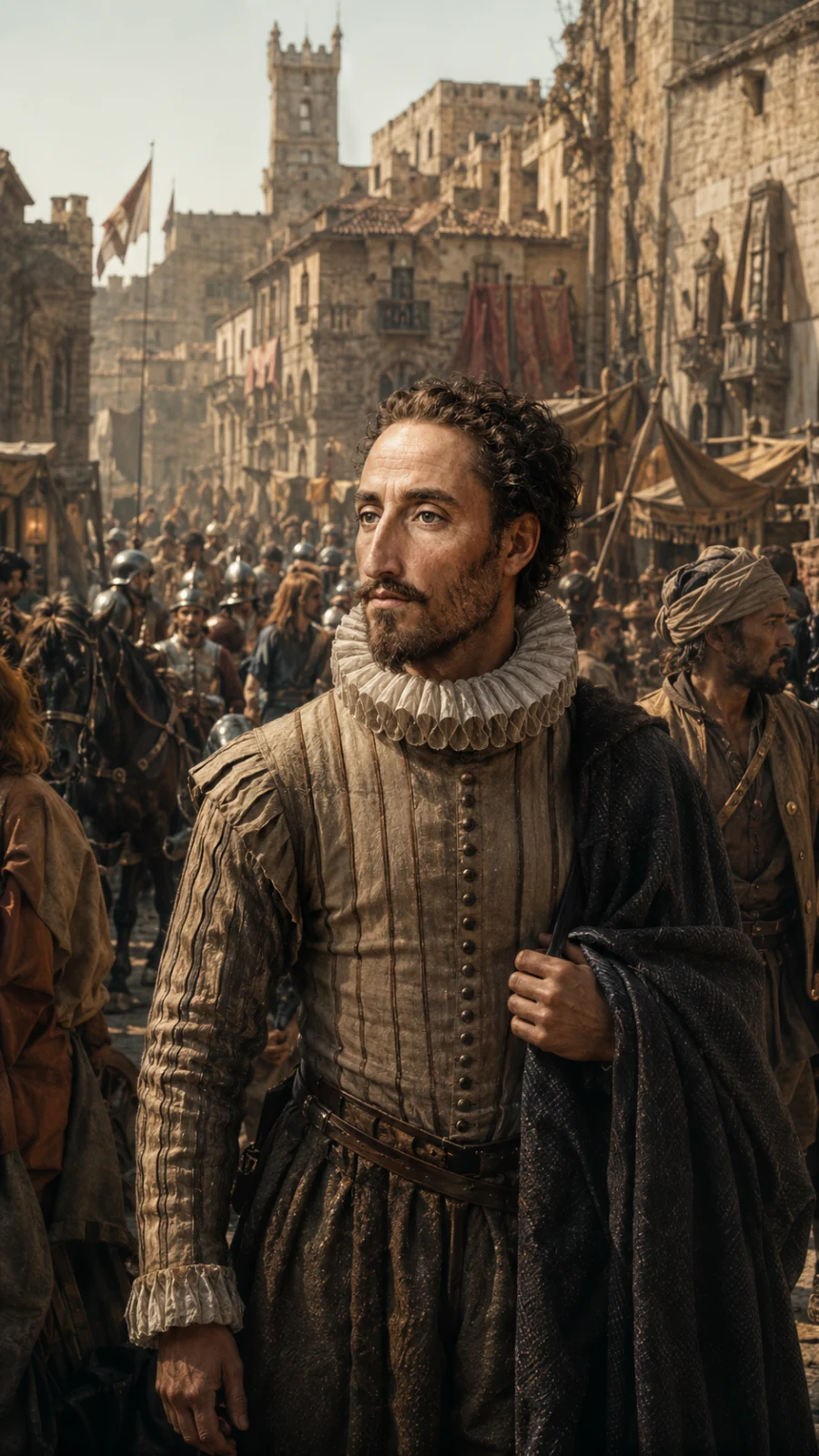
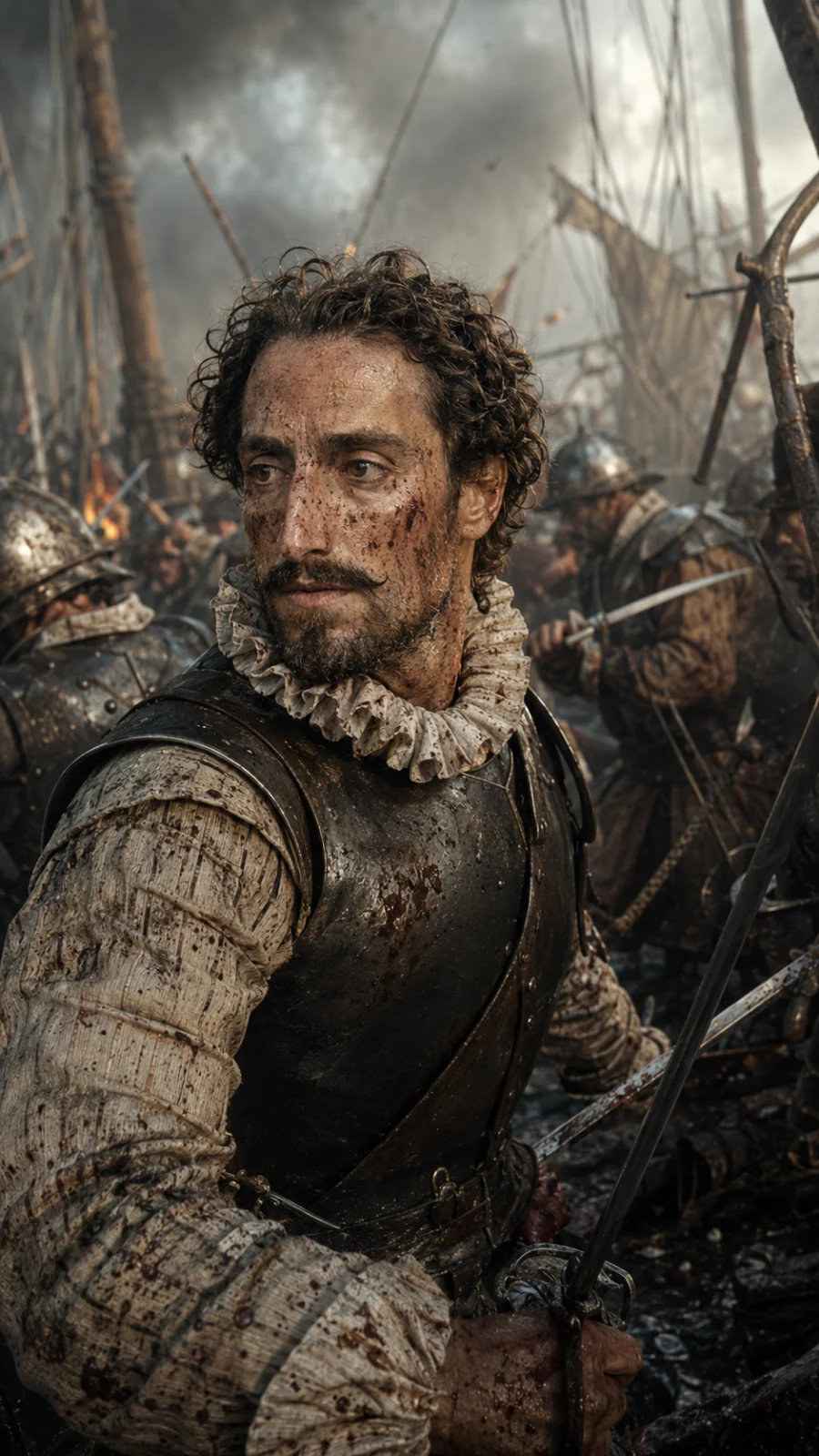
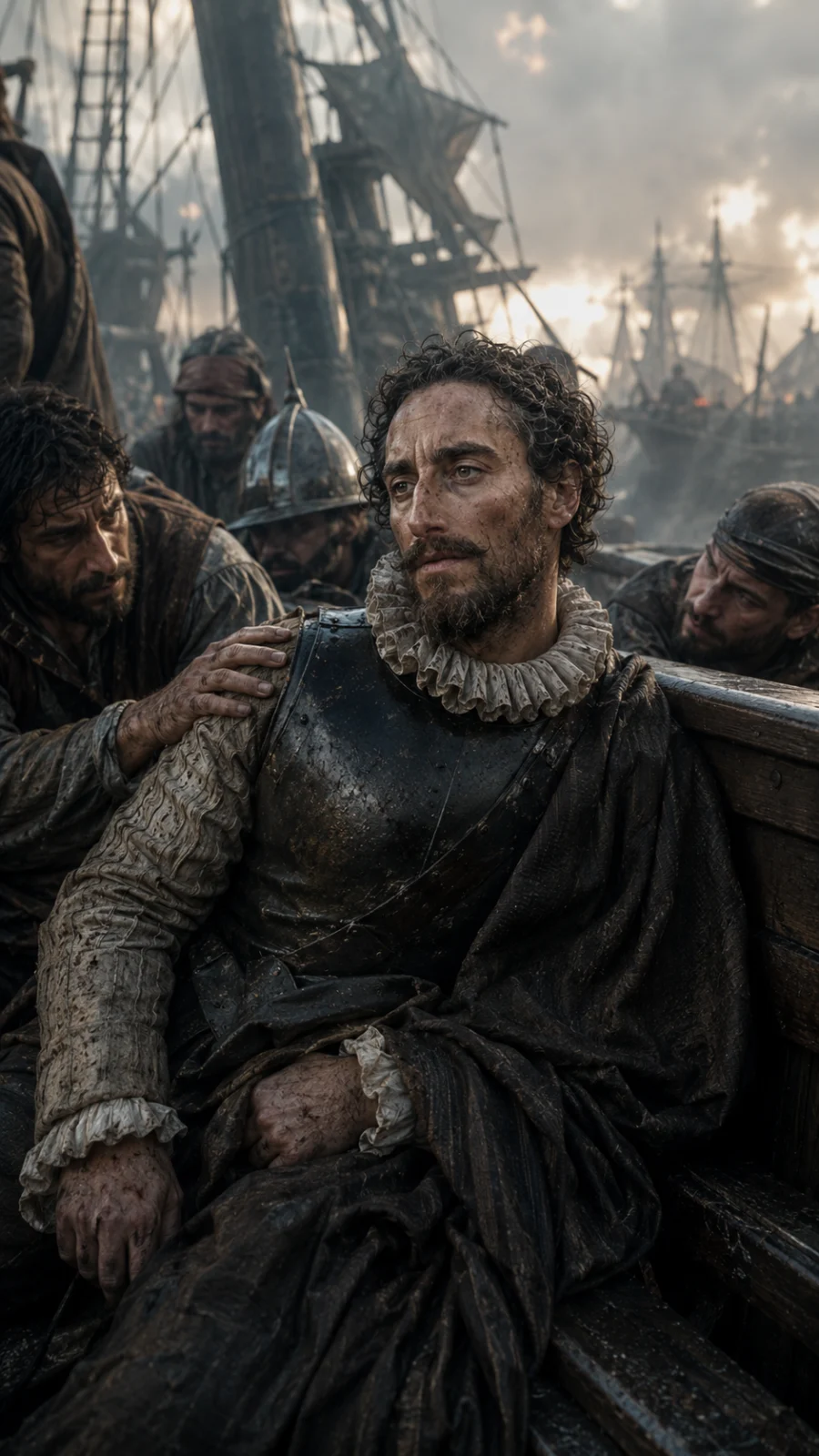
Cervantes joined the military and fought on October 7, 1571, at the Battle of Lepanto, where a Christian coalition confronted the Ottoman fleet. He was sick with fever but requested permission to occupy his post during the fighting.
He received several arquebus wounds: two in the chest and another in his left hand. The injury left the hand seriously damaged or disabled, but it was not amputated. The famous description “the one-handed man of Lepanto” refers to its loss of function, not the physical absence of the limb (Canavaggio, 1990; McCrory, 2002).
Cervantes remembered the battle with pride for the remainder of his life. He did not consider the wound a shameful misfortune but evidence that he had participated in an event he regarded as decisive.
After recovering, he continued serving as a soldier. He participated in other Mediterranean expeditions and remained in Italy for several years. Military life was not a brief episode later added to his biography: it occupied an important part of his youth and left his writing with an unsentimental view of weapons, obedience, and the price of glory.
Five years in Algiers
In September 1575, Cervantes and his brother Rodrigo boarded a vessel bound for Spain. Corsairs attacked their galley, and both brothers were taken captive to Algiers.
Their captors found letters of recommendation to the king that Cervantes carried with him. They concluded that he belonged to an influential family and set a high ransom. The documents intended to help him obtain a reward for his military service instead prolonged his captivity (Canavaggio, 1990).
Over nearly five years, he attempted to escape four times. He organized overland routes, searched for boats, and tried to assist other captives. The plans failed because of betrayal, delays, or insufficient resources.
Testimony collected in the document known as the Información de Argel, requested by Cervantes himself before his return to Spain, stated that he accepted responsibility for the escape attempts to protect his companions. The statements were also intended to certify his conduct before Spanish authorities and must therefore be read within that context. Nevertheless, they consistently portray an unusually active and resilient captive (Sliwa, 2000).
Cervantes was not executed despite his repeated escapes. His presumed value as a hostage and the expectation of a large ransom probably helped keep him alive.
In September 1580, members of the Trinitarian Order succeeded in completing the payment demanded by his captors. Cervantes recovered his freedom as preparations were reportedly being made to transfer him to Constantinople (Canavaggio, 1990).
Returning home and finding no reward
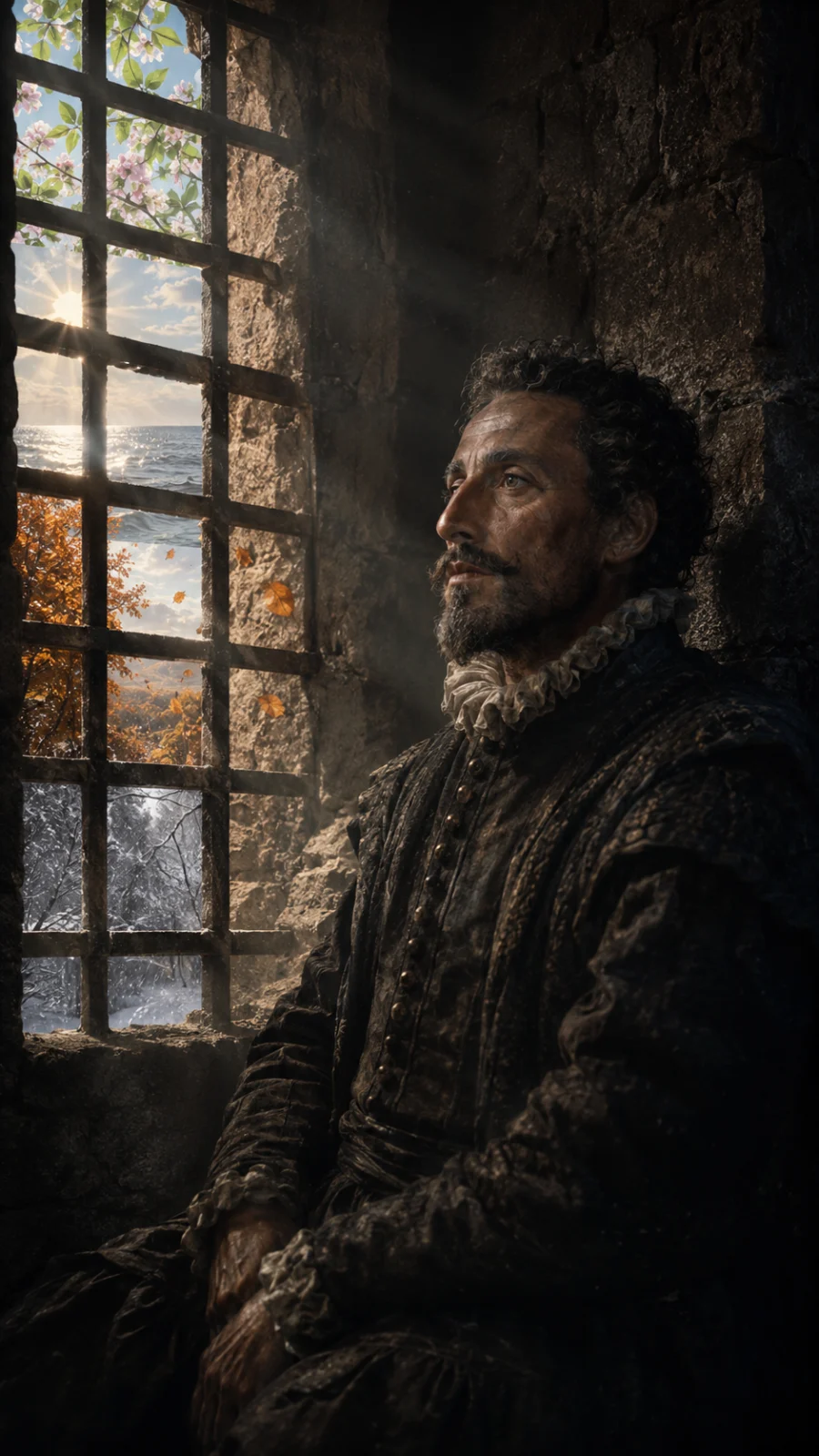
Cervantes returned to Spain expecting his military service to be recognized. Instead, he found a monarchy burdened with veterans, increasing debts, and few rewards to distribute.
He completed several administrative missions in North Africa but failed to obtain a stable position. He had a daughter, Isabel de Saavedra, from his relationship with Ana Franca de Rojas. In 1584, he married Catalina de Salazar y Palacios, a young woman from Esquivias who was considerably younger than he was (Canavaggio, 1990).
In 1585, he published La Galatea, a pastoral novel that provided him with a measure of literary recognition but no economic security. He also wrote numerous plays. Some were performed, although his success was overshadowed by the transformation of the Spanish stage later led by Lope de Vega.
The Cervantes who existed before Don Quixote was not an unknown writer, but neither was he a central literary figure. He was attempting to survive in a profession where authors received limited payments and frequently lost economic control of their works after selling them.
Requisitioning grain and oil for the Armada
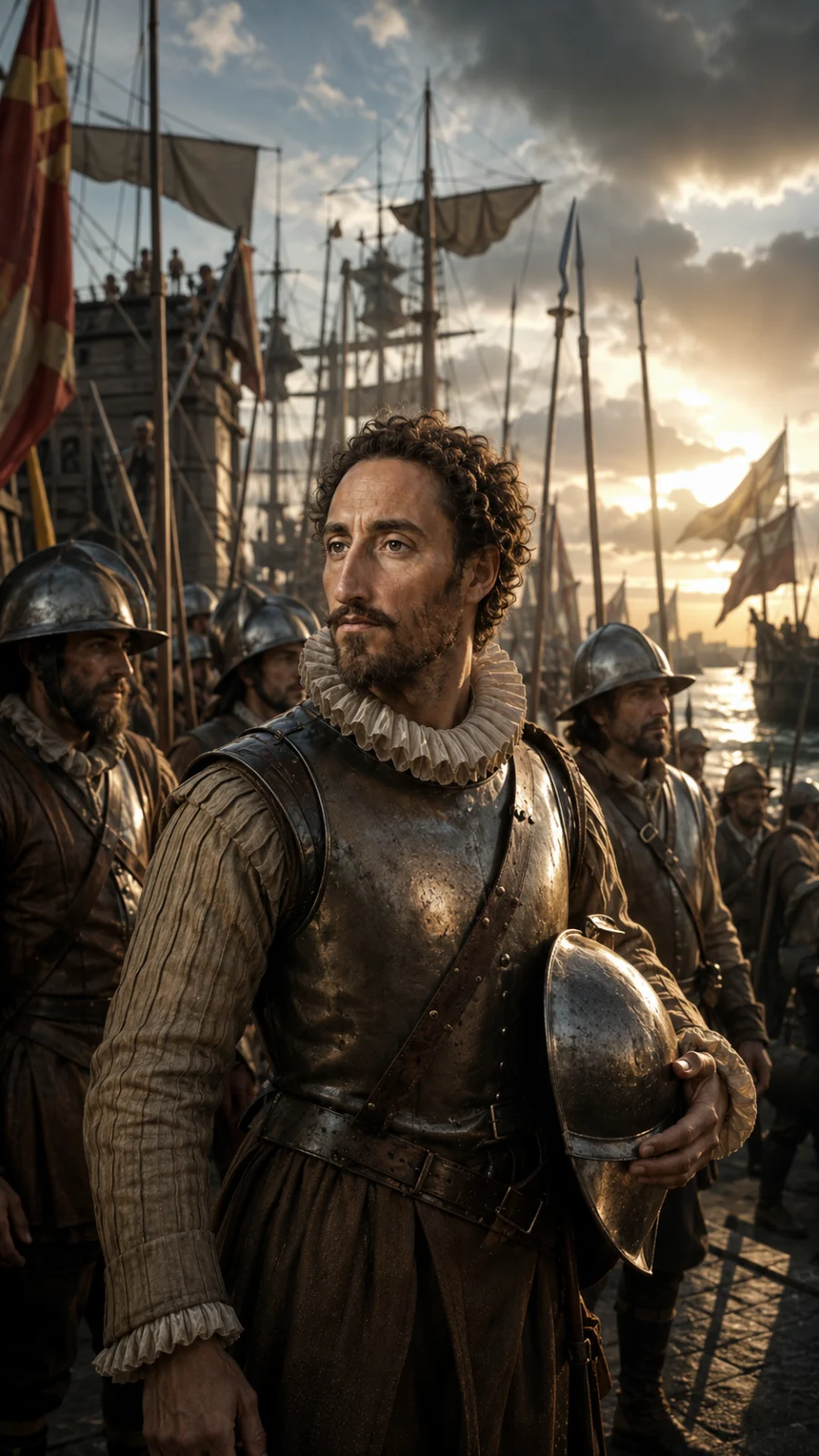
In 1587, Cervantes began working as a purchasing commissary for the Crown. His responsibility was to obtain wheat, barley, oil, and other supplies for naval campaigns, including preparations for the fleet known in English as the Spanish Armada.
The employment forced him to travel through Andalusia and negotiate—or clash—with farmers, landowners, municipal governments, and religious authorities. On several occasions, he requisitioned goods belonging to ecclesiastical institutions and was temporarily excommunicated, an administrative measure used to pressure him into returning or regularizing the resources (Canavaggio, 1990; McCrory, 2002).
He later worked collecting overdue taxes. He had to transport and account for large sums of money within an unreliable financial system. Some public funds were deposited with a banker who failed, and Cervantes could not immediately produce all the money demanded from him.
In 1597, he was imprisoned in Seville over irregularities in his accounts. This was not a conviction for proven theft but a detention connected with public funds he was required to justify (Canavaggio, 1990).
The little-known fact: he applied for a position in America
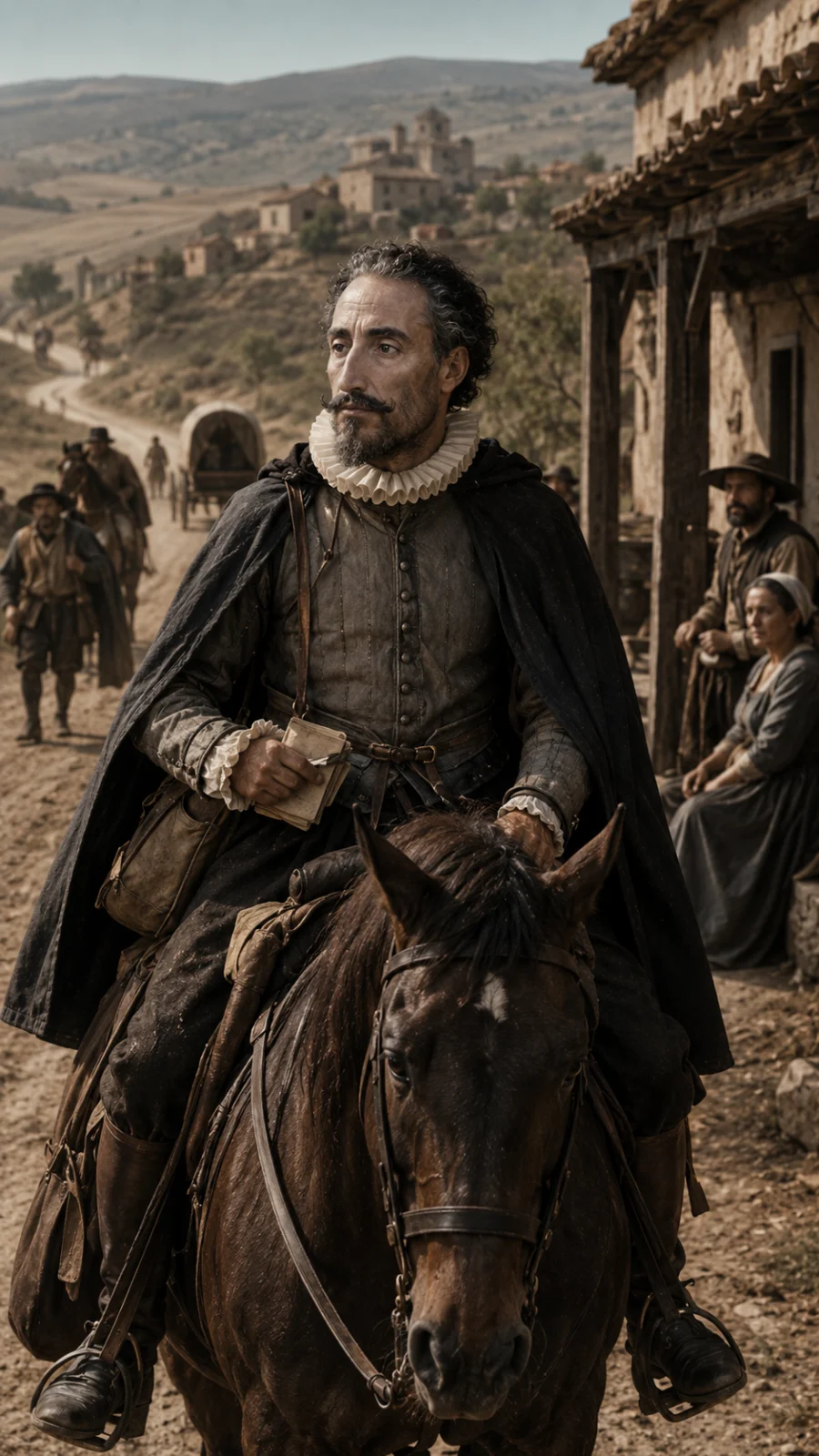
In May 1590, before that imprisonment, Cervantes submitted an application to the Council of the Indies. He sought one of four available positions: an accounting office in the New Kingdom of Granada, the governorship of Soconusco, an appointment in Cartagena de Indias, or the corregimiento of La Paz (De Armas Wilson, 2000; Sliwa, 2000).
The petition summarized his military service, wounds, and years in captivity. He did not ask to travel as a novelist or adventurer but as a servant of the imperial administration hoping to obtain the salary and position Spain had denied him.
The answer was negative. He was advised to seek employment within the kingdom.
The document reveals a possible life that never occurred. Cervantes came close to disappearing into the colonial bureaucracy. America, however, did not disappear from his imagination. The wealth, migrations, and contradictions of the transatlantic world appear indirectly in several of his works (De Armas Wilson, 2000).
The rejection forced him to remain in a Spain where he accumulated debts, uncertain employment, and experiences among people who rarely entered books: innkeepers, impoverished soldiers, officials, prisoners, farmers, actors, merchants, and travelers.
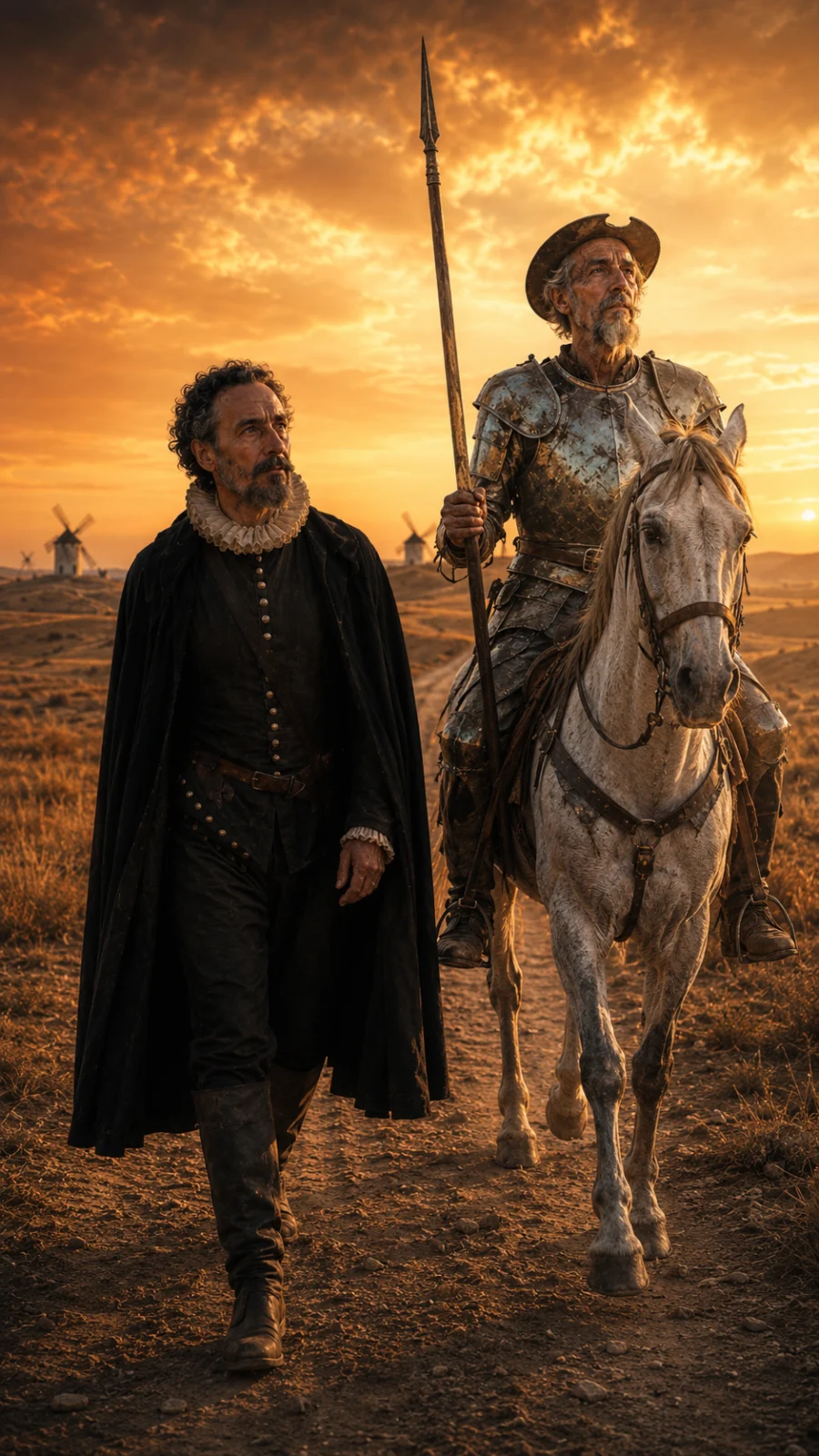
Don Quixote and Sancho Panza would emerge from that world.
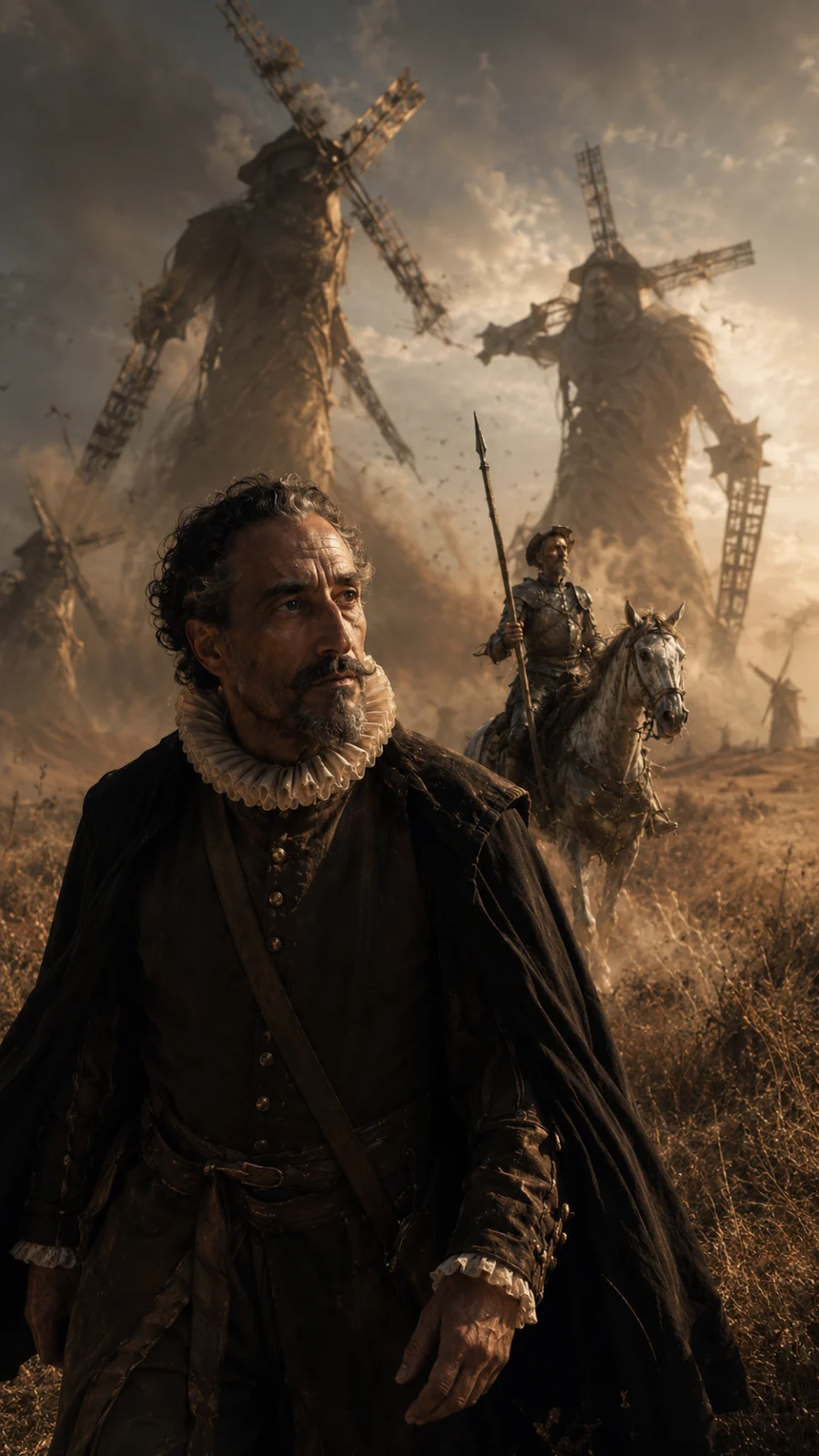
Did he write Don Quixote in prison?
The prologue to the first part states that the work was conceived in a prison, a place where every discomfort resides. The phrase produced the popular belief that Cervantes wrote Don Quixote while imprisoned in Seville.
There is no evidence that he composed the entire novel there. The wording may indicate that the idea originated during a period of imprisonment, but Cervantes may also have been using a literary image. Moreover, he experienced more than one detention, making it uncertain which prison he meant (Cervantes, 1605/2015; Canavaggio, 1990).
What can be established is that the first part of The Ingenious Gentleman Don Quixote of La Mancha appeared in Madrid in 1605. Cervantes was 57 years old.
The book began as a parody of chivalric romances. Alonso Quijano loses his judgment by reading those stories, adopts the name Don Quixote, and sets out to transform inns into castles, peasant women into princesses, and defeats into heroic trials.
Yet the novel quickly exceeded parody. Reality does not appear as a stable surface: it changes according to who tells it, who listens, and who needs to believe it. Sancho begins by viewing the world with practical common sense, while Don Quixote interprets it through books. Over time, each changes the other (Riley, 1986).
Cervantes incorporated discovered manuscripts, unreliable narrators, interrupted stories, and comments on the act of writing itself. The book seems to observe itself while being created. Because of that complexity, it is regarded as a foundational work in the development of the modern novel (Cascardi, 2002).
Fame that did not end poverty
Don Quixote quickly succeeded and was reprinted and translated. The publishing conditions of the period, however, prevented its author from receiving wealth proportional to the book’s popularity.
Cervantes continued writing. He published the Exemplary Novels in 1613; Journey to Parnassus in 1614; and, in 1615, his Eight Comedies and Eight New Interludes and the second part of Don Quixote.
In 1614, an author concealed behind the name Alonso Fernández de Avellaneda published an unauthorized continuation of the adventures. Cervantes was already working on his own second part, but he responded directly to the impostor and incorporated the rival book’s existence into his narrative (Canavaggio, 1990).
The characters in Part Two have read the first Don Quixote and know about the false sequel. Cervantes thus transformed a publishing attack into a narrative innovation: Don Quixote and Sancho began living inside a world where they were already famous literary characters.
At the end, Don Quixote regains his sanity and dies as Alonso Quijano. Cervantes thereby closed the possibility that another writer could continue appropriating the character.
Cervantes and Shakespeare did not die on the same day
Cervantes died in Madrid on April 22, 1616, and was buried the following day in the convent of the Discalced Trinitarians. It was long repeated that he died on April 23, the same date traditionally assigned to William Shakespeare’s death.
Even if Cervantes’s burial date is used, the two events did not occur on the same actual day. Spain followed the Gregorian calendar, while England still used the Julian calendar. England’s April 23 corresponded to May 3 in Spain. Their deaths were separated by approximately ten days (Canavaggio, 1990).
Shortly before dying, Cervantes completed the dedication of The Trials of Persiles and Sigismunda. The novel was published posthumously in 1617.
He died without knowing the future dimensions of his work. He had been a soldier, captive, fugitive, tax collector, prisoner, displaced dramatist, and rejected applicant. Most of his life seemed to unfold far from the success that now defines his name.
Cervantes wrote from visible and invisible wounds: a damaged hand, memories of captivity, poverty, bureaucracy, and the sensation of arriving late everywhere.
Yet from that fragmented life came an idea capable of surviving him: a person can be repeatedly defeated without completely surrendering the story they tell about themselves.
Don Quixote fails because the world does not correspond to his books. Cervantes succeeded because he transformed the distance between what we are and what we wish to be into literature.
References
Canavaggio, J. (1990). Cervantes (J. R. Jones, Trans.). W. W. Norton.
Cascardi, A. J. (Ed.). (2002). The Cambridge companion to Cervantes. Cambridge University Press.
Cervantes Saavedra, M. de. (2015). Don Quijote de la Mancha (F. Rico, Ed.). Real Academia Española & Alfaguara. (Original work published 1605 and 1615)
De Armas Wilson, D. (2000). Cervantes, the novel, and the New World. Oxford University Press.
McCrory, D. P. (2002). No ordinary man: The life and times of Miguel de Cervantes. Peter Owen.
Riley, E. C. (1986). Cervantes’s theory of the novel. Clarendon Press.
Sliwa, K. (2000). Documentos de Miguel de Cervantes Saavedra. Ediciones Universidad de Navarra.
More from this collection
Arthur Conan Doyle: The Man Who Invented Reason and Sought Comfort in the Invisible
Read story →
William Shakespeare: The Man Who Turned the Human Wound into Words
Read story →