In this storyOpen index
Henri Matisse: The Painter Who Liberated Color and Ended Up Drawing with Scissors
He liberated color from reality and, when his body changed, turned scissors and painted paper into a new visual language.
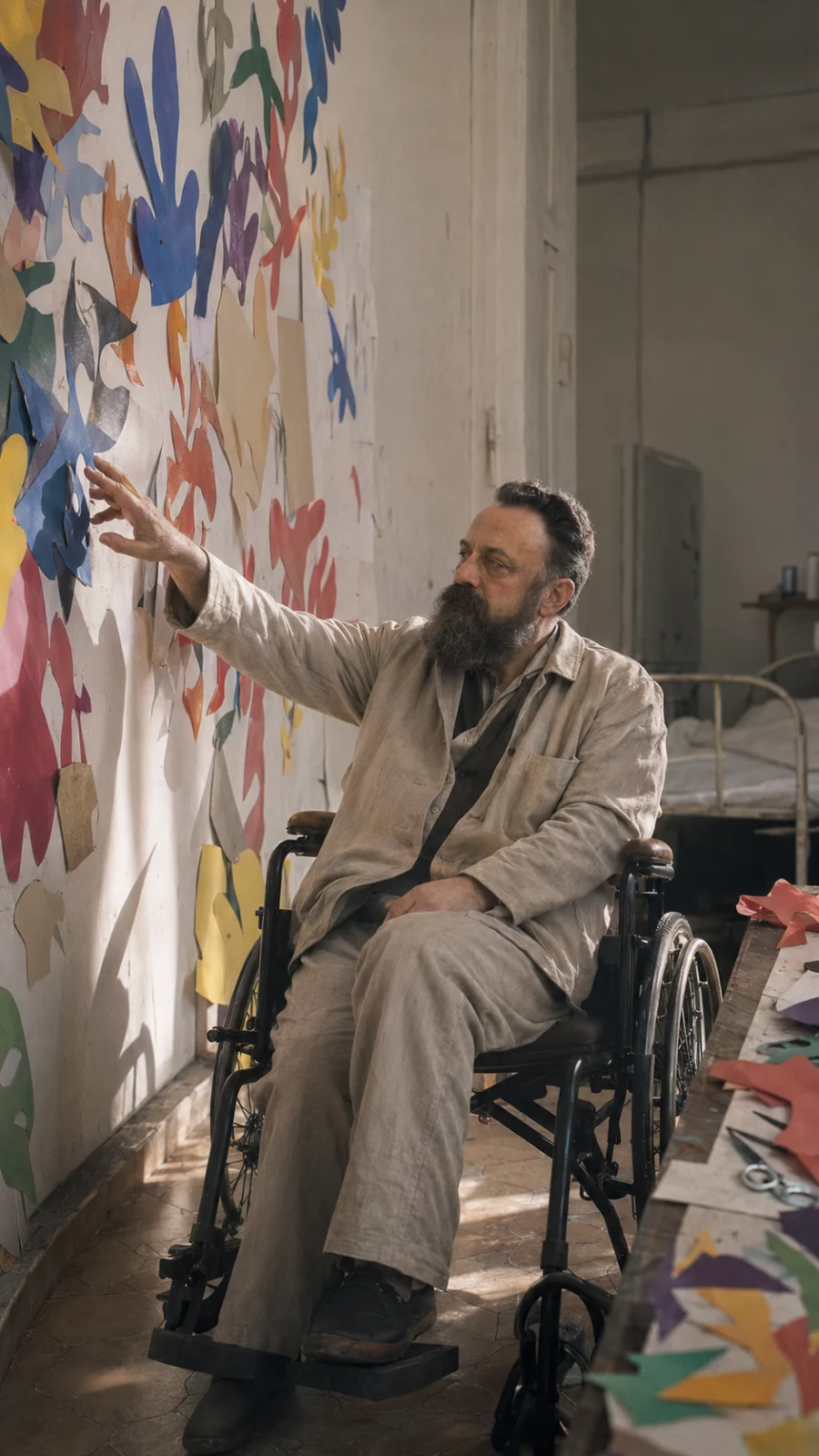
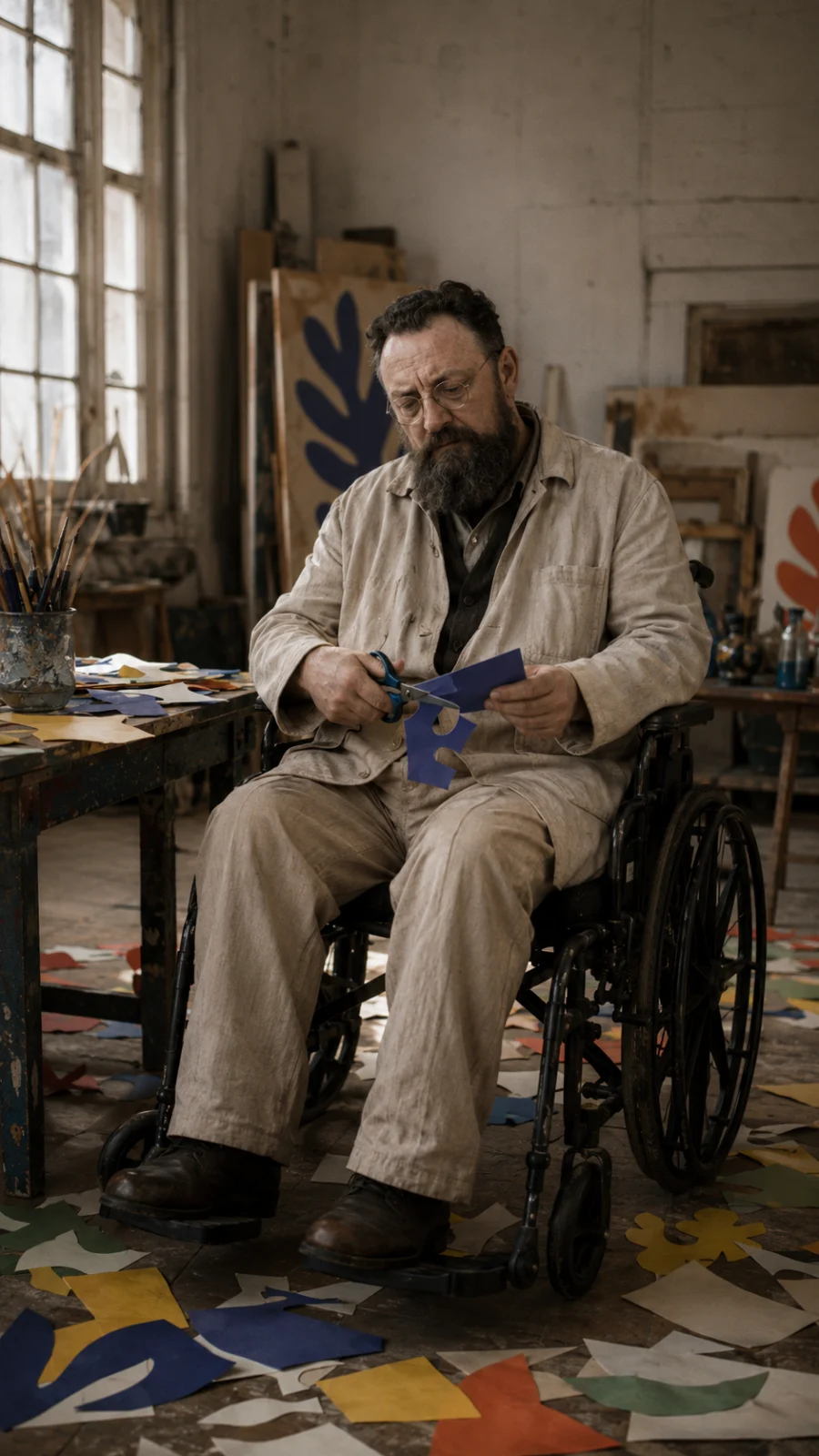
When his body no longer allowed him to work as before, he did not abandon art. He instructed assistants to paint large sheets of paper in intense colors, picked up a pair of scissors, and began cutting directly into the forms he imagined. Without detailed preliminary drawings and without attempting to conceal revisions, he transformed paper into leaves, bodies, stars, birds, and marine creatures.
The technique appeared simple, almost childlike. In reality, it was the conclusion of more than fifty years devoted to one question: how much could be removed from an image without destroying its ability to move the viewer?
Henri Matisse had spent his career freeing color from the obligation to imitate reality. During his final years, he also freed drawing from the pencil and the picture from its frame. Those cut-outs were not the hobby of a sick old man. They constituted a new way of creating images.
Henri Matisse on video
Discover this story on our YouTube channel.
A life told through places and decisive moments
Enter the archive
MoMA preserves and documents The Swimming Pool, the only cut-out Matisse conceived for a specific room and a work restored after more than twenty years off view.
- Collection
- Drawings and Prints
- Institution
- Museum of Modern Art
Institutional record from the Museum of Modern Art.
The lawyer who became ill and began to paint
Henri-Émile-Benoît Matisse was born on December 31, 1869, in Le Cateau-Cambrésis in northern France and grew up in the nearby town of Bohain-en-Vermandois. His family operated a business selling grain, seeds, and household materials and expected the young man to pursue a stable profession (Spurling, 1998).
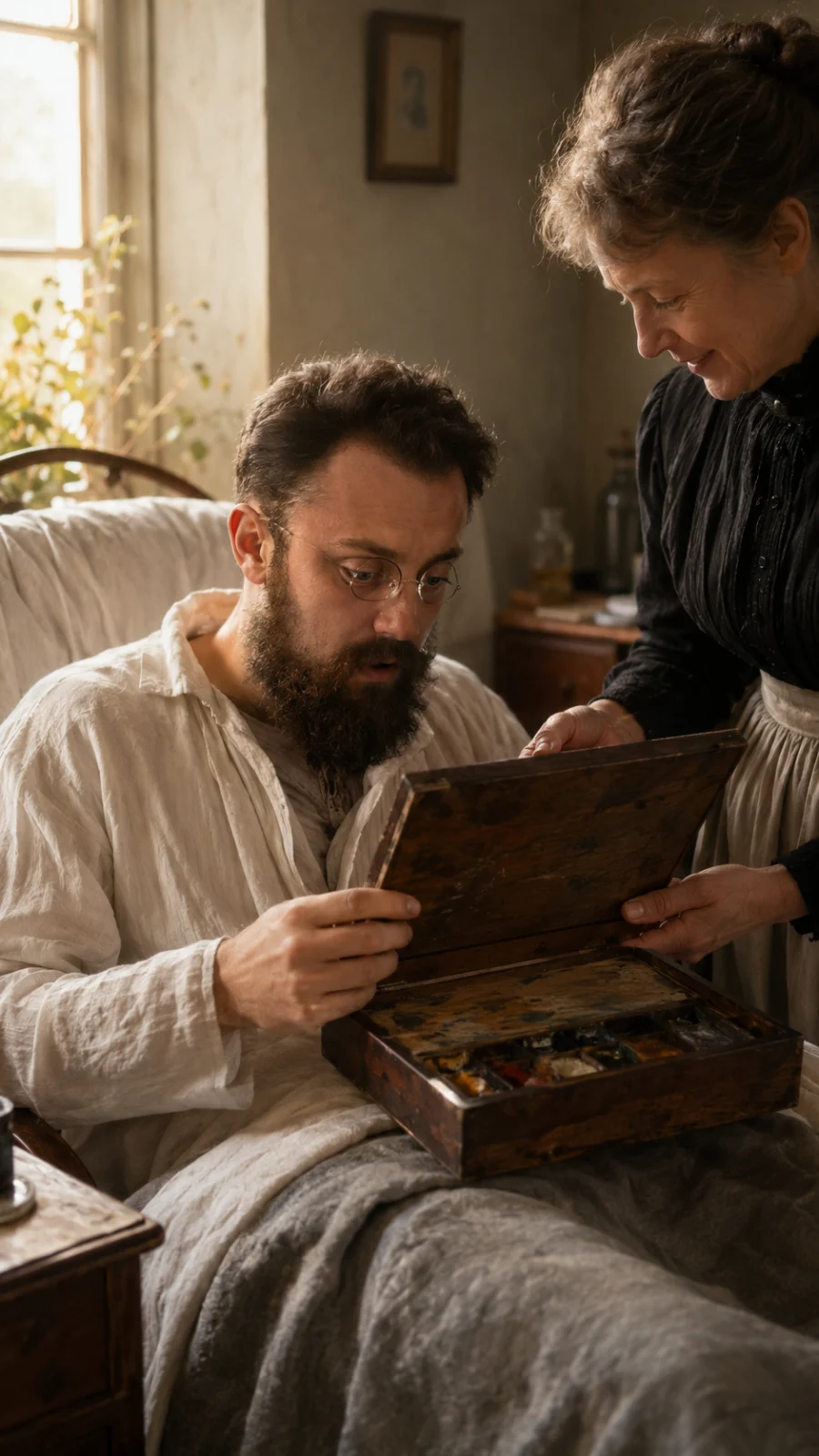
Matisse studied law in Paris and began working as a clerk in a legal office. He did not appear destined to become a painter. The transformation came in 1890, when an intestinal illness forced him to undergo a long recovery. His mother gave him painting supplies to help him pass the time.
The effect was decisive. Matisse later described the experience as the discovery of a kind of paradise. After recovering, he decided to abandon law and return to Paris to study art (Spurling, 1998).
His father reacted with concern. Painting offered no security, and Matisse was not a childhood prodigy who had spent his entire life drawing. He began relatively late and had to learn by copying works in the Louvre, studying anatomy, and working within an academic system he would soon find insufficient.
After attending the Académie Julian, he studied under Gustave Moreau at the École des Beaux-Arts. Moreau encouraged his students to develop personal visions rather than reproduce formulas. That freedom helped Matisse search for a language of his own (Spurling, 1998).
Learning from everyone without belonging to anyone
During his early years, Matisse experimented with very different styles. He studied the old masters, Impressionism, Paul Signac’s Neo-Impressionism, and Paul Cézanne’s pictorial structures. He also became interested in Japanese prints, Islamic decorative arts, and African sculpture.
In 1904, while working alongside Signac in Saint-Tropez, Matisse temporarily adopted the Pointillist technique. He soon felt, however, that dividing color into tiny dots limited the direct force he was seeking.
The following year, he traveled to Collioure with André Derain. There, both artists began using intense colors without subordinating them to the natural appearance of objects. A face could contain green, red, or blue, not because light literally produced those tones but because color could express tension, balance, or emotion (Elderfield, 1976).
Matisse was not trying to paint incorrectly. He was asserting that a painting did not need to copy the world in order to create a truthful experience.
The “wild beasts” of the Autumn Salon
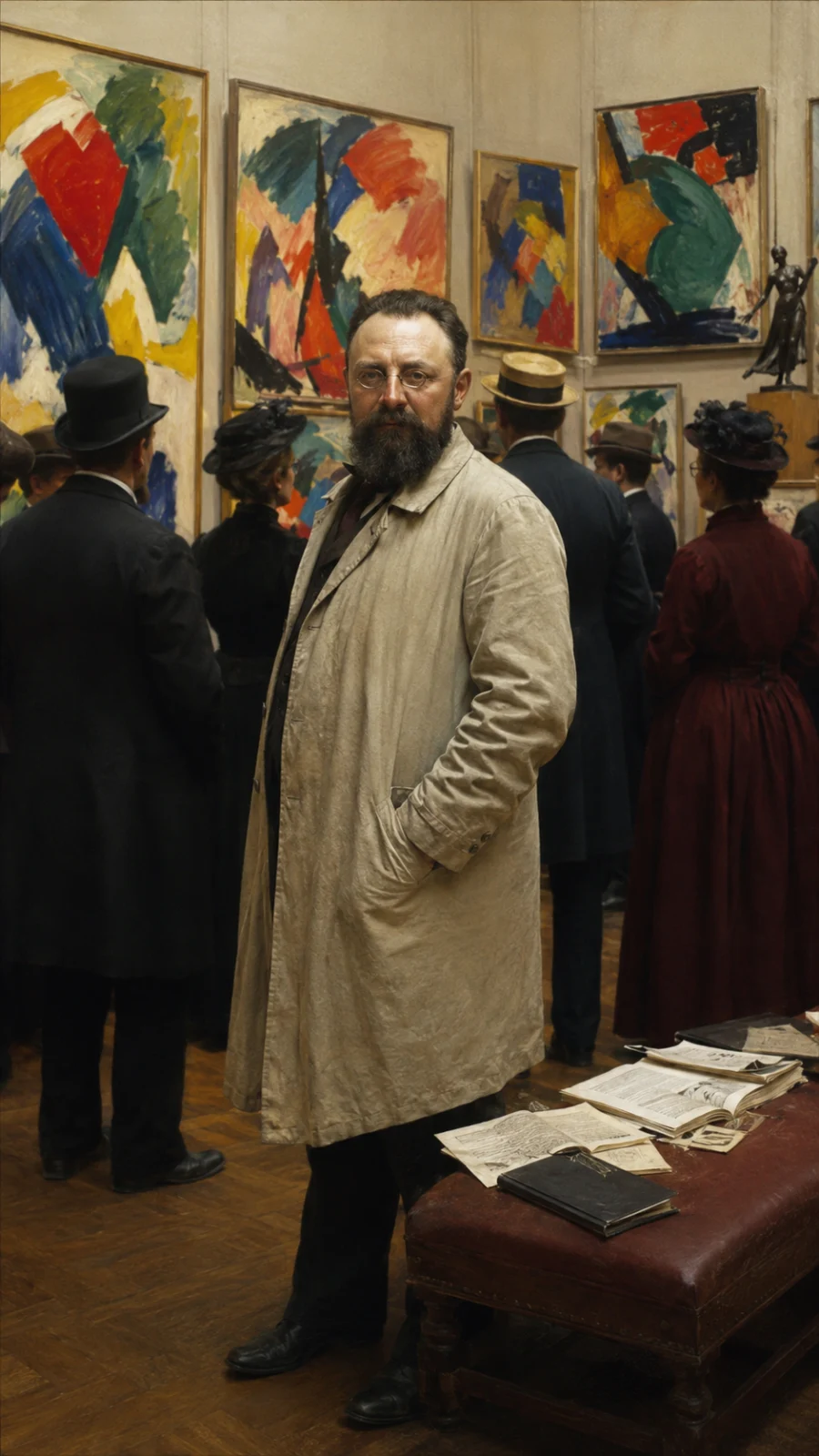
At the 1905 Salon d’Automne in Paris, Matisse, Derain, Maurice de Vlaminck, and other artists exhibited paintings filled with violent colors and visible brushwork. A traditionally styled sculpture stood in the same room.
Critic Louis Vauxcelles ironically described the scene as “Donatello among the wild beasts.” The expression helped give the painters their name: les fauves, the wild beasts (Elderfield, 1976).
One of the most controversial works was Woman with a Hat, a portrait of Amélie Matisse. The model’s face was crossed by areas of green, yellow, pink, and blue. To many visitors, it appeared either deliberately provocative or evidence of an inability to represent skin correctly.
Gertrude and Leo Stein purchased the painting. The acquisition helped support Matisse financially and gave the work international visibility within the circle of collectors, writers, and artists who visited the Stein home (Spurling, 1998).
Fauvism lasted only a few years as a recognizable group, but its consequences were profound. After those works, color no longer had to justify itself solely through light, atmosphere, or visible reality. It could independently organize the emotional structure of a painting.
An art that appeared simple
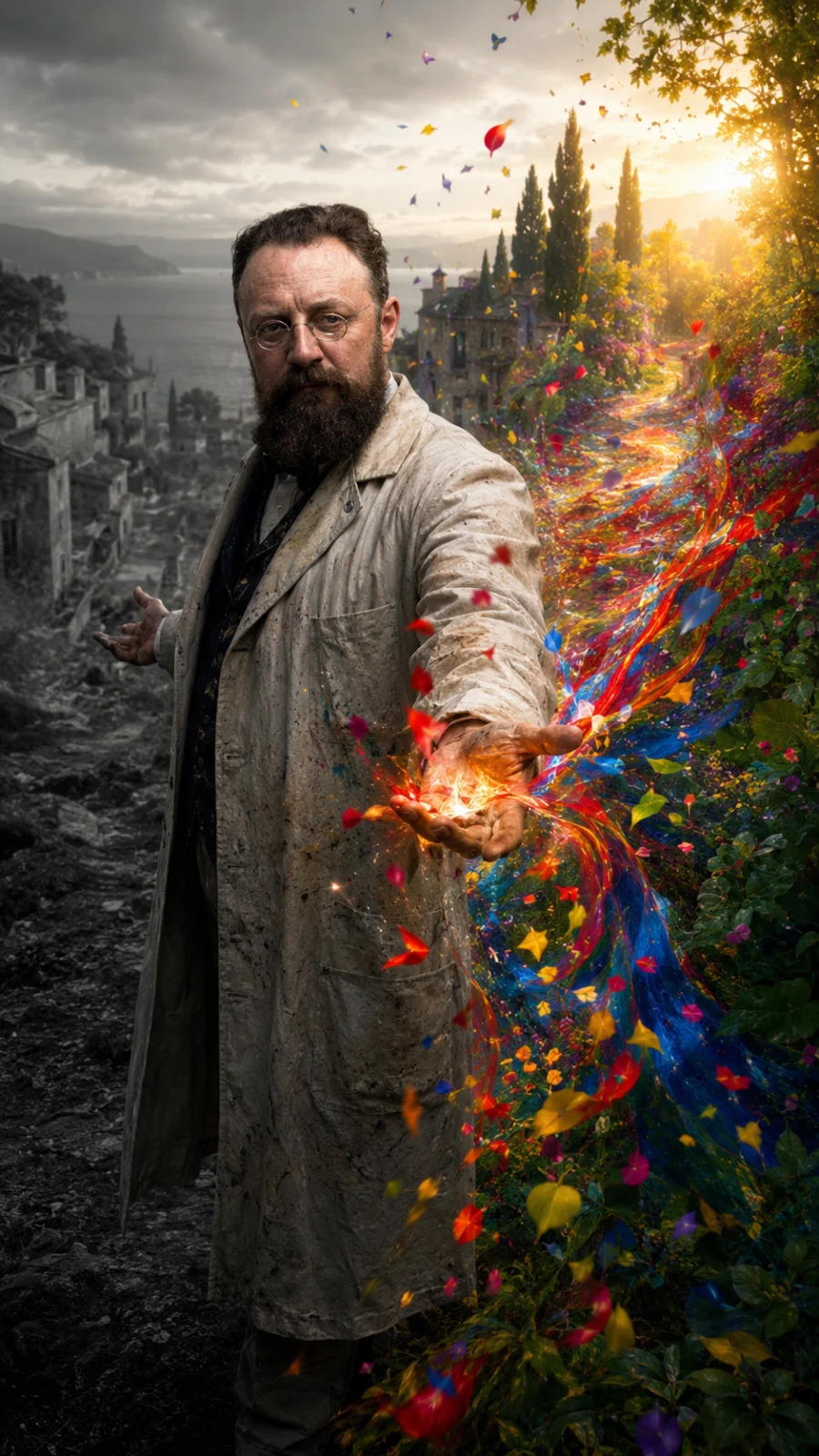
In works such as The Joy of Life, created between 1905 and 1906, Matisse reduced depth and distributed figures across a landscape made of broad areas of color. The proportions did not completely follow anatomy, while the lines appeared to move with the rhythm of a musical composition.
The apparent calm of these images could conceal the labor required to produce them. Matisse revised continuously. He painted, scraped, covered, and began again. His goal was not effort-free spontaneity but to make a complex organization appear inevitable (Flam, 1995).
In 1909, Russian collector Sergei Shchukin commissioned two large panels for his Moscow residence. Dance and Music used simplified figures and expansive surfaces of blue, green, and red.
In Dance, five bodies form a circle that seems about to break and then reassemble. The painting contains almost no unnecessary detail: nearly everything depends upon the tension between the rhythm of the figures and the three principal colors. That reduction helped establish a path Matisse would follow for the rest of his life (Spurling, 2005).
Matisse and Picasso: a rivalry without a winner
Matisse met Pablo Picasso during the early years of the twentieth century. The two artists watched, challenged, and influenced each other for decades. Their followers attempted to portray them as enemies: Matisse supposedly represented color and visual pleasure, while Picasso represented structure, rupture, and violence.
Their relationship was more complicated. They exchanged works, studied what the other was doing, and answered through their own paintings. Picasso understood that Matisse’s apparent serenity was constructed through radical decisions. Matisse recognized Picasso’s ability to break apart and reorganize forms (Spurling, 2005).
They did not travel along the same path, but each understood that the other was transforming the boundaries of modern painting.
Matisse also traveled to North Africa. His visits to Morocco in 1912 and 1913 intensified his interest in light, ornamental surfaces, and spaces where figure and background could merge (Cowart et al., 1990).
His later depictions of odalisques in decorated interiors reflected his fascination with textiles and Islamic visual traditions. They also belonged to the European Orientalist gaze, which transformed North Africa and the so-called East into imagined sensual settings for Western audiences. Recognizing that dimension makes it possible to appreciate their formal beauty without ignoring the cultural context that produced them.
Nice and rooms transformed into worlds
Matisse began spending long periods in Nice around 1917. There he painted hotel rooms, open windows, reclining models, fabrics, and decorative objects. At first glance, he appeared to have moved away from Fauvism’s radical disruptions.
Yet he continued investigating the relationship between surface and depth. A window could operate simultaneously as an opening toward the exterior and as a rectangle of color within the painting. Walls, carpets, and dresses reduced the separation between the body and its surroundings.
In The Red Studio, painted in 1911, he had already covered almost the entire room with a uniform red. Furniture and paintings are defined by lines that appear to emerge from the surface itself. Space does not vanish, but it ceases to behave according to traditional rules of perspective.
Matisse sought an art of balance and clarity. That aspiration was sometimes interpreted as mere decoration. Yet creating serenity during decades marked by wars and crises did not mean ignoring the world’s violence. It was a deliberate response to it (Flam, 1995).
An operation and the beginning of another life
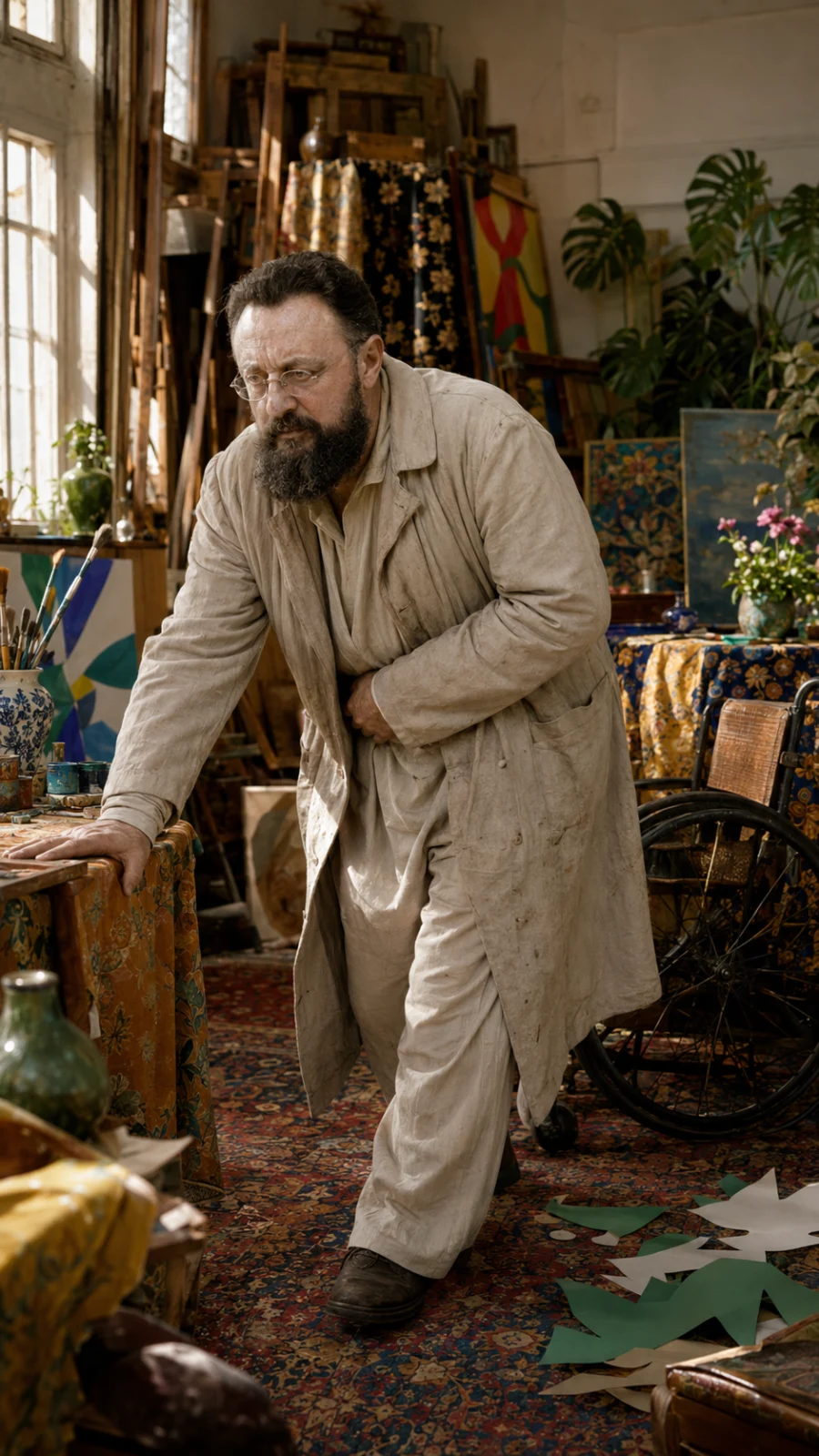
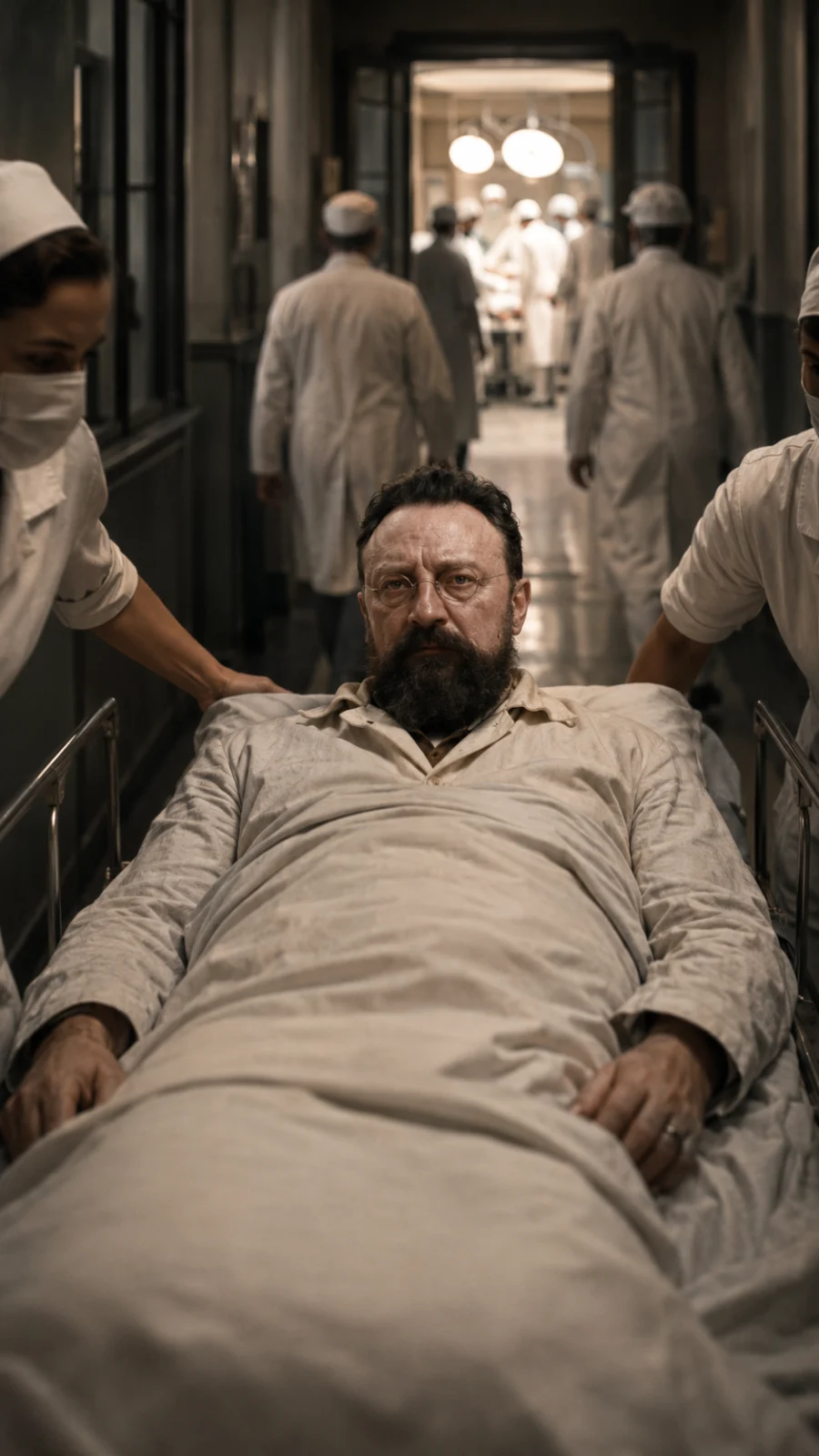
In 1941, at the age of 71, Matisse underwent major intestinal surgery. He survived, but his mobility became considerably restricted. He spent long periods in bed or used a wheelchair and required assistants to organize his materials.
It is often said that he stopped painting and began making cut-outs because he could no longer hold a brush. The reality is more nuanced. He continued to draw and paint, sometimes using brushes attached to long handles. He had also previously employed cut paper while planning compositions and murals (Buchberg et al., 2014).
His illness did not invent the technique, but it transformed it into an independent language.
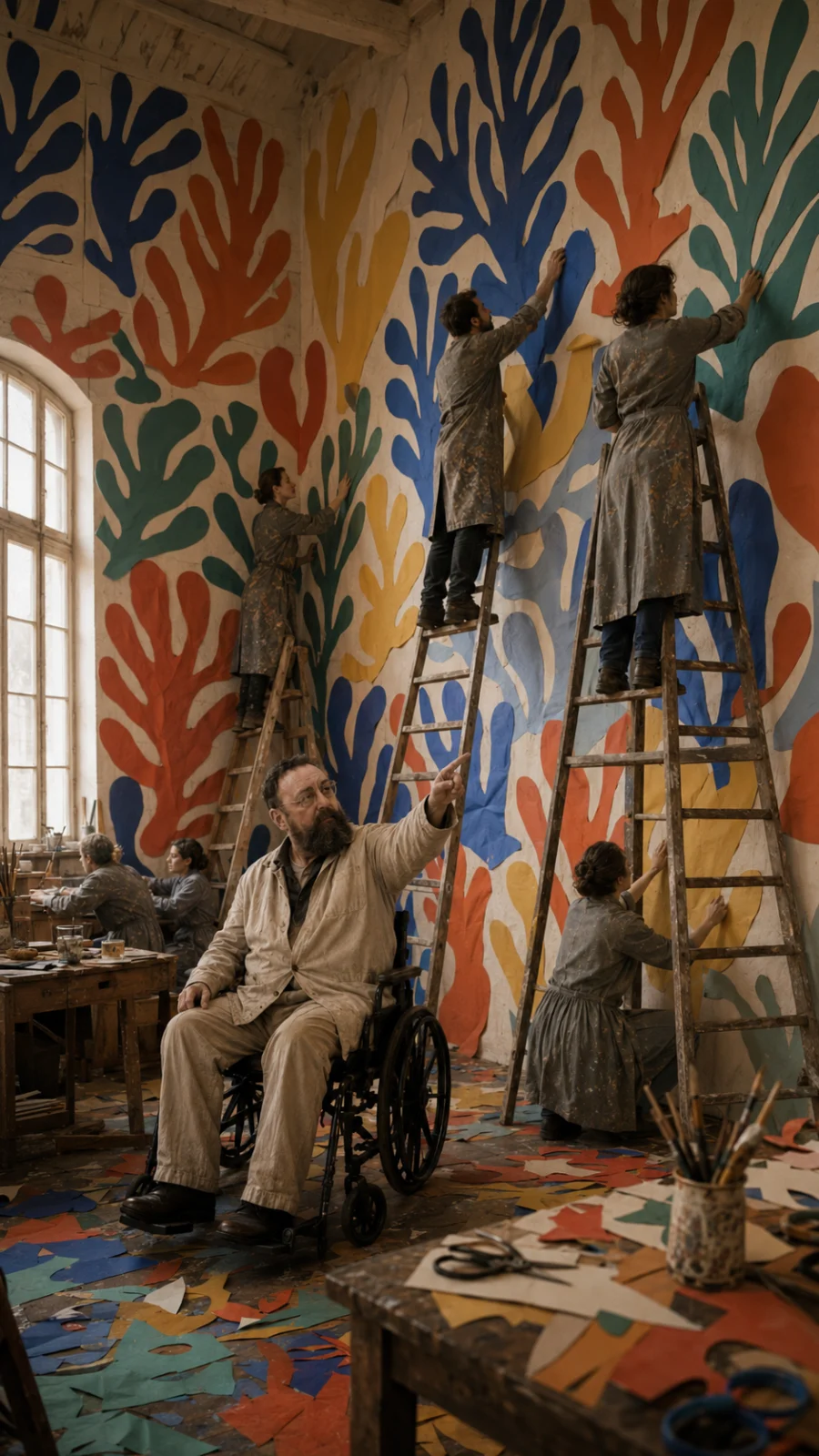
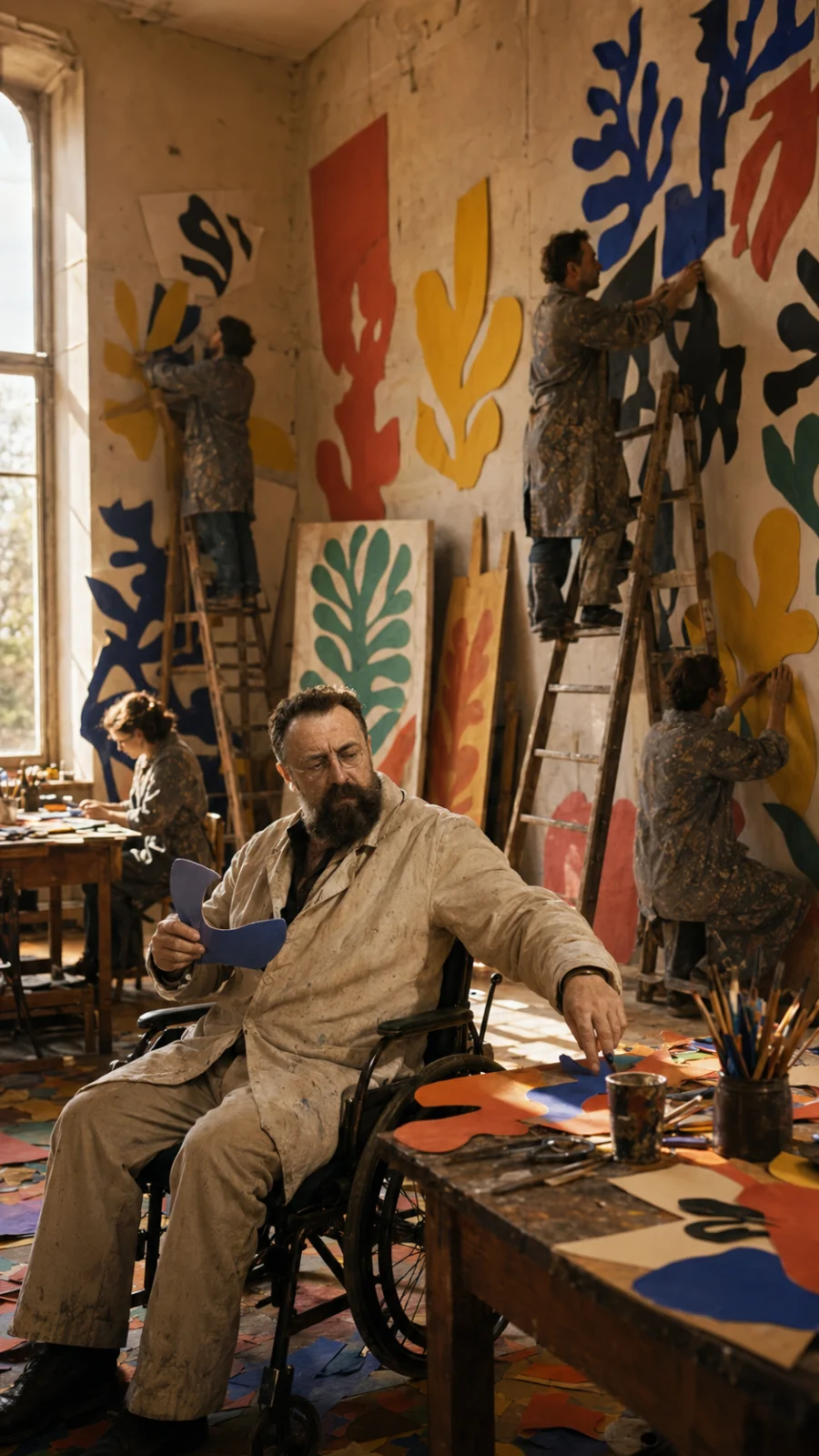
His assistants covered sheets of paper with gouache according to his instructions. Matisse cut the shapes directly with scissors, while another person pinned them to the walls. He could move them, replace them, and alter the composition until he found the desired balance.
He called this procedure “drawing with scissors.” Cutting created both contour and figure at the same time: there was no need to draw a line around a shape because the scissors produced both elements in a single gesture (Buchberg et al., 2014).
The little-known fact: the cut-outs were not small works
Reproductions in books can create the impression that Matisse’s cut-outs were manageable compositions. Some occupied entire walls. His bedroom and studio became environments covered with bodies, leaves, and colored forms temporarily held in place by pins.
In The Swimming Pool, created in 1952, a band of blue figures moves around the walls as if swimmers were circling the viewer. The work originated after Matisse visited a swimming pool and decided to create an experience capable of surrounding him inside his own home (Buchberg et al., 2014).
The book Jazz, published in 1947, brought together images derived from cut-outs and handwritten texts by the artist. It included circus scenes, stars, bodies, and the figure of Icarus. Its title suggested improvisation, variation, and rhythm, although the complete work had been carefully prepared.
Works such as The Snail, The Sorrows of the King, and the Blue Nudes series carried simplification to an extreme. A body could be constructed from only a few blue fragments separated by the white background. The absences became as important as the colored paper.
The nurse who inspired a chapel
During his recovery, Matisse met Monique Bourgeois, a young nurse who also posed for several portraits. She later entered the Dominican order and took the name Sister Jacques-Marie.
Years later, she told him about the need to build a chapel for her community in Vence. Matisse eventually became involved in the project and, beginning in 1947, designed not only the stained glass and images but also architectural elements, ceramic murals, furniture, and liturgical vestments (Spurling, 2005).
The Chapel of the Rosary opened in 1951. Light passes through yellow, green, and blue glass, while extremely simple black drawings extend across the white walls. Architecture, color, drawing, and objects become parts of a single composition.
Matisse, who was not a practicing Catholic during those years, considered the chapel the culmination of his artistic life. It was not merely a devotional act or a decorative commission. It represented the possibility of transforming an entire room into a work constructed from light (Spurling, 2005).
Color after Matisse
Matisse died in Nice on November 3, 1954, at the age of 84. By then, he had demonstrated that intensity did not depend upon faithfully copying an object or filling a surface with details.
His influence extended into abstract painting, graphic design, illustration, fashion, and installation art. Later artists found in his cut-outs a way to combine color, scale, and space without preserving the traditional boundaries of the picture.
The apparent joyfulness of his art can be misleading. Behind those luminous surfaces lay doubt, revision, and years of work. Matisse did not paint intense colors because the world was simple. He used them to construct an order he could not find outside the studio.
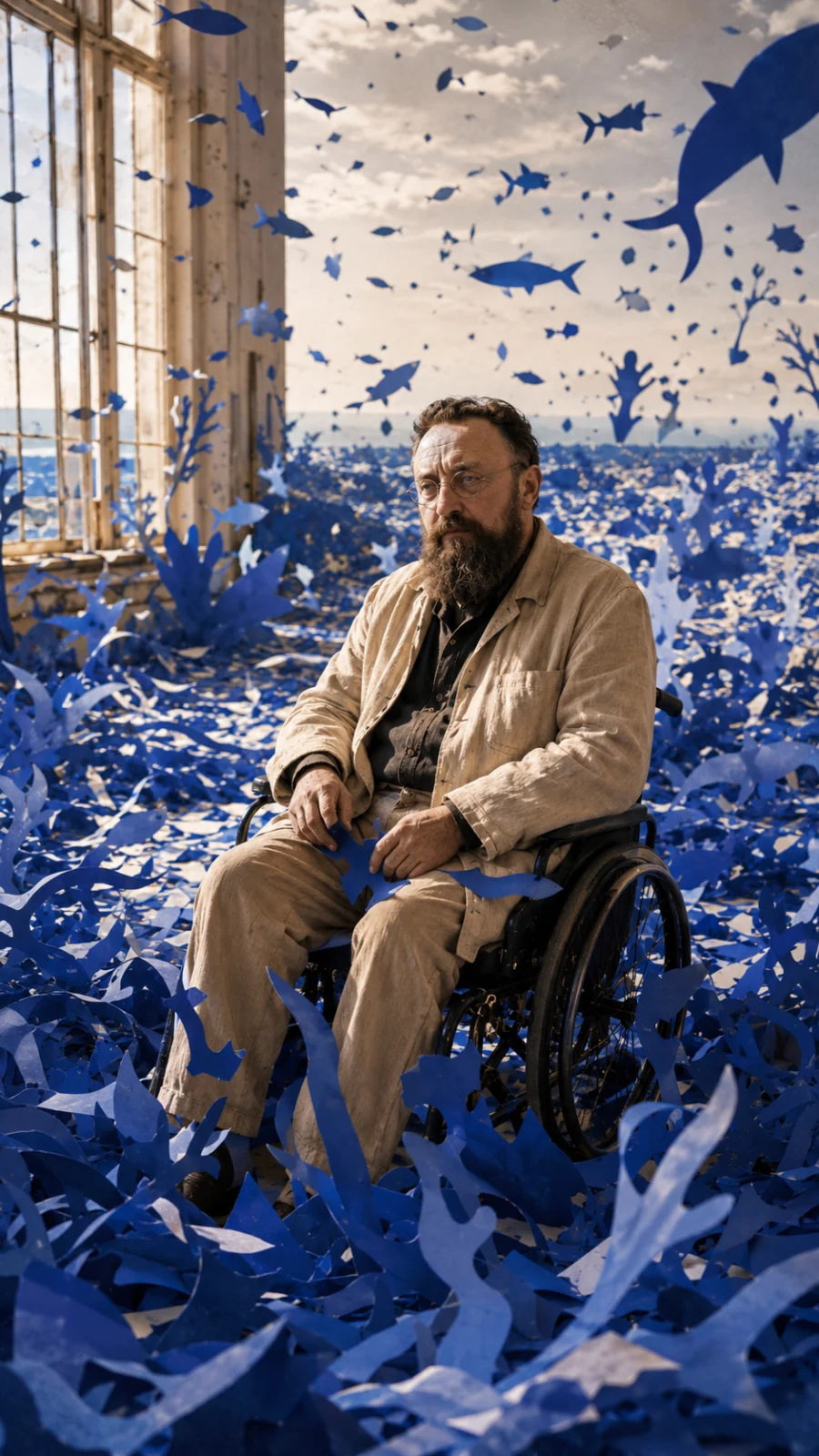
When he could no longer move freely through space, he brought space onto the walls surrounding him. He cut out bodies, plants, and oceans that he could rearrange from a chair or bed.
He did not turn physical limitation into a final note. He turned it into another beginning. First, he liberated color from reality. Then he liberated painting from the canvas. Finally, he demonstrated that a pair of scissors could once again change the way we see.
References
Buchberg, K., Eshoo, C., & Starke, N. (Eds.). (2014). Henri Matisse: The cut-outs. Museum of Modern Art.
Cowart, J., Duthuit, C., Cowart, J. R., & Schneider, P. (1990). Matisse in Morocco: The paintings and drawings, 1912–1913. National Gallery of Art.
Elderfield, J. (1976). The “wild beasts”: Fauvism and its affinities. Museum of Modern Art.
Flam, J. D. (Ed.). (1995). Matisse on art (Rev. ed.). University of California Press.
Spurling, H. (1998). The unknown Matisse: A life of Henri Matisse, the early years, 1869–1908. Alfred A. Knopf.
Spurling, H. (2005). Matisse the master: A life of Henri Matisse, the conquest of colour, 1909–1954. Alfred A. Knopf.
More from this collection
Artemisia Gentileschi: The Painter Who Made Women the Protagonists of Their Own Stories
Read story →
Pablo Picasso: The Man Who Shattered the Way We See
Read story →