In this storyOpen index
Dante Alighieri: The Man Who Turned Exile into a Journey Through the Afterlife
Florence, Beatrice and exile: how Dante transformed a fractured life into the universe of the Comedy.
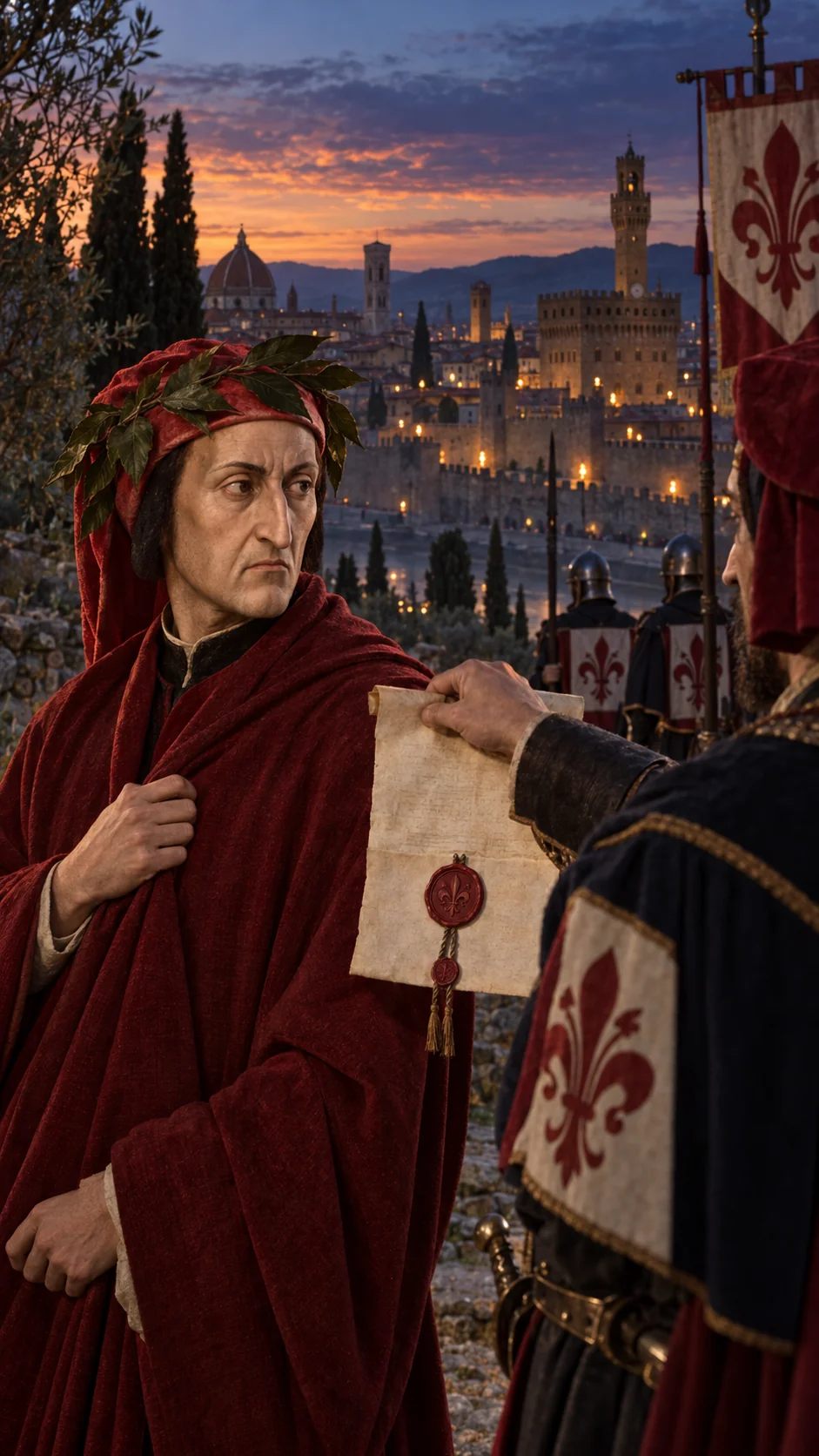
Dante Alighieri did not write the story of a man lost in a forest merely to discuss sin, salvation, or life after death. He also wrote from the experience of someone who had lost his city, political position, possessions, and opportunity to return home without humiliation.
By the time he began the Comedy, Florence was no longer simply his birthplace. It was a locked door.
The journey through Hell, Purgatory, and Paradise emerged from that wound. Dante turned his enemies into characters, questioned the dead, passed judgement on popes and rulers, and used poetry to reconstruct the order he could not find in Italy. His work was not an escape from the world: it was a trial against it.
Dante Alighieri
A life between Florence and exile
Museo Dante: the traces of an absence
In Ravenna, Museo Dante preserves the wooden box that held the poet’s remains from 1677 until their recovery in 1865. Its galleries explore Dante’s life, work and memory near his tomb and the former Franciscan convent. The link opens the museum’s official information; this illustration is an AI recreation, not a photograph of its exhibits.
The Boy Who Encountered Beatrice
Dante was born in Florence in 1265, probably between late May and early June. He belonged to a Guelph family of modest means, although he later attempted to attribute a prestigious ancestry to it. Much of what is known about his youth comes from his own writings, where memory, literature, and the construction of a public identity are constantly intertwined (Wetherbee & Aleksander, 2024).
According to the Vita nuova, he was nine years old when he first saw Beatrice, traditionally identified as Beatrice Portinari. He encountered her again nine years later and transformed the greeting she gave him into a spiritual event.
This does not mean that they experienced a love affair in the modern sense. Their documented contact was minimal, and the story depends principally on Dante’s poetic account. Beatrice married Simone de’ Bardi, while Dante married Gemma Donati, with whom he had several children. When Beatrice died in 1290 at approximately twenty-four, Dante turned her loss into the centre of a new conception of poetry.
In the Vita nuova, written during the 1290s, Beatrice ceases to be only a beloved woman and becomes an intermediary between the poet and the divine. The book concludes with a promise to write about her what had never been written about any woman. The Comedy would fulfil that promise many years later (Treccani, n.d.).
A Poet on the Battlefield
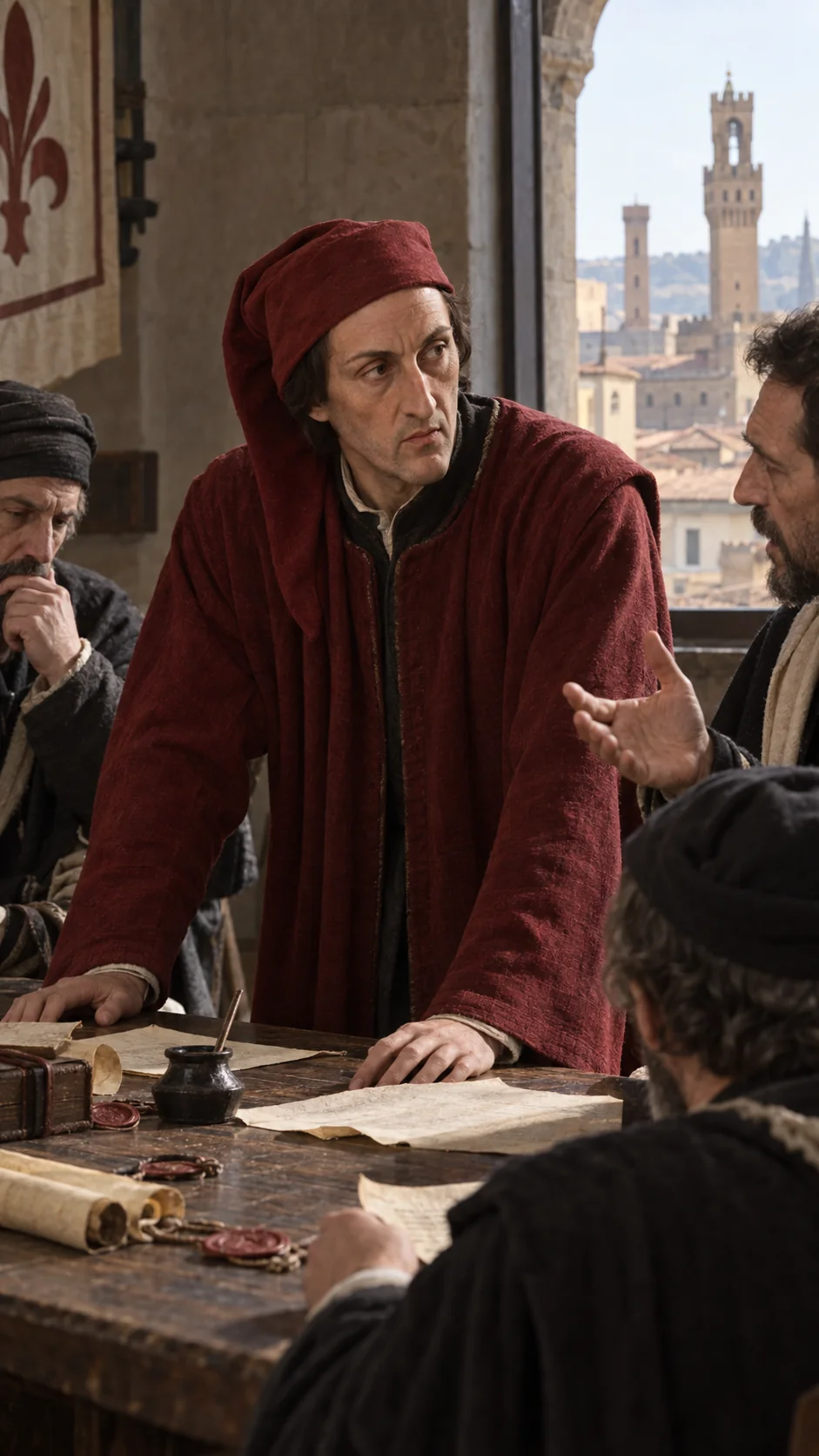
Dante did not live enclosed among books. In 1289, he fought at the Battle of Campaldino, where the Florentine Guelphs defeated the Ghibelline forces of Arezzo. Political violence was not a philosophical abstraction to him: he knew fear, combat, and the consequences of rivalries between cities.
Florence was shaped by conflict between the Guelphs, historically aligned with the papacy, and the Ghibellines, associated with the imperial cause. After gaining control, the Guelphs divided among themselves. The Blacks favoured closer relations with papal power, while the Whites—Dante’s faction—resisted excessive papal intervention in Florentine affairs.
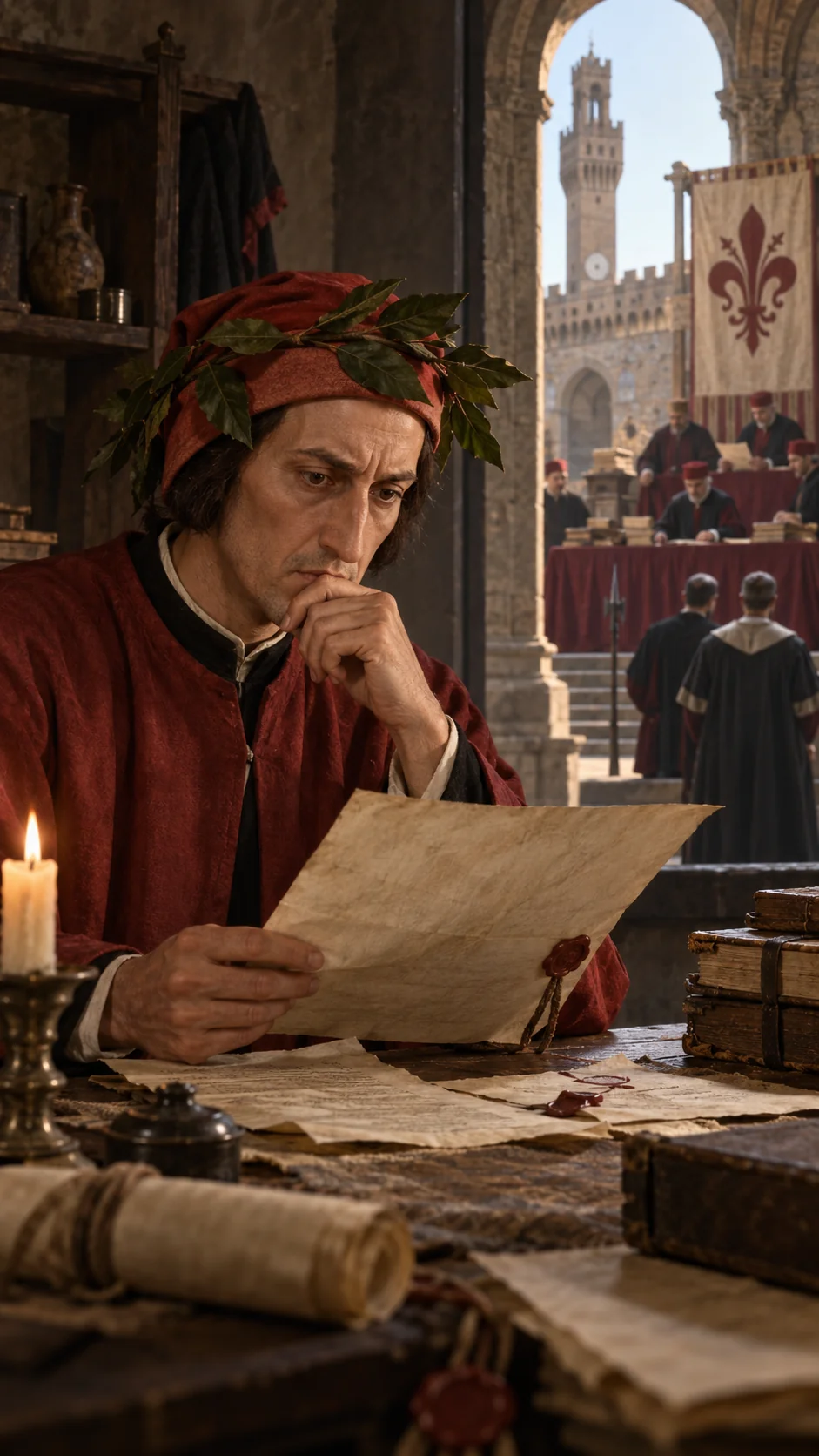
To participate in politics, Dante enrolled in the physicians’ and apothecaries’ guild, an affiliation that allowed intellectuals without a manual trade to hold public office. He sat on several councils and, in 1300, was elected one of Florence’s priors, the republic’s highest magistrates.
His term lasted only two months, as the city’s rules required, but it had serious consequences. To curb street violence, the priors temporarily exiled leaders from both factions, including Guido Cavalcanti, Dante’s close friend. Politics forced him to act against members of his own circle.
The Sentence That Never Ended
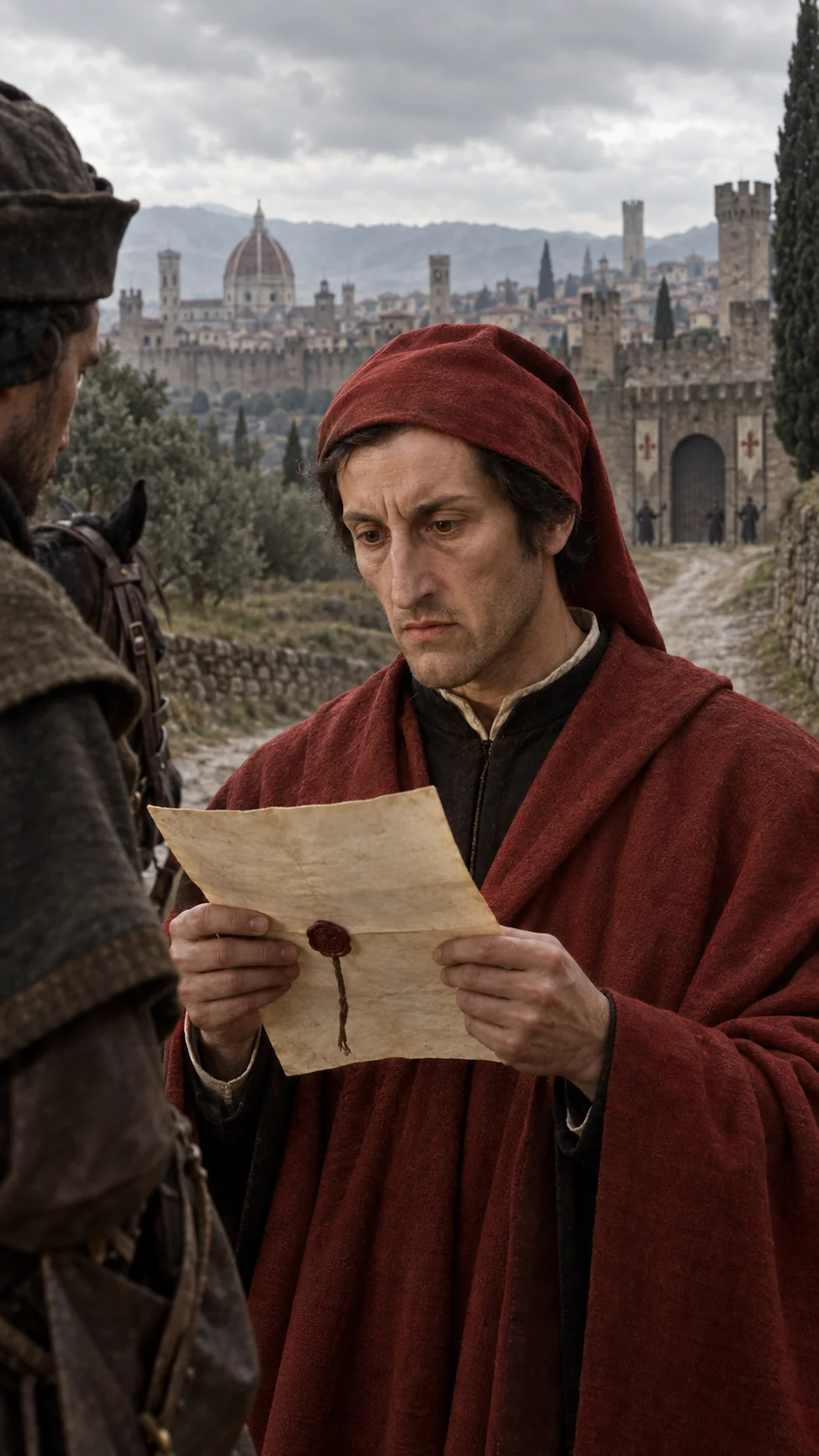
In 1301, Pope Boniface VIII supported the intervention of Charles of Valois in Florence. While Dante was away from the city—traditionally as a member of an embassy to the pope—the Black Guelphs seized power.
In January 1302, Dante was accused of corruption, fraud, and opposition to the pontiff. He received a fine, exile, and permanent exclusion from public office. When he neither appeared nor paid, a second sentence declared that he would be burned alive if captured by Florentine authorities (Treccani, n.d.).
He never saw Florence again.
During the early years of exile, he cooperated with other White exiles who sought to return through negotiation or military action. He eventually separated from them and began moving between courts and cities in northern Italy. He depended on patrons such as the Malaspina family and Cangrande della Scala, lord of Verona.
In 1315, Florence allowed certain exiles to return if they paid a fine and underwent a public ceremony of penance. Dante refused the conditions. To accept them, he believed, would amount to confessing guilt. The city consequently renewed the sentence and extended its threat to his sons (Francis, 2021).
His pride cost him his homeland but preserved the voice from which he would write.
The Bread of Others
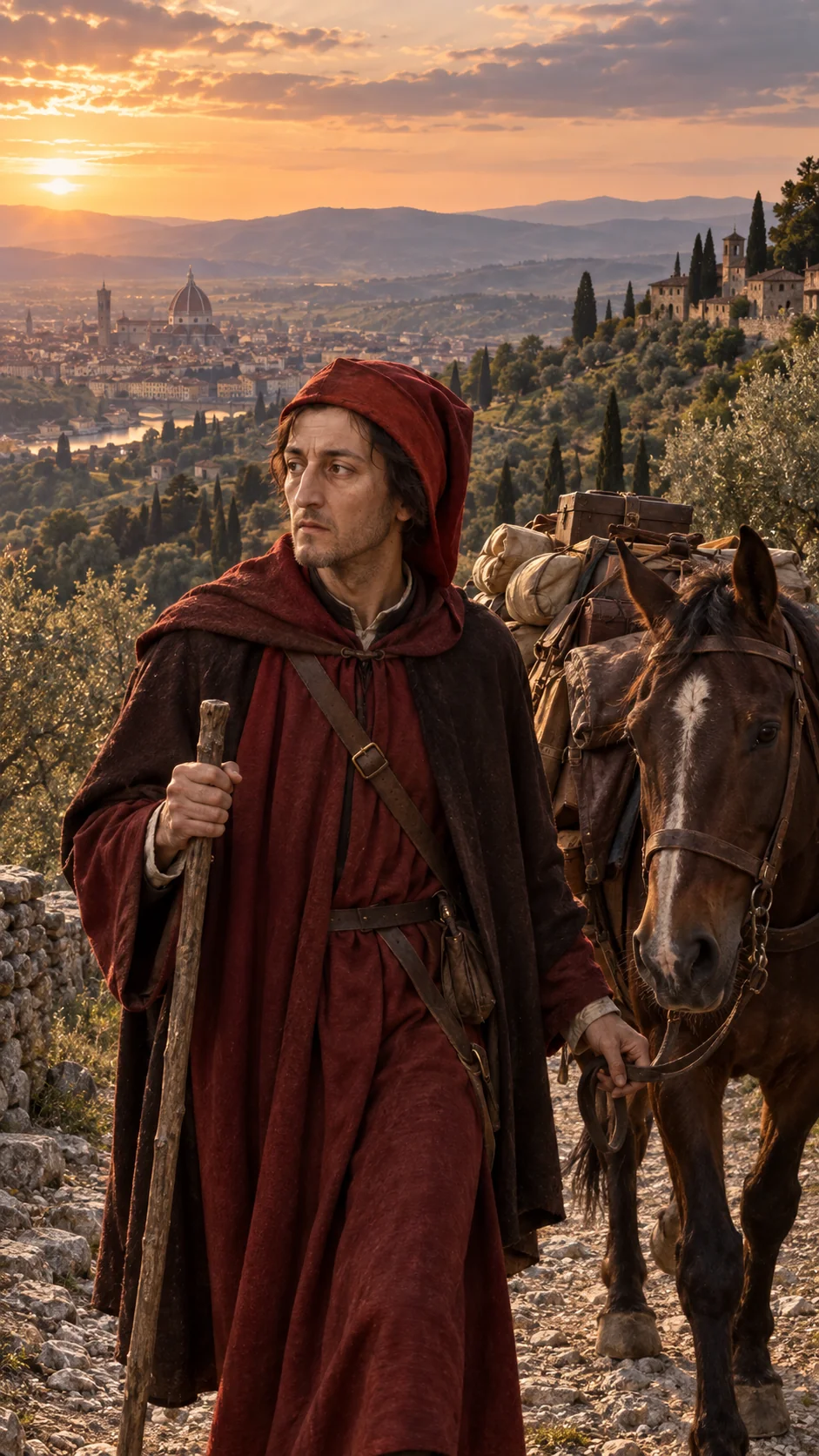
In Canto XVII of Paradiso, Dante’s ancestor Cacciaguida foretells the pain of exile: he will abandon everything most dearly loved and learn how salty another person’s bread tastes and how difficult it is to climb and descend another person’s stairs.
The image of salty bread conveys the bitterness of depending on others. It is often connected with Tuscany’s tradition of unsalted bread, but it should not be reduced to a culinary explanation. In the poem, it represents dependence: an exile had to eat at his patrons’ tables, accommodate their decisions, and remain grateful for hospitality that might disappear.
Exile transformed Dante. Before 1302, he had written primarily as a love poet and Florentine citizen. Afterwards, he became an intellectual who intended to address all of Italy. In the Convivio, he attempted to offer philosophical knowledge to readers who did not know Latin. In De vulgari eloquentia, he studied the possibility of a shared literary language. In Monarchia, he defended an imperial authority independent of the papacy’s temporal power (Wetherbee & Aleksander, 2024).
A private wound became a cultural project.
The Book That Contained a World
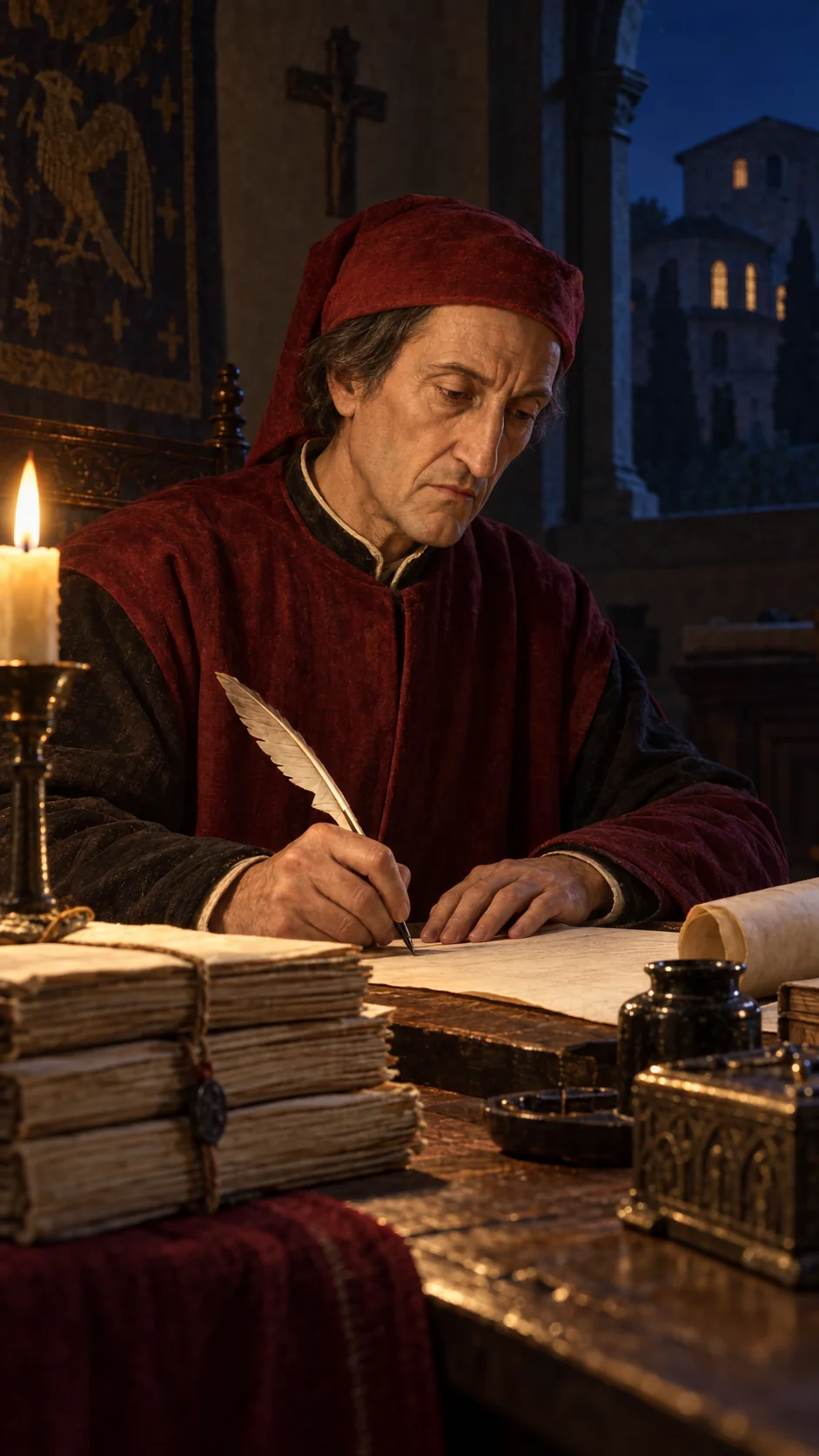
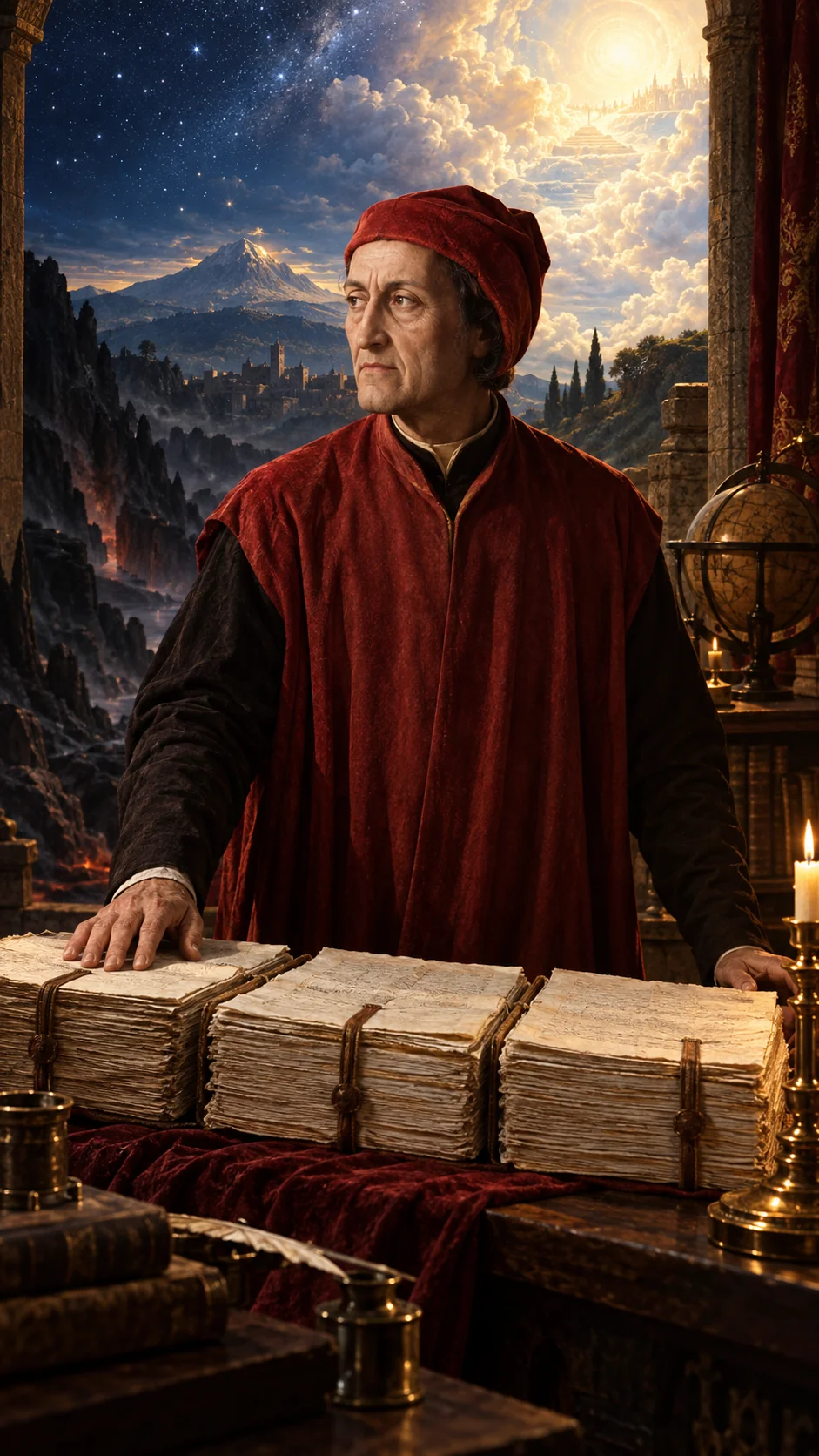
Dante probably began the Comedy during the early years of exile and continued working on it until the end of his life. The poem contains one hundred cantos distributed across Inferno, Purgatorio, and Paradiso. It employs interlocking three-line stanzas—terza rima—whose rhyme pattern continually drives the poem forward.
The action is set in 1300. Dante, lost midway through life in a dark wood, is guided through Hell and Purgatory by the Roman poet Virgil. Virgil represents reason and human wisdom but cannot enter Paradise. Beatrice then becomes Dante’s guide until Saint Bernard prepares him for the final vision of God.
The poem combines theology, astronomy, philosophy, history, satire, personal memory, and contemporary politics. Its dead are not silent figures: they argue, remember, justify their choices, and contradict the traveller. Dante speaks with teachers, enemies, lovers, warriors, popes, and former fellow citizens.
He does more than imagine punishments. He asks what makes a life just, how far reason can reach, and what happens when desire is directed toward the wrong object.
Dante Alighieri: continue the journey
Writing in the Language of the Street
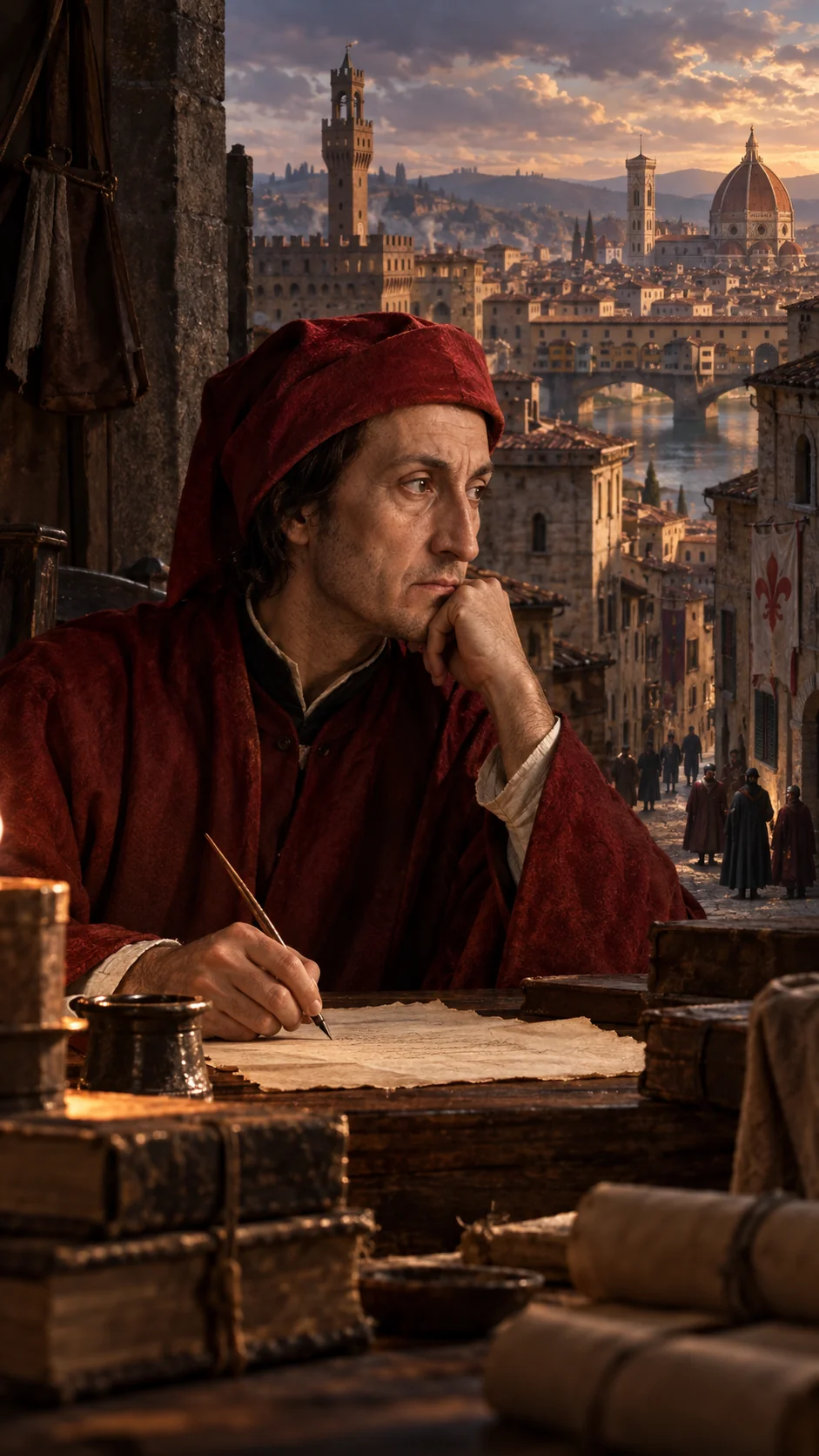
The great intellectual works of medieval Europe were generally composed in Latin. Dante mastered that language and used it in several treatises, but he wrote the Comedy in the Tuscan vernacular.
This decision allowed philosophy, theology, and politics to enter a language also associated with commerce, conversation, and ordinary life. Dante mixed elevated and vulgar registers, tenderness and obscenity, prayers and street arguments. He demonstrated that a vernacular language could sustain an intellectual universe as complex as anything written in Latin.
Dante did not single-handedly “invent” modern Italian, which emerged through a much longer historical process. The prestige and circulation of his poem, however, contributed decisively to Tuscan becoming the foundation of literary Italian (Treccani, n.d.).
Dante also did not call his work The Divine Comedy. He named it simply the Comedy, probably because it began in misery and ended happily and because it employed a wide range of styles. The adjective “divine,” initially associated with Giovanni Boccaccio’s admiration for the poem, became a permanent part of the title in later editions.
Condemning the Living Among the Dead
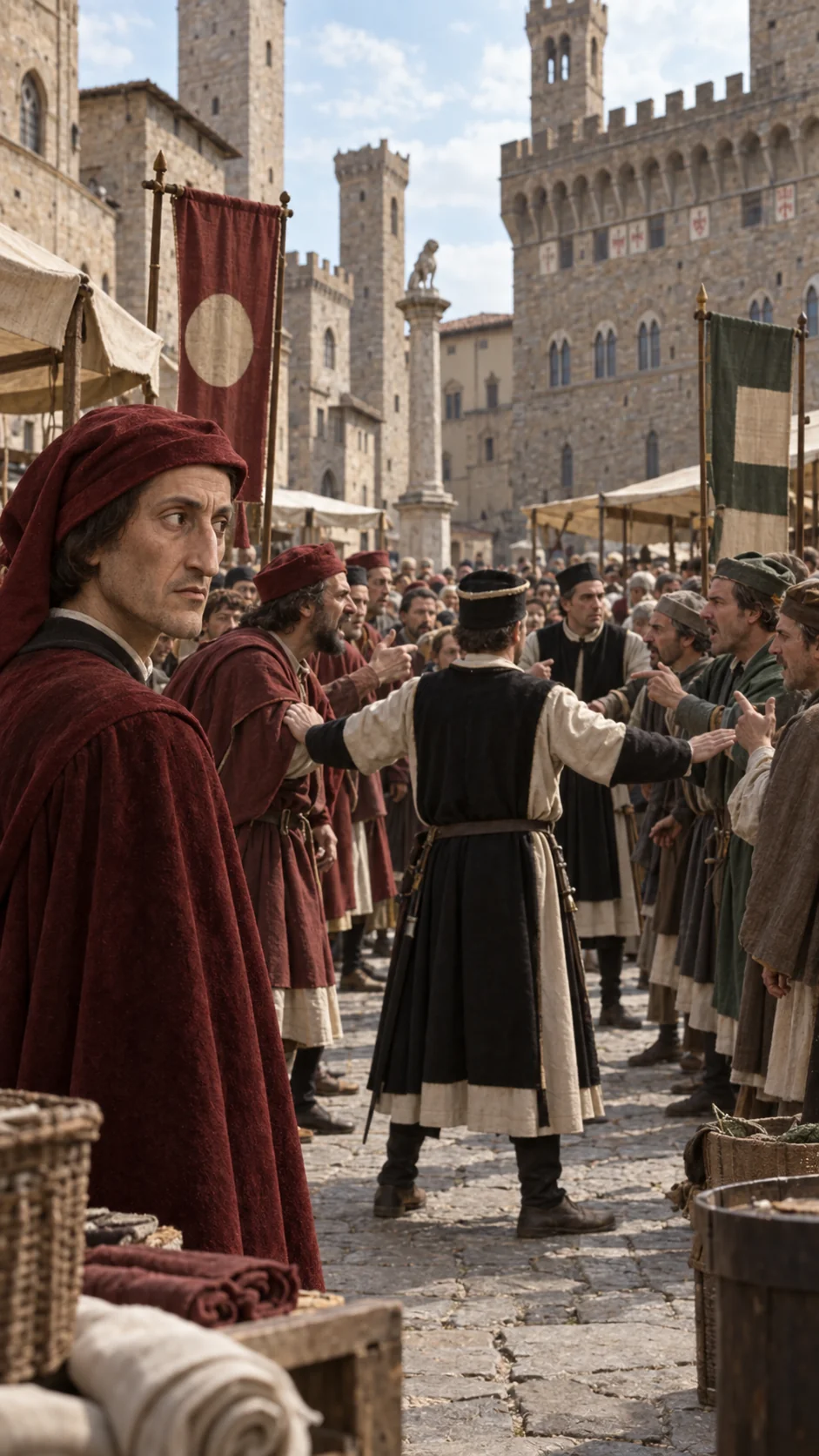
Dante’s Hell is populated by historical figures, but some of those condemned were still alive in 1300, the fictional date of the journey. Through prophecies and allusions, the poet could place them in the afterlife in advance.
His literary revenge was more complicated than a catalogue of punished enemies. He sometimes showed compassion toward the damned and treated members of his own political faction severely. He placed corrupt popes in Hell and repeatedly attacked Florence, yet he also examined his own weaknesses.
The Comedy enabled an exile to reclaim symbolically the authority to judge. The city could confiscate his property and threaten his body; it could not prevent him from deciding how it would be remembered.
A Lesser-Known Story: Thirteen Cantos Recovered Through a Dream
Dante spent his final years in Ravenna under the protection of Guido Novello da Polenta. He died during the night of 13–14 September 1321, probably from malarial fever contracted while returning from a diplomatic mission to Venice (Treccani, n.d.).
According to a story recorded by Boccaccio, the last thirteen cantos of Paradiso could not be found after Dante’s death. His sons feared that the poem had remained unfinished. Eight months later, Jacopo Alighieri dreamed of his father, dressed in white and surrounded by light. In the dream, Dante showed him a concealed place in the wall of the room where he had lived.
Jacopo and a disciple named Piero Giardino went to the location and discovered, behind a wall hanging, a recess containing manuscripts already damaged by damp. The cantos were cleaned, copied, and added to the rest of the poem (Boccaccio, 1901).
The account was written decades later and follows the pattern of a saint’s legend. It cannot be verified as a literal event. What matters historically is that the final cantos circulated after Dante’s death and that tradition needed to explain their appearance. The dream turned the poem’s completion into one final visit from the afterlife—as though its author had returned from the world he had just finished describing.
The Homeland That Could Not Reclaim His Body
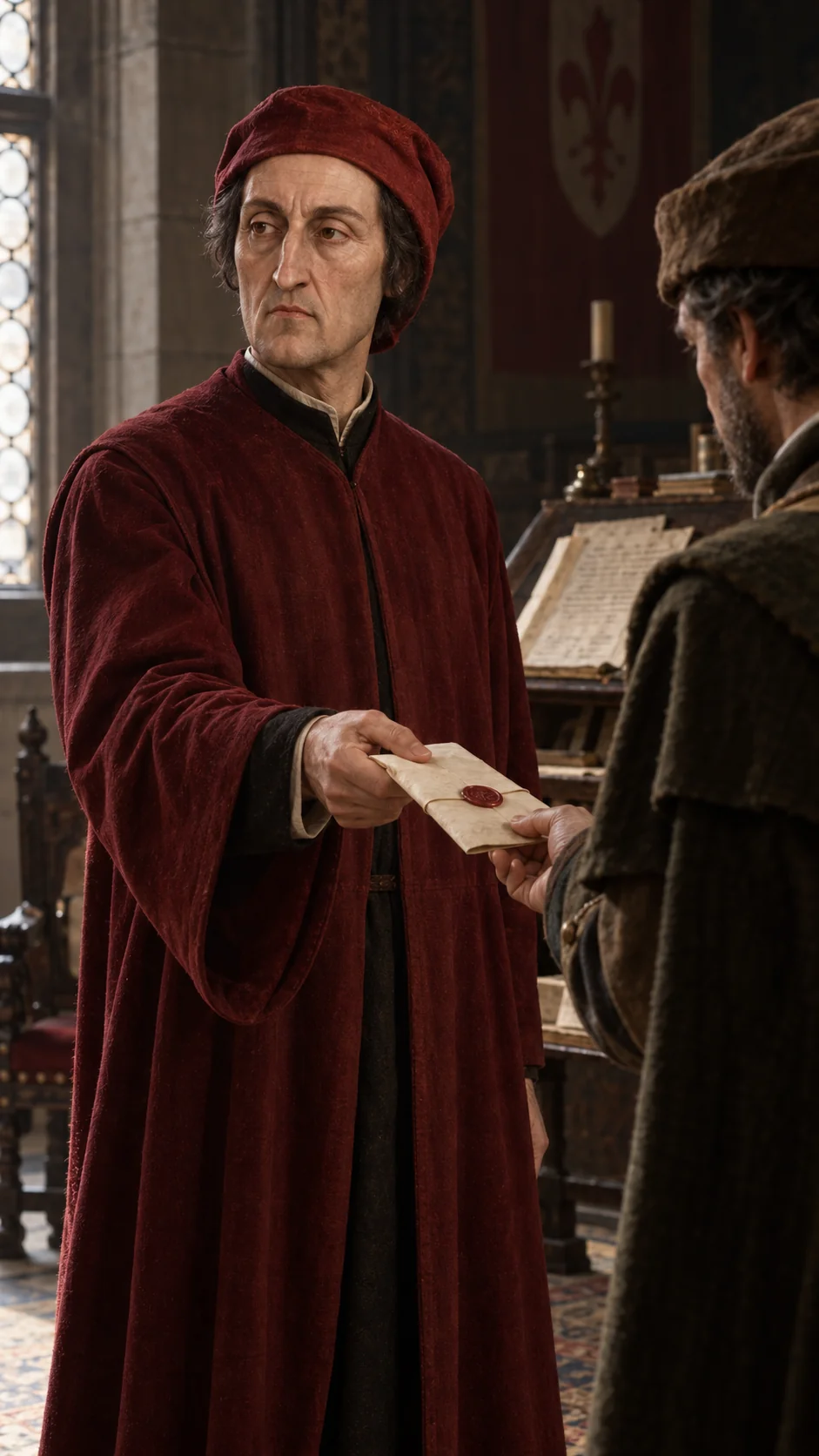
Dante was buried in Ravenna. Centuries later, Florence attempted to bring his remains back to the city that had expelled him. Ravenna’s Franciscan friars concealed the bones to prevent their removal, and their exact location remained unknown for a long time. They were rediscovered in 1865 during work near the tomb.
A grand cenotaph dedicated to the poet stands in Florence’s Basilica of Santa Croce, but it is empty. Ravenna still possesses his remains.
Florence eventually honoured the citizen it had condemned but failed to recover him. The absence inside the monument seems a fitting conclusion to the life of a man who transformed the loss of his home into a literary homeland.
Writing from the Wound
Dante belongs among the authors who wrote from the wound because his greatest work cannot be separated from the expulsion that reorganised his existence. Exile took away one city and painfully gave him a vantage point from which to contemplate the entire world.
The Comedy begins with a lost man and ends with a vision of the love that moves the sun and the other stars. Between those extremes lie anger, nostalgia, judgement, and hope.
Dante never returned to Florence. He accomplished something more enduring: he built with words a moral city in which he could gather his dead, confront his enemies, recover Beatrice, and discover the order that history had denied him.
References
- Boccaccio, G. (1901). Life of Dante (J. R. Smith, Trans.). In The earliest lives of Dante. Henry Holt and Company. View source
- Francis. (2021). Candor lucis aeternae. Holy See. View source
- Ravenna Turismo. (n.d.). Museo Dante. View source
- Ravenna Turismo. (n.d.). Dante Alighieri’s tomb. View source
- Treccani. (n.d.). Dante Alighieri. Enciclopedia on line. View source
- Wetherbee, W., & Aleksander, J. (2024). Dante Alighieri. In E. N. Zalta & U. Nodelman (Eds.), The Stanford Encyclopedia of Philosophy (Winter 2024 ed.). Stanford University. View source
More from this collection
Agatha Christie: The Woman Who Turned Uncertainty into the Perfect Crime
Read story →
Arthur Conan Doyle: The Man Who Invented Reason and Sought Comfort in the Invisible
Read story →