In this storyOpen index
Isaac Newton: The Man Who Turned the Universe’s Invisible Forces Into Mathematical Laws
From light and gravity to the Royal Mint, Newton searched for laws behind what no one could see.
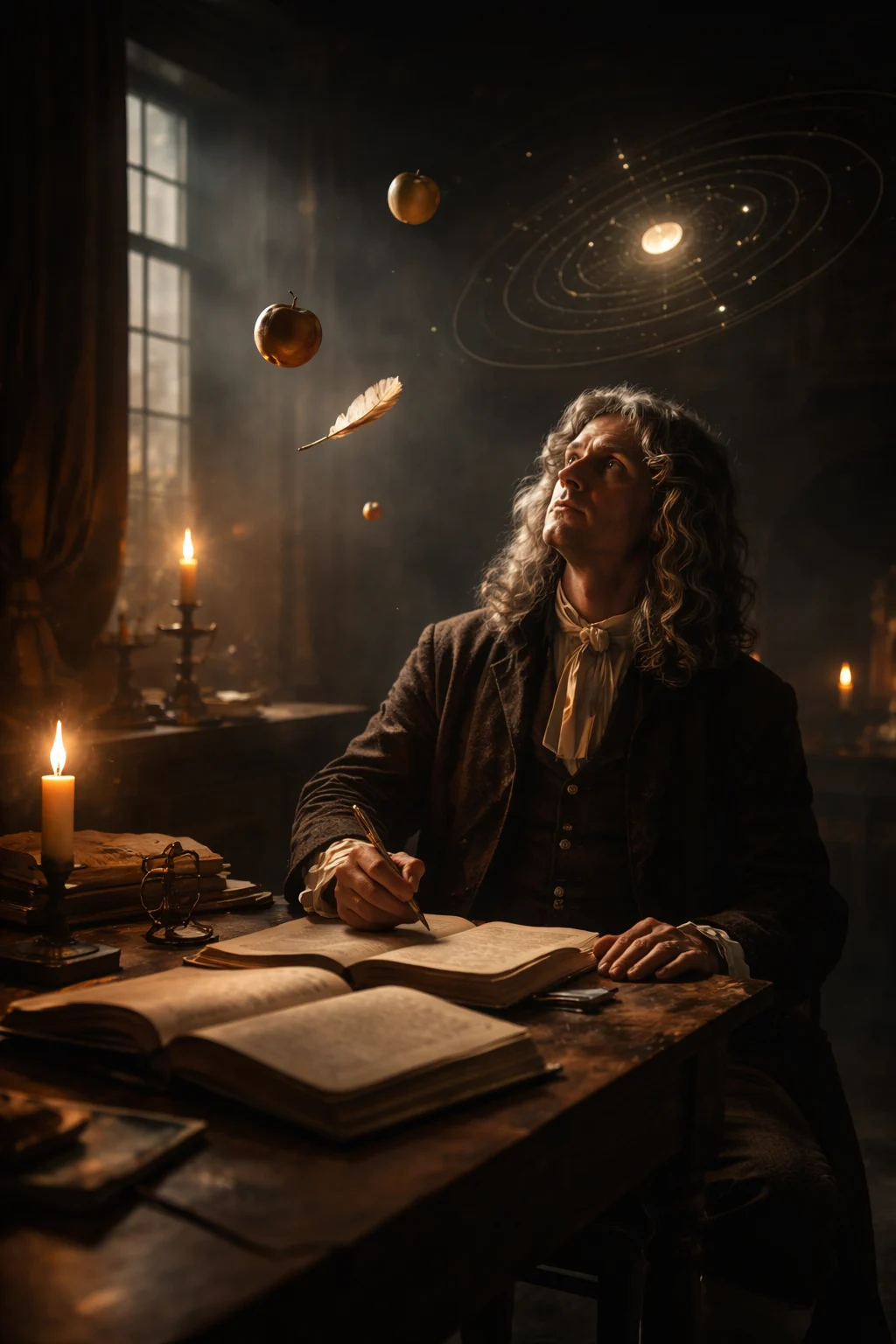
No one could see gravity. Only its consequences were visible: a falling stone, an advancing tide, the Moon remaining near Earth and planets moving across the sky without escaping their orbits. For centuries, these phenomena appeared to belong to different worlds. Events on Earth were explained in one way; events in the heavens, in another.
Isaac Newton understood that the same force might govern them all.
He did not discover that objects fall, nor was he the first person to consider terrestrial attraction. His revolution consisted of demonstrating mathematically that the force causing an apple to descend could be the same force keeping the Moon around Earth. By connecting the heavens and the ground through a single mathematical structure, he transformed humanity’s understanding of the universe.
The historical Newton, however, was much stranger than the serene old man depicted in portraits. He studied alchemy for decades, wrote extensively about biblical prophecy, concealed some of his religious beliefs, engaged in ferocious disputes with other scholars and eventually worked for the Royal Mint, where he personally interrogated counterfeiters.
He searched for invisible forces in planets, light, metals and Scripture. Some of those investigations helped establish modern physics. Others still belonged to the seventeenth-century worlds of alchemy and religion. All arose from the same obsession: discovering the hidden mechanism behind appearances.
Isaac Newton: the laws of the invisible
A life between observation, mathematics and power
Enter the archive
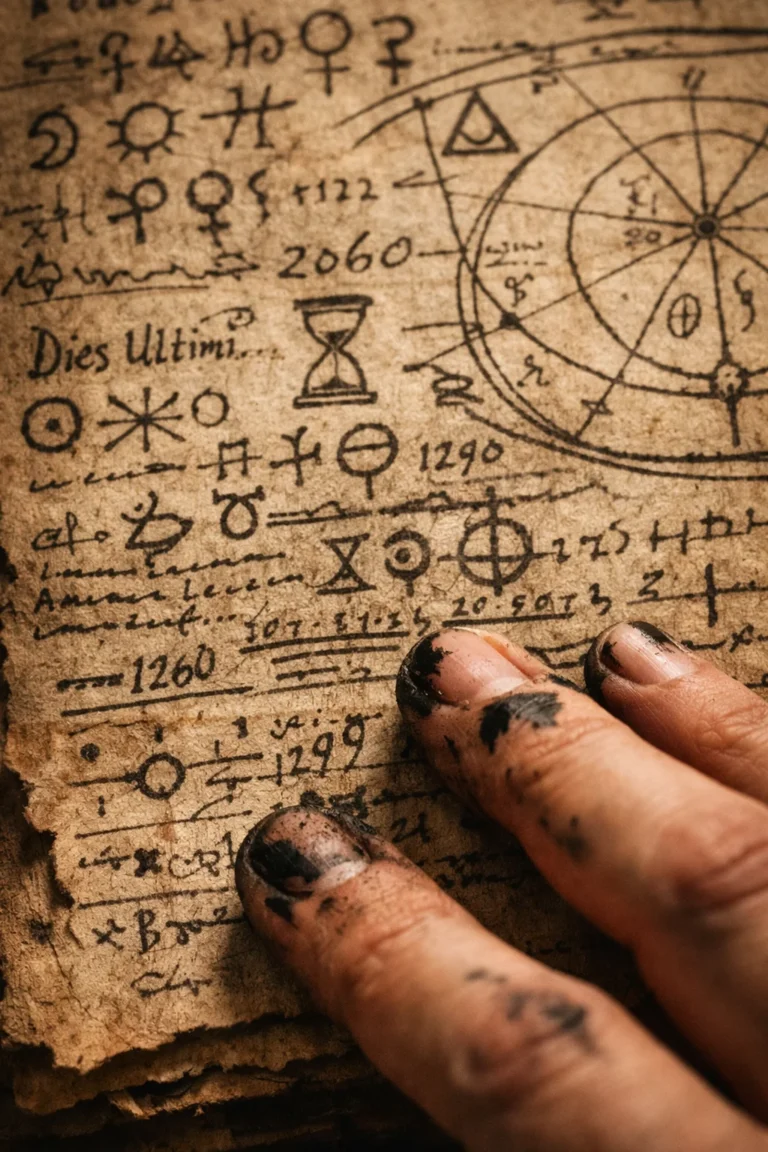
The University of Cambridge holds Newton’s papers, which were added to UNESCO’s Memory of the World Register. The image in this feature is a reconstruction, not an original manuscript.
AI-generated visual reconstruction; not a historical document.
The Child Born After His Father’s Death
Isaac Newton was born prematurely at Woolsthorpe, Lincolnshire, on December 25, 1642, according to the calendar then used in England—a date equivalent to January 4, 1643, in the Gregorian calendar. His father, also named Isaac, had died approximately three months earlier.
When the boy was three, his mother, Hannah Ayscough, married the clergyman Barnabas Smith and moved into her new husband’s home. Isaac remained with his maternal grandparents. The separation appears to have affected him profoundly. In a list of his childhood wrongdoings, he admitted that he had once threatened to burn the house in which his mother and stepfather lived (The Newton Project, n.d.-a).
After Smith’s death, Hannah returned and attempted to make her son manage the family property. The plan failed. Newton showed little interest in agricultural duties and preferred building mechanisms, drawing, reading and observing natural phenomena.
He eventually returned to school in Grantham and entered Trinity College, Cambridge, in 1661. University teaching remained dominated by Aristotle, but Newton independently read René Descartes, Johannes Kepler, Galileo Galilei, Pierre Gassendi and other authors associated with the new natural philosophy.
In his notebook, he wrote a sentence anticipating his method: Plato and Aristotle were his friends, but his best friend must be truth. He did not intend merely to repeat authorities. He wanted to reconstruct knowledge from its foundations.
The Plague That Closed Cambridge and Opened a Universe
In 1665, bubonic plague forced the University of Cambridge to close temporarily. Newton returned to Woolsthorpe and remained there, with some interruptions, until 1667. He later described this as the period when he was in his prime age for invention.
During that isolation, he developed fundamental ideas about what would later be called calculus, investigated the nature of light and began connecting terrestrial gravity with the Moon’s motion. He did not complete all his theories during those years, as legend sometimes suggests, but he established several of their essential foundations (The Newton Project, n.d.-a).
His mathematical method of “fluxions” made it possible to study quantities that changed continuously. Tools of this kind could calculate instantaneous speeds, slopes, areas and variable motions. Gottfried Wilhelm Leibniz independently developed calculus and published a clearer system of notation first; many symbols used today derive from his work.
Decades later, priority over the invention caused a bitter dispute between Newton and Leibniz. The Royal Society, then presided over by Newton himself, issued a report supporting the English claim. Historians now recognize that both men made independent and fundamental contributions, although Leibniz’s notation proved more influential in the later development of mathematics (Guicciardini, 2018).
The Apple: What Happened and What Legend Invented
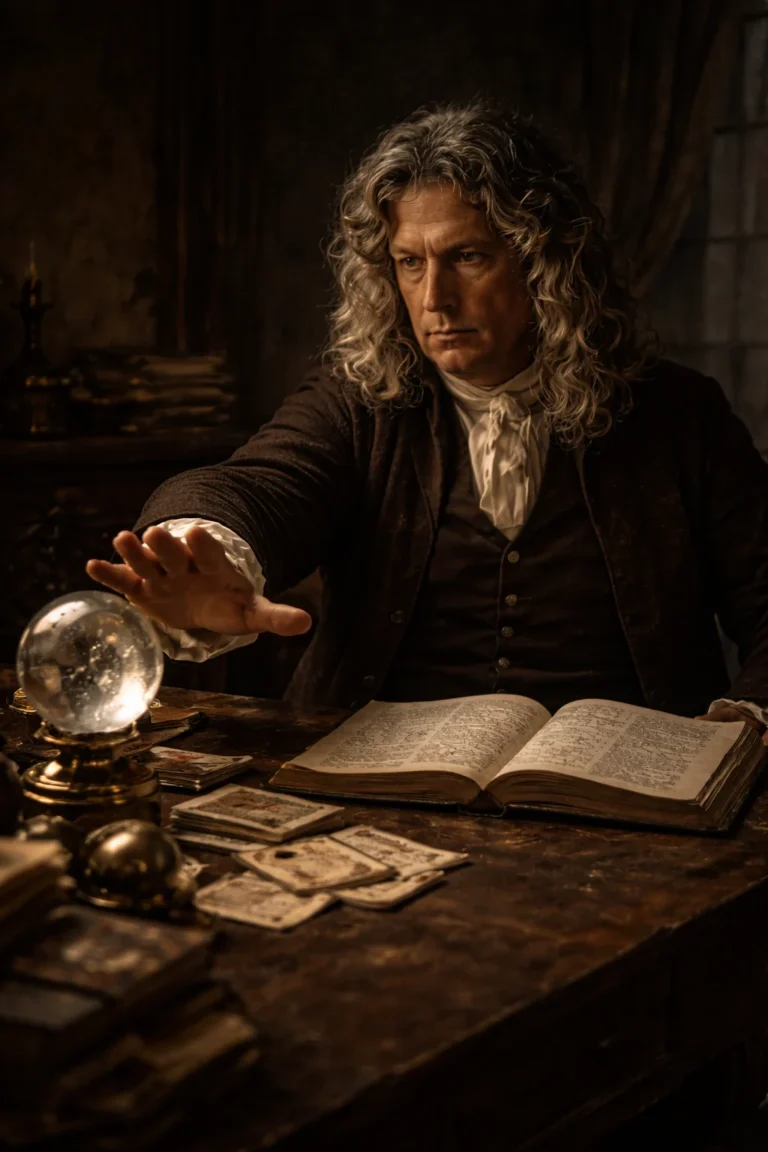
The apple story was not created entirely by popular imagination. Late in life, Newton said that while at Woolsthorpe, the fall of an apple led him to wonder why objects descended perpendicularly toward Earth and how far that attraction might extend.
William Stukeley, who knew Newton personally, recorded the conversation after spending an afternoon with him beneath apple trees in 1726. In his account, Newton watched an apple fall while reflecting. Stukeley did not write that the fruit struck Newton’s head or that the completed law of gravitation appeared in a miraculous instant (Stukeley, 1752/1936).
The anecdote represents the beginning of a question, not a sudden revelation. Newton required years of calculations, astronomical data and exchanges with other investigators to produce a complete theory.
Important precedents also existed. Galileo had studied falling and accelerating bodies; Kepler had mathematically described planetary orbits, and Robert Hooke had suggested that orbital motion could result from a combination of inertia and attraction toward a center. Newton brought these problems together within a far more powerful mathematical system.
His decisive question was not why the apple fell. It was whether gravity reached as far as the Moon.
The Experiment That Revealed What Light Concealed
Newton also investigated something as apparently familiar as sunlight. In a darkened room, he allowed a beam of light to enter through a small opening and pass through a prism. A band of colors appeared.
The traditional explanation held that the prism modified or colored white light. Newton performed additional experiments, isolating one color and sending it through a second prism. That color did not divide in the same way. He then reunited different colors to reconstruct white light.
He concluded that white light was not pure: it contained rays of different colors, each possessing a different degree of refraction. The prism did not manufacture the rainbow; it revealed diversity already concealed within the light (Newton, 1672/2003).
The discovery led him to another problem. Refracting telescopes produced colored edges because their lenses bent the components of light unequally. Newton therefore designed a telescope that used a curved mirror rather than a large primary lens.
His reflecting telescope was presented to the Royal Society in 1671. The instrument was small but provided an effective image without requiring the long tubes used by contemporary refracting telescopes. The demonstration helped secure Newton’s election as a Fellow of the Society in 1672 (Royal Society, n.d.).
The Book That Made the Heavens Calculable
In 1684, astronomer Edmond Halley visited Newton at Cambridge and asked what orbit a planet would follow under a force that diminished with the square of the distance. Newton answered that it would be an ellipse and claimed that he had already performed the calculation.
Halley encouraged him to develop the proof. The result expanded into Philosophiæ Naturalis Principia Mathematica, published in 1687. Because the Royal Society was experiencing financial problems—partly after financing an expensive book about fish—Halley personally covered the publication costs (Royal Society, 2012).
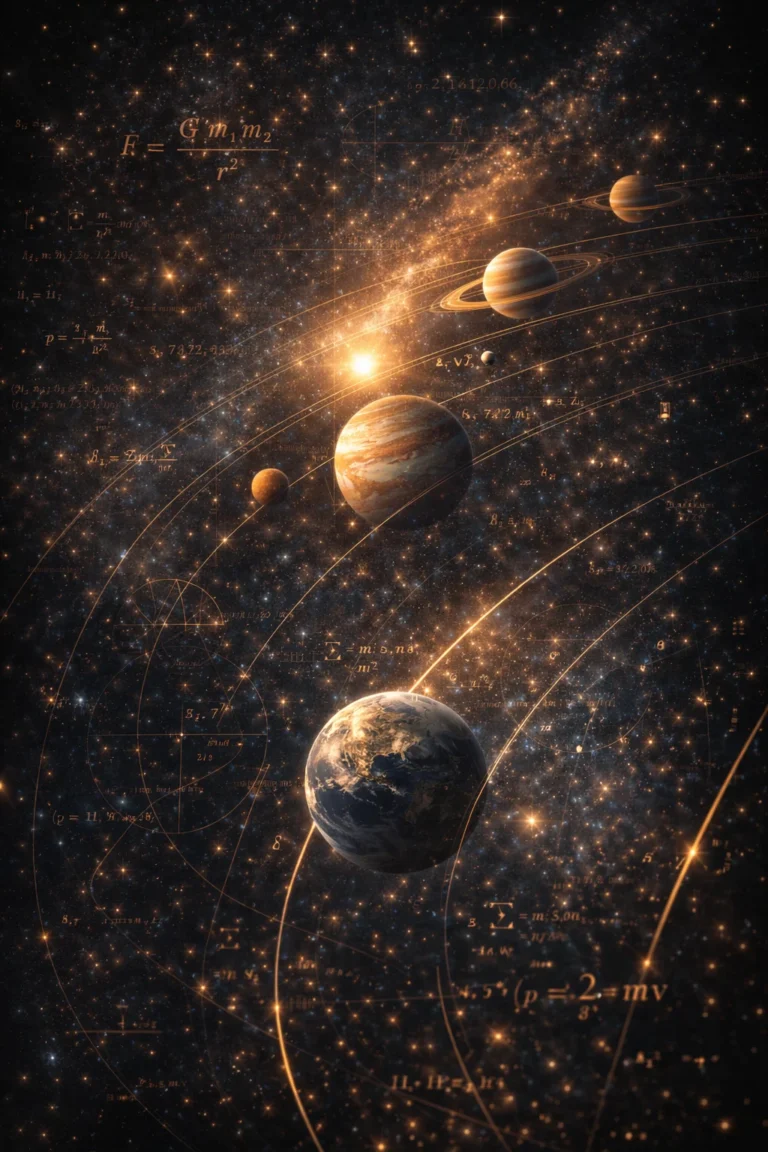
In the Principia, Newton formulated the three laws of motion and the law of universal gravitation. He demonstrated that projectiles, falling bodies, planetary orbits, comets and tides could be analyzed through related principles.
The first law described the persistence of motion unless altered by a force. The second connected force with a change in motion, and the third stated that interactions between bodies produced equal and opposite reactions. Gravitation added that every mass attracted every other mass and that this force decreased with the square of the distance.
Newton did not explain the physical mechanism transmitting gravity through space. He refused to invent a cause that he could not demonstrate. He nevertheless provided equations capable of predicting its effects with unprecedented accuracy.
The invisible had become calculable.
A Genius Who Did Not Work Entirely Alone
The image of Newton isolated from the world contains some truth. He was private, suspicious and extremely reluctant to publish results that might attract criticism. His work nevertheless depended upon knowledge constructed by many people.
He used the observations of astronomers such as John Flamsteed, Kepler’s planetary laws, Galileo’s studies and questions raised by Hooke. Halley not only persuaded him to write the Principia but also corrected proofs, managed editorial conflicts and paid for its printing.
Newton famously acknowledged in a letter that if he had seen farther, it was by standing on the shoulders of giants. The expression had much older origins and may have contained an ironic reference to Hooke, with whom he had a difficult relationship. Even so, it conveys an essential reality: not even a scientific transformation this profound emerged in complete isolation.
Newton’s temperament turned intellectual disagreements into personal conflicts. He disputed with Hooke over light and gravity, with Leibniz over calculus and with Flamsteed over the use of astronomical observations. After becoming president of the Royal Society in 1703, he exercised institutional authority with a severity that damaged some of his rivals (Westfall, 1980).
The Little-Known Fact: Newton Became an Investigator of Counterfeiters
In 1696, Newton left Cambridge to become Warden of the Royal Mint in London. The position might have been a comfortable administrative appointment, but it coincided with the Great Recoinage, an operation intended to replace England’s badly deteriorated silver currency.
Counterfeiting and coin clipping were serious problems. Newton reorganized production, monitored the quality of the new money and began investigating criminal networks that manufactured or altered coins.
He visited prisons and taverns, hired informants, collected depositions and personally conducted dozens of interrogations. He studied suspects’ contradictions with the same patience he applied to mathematical problems. His most notorious adversary was William Chaloner, a counterfeiter who attempted to discredit Newton and accuse the Mint itself of corruption.
Newton assembled enough testimony to bring him to trial. Chaloner was convicted in 1699 and executed under England’s exceptionally harsh laws. The episode reveals an uncomfortable dimension of Newton: the scientist who formulated the laws of motion also became a relentless official operating within an extremely brutal penal system.
Newton was promoted to Master of the Mint in 1699 and retained the position until his death. His monetary work was not a minor distraction. He managed an institution essential to the state and participated in decisions that helped transform the British monetary system (Royal Mint Museum, n.d.).
The Other Newton: Alchemist and Secret Theologian
When Newton died, he left an enormous collection of manuscripts that did not fit the familiar image of the founder of modern science. He had spent years copying alchemical recipes, interpreting symbols, investigating the transformation of metals and searching for active principles hidden within matter.
For Newton, alchemy was not necessarily the opposite of physics. Both investigations attempted to discover invisible forces. The difference was that his alchemical experiments never produced a verifiable theory comparable to his laws of motion.
He also wrote more about religion than about physics and mathematics. He studied biblical languages, Church history, ancient chronology and prophecy. Privately, he rejected the doctrine of the Trinity, a position that could have destroyed his university career and exposed him to accusations of heresy. He therefore kept many of his conclusions secret (Iliffe, 2017).
The scale of these interests remained partly hidden until many of his papers were dispersed in a Sotheby’s auction in 1936. Later scholars gradually reconstructed a Newton who did not clearly separate science, alchemy and theology. To him, the entire universe was an encrypted text authored by God (The Newton Project, n.d.-b).
The Man Transformed Into a Monument
Newton became president of the Royal Society in 1703 and held the office until his death. In 1704, he published Opticks, assembling his investigations into light and adding speculative questions that influenced later generations.
Queen Anne knighted him in 1705. Although his scientific prestige contributed to the honor, the knighthood was also connected with electoral politics and his public service. He became the first scientist to achieve international fame on such a scale within British culture.
He died in London on March 20, 1727, according to the English calendar then in use, and was buried with great ceremony in Westminster Abbey. The nation transformed him into a symbol of reason, although that image excluded the alchemist, heterodox theologian and public official who pursued counterfeiters.
His laws were not the final word on the universe. In the twentieth century, Albert Einstein’s relativity revealed that gravity could be understood more deeply as the curvature of spacetime, while quantum mechanics exposed realms where Newtonian physics was insufficient.
Newton’s equations nevertheless continue to describe an immense range of everyday movements, machines, buildings, projectiles, satellites and spacecraft trajectories with extraordinary precision.
His achievement was not that he saw everything. It was that he taught the world how something no one could see directly—a force, an acceleration or the composition of light—could be discovered through its effects and expressed through mathematics.
Newton did not make gravity visible. He accomplished something more enduring: he found the language through which the universe revealed that it was there.
References
- Cambridge University Library. (2017, December 1). Sir Isaac Newton’s Cambridge papers added to UNESCO’s Memory of the World Register. University of Cambridge. https://www.cam.ac.uk/research/news/sir-isaac-newtons-cambridge-papers-added-to-unescos-memory-of-the-world-register
- Guicciardini, N. (2018). The Newton–Leibniz calculus controversy, 1708–1730. In R. Iliffe & G. E. Smith (Eds.), The Oxford handbook of Newton. Oxford University Press. https://doi.org/10.1093/oxfordhb/9780199995356.013.9
- Iliffe, R. (2017). Priest of nature: The religious worlds of Isaac Newton. Oxford University Press.
- Newton, I. (2003). A letter of Mr. Isaac Newton containing his new theory about light and colors. The Newton Project. (Original work published 1672). https://newtonproject.ox.ac.uk/view/texts/normalized/NATP00006
- Royal Mint Museum. (n.d.). Isaac Newton, Warden and Master of the Royal Mint, 1696–1727. https://www.royalmintmuseum.org.uk/journal/people/isaac-newton/
- Royal Society. (2012, July 19). The fishy blunder that nearly prevented Newton’s masterpiece from being published. https://royalsociety.org/news/2012/the-fishy-blunder-that-nearly-prevented-newtons-principia-from-being-published/
- Royal Society. (2014). Principia. https://royalsociety.org/blog/2014/07/principia/
- Royal Society. (n.d.). Note about reflecting telescope by Isaac Newton. Science in the Making. https://makingscience.royalsociety.org/items/el_n1_50/note-about-reflecting-telescope-by-isaac-newton
- Stukeley, W. (1936). Memoirs of Sir Isaac Newton’s life (A. H. White, Ed.). Taylor and Francis. (Original manuscript written 1752).
- The Newton Project. (n.d.-a). The life and work of Isaac Newton at a glance. University of Oxford. https://www.newtonproject.ox.ac.uk/his-life-and-work-at-a-glance
- The Newton Project. (n.d.-b). Introduction to the Newton manuscripts catalogue. University of Oxford. https://www.newtonproject.ox.ac.uk/introduction-to-the-newton-manuscripts-catalogue
- Westfall, R. S. (1980). Never at rest: A biography of Isaac Newton. Cambridge University Press.
More from this collection
Nicolaus Copernicus: The Man Who Moved the Earth Without a Telescope
Read story →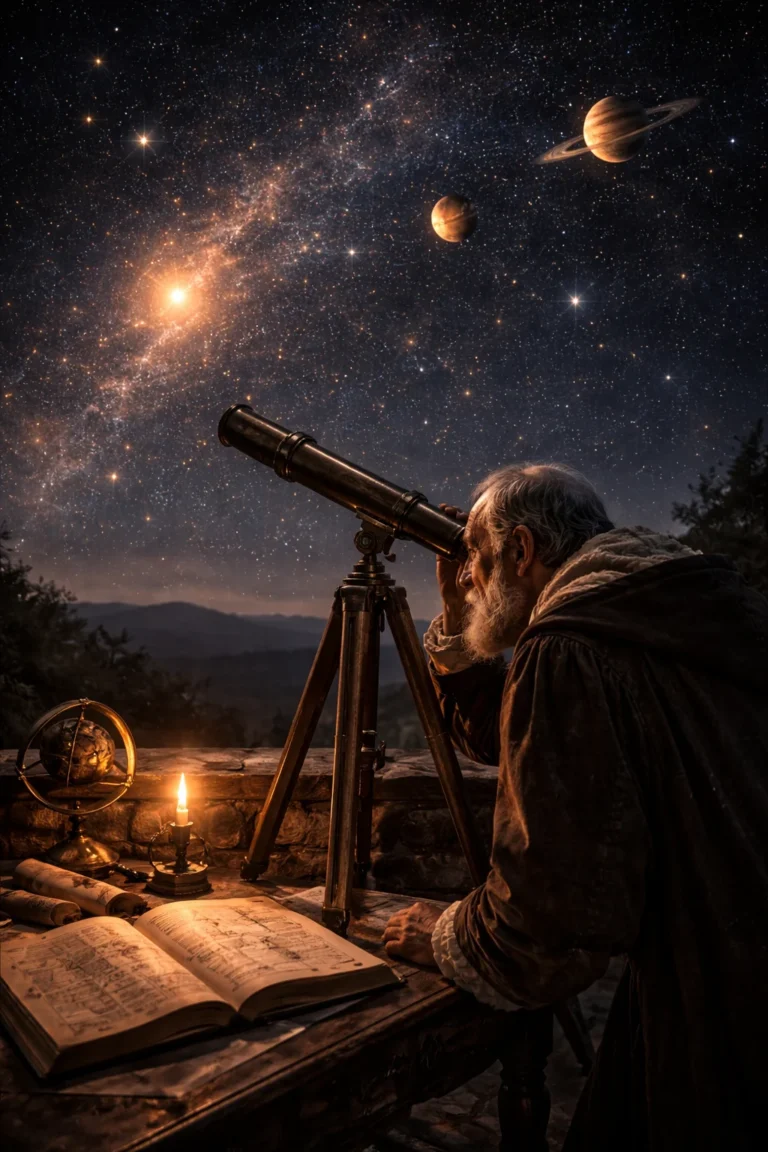
Galileo Galilei: The Man Who Pointed a Military Instrument at the Sky
Read story →