In this storyOpen index
Cantinflas: The Man Who Turned Confusion into a Universal Language
Mario Moreno created a character who could disarm authority with words and turned confusion into one of cinema’s most recognizable languages.

Featured historical fact: Mario Moreno created such a recognizable way of speaking—long, tangled, seemingly logical, yet incapable of reaching a conclusion—that his character eventually gave rise to the Spanish verb cantinflear. The Royal Spanish Academy included it in its dictionary to describe speaking or acting incongruously without saying anything of substance.
Cantinflas could enter a conversation without being right, understanding the subject, or possessing any authority. Minutes later, the people questioning him could no longer remember what they had asked.
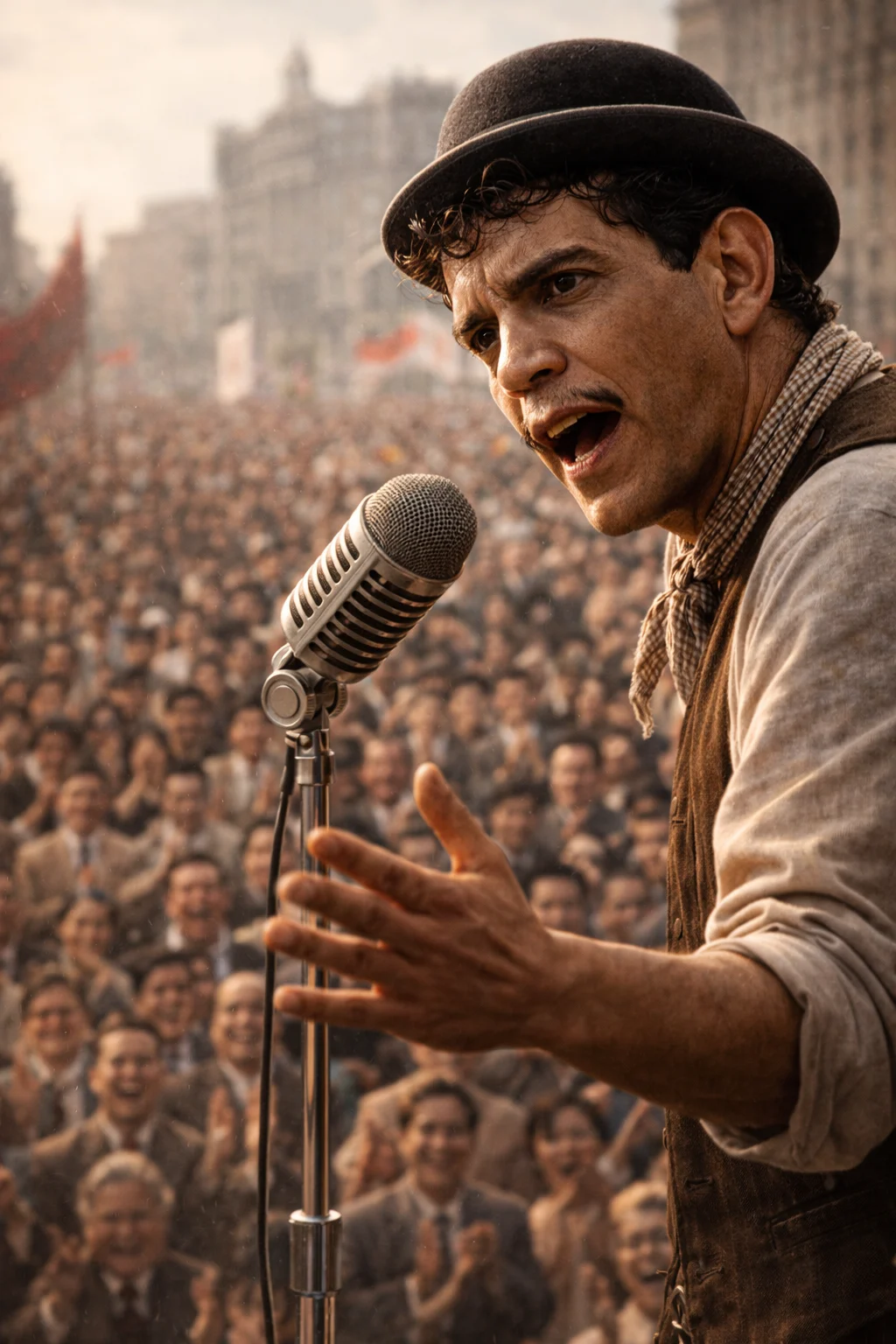
That confusion was not merely a collection of absurd words. It was a form of resistance. When confronting police officers, judges, teachers, politicians, and wealthy men, the character used language to overturn the social order for a few minutes: the powerful person ended up bewildered, while the humble man escaped without submitting.
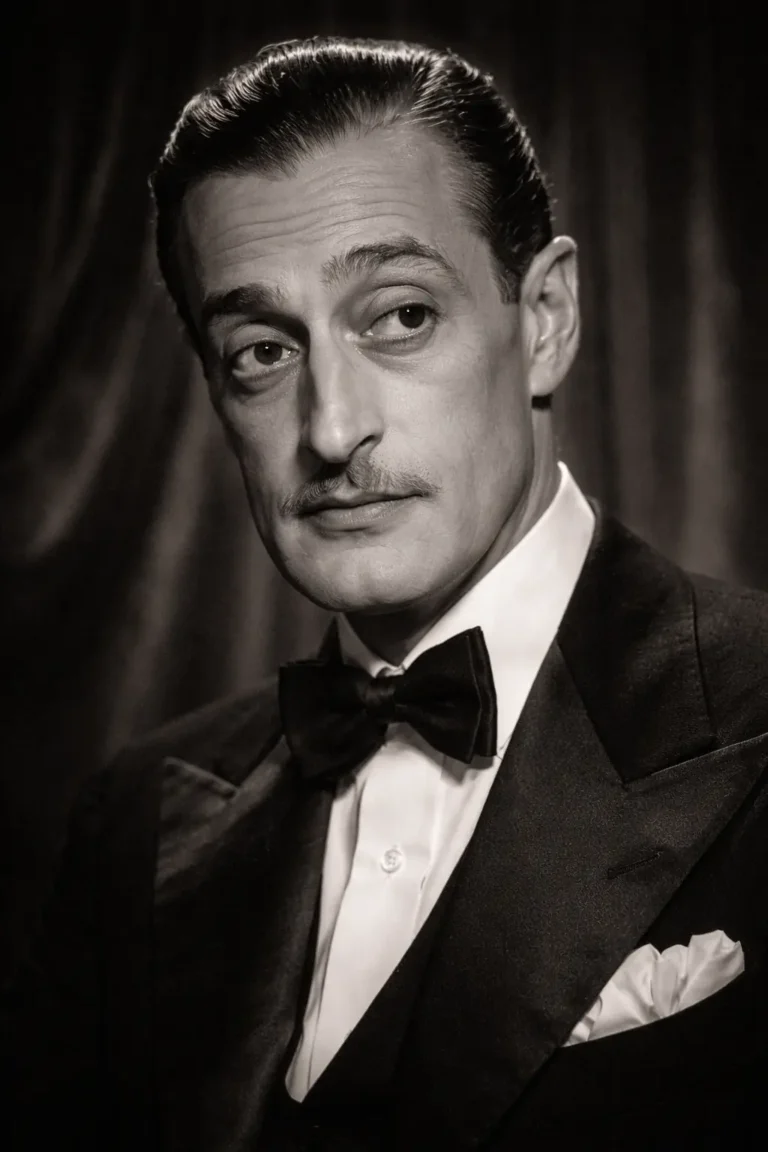
Behind the sagging trousers, tiny mustache, and rope tied around his waist stood Mario Moreno, an actor who transformed the representation of ordinary people in Mexican cinema.
Cantinflas: The Man Who Turned Confusion into a Universal Language
Discover this story on our YouTube channel.
A life told through places and turning points
Before Cantinflas Existed
Mario Fortino Alfonso Moreno Reyes was born on August 12, 1911, in Mexico City (Pilcher, 2001; Stavans, 1998). He grew up in a large family and became closely acquainted with the capital’s working-class neighborhoods, although later accounts sometimes exaggerated or simplified the circumstances of his childhood.
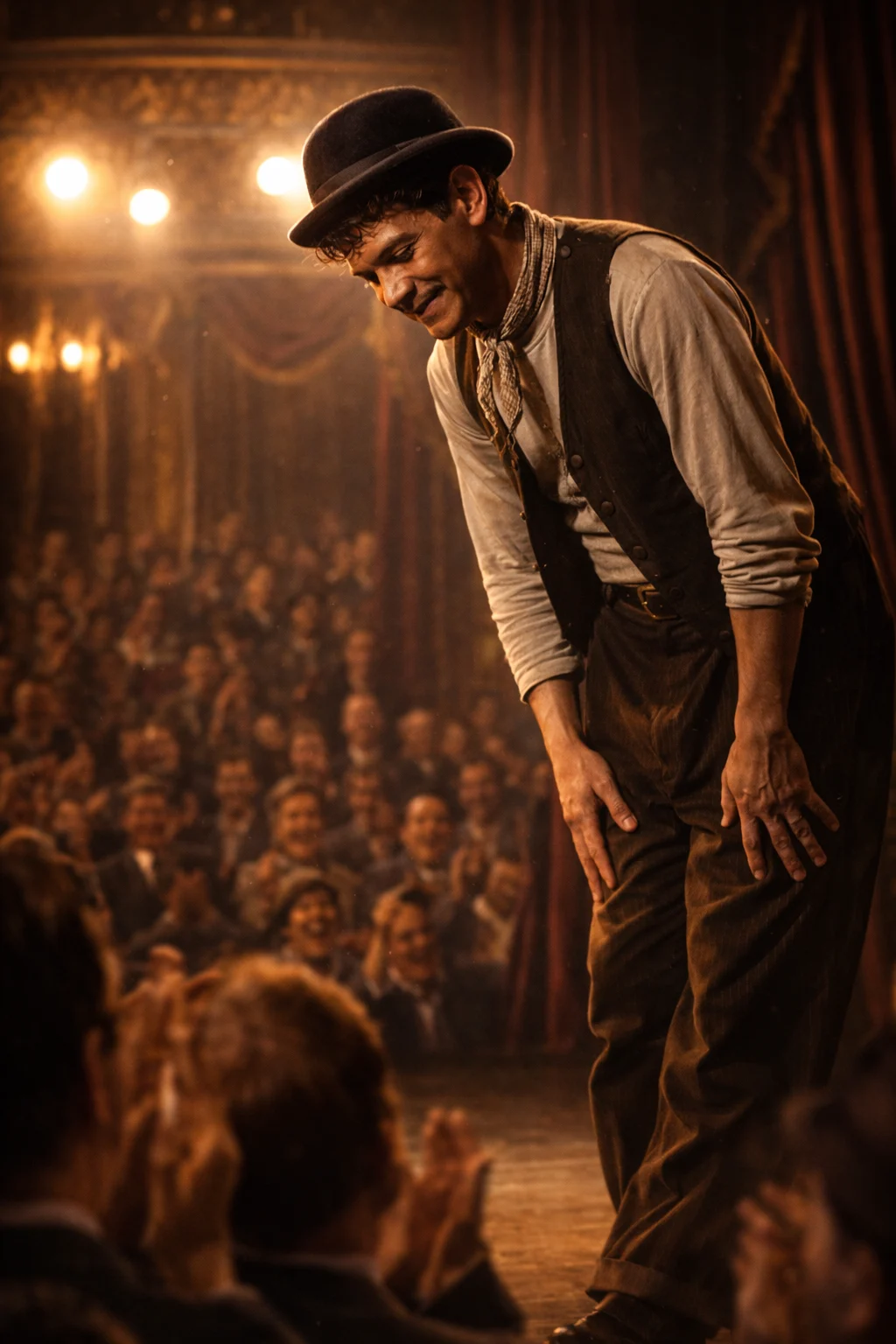
Before establishing himself as an entertainer, he attempted several occupations. Biographies mention experiences as a dancer, amateur boxer, and even an occasional participant in bullfighting shows. It was in the popular tent theaters known as carpas, however, that he began discovering the character that would change his life.
The carpas were variety theaters housed in temporary structures. Musicians, dancers, acrobats, comedians, and political parodists performed before demanding audiences that might interrupt or heckle an act that failed to amuse them.
In this environment, Mario Moreno learned something no conservatory could teach him: how to listen to the audience’s immediate reaction (Monsiváis, 1999; Pilcher, 2001). His character did not emerge fully formed. It was constructed through gestures, pauses, mistakes, and improvisations tested repeatedly before different crowds.
The precise origin of the name “Cantinflas” was never conclusively established. Moreno offered contradictory explanations and allowed the mystery to grow. That ambiguity suited a character who appeared capable of explaining everything while clarifying nothing.
Creating the Peladito
Cantinflas belonged to the tradition of the pelado, the poor urban man without prestige or financial security who survived through ingenuity (Monsiváis, 1999). Mario Moreno, however, transformed the archetype.
His clothing always seemed on the verge of falling apart: trousers hanging too low, a worn shirt, a neckerchief, a small hat, and a mustache reduced to two short marks at the corners of his mouth. His body moved as if he were trying to preserve a dignity denied to him by both his clothing and his circumstances.
He was not simply playing an ignorant man. Cantinflas understood that institutions used complicated language to impose authority. He therefore imitated that language, stretched it, and emptied it of meaning until it became useless.
When he could not defeat power with arguments, he exhausted it with words.
The Film That Found His Voice
Mario Moreno appeared in several productions during the second half of the 1930s, but his major breakthrough came with Ahí está el detalle, released in 1940 and directed by Juan Bustillo Oro (García Riera, 1992–1997).
The film employs a chain of misunderstandings, mistaken identities, and double meanings. Cantinflas enters a house intending to kill a dog named Bobby and becomes entangled in a criminal investigation involving a man with the same name.
During the courtroom scene, his language reaches one of its purest forms. He speaks at length, changes the subject, contradicts his own claims, and draws the other characters into an impossible logic. The phrase ahí está el detalle—roughly, “that is where the detail lies”—became one of his most famous expressions because it perfectly summarized his method: announcing an explanation that never actually explained anything.
The film helped turn him into a star throughout Mexico and much of Spanish-speaking America.
Laughing at Those Who Gave Orders
During the 1940s and 1950s, Cantinflas portrayed police officers, street sweepers, hotel workers, shoeshiners, illiterate men, improvised priests, and people forced into occupations for which they appeared entirely unprepared.
Films such as El gendarme desconocido, Ni sangre ni arena, Gran Hotel, El supersabio, and Si yo fuera diputado constructed a world in which the humble character could enter spaces normally reserved for the powerful.
The formula contained an interesting contradiction. Cantinflas mocked bureaucracy and inequality, but many stories ended by defending honesty, work, and social reconciliation. His cinema questioned abuses of authority without calling for revolution.
Mario Moreno also participated in the film industry’s labor movement. He held responsibilities within organizations representing actors and production workers during a period of intense conflict over control of Mexican unions. The comedian who confused authority on the screen experienced negotiations offscreen in which every word carried real consequences.
The Language Hollywood Could Not Translate
In 1956, Cantinflas made the most important international leap of his career when he played Passepartout in Around the World in 80 Days, directed by Michael Anderson and also starring David Niven (Pilcher, 2001).
The challenge was considerable. Much of his comedy depended on the sounds, double meanings, and social hierarchies of Mexican Spanish. Translating a cantinflada literally could destroy the joke.
The production addressed this problem by placing greater emphasis on his physical comedy. Passepartout dances, travels through different cultures, and participates in an extended bullfighting sequence. Cantinflas did not abandon words completely, but he had to prove that his character could survive without depending on them.
The performance earned him the 1957 Golden Globe for best actor in a musical or comedy (Golden Globes, n.d.). The film also won the Academy Award for best picture, although Cantinflas did not receive an acting nomination from the Academy.
This detail is frequently confused: he won the Golden Globe, not an Oscar.

When the Comedian Was Advertised as the Star
There was also a revealing difference in the way Around the World in 80 Days was promoted. David Niven received top prominence in English-speaking markets. Across much of the Spanish-speaking world, Cantinflas’s enormous popularity gave his name and image a far more prominent position.
He was not merely a Mexican performer hired by Hollywood. He was a star capable of changing the way an international blockbuster was marketed to millions of viewers.
His success, however, proved difficult to repeat. In 1960, he starred in Pepe, an expensive production filled with celebrity appearances. Although the role brought him another Golden Globe nomination, the film failed to reproduce the impact of his American debut.
The difficulty involved more than language. Cantinflas represented a specific social reality: the poor man who understood the codes of the Mexican street and used popular speech against official language. Removing him from that world meant taking away part of his power.
The Character Changes
After fully returning to Mexican cinema, Cantinflas began portraying characters more thoroughly integrated into society: teachers, priests, doctors, diplomats, and public officials. Films such as El analfabeto, El padrecito, El señor doctor, and Su excelencia preserved his verbal skill, but the old peladito gradually became more respectable and morally instructive.
The change also reflected Mario Moreno’s own transformation. The entertainer who emerged from the tent shows had become a producer, businessman, and one of the most powerful celebrities in the Spanish-speaking world.
This evolution divided some critics. To some, his later films lost the social irreverence of his early work. To others, they allowed the character to accompany his audience through several generations.
His final film was El barrendero, released in 1982 (García Riera, 1992–1997).

The Actor Who Entered the Dictionary
Few performers have left such a tangible mark upon their language. The Spanish word cantinflear continues to define a form of speaking in which words multiply while meaning disappears (Real Academia Española, n.d.). Related terms include cantinflada and cantinflesco.
This linguistic recognition contains a certain irony. Cantinflas, so often associated with characters of limited education, ultimately altered the vocabulary of millions of people.
His comedy worked because it was not entirely absurd. Audiences recognized in it the speeches of officials, lawyers, and politicians capable of speaking at length without answering a question. Cantinflas took that behavior to its extreme and returned it to the public in the form of laughter.
Mario Moreno died from lung cancer on April 20, 1993, at the age of 81. Mexico mourned him as a national figure.
Two Men Beneath the Same Hat
Mario Moreno and Cantinflas were not exactly the same person. The first was a disciplined actor, producer, and businessman who carefully protected his creation. The second was a powerless man trapped inside trousers that did not fit, armed only with an inexhaustible capacity for speech.
Together, they created one of the essential characters of Spanish-language cinema.
Cantinflas did not invent popular comedy, nor was he the first actor to portray a poor man. His contribution was more specific and enduring: he turned language into cinematic action. His words produced the same effect as a fall, a chase, or a blow in physical comedy.
The body generated laughter, but confusion disarmed authority.
That is why the character survived the world that created him. Cities, governments, and the film industry changed, but there were still people capable of using many words to conceal the absence of an answer.
And as long as such people exist, a verb will still be needed to describe them.





Sources and further reading
References
García Riera, E. (1992–1997). Historia documental del cine mexicano (Vols. 1–18). Universidad de Guadalajara.
Golden Globes. (n.d.). Around the World in 80 Days. https://goldenglobes.com/film/around-the-world-in-80-days/
Hershfield, J., & Maciel, D. R. (Eds.). (1999). Mexico’s cinema: A century of film and filmmakers. Scholarly Resources.
Monsiváis, C. (1999). Cantinflas and Tin Tan: Mexico’s greatest comedians. In J. Hershfield & D. R. Maciel (Eds.), Mexico’s cinema: A century of film and filmmakers (pp. 49–79). Scholarly Resources.
Pilcher, J. M. (2001). Cantinflas and the chaos of Mexican modernity. Scholarly Resources.
Real Academia Española. (n.d.). Cantinflear. In Diccionario de la lengua española. https://dle.rae.es/cantinflear
Stavans, I. (1998). The riddle of Cantinflas: Essays on Hispanic popular culture. University of New Mexico Press.
More from this collection
Lillian Gish: The Face That Taught Cinema to Think in Silence
Read story →
Roscoe “Fatty” Arbuckle: The Face Hollywood Condemned After Justice Acquitted Him
Read story →