In this storyOpen index
Maryam Mirzakhani: The Mathematician Who Drew Paths Across Invisible Worlds
From Iran’s Olympiads to the Fields Medal: how patience, drawings, and collaboration transformed geometry.
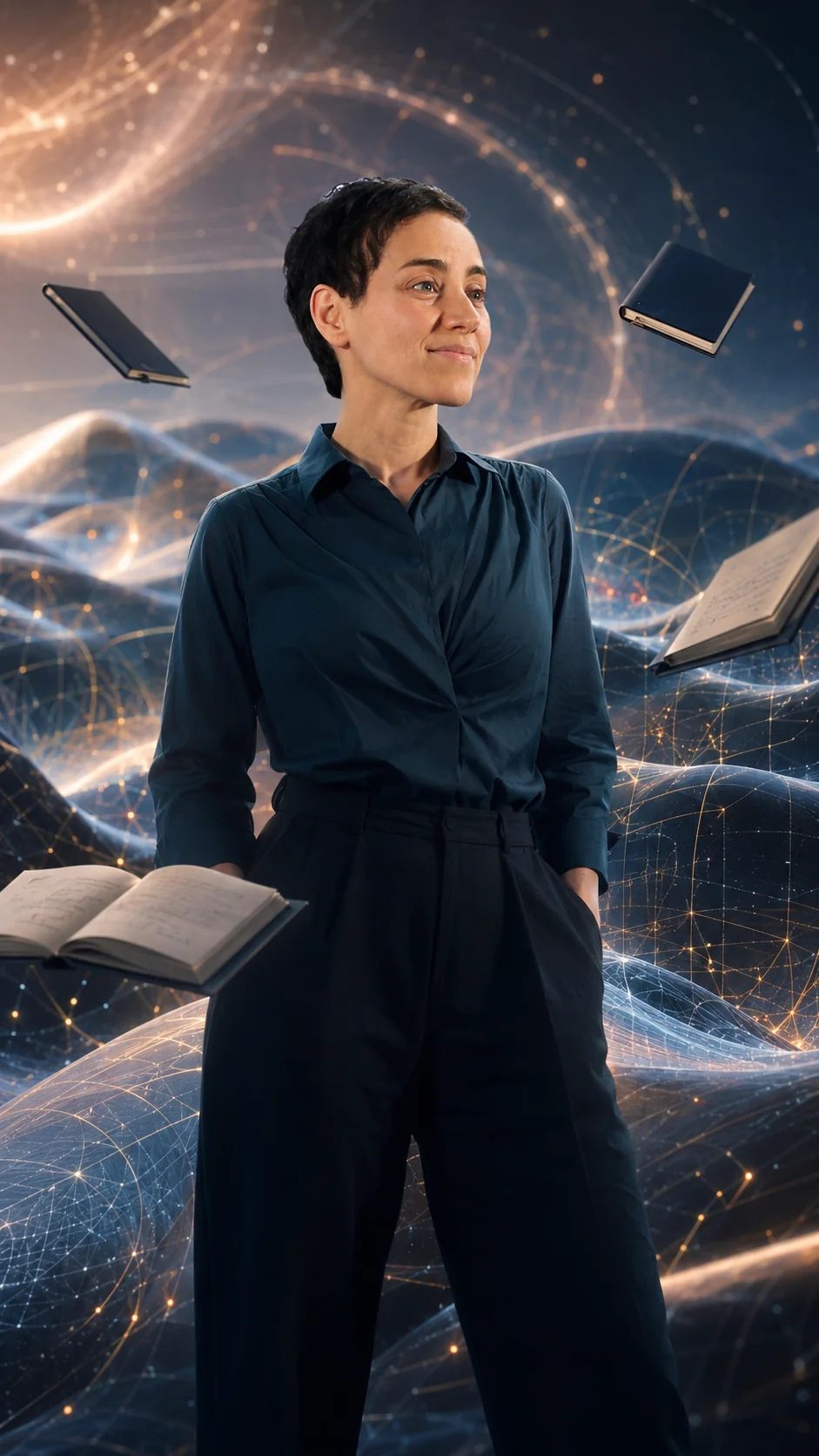
Maryam Mirzakhani covered enormous sheets of paper with curves, arrows, and figures that looked like doodles to other people. Her young daughter called it “painting.” For Mirzakhani, it was a way of entering spaces no human being could see directly.
She was not pursuing enormous numbers or secret codes. She studied curved surfaces, trajectories, and geometric universes in which every point might represent a different shape. Her research connected areas of mathematics that had appeared separate and resolved problems that had remained open for decades.
In 2014, she became the first woman and the first Iranian to receive the Fields Medal. She was thirty-seven. She died only three years later, but by then she had already transformed how mathematicians understood geometry and motion.
Maryam Mirzakhani
A life told through drawings and geometric worlds
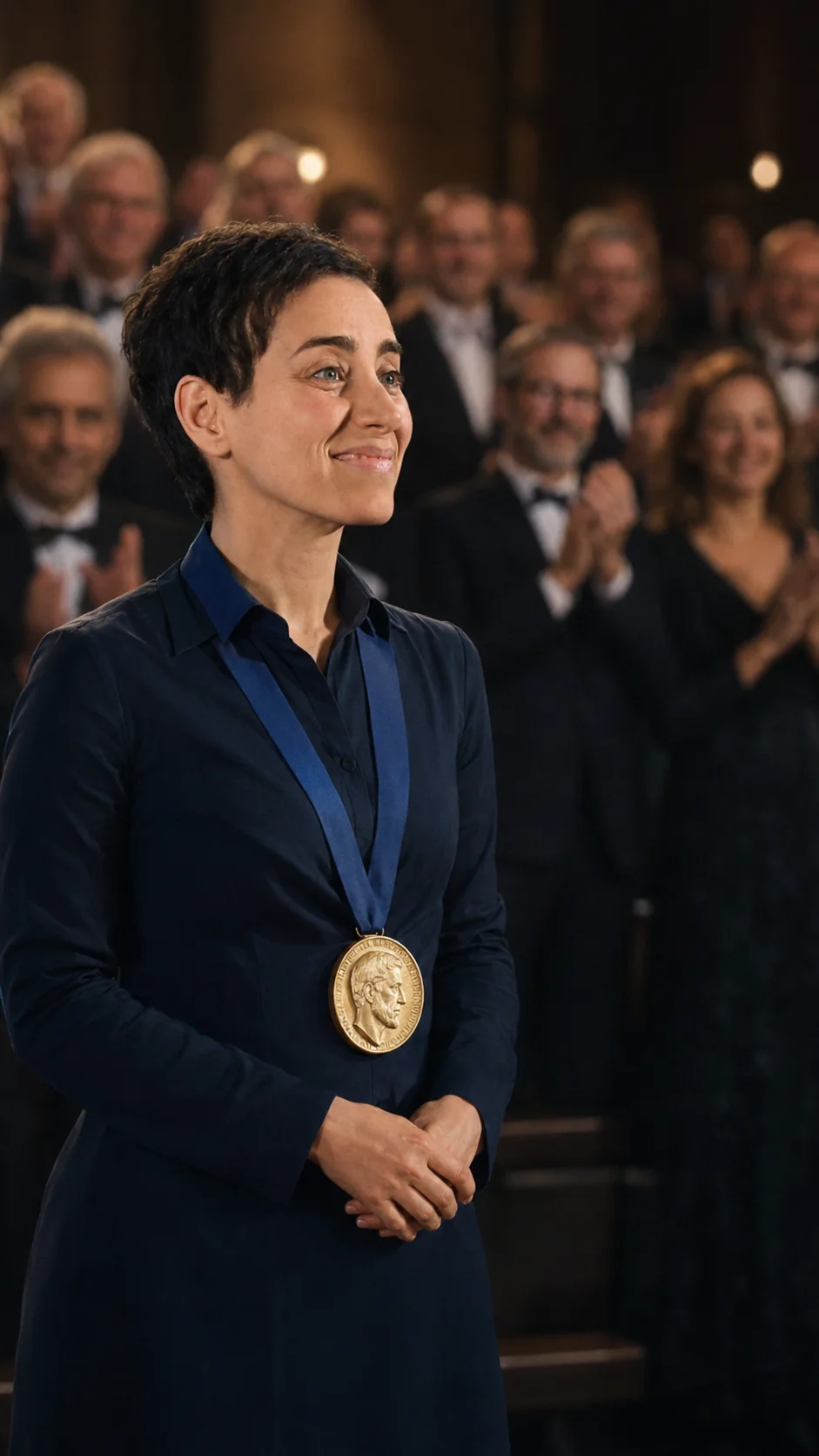
The record of the 2014 Fields Medal
The International Mathematical Union preserves Mirzakhani’s official citation and materials explaining her contributions to Riemann surfaces and their moduli spaces. The medal was awarded on 13 August 2014 in Seoul. The record reveals the scientific achievement behind her historic recognition as the first female recipient. The image is an artistic tribute, not a photograph of the ceremony or an exact reproduction of the medal.
A Girl Who Wanted to Write Stories

Maryam Mirzakhani was born in Tehran on 12 May 1977. She grew up during the years of the Iranian Revolution and the Iran–Iraq War. Her father, Ahmad, was an electrical engineer, and her mother, Zahra, supported the education of Maryam and her siblings in a period marked by instability.
As a child, she did not dream of becoming a mathematician. She wanted to be a writer and read every novel she could find. With her friend Roya Beheshti, she visited Tehran bookshops and bought books almost at random, guided by curiosity rather than any particular plan (O’Connor & Robertson, 2017).
She did not immediately excel in mathematics either. During her first year of middle school, she received disappointing results, and one teacher showed little confidence in her abilities. The following year, another teacher encouraged her, and her performance changed dramatically. Mirzakhani later recalled the experience as evidence of how much influence an adult’s perception can have on a student (O’Connor & Robertson, 2017).
She attended the Farzanegan School in Tehran, part of a network for academically gifted girls. There, surrounded by classmates, solving problems ceased to be an obligation and began to resemble an investigation.
The Door That Had Not Yet Opened
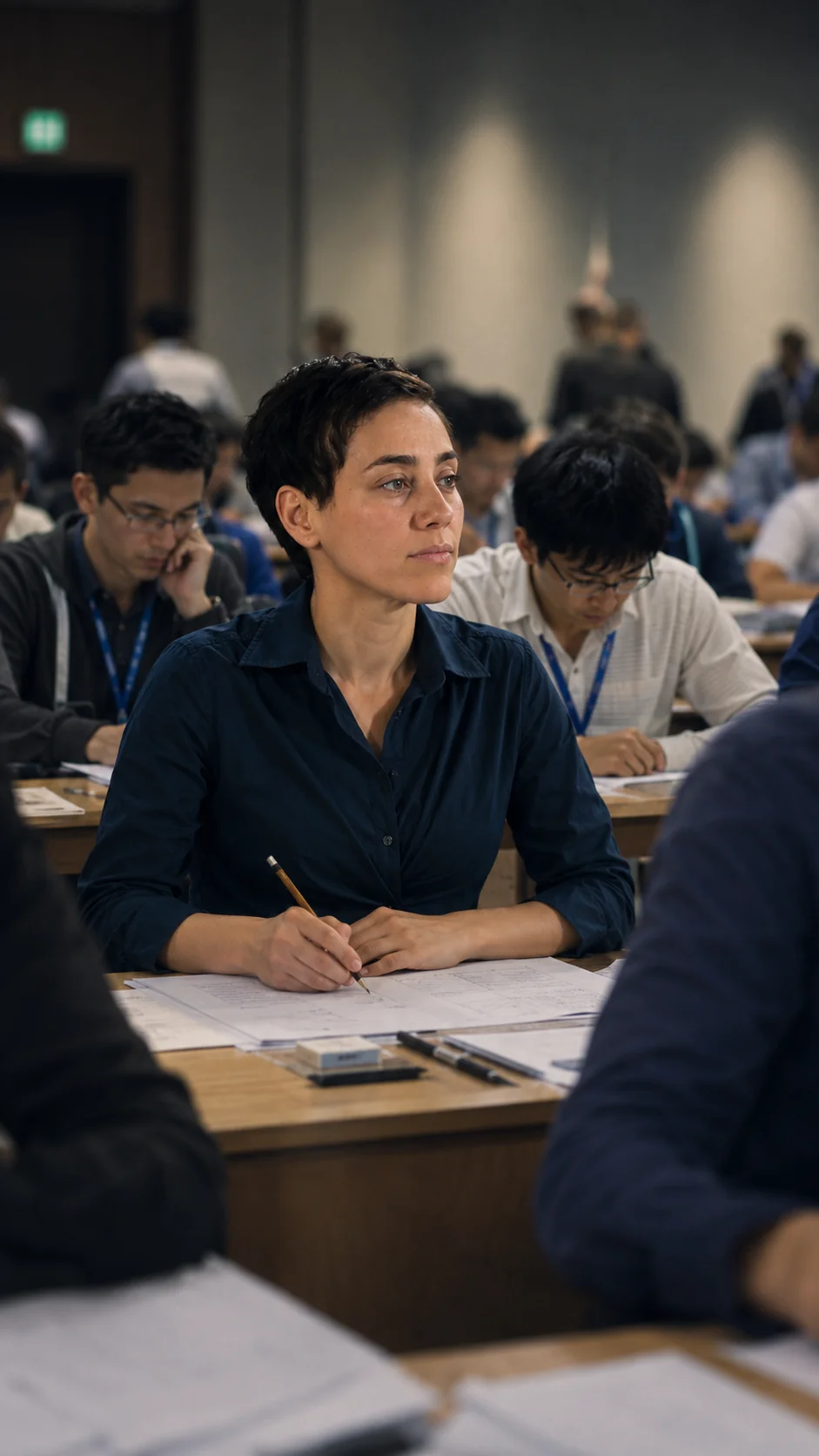
Maryam and Roya wanted to compete in the International Mathematical Olympiad, but no Iranian girl had ever joined the national team. They approached their school principal and asked her to arrange special preparation sessions.
The principal agreed without knowing whether they would qualify. That decision changed two lives and opened a door that had not previously existed.
In 1994, Mirzakhani became one of the first two girls selected to represent Iran at the International Mathematical Olympiad. She won a gold medal in Hong Kong. The following year, she competed again in Toronto and earned a second gold medal with a perfect score: 42 points out of 42 (Stanford University, 2014).
Those achievements made her known within the mathematical community, but they did not make her obsessed with competition. Olympiads rewarded speed in solving carefully formulated questions. Research demanded something different: remaining for months or years inside a question whose solution might not even exist.
That slowness would ultimately suit her better.
The Bus That Never Reached Tehran
Mirzakhani enrolled at Sharif University of Technology, one of Iran’s leading scientific institutions. She joined informal reading and problem-solving groups, published research while still an undergraduate, and found a community that reinforced her decision to devote her life to mathematics.
In 1998, she travelled with a group of outstanding students to a competition in Ahvaz. On the return journey to Tehran, the bus driver lost control and the vehicle plunged into a ravine. Seven students and two drivers died. Maryam survived (O’Connor & Robertson, 2017).
The accident was a tragedy for Iran’s scientific community. The victims included young people regarded as members of an exceptional generation of mathematicians. Mirzakhani rarely turned the experience into a public part of her biography, and its personal meaning should not be invented on her behalf.
She completed her bachelor’s degree in 1999 and travelled to the United States to study at Harvard.
Learning a New Mathematical Language
At Harvard, she began working under Curtis McMullen, who had received the Fields Medal in 1998. Mirzakhani arrived with formidable problem-solving abilities but had to adapt to seminars conducted in English and to an unfamiliar mathematical field.
She frequently asked questions that appeared too broad. McMullen realised this was not naïveté: she was attempting to reconstruct every subject from its foundations and discover connections that others accepted without examination.
Her doctoral thesis, completed in 2004, produced several major results concerning Riemann surfaces and moduli spaces. It was not merely promising research that might mature one day. It already contained work of exceptional quality (Clay Mathematics Institute, n.d.).
To understand why it mattered, it is necessary to enter briefly into the worlds she studied.
Surfaces, Paths, and Moduli Spaces
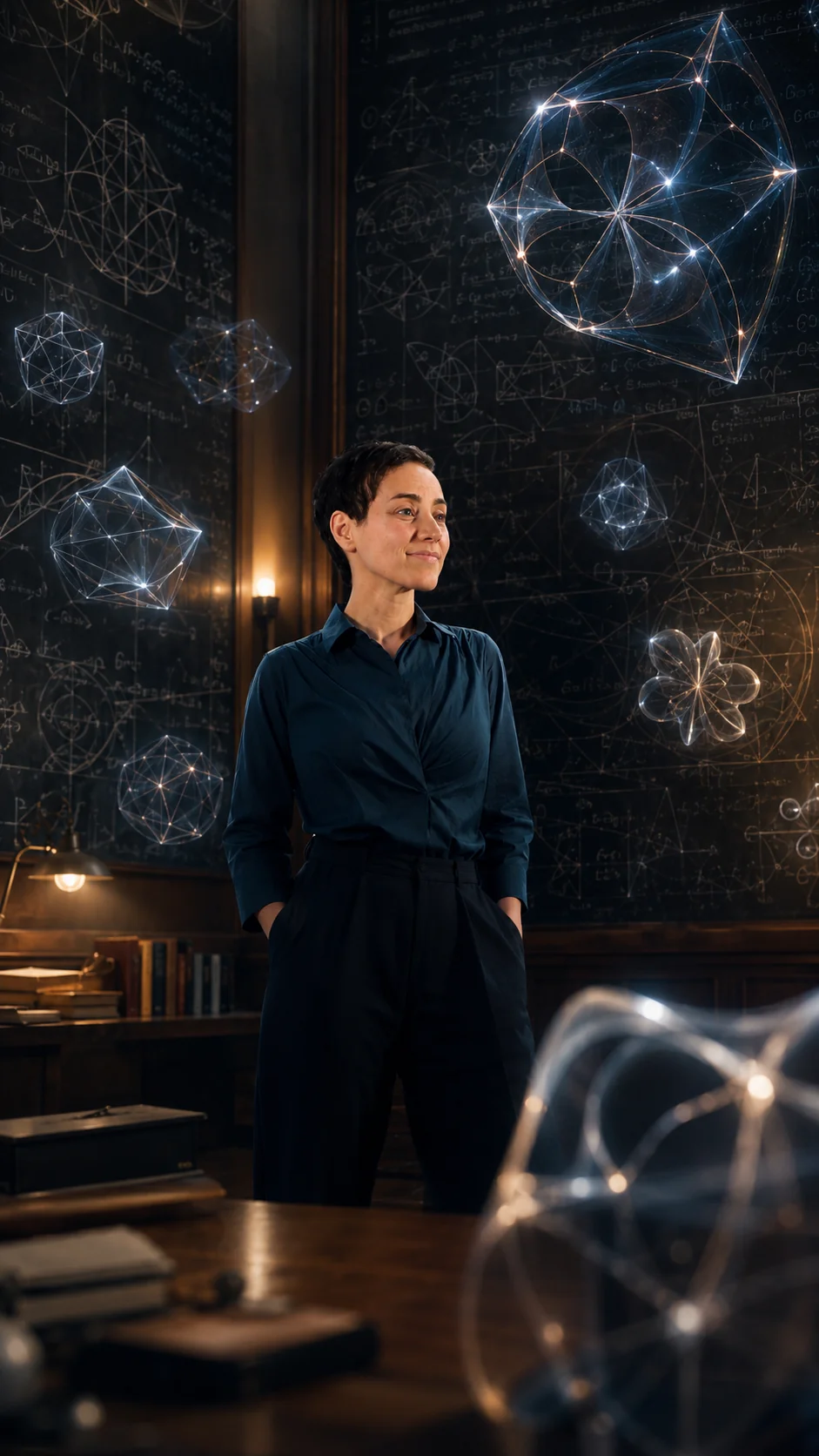
A Riemann surface may be imagined—incompletely but usefully—as a curved surface possessing an additional mathematical structure. Some have the topology of a sphere; others resemble a doughnut with one or several holes.
Geodesics can be drawn across these surfaces: the straightest possible paths within curved space. On a sphere, for example, great-circle routes play this role. On more complicated surfaces, geodesics may circle holes, cross one another, or continue according to patterns that are difficult to classify.
Mirzakhani studied simple closed geodesics in particular: paths that return to their starting point without crossing themselves. She determined how the number of these curves grows as their permitted length increases, solving a problem that connected geometry, topology, and dynamics (International Mathematical Union, 2014).
She also investigated moduli spaces. Instead of analysing a single surface, mathematicians construct an abstract space in which every point represents a possible surface with specified characteristics. Moving through this space means deforming the object’s geometry.
It is like creating an atlas not of countries, but of every form a world might take.
Measuring the Space of All Shapes
In her thesis, Mirzakhani developed methods for calculating the volumes of moduli spaces of bordered Riemann surfaces. Her formulas related curve lengths, hyperbolic geometry, and quantities known as Weil–Petersson volumes.
Using these results, she produced a new proof of Witten’s conjecture concerning intersection classes on moduli spaces. Maxim Kontsevich had already proved the conjecture, but Mirzakhani’s route was unexpected: she reached it through geometry and recursive relationships built from surfaces (International Mathematical Union, 2014).
The importance did not lie merely in obtaining an already known answer. Her proof revealed new connections and supplied tools capable of addressing other problems.
After completing her doctorate, she received a Clay Mathematics Institute Research Fellowship and worked at Princeton. In 2008, she joined the faculty at Stanford.
The “Magic Wand”
One of Mirzakhani’s most important collaborations was with Alex Eskin. Together, they studied dynamics in moduli spaces of flat surfaces, connected among other questions with the idealised movement of a billiard ball across a polygonal table.
A ball bouncing inside a rectangular table produces relatively understandable paths. For other polygons whose angles are rational multiples of π and friction is ignored, trajectories can become extremely complicated. A mathematical technique “unfolds” the rebounds and turns them into straight-line motion across surfaces assembled from copies of the polygon.
Mirzakhani and Eskin analysed the possible orbits within these spaces. Their extensive work established a surprising rigidity: although trajectories might appear chaotic, the closures of certain orbits possessed an algebraic structure far more orderly than expected (International Mathematical Union, 2014).
Amir Mohammadi coauthored the orbit-closure work with Eskin and Mirzakhani, building on Eskin and Mirzakhani’s measure-classification theorem (Eskin et al., 2013). The result became informally known as the “magic wand theorem,” not because it used magic, but because it made numerous previously inaccessible problems solvable.
The result emerged from several complementary papers and required years of effort.
Thinking Slowly
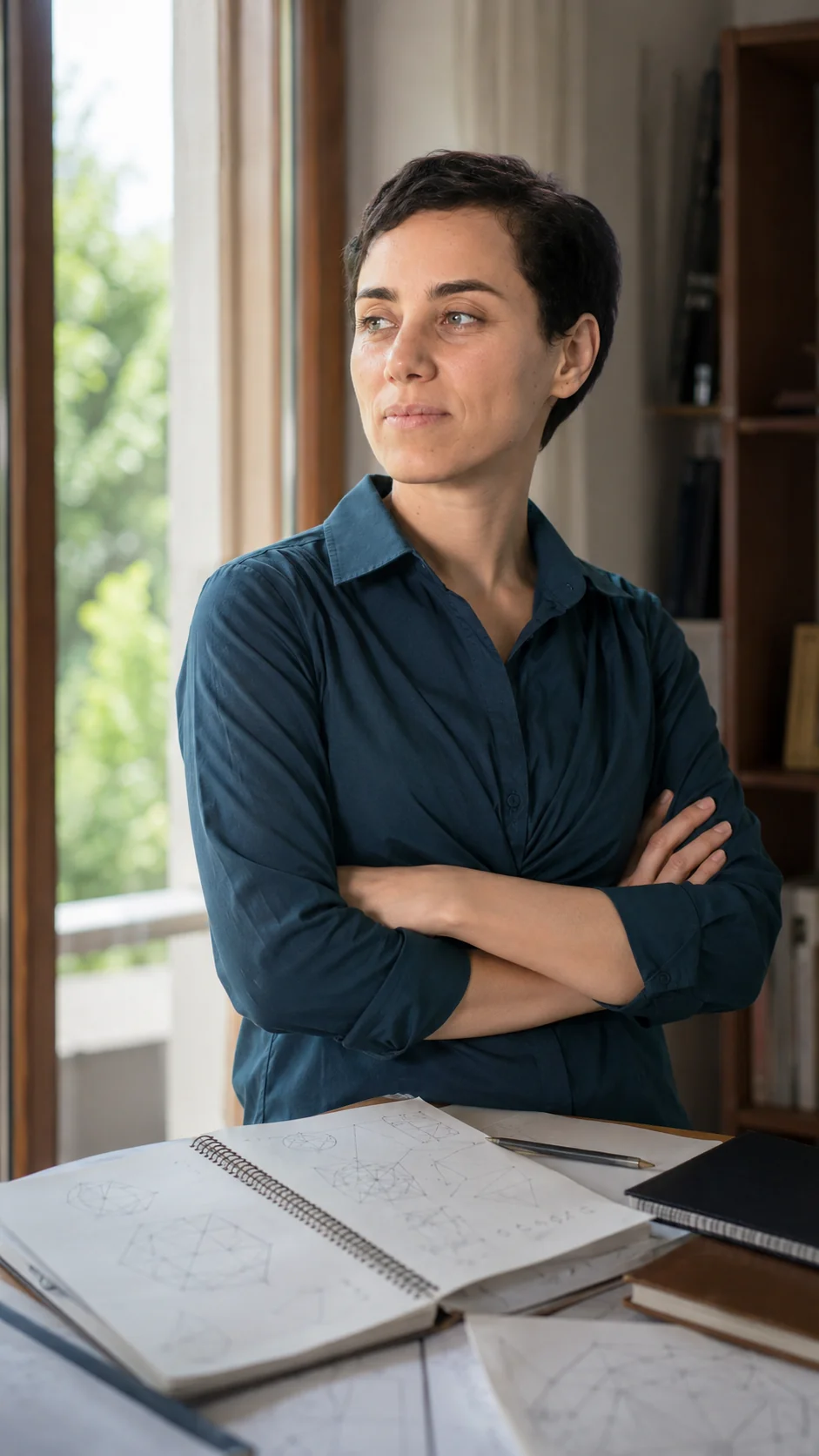
Mirzakhani did not match the stereotype of a genius producing instant answers. She could work for long periods without knowing whether an idea would lead anywhere. She compared research to being lost in a jungle, gathering knowledge and trying new tools until a path out appeared.
She used enormous sheets of paper and filled them with drawings. She wrote equations around curves, repeated configurations, and allowed the image of a problem to evolve. This visual form of reasoning connected with her childhood ambition to become a writer: she constructed mathematical narratives in which objects changed and followed paths (Stanford University, 2014).
She also rejected the image of the isolated mathematician. Her discoveries depended on teachers, friends, seminars, and collaborators. She needed prolonged concentration, but community remained part of the process.
Her husband, Jan Vondrák, was a theoretical computer scientist. They had a daughter, Anahita, who watched the sheets fill with figures and said that her mother was painting.
She was not entirely wrong.
The Fields Medal
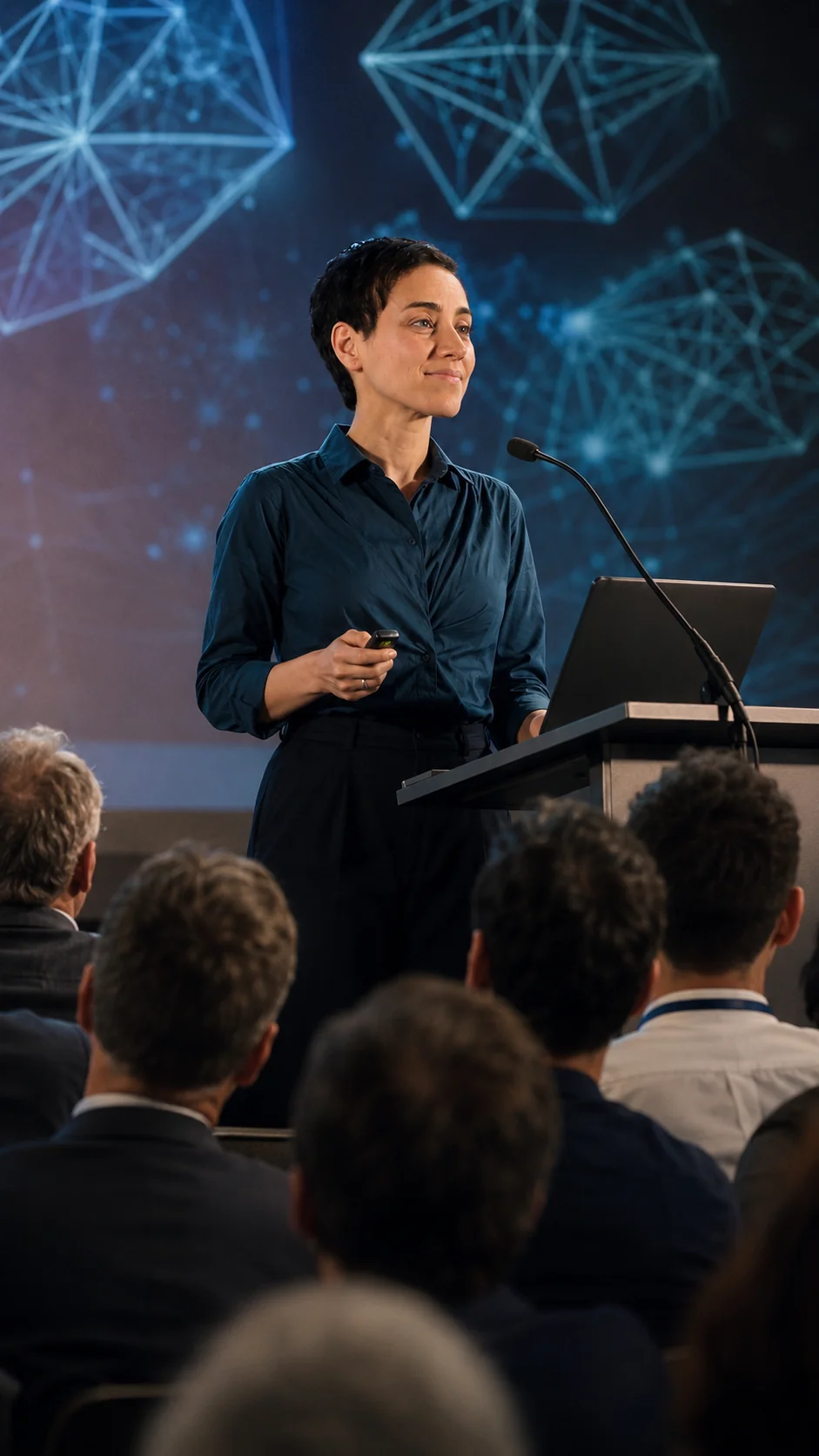
On 13 August 2014, at the International Congress of Mathematicians in Seoul, Mirzakhani received the Fields Medal for her contributions to the dynamics and geometry of Riemann surfaces and their moduli spaces.
Established in 1936 and awarded every four years with an age rule requiring a candidate’s fortieth birthday not to precede 1 January of the congress year, it is regarded as one of the discipline’s highest honours.
Mirzakhani was the first woman and first Iranian to receive it. The achievement revealed both the magnitude of her work and a history of exclusion: seventy-eight years had passed since the medal was first awarded without a woman among its recipients (International Mathematical Union, 2014).
She received the news modestly and expressed the hope that it would encourage other young women in science and mathematics. She did not wish to be reduced to the symbol of “the first woman,” but understood that her presence changed what others could imagine as possible.
A Career Interrupted
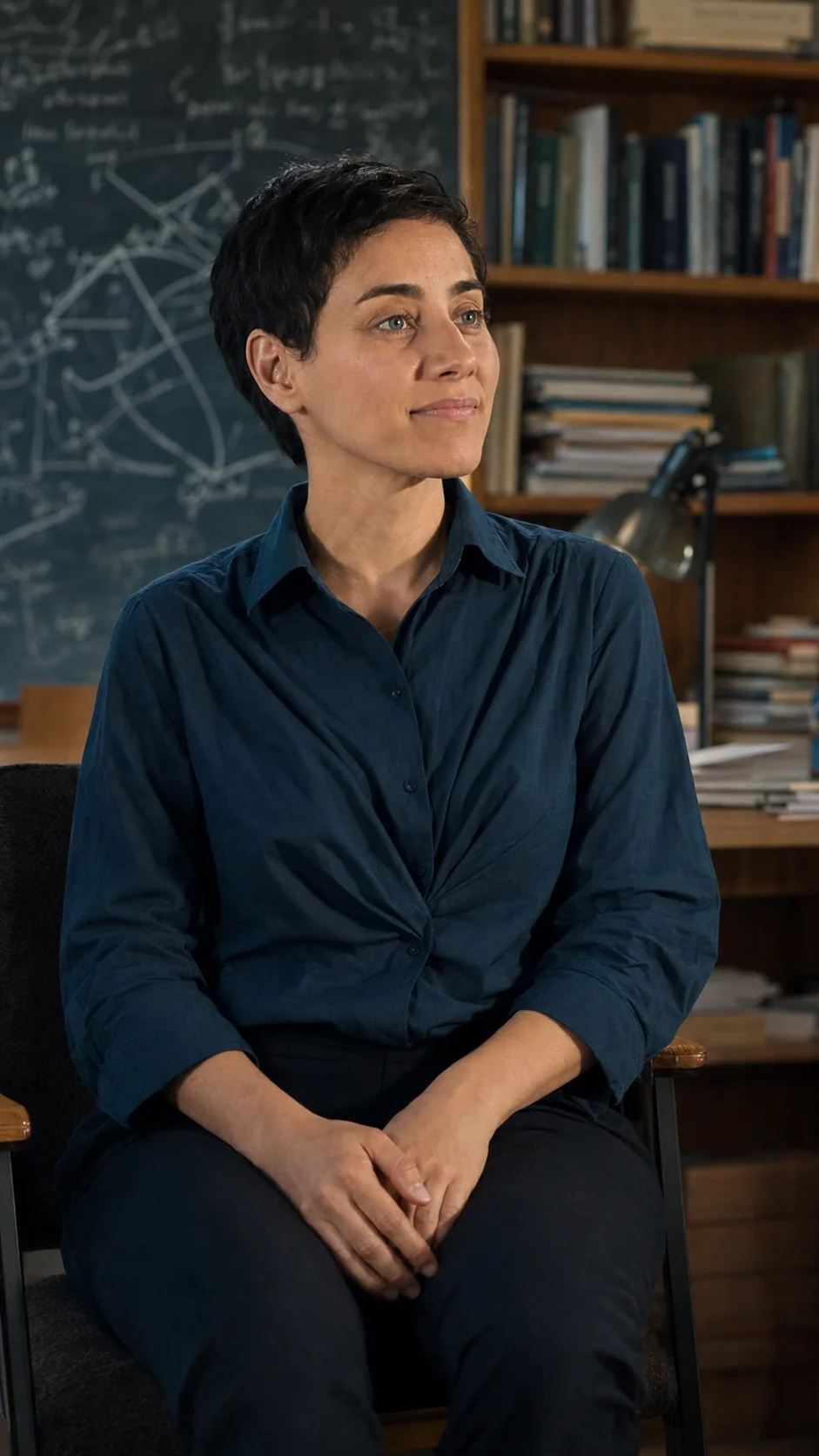
Mirzakhani had been diagnosed with breast cancer in 2013. She continued researching, teaching, and collaborating while receiving treatment. The illness later spread to other organs.
She died on 14 July 2017 at the age of forty. The news prompted tributes at universities around the world and especially intense mourning in Iran. Some Iranian newspapers published photographs of her without the legally required head covering—an unusual decision reflecting the scale of the national loss.
Less than a decade had passed since she joined Stanford and only three years since she received the Fields Medal. Many of her research programmes remained open.
Drawing the Invisible
Maryam Mirzakhani belongs among the mathematicians, codes, and obsessions that touched the human limit because she devoted her life to understanding spaces beyond ordinary intuition. She did not seek to dominate the world with quick formulas. She remained inside a question until its hidden structure appeared.
Her work continues to shape geometry, topology, dynamical systems, and mathematical physics. The International Women in Mathematics Day is observed on 12 May, her birthday, extending her capacity to open doors.
As a child, she wanted to write novels. In a sense, she never abandoned that ambition. Her surfaces contained characters, transformations, journeys, and conclusions. Her stories simply took place not in visible cities but in curved universes where a line might travel for years before revealing where it belonged.
References
- Clay Mathematics Institute. (n.d.). Maryam Mirzakhani. View source
- International Mathematical Union. (2014). The work of Maryam Mirzakhani. View source
- Eskin, A., Mirzakhani, M., & Mohammadi, A. (2013). Isolation, equidistribution, and orbit closures for the SL(2,R) action on moduli space [Preprint]. arXiv. View source
- International Mathematical Olympiad. (n.d.). Maryam Mirzakhani: Results. View source
- O’Connor, J. J., & Robertson, E. F. (2017). Maryam Mirzakhani. MacTutor History of Mathematics Archive. View source
- Stanford University. (2014). Stanford’s Maryam Mirzakhani wins Fields Medal. View source
- Stanford University. (2017). Maryam Mirzakhani, mathematician and Fields Medal winner, dies at Stanford. View source
- International Mathematical Union. (n.d.). May 12 – Celebrating women in mathematics. View source
More from this collection

Sofia Kovalevskaya: The Woman Who Had to Marry to Study Mathematics
Read story →
Emmy Noether: The Woman Who Found the Laws Hidden Behind Symmetry
Read story →