In this storyOpen index
Bela Lugosi: The Man Imprisoned Inside Dracula
Bela Lugosi before and after Dracula: theater, exile, typecasting and a career that extended far beyond the vampire’s cape.
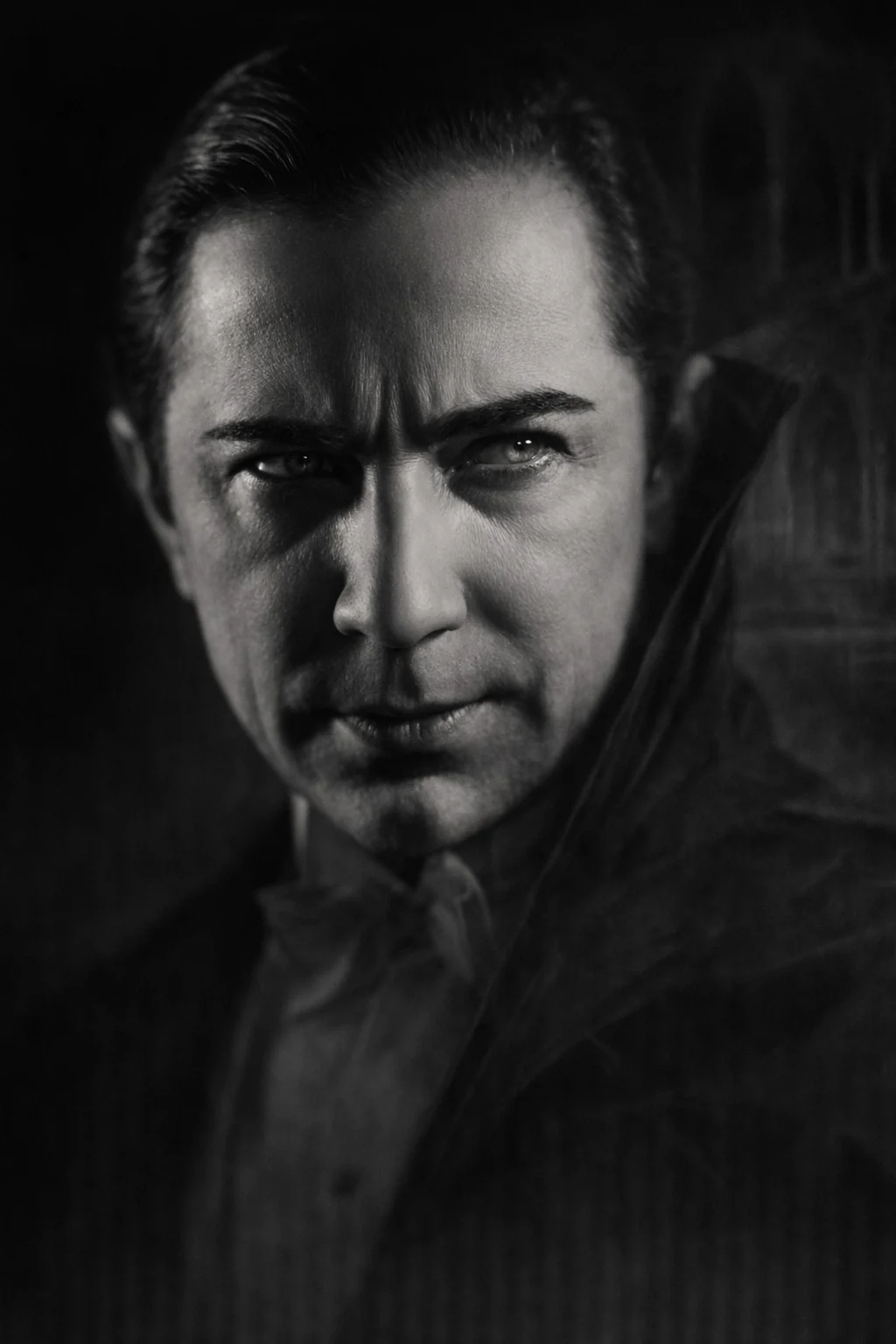
One performance made him an immortal face of cinema. It also made Hollywood confuse the actor with the character he would struggle to escape.
Bela Lugosi transformed Dracula into an elegant, hypnotic and dangerously human presence. His accent, motionless gaze and deliberate movements defined the cinematic vampire for generations. Yet the character that gave him immortality eventually concealed the actor behind the cape.
Before Hollywood, he had been a soldier, union organizer, exile and stage performer. After Dracula, the film industry began treating him as though he could exist only among coffins, castles and laboratories. His later performances, however, reveal a career broader than that label.
Bela Lugosi
The actor behind the cape
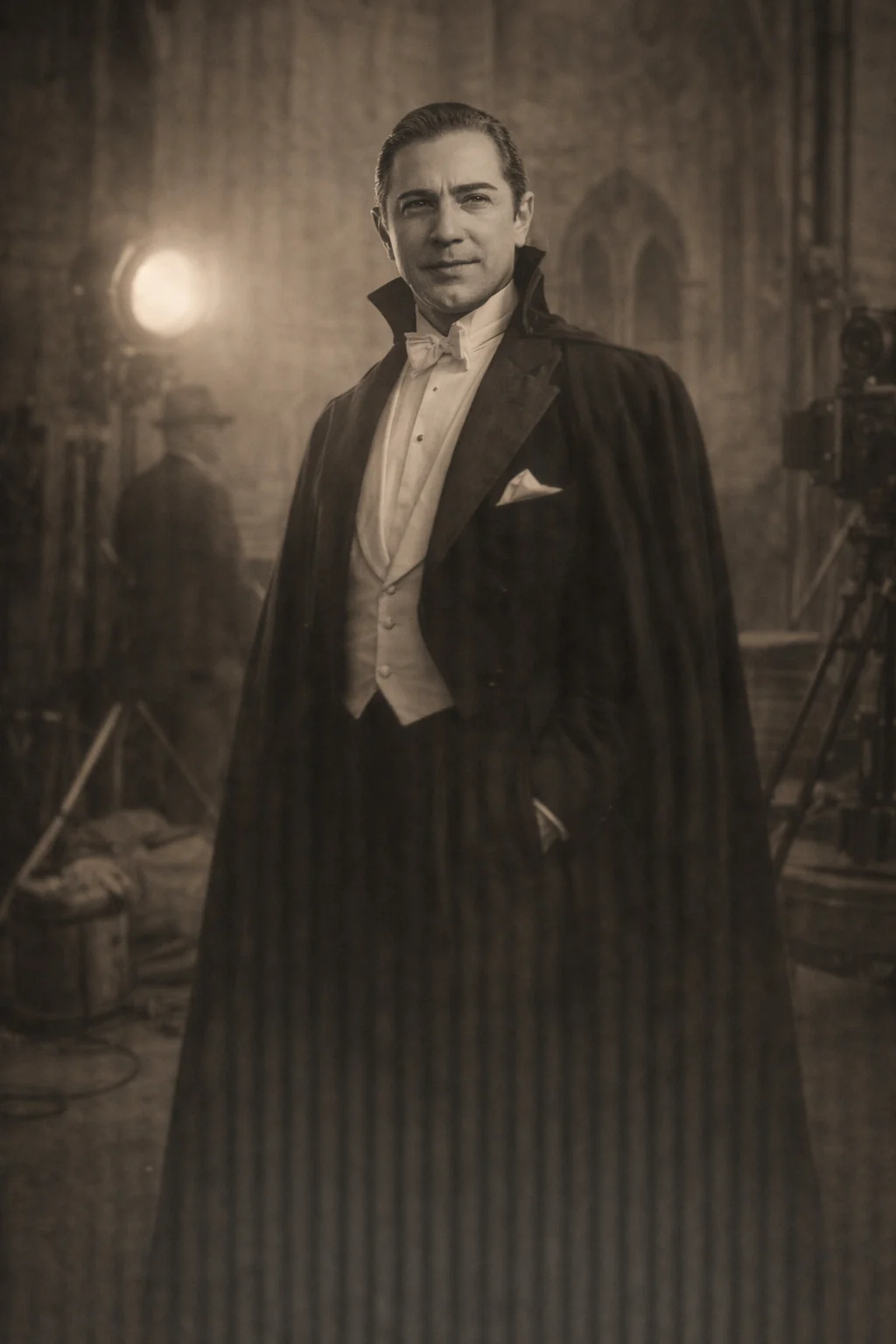
The cape that outlived Dracula
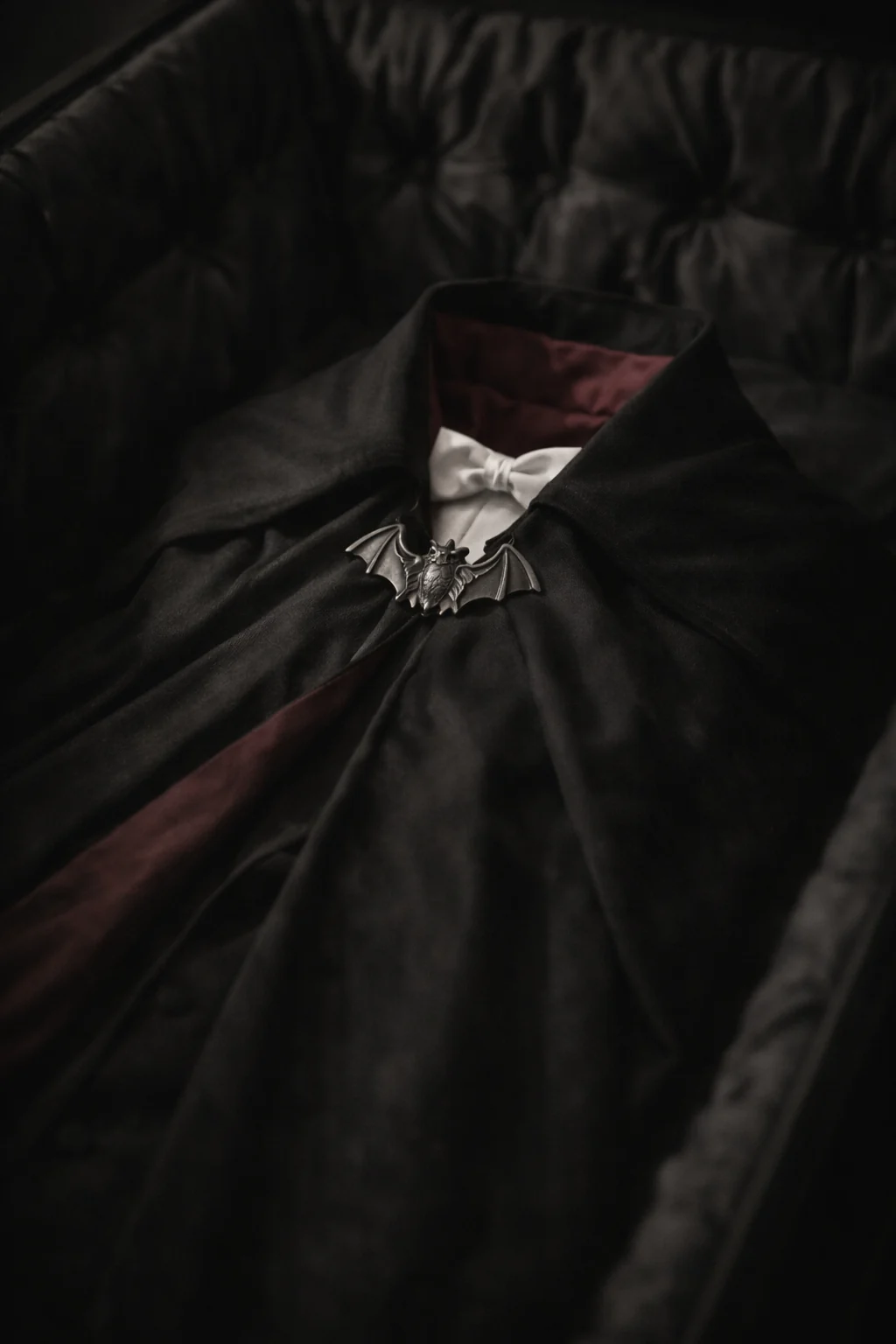
In 2019, the Academy announced its acquisition of a cape worn by Bela Lugosi in Dracula (1931). Preserved by the actor and later his family, it connects the film performance with his life beyond the studio. The institutional record traces its provenance and explains its place in a collection devoted to preserving film history. The accompanying image is an artistic recreation, not a photograph of the artifact.
A name taken from his birthplace
Béla Ferenc Dezső Blaskó was born on October 20, 1882, in Lugos, a town in the Kingdom of Hungary within the Austro-Hungarian Empire. It is now called Lugoj and lies within Romania.
He was the youngest of four children. His father, István Blaskó, was a bank official who expected his son to pursue a stable life. Béla instead left home as a teenager and worked at various jobs before entering the theater.
When his acting career began, he adopted the surname Lugosi, derived from the name of his birthplace. The decision seems almost prophetic: even after crossing Europe and the Atlantic, he carried in his name the memory of the town he had left behind.
He began acting professionally in the early twentieth century, joining provincial theater companies before reaching Budapest. He performed Shakespeare, romantic dramas and contemporary plays. Although he later exaggerated the importance of some of his roles at Hungary’s National Theatre, he possessed substantial stage experience before entering motion pictures (Rhodes, 1997).
Lugosi was not born as a horror actor. He had played lovers, heroes and dramatic characters long before Hollywood discovered his face.
War before the monsters
When the First World War began, Lugosi entered the Austro-Hungarian Army. He served on the Eastern Front and fought in the Carpathian region. He was wounded and received recognition for his service before returning to acting.
The precise details of his military record have become surrounded by conflicting stories, some promoted by Lugosi himself. His wartime service is documented, but not every heroic episode later attributed to him can be independently verified (Lennig, 2010).
Hungary underwent a revolution after the war. Lugosi helped organize an actors’ union associated with the socialist movement. When the Hungarian Soviet Republic collapsed in 1919 and its supporters faced persecution, he fled the country.
He traveled through Vienna and Germany, appearing in silent films. In 1920, he sailed to the United States as a crewman aboard a merchant vessel. He disembarked in New Orleans and eventually made his way to New York.
He arrived without speaking fluent English, but he did not abandon the stage.
Acting in a language he did not yet understand
In New York, Lugosi found employment with Hungarian immigrant theater companies. His earliest American productions were intended for audiences who understood his language, but he wanted to enter English-language theater.
For some early roles, he memorized his dialogue phonetically. He learned the sounds and intonation even when he did not fully understand every word. The method allowed him to perform, although his strong accent restricted the kinds of characters producers were willing to offer him.
In 1927, he obtained the role that transformed his life: Count Dracula in the stage adaptation created by Hamilton Deane and John L. Balderston from Bram Stoker’s novel.
The production opened on Broadway on October 5, 1927. Lugosi did not portray the vampire as a hunched and repulsive creature. He appeared in evening clothes, with aristocratic manners, controlled movements and an unsettling sensuality.
The play ran for 261 performances in New York before touring. During its West Coast engagement, Lugosi decided to remain in California. Hollywood was entering the age of sound, and for the first time a voice could become an essential part of a monster.
The Dracula Hollywood did not want to hire
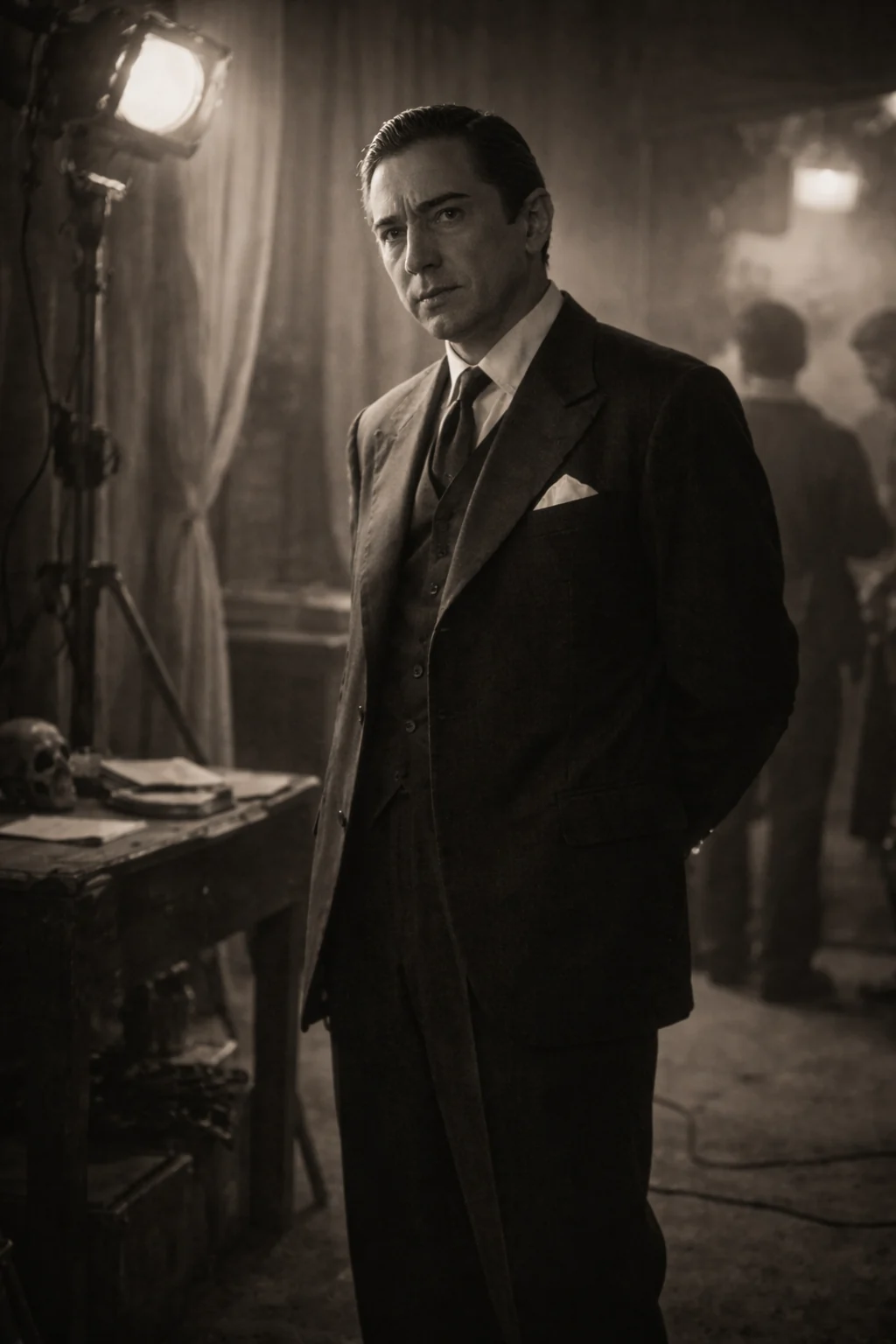
Universal Pictures decided to transform the stage play into a film. Despite Lugosi’s success in the theater, the studio did not initially consider him indispensable. Other actors were discussed, and the Hungarian performer had to campaign for the role.
Lugosi accepted a modest salary in comparison with the film’s eventual importance: approximately $3,500 for seven weeks of work. His determination to play the character and his stage experience ultimately helped secure the part (Lennig, 2010).
Directed by Tod Browning, Dracula was released in 1931. Many of its scenes retained the stiffness of a theatrical production, but Lugosi turned that slowness to his advantage. His silences, pauses and deliberate pronunciation produced a tension that silent cinema could not have created.
His Dracula did not require visible fangs or large quantities of blood. He controlled a scene through his gaze and voice.
With his screen presence, Lugosi established an image that survives today: slicked-back hair, evening clothes, a medal across the chest and a high-collared cape. Part of that iconography came from the stage production, but Lugosi’s face and voice transformed it into a universal visual language (Skal, 2004).
The other Dracula filmed at night
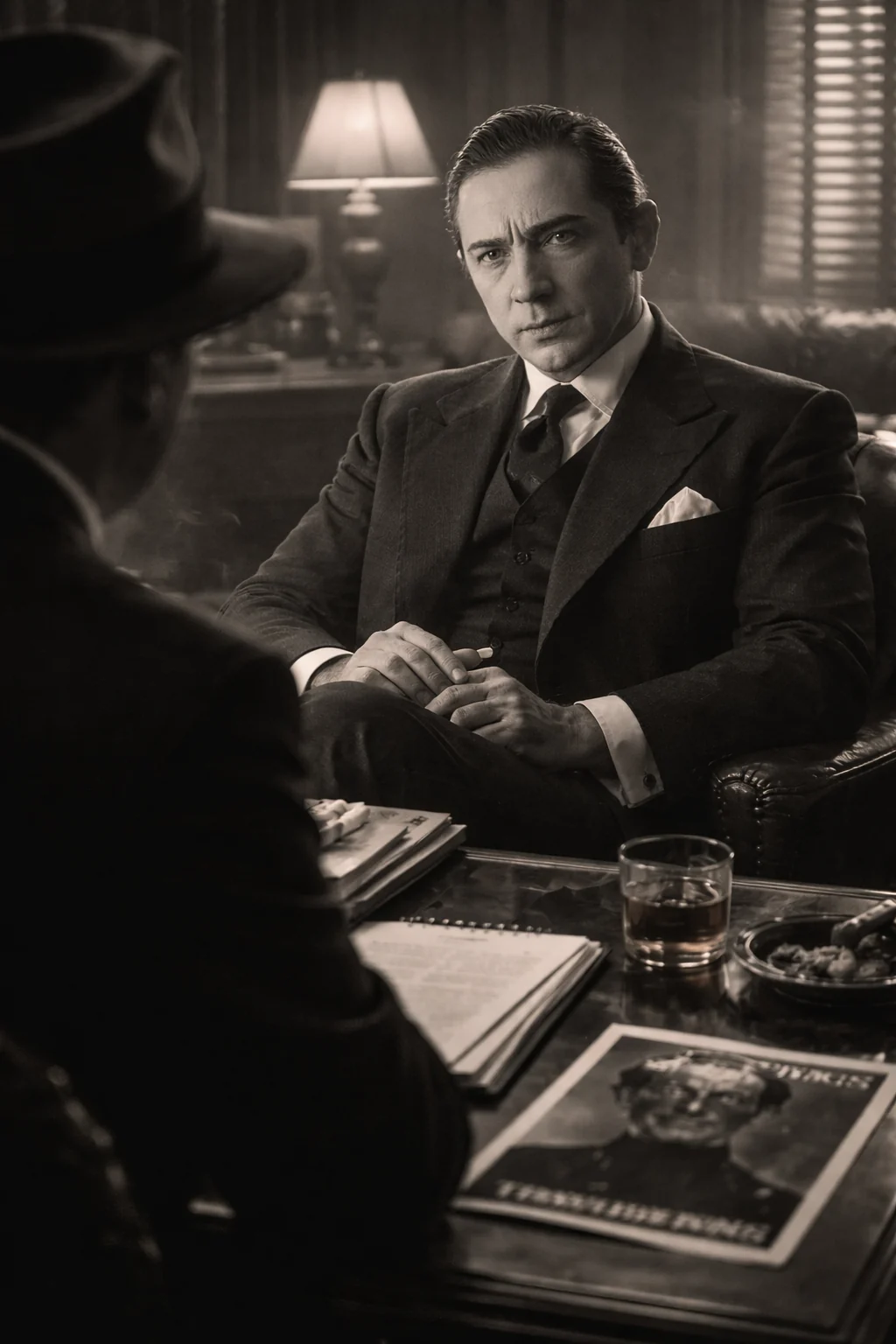
While Lugosi and Tod Browning filmed the English-language version during the day, another company entered the same Universal sets at night.
Director George Melford shot a Spanish-language version starring Carlos Villarías and Lupita Tovar. During the early years of talking pictures, before dubbing became standard, studios often created separate versions of films for international markets.
The Spanish version developed a different visual approach. In her memoir, quoted by the Latin American Cinemateca of Los Angeles, Lupita Tovar recalled that only Carlos Villarías could see the other production’s daily footage and that he was encouraged to imitate Lugosi (de las Carreras, 2022).
The film’s recovery happened in stages. The negative found in the United States was incomplete; a print preserved by the Cinemateca de Cuba supplied missing material for restoration. Cooperation between archives returned to audiences a film that had remained largely unseen for decades (de las Carreras, 2022).
The shadow of typecasting
The success of Dracula did not turn Lugosi into the dramatic leading man he hoped to become. It made him Hollywood’s “horror man,” summoned whenever a studio required a sinister scientist, hypnotist, foreign criminal or supernatural presence.
In 1932 he starred in White Zombie, generally regarded as the first feature-length zombie film. That same year, he appeared in Island of Lost Souls. The Black Cat and The Raven, both pairing him with Boris Karloff, followed.
Hollywood promoted a rivalry between the two actors. Karloff had become another major horror figure after playing the creature in Frankenstein, and studios understood that audiences would pay to see the stars together.
Their careers did not progress equally. Karloff obtained better contracts and a wider range of characters. Lugosi remained restricted by his accent, his association with Dracula and professional decisions that did not always serve him well.
For years, it was claimed that Lugosi arrogantly rejected the Frankenstein monster. The actual history is uncertain. Universal considered him during different stages of the project, and tests may have been made, but there is insufficient evidence to support the simplified legend that he categorically rejected the character because he refused to perform under makeup without dialogue (Rhodes, 1997; Weaver et al., 2007).
Ygor: the role that revealed what he could still do
After several years of professional decline, Lugosi was offered the role of Ygor in Son of Frankenstein in 1939.
He was not the protagonist and bore none of Dracula’s elegance. Ygor was a former blacksmith with a damaged neck, ragged appearance and manipulative personality. Lugosi disappeared into the role and delivered one of his finest performances.
Ygor’s success brought him back for The Ghost of Frankenstein in 1942. Paradoxically, an actor trapped inside one recognizable face demonstrated his range when makeup rendered him almost unrecognizable.
In 1943 he finally portrayed the creature in Frankenstein Meets the Wolf Man. The monster was originally supposed to speak and had become blind because of events in the previous film, explaining why Lugosi walked with his arms extended. His dialogue and the references to blindness were removed during editing.
The cuts made some of his physical movements appear clumsy or inexplicable. A performance designed around narrative logic became another image used to ridicule him.
Dracula returns
Despite his permanent association with the character, Lugosi officially portrayed Dracula in only two feature films.
The second came seventeen years later in Abbott and Costello Meet Frankenstein, released in 1948. The comedy placed Dracula, Frankenstein’s monster and the Wolf Man alongside the popular duo Bud Abbott and Lou Costello.
Lugosi treated the character with complete seriousness. That decision allowed the comedy to work: while the leading characters responded with fear and confusion, his Dracula remained a genuine threat.
The film was successful, but it did not restore his career. Hollywood was moving away from its classic monster cycle, and Lugosi again found opportunities disappearing.
Pain, dependency and a public confession
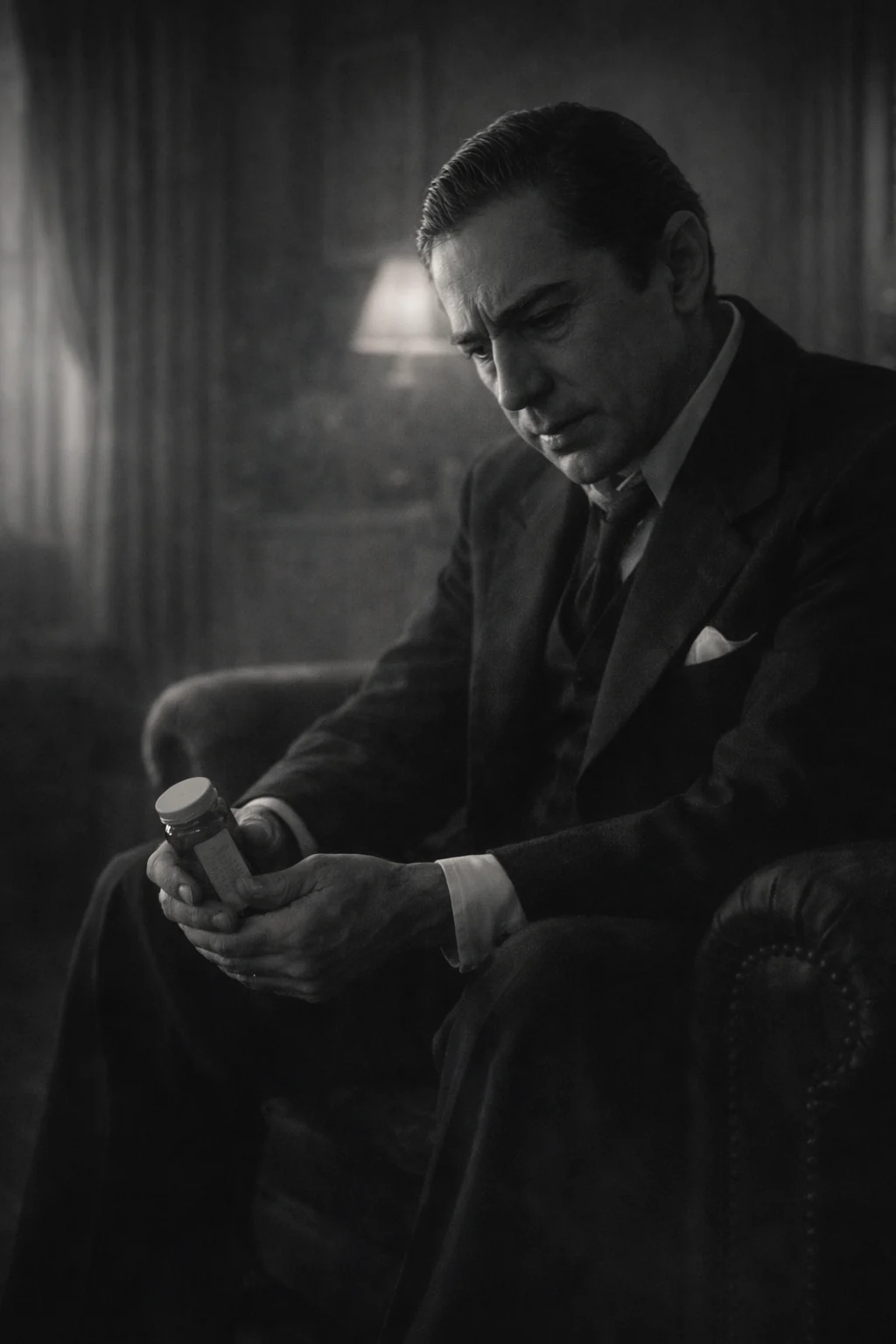
Over the years, Lugosi developed a dependency on morphine and other opioids. Treatment had begun as an attempt to control physical pain, associated in different accounts with sciatica and older injuries. His dependence worsened as his career and finances deteriorated.
In April 1955, he voluntarily entered a Los Angeles public institution for treatment. He did so openly and allowed the press to learn about his condition. At a time when studios routinely concealed performers’ addictions, his decision represented an unusually public acknowledgment.
He was not merely a passive victim of drugs. He asked for help and attempted to regain control of his life. After treatment, he announced that he was prepared to return to work.
The Hollywood that had transformed him into an icon, however, had almost stopped calling.
Ed Wood and the final pictures
In the early 1950s, Lugosi met Edward D. Wood Jr., an enthusiastic young filmmaker who deeply admired him.
Wood could not offer major budgets or prestige. He could offer something the large studios no longer provided: work and attention. Lugosi appeared in Glen or Glenda and starred in Bride of the Monster.
They were extremely modest productions filled with technical limitations. Decades later, they would be celebrated as cult films and cited as examples of “bad” filmmaking. Yet reducing their relationship to a joke is unfair. For Lugosi, these projects represented a chance to stand before a camera again.
Wood also filmed silent footage of Lugosi walking outside a house and among shrubbery. After the actor’s death, he incorporated those fragments into Plan 9 from Outer Space. To complete the character, Wood used another man who concealed much of his face behind a cape.
The result was one of cinema’s strangest resurrections: Lugosi appeared in a movie released after his death beside a substitute who barely resembled him.
The cape in which he was buried
Bela Lugosi died of a heart attack on August 16, 1956, in his Los Angeles apartment. He was seventy-three.
He was buried at Holy Cross Cemetery dressed as Dracula, wearing evening clothes, a medallion and a black cape. This produced the popular story that he had ordered his family to bury him as the vampire.
That funerary image should be distinguished from an artifact whose provenance the Academy documents: the cape worn in the 1931 film that remained with his family.
After the actor’s death, that cape remained with his former wife Lillian, who later gave it to their son, Bela G. Lugosi. The Academy announced its acquisition in 2019, partly as a gift from the family (Academy of Motion Picture Arts and Sciences, 2019).
The actor was buried beneath the image of Dracula, but a screen-worn cape remained above ground.
The face that taught vampires how to move
Bela Lugosi did not invent Dracula. Bram Stoker published the novel in 1897, and other actors had portrayed vampires before him. What Lugosi created was a way of inhabiting the character.
Before his performance, the cinematic vampire could appear as a repulsive creature associated with disease and death. Lugosi transformed him into a seductive aristocrat capable of entering a room without immediately provoking rejection. The danger no longer existed only in monstrous appearance, but in attraction itself.
The accent Hollywood considered a limitation became inseparable from the character. Countless later imitations exaggerated his pauses and pronunciation, although Lugosi never said the famous line “I want to suck your blood” in Dracula.
The film industry that exploited his image could not imagine everything else he might have accomplished. It turned him into a symbol and then punished him for being unable to escape that symbol.
Yet Lugosi’s defeat was never complete. Every new screen Dracula must engage, directly or indirectly, with the count of 1931. The cape, the gaze and the voice keep returning.
Hollywood locked him inside a cinematic coffin.
From within it, Bela Lugosi helped invent the way fear would present itself to a camera.
References
- Academy of Motion Picture Arts and Sciences. (2019, October 21). Academy Museum of Motion Pictures announces acquisition of Bela Lugosi’s iconic cape from Dracula. View source
- de las Carreras, M. E. (2022, October). Drácula. Latin American Cinemateca of Los Angeles. View source
- The Broadway League. (n.d.). Dracula. Internet Broadway Database. View source
- American Film Institute. (n.d.). Dracula. AFI Catalog. View source
- Lennig, A. (2010). The immortal count: The life and films of Bela Lugosi. University Press of Kentucky. View source
- Rhodes, G. D. (1997). Lugosi: His life in films, on stage, and in the hearts of horror lovers. McFarland. View source
- Skal, D. J. (2004). Hollywood gothic: The tangled web of Dracula from novel to stage to screen. Faber and Faber. View source
- Weaver, T., Brunas, M., & Brunas, J. (2007). Universal horrors: The studio’s classic films, 1931–1946 (2nd ed.). McFarland. View source
More from this collection
Ben Turpin: The Man Who Turned an Impossible Gaze into Cinematic Language
Read story →
Lillian Gish: The Face That Taught Cinema to Think in Silence
Read story →