In this storyOpen index
Virginia Woolf: The Writer Who Turned Her Dining Room Into a Publishing House
In 1917, she installed a small hand press in her dining room. That domestic project eventually became the Hogarth Press.
In 1917, while major publishing houses decided which authors deserved to be read, Virginia Woolf installed a small hand press in her dining room. She learned to set texts letter by letter and began printing her own stories. That domestic project eventually became the Hogarth Press, a publishing house that issued some of modernism’s foundational works and allowed Woolf to write without submitting completely to other publishers’ commercial judgments.
Virginia Woolf on video
Discover this story on our YouTube channel.
A life told through places and turning points

Enter the archive
An authentic object preserved by a cultural institution brings us closer to the world behind this life.
- Collection
- Wikimedia Commons
- Rights
- Public domain
Filippo Venturi Photography Blog
A Different Education for Sons and Daughters
Adeline Virginia Stephen was born in London on January 25, 1882. Her father, Leslie Stephen, was a writer, historian, and editor. Her mother, Julia Prinsep Jackson, had modeled for several artists and belonged to a family closely connected with Victorian culture.
The family home at Hyde Park Gate contained an extraordinary library and regularly received writers and intellectuals. Virginia grew up surrounded by books, but also within the educational limitations imposed upon women. While her brothers could attend Cambridge, she and her sister Vanessa were educated primarily at home.
That difference does not mean Virginia lacked a rigorous education. She studied history, literature, Greek, and Latin, and attended courses at the Ladies’ Department of King’s College London between 1897 and 1901. She did not receive the kind of university degree available to men, an inequality that would later influence her reflections on gender, education, and economic power (King’s College London, 2024).
Her adolescence was marked by successive losses. Her mother died in 1895; her half-sister Stella Duckworth in 1897; her father in 1904; and her brother Thoby in 1906. Woolf also left autobiographical accounts of sexual abuse within her family environment. Loss, trauma, and a possible biological predisposition have all been considered among the factors associated with her recurring mental health crises, although no single explanation can provide a definitive retrospective diagnosis.
The Birth of the Bloomsbury Group
Following Leslie Stephen’s death, Virginia, Vanessa, and their brothers Thoby and Adrian left the rigid respectability of Kensington and moved to 46 Gordon Square in Bloomsbury.
There, they began meeting with Thoby’s Cambridge friends. These included Lytton Strachey, Clive Bell, and Leonard Woolf. Over time, economist John Maynard Keynes, writer E. M. Forster, painter Duncan Grant, and art critic Roger Fry also became associated with the circle.
There was never a formal organization called the Bloomsbury Group with a manifesto or official membership list. It was a shifting circle of writers, artists, and intellectuals who shared conversations about art, friendship, sexuality, pacifism, and politics. Their ideas challenged numerous Victorian conventions, although the group was also criticized for its privileged origins and socially exclusive character (Inglis-Taylor, n.d.).
Virginia began publishing literary criticism and articles while developing her first novel. In 1912, she married Leonard Woolf, a writer, retired colonial administrator, and political activist. Her first novel, The Voyage Out, appeared in 1915 after a prolonged and emotionally difficult writing process.
The Printing Press in the Dining Room
In 1917, Virginia and Leonard purchased a small hand press. They installed it in the dining room of Hogarth House, their Richmond home, and taught themselves to arrange type, ink the machine, print pages, and bind the finished copies.
Their first publication was Two Stories, a small volume containing Leonard’s “Three Jews” and Virginia’s “The Mark on the Wall.” The couple performed the physical work themselves. The name Hogarth Press came from the house in which the project began (Archives Hub, n.d.).
Printing provided Virginia with a physical and repetitive activity that she could alternate with writing, but its importance went far beyond therapeutic distraction. It gave her editorial independence. She could experiment with structure, rhythm, and punctuation without first persuading a commercial publisher that her innovations would be profitable.
The Hogarth Press gradually expanded beyond its domestic origins. It published writing by Katherine Mansfield, E. M. Forster, Robert Graves, and other authors associated with modernism. In 1923, it produced the first British edition of T. S. Eliot’s The Waste Land. It also became an important platform for English translations of works by Sigmund Freud and other psychoanalytic writers (Penguin Books, 2017).
The press did not accept every significant project submitted to it. Virginia and Leonard declined to print James Joyce’s Ulysses, but the decision should not be reduced simply to censorship or a failure of judgment. Their small press lacked the technical and financial capacity required to produce such a long and typographically complicated book.
A New Way of Representing Consciousness
The freedom provided by the Hogarth Press coincided with Woolf’s artistic maturation. In Jacob’s Room (1922), Mrs Dalloway (1925), To the Lighthouse (1927), and The Waves (1931), she moved away from conventional linear storytelling.
Her novels do not merely recount what characters do. They move among memories, sensations, conversations, and thoughts. A walk through London, the sound of a clock, or preparations for a dinner can open paths into the past and reveal the inner lives of several people.
The phrase “stream of consciousness” is frequently used to describe her work, but Woolf did not simply transcribe thought in a disorganized way. Her books were carefully constructed. Beneath their apparent fluidity are precise rhythms, repetitions, changes in perspective, and temporal structures.
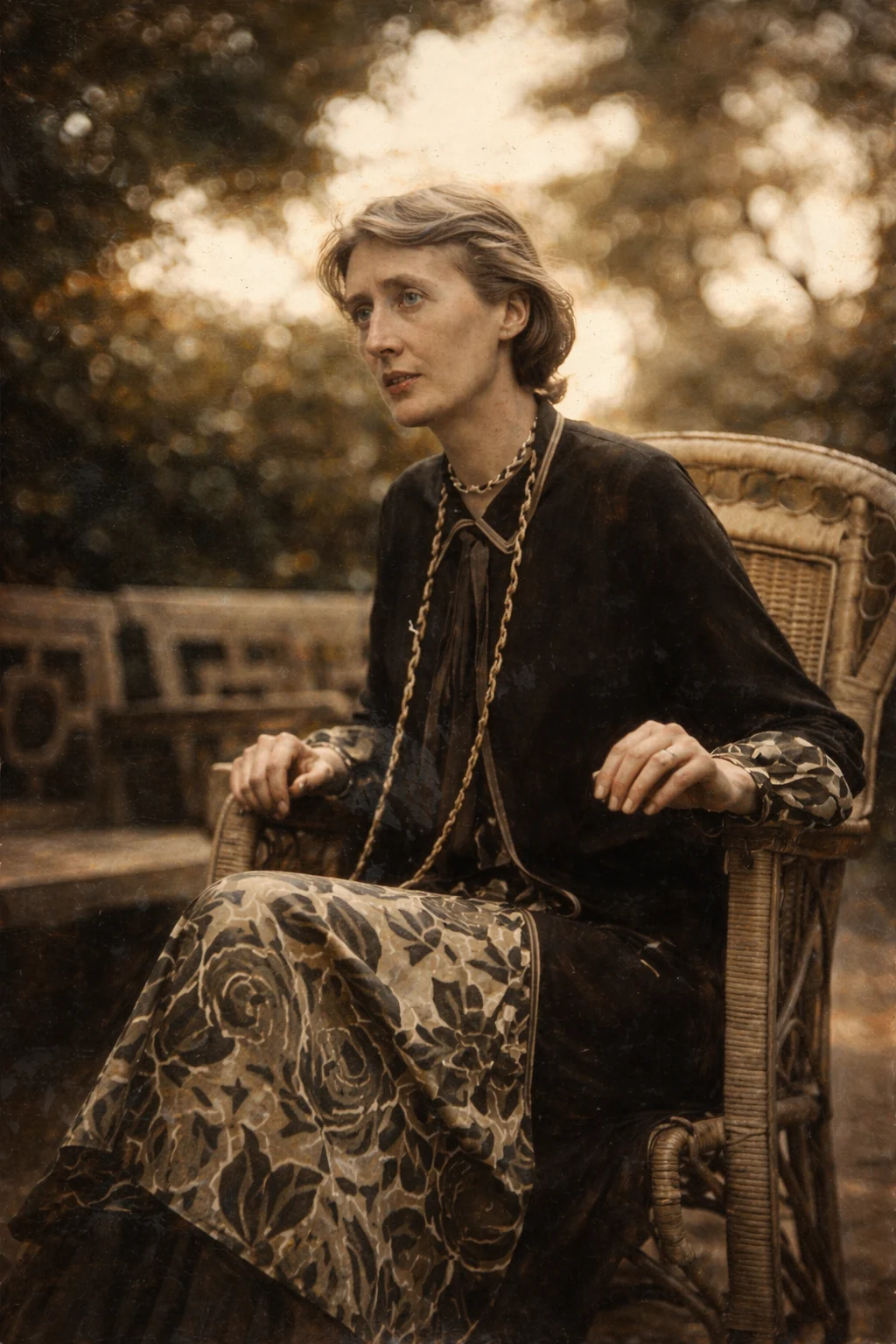
In 1919, Virginia and Leonard purchased Monk’s House, a modest home in the Sussex village of Rodmell. A small writing lodge was eventually created for her in the garden. She worked there for hours, revising her manuscripts carefully while surrounded by the South Downs landscape (National Trust, n.d.-a).
A Room, Money, and Independence
In 1928, Woolf delivered two lectures to female students at Girton and Newnham Colleges in Cambridge. Those talks became A Room of One’s Own, published by the Hogarth Press in 1929.
The essay argued that a woman needed money and private space if she was to write. Woolf’s argument was not simply a demand for a physical room. She examined how economic dependence, limited education, and domestic obligations had prevented countless women from developing their abilities.
To demonstrate this, she imagined a sister of William Shakespeare who possessed talents comparable to those of the playwright. Under the social conditions of the sixteenth century, this fictional woman would have had little opportunity to study, act, travel, or publish. Woolf used that imaginary absence to represent many real women whose creative works were never allowed to exist.
In Orlando (1928), inspired partly by Vita Sackville-West and her family history, Woolf created a character who lives for centuries and changes sex. The novel combined biography, satire, and fantasy to question the stability of gender and the ways society distributes rights and opportunities.
Her relationship with Vita was emotional and intellectual and coexisted with her marriage to Leonard. Presenting Woolf solely as an isolated and tormented writer obscures the complexity of her friendships, loves, and collaborations.
War and the Final Crisis
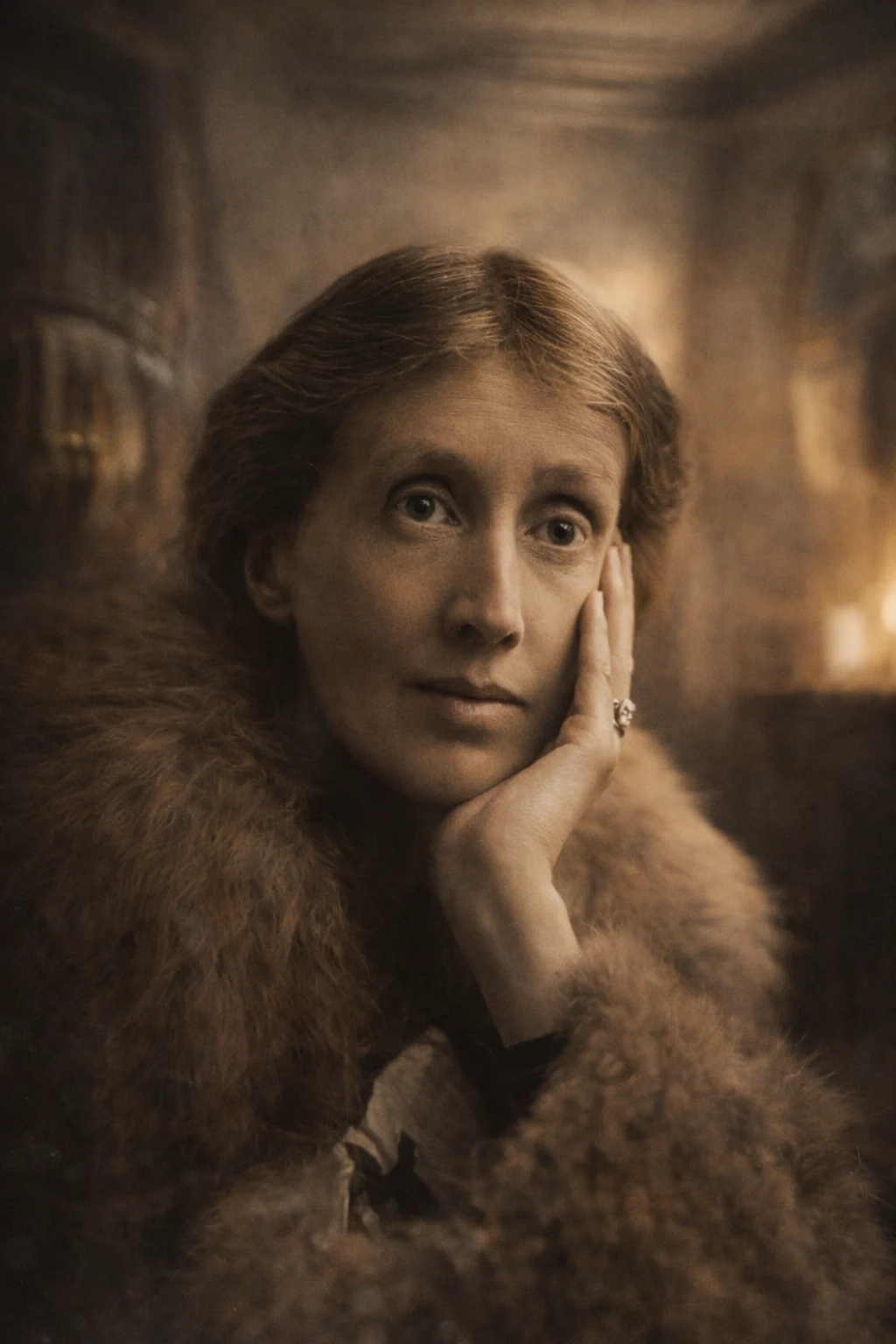
During the 1930s, Woolf watched the rise of fascism and the possibility of another European war with alarm. In Three Guineas (1938), she connected militarism with patriarchy, educational exclusion, and systems of power that kept women outside the professions.
The beginning of the Second World War intensified her anxiety. Leonard was Jewish, and both understood the danger they would face if Germany invaded Britain. Their London home in Tavistock Square was destroyed during the Blitz, and the residence to which they subsequently moved was also damaged.
In early 1941, while completing Between the Acts, Virginia felt another mental crisis approaching. She experienced increasing difficulty working and feared losing once again her ability to read and write. On March 28, she left Monk’s House and died in the River Ouse. She was 59. Her body was recovered several weeks later (National Trust, n.d.-b).
Reducing her life to that ending would repeat precisely the kind of simplification her literature resisted. Virginia Woolf was a novelist, essayist, critic, diarist, editor, and printer. She did not merely write books; she helped create the system through which they reached readers.
The press installed in a dining room provided more than personal independence. It transformed a private home into an entrance for new forms of literature. While arguing that every woman needed money and a room of her own, Virginia Woolf had already demonstrated that she might also need a printing press of her own.
References
- Archives Hub. (n.d.). Archives of the Hogarth Press. Jisc.
- Inglis-Taylor, A. A. (n.d.). What was the Bloomsbury Group?. National Trust.
- King’s College London. (2024, June 11). Virginia Woolf’s reading and research archive project receives funding.
- National Trust. (n.d.-a). The history of Monk’s House.
- National Trust. (n.d.-b). Who was Virginia Woolf?.
- Penguin Books. (2017, June 12). The history of Hogarth Press.
More from this collection
Miguel Hernández: The Poet Whose Voice Survived Prison
Read story →
Sylvia Plath: The Poet Who Lived Beneath a Bell Jar and Hid Spring Inside Her Final Poems
Read story →