
In this storyOpen index
Edgar Allan Poe: The Writer Who Made New York Believe a Balloon Had Crossed the Atlantic
In 1844 he turned an aeronautical fiction into a news story that New York believed was true.

On April 13, 1844, readers of the New York Sun received an extraordinary piece of news: a navigable balloon called the Victoria had crossed the Atlantic Ocean in only seventy-five hours. According to the newspaper, the craft had departed from England and landed near Charleston, South Carolina. The report included names, technical specifications, and a detailed account of the voyage. It looked like a thoroughly documented piece of journalism.
But none of it had happened.
The story’s author was Edgar Allan Poe, who had used a reporter’s precision and his knowledge of science to turn fiction into news. The episode, later known as “The Balloon-Hoax,” anticipated a distinctly modern problem: how easily a convincing narrative can be mistaken for the truth.
Edgar Allan Poe on video
Discover this story on our YouTube channel.
A life told through places and turning points

Enter the archive
An authentic object preserved by a cultural institution brings us closer to the world behind this life.
- Collection
- Library of Congress
- Rights
- See the Library of Congress rights advisory
Library of Congress, Prints and Photographs Division
A child without a permanent home
Edgar Poe was born in Boston on January 19, 1809. His parents, David and Elizabeth Poe, were actors. His father abandoned the family, and his mother died of tuberculosis when Edgar was two. The child was taken into the Richmond, Virginia, home of merchant John Allan and his wife, Frances.
Although Edgar added “Allan” to his name, the couple never legally adopted him. His relationship with John Allan was marked by occasional affection, unfulfilled expectations, and repeated disputes over money. That incomplete sense of belonging—living within a family without being fully its son—seems to anticipate one of the central anxieties in his writing: the fear of losing one’s home, identity, or beloved.
In 1826, Poe entered the University of Virginia but left after less than a year. He maintained that Allan had not given him enough money to meet his expenses. His attempts to cover his debts through gambling only made his situation worse (National Park Service, 2023).
Penniless and estranged from his foster family, Poe enlisted in the United States Army under the name Edgar A. Perry. In 1827, he anonymously published his first book, Tamerlane and Other Poems, credited only to “a Bostonian.” Only a few dozen copies were distributed.
He later entered the United States Military Academy at West Point, but his military career ended in 1831 when he was court-martialed for neglecting his duties. John Allan remained behind and died in 1834 without leaving Poe an inheritance.

Writing to survive
Poe was not an aristocrat writing from the protection of a family fortune. He was one of the first American authors to attempt to support himself primarily through literature, at a time when magazines paid poorly and copyright protections were weak.
In 1833, he won a fifty-dollar prize for “MS. Found in a Bottle.” The recognition led to an editorial position at the Southern Literary Messenger in Richmond. There he began to establish himself as an editor and critic. His reviews could be perceptive, severe, and devastating; they won him readers but also created enemies.
In 1836, Poe married his first cousin Virginia Clemm. He was twenty-seven, and Virginia was not yet fourteen—a fact that should be stated without concealing or romanticizing it. Virginia’s mother, Maria Clemm, lived with them and became an essential figure in the writer’s precarious household (National Park Service, 2022).
The family moved between Richmond, New York, Philadelphia, and New York again, pursuing editorial opportunities that rarely provided stability. During his years in Philadelphia, Poe wrote several of his most important tales, including “The Fall of the House of Usher,” “The Masque of the Red Death,” “The Black Cat,” and “The Tell-Tale Heart.”
The birth of the modern detective
In 1841, Poe published “The Murders in the Rue Morgue.” Its protagonist, C. Auguste Dupin, solves a seemingly impossible mystery through observation and analytical reasoning. The tale is widely regarded as the first modern detective story.
Poe established several conventions that later became essential to the genre: the eccentric investigator, the companion who narrates the events, the police officers unable to understand all the evidence, and the final solution presented through a logical reconstruction. Decades before Sherlock Holmes appeared, Dupin had already demonstrated that a literary crime could function as an intellectual problem.
Poe did not write only about fear. He also examined how the mind works when attempting to distinguish the possible from the impossible.

The day he invented the news
“The Balloon-Hoax” was a particularly daring application of that knowledge. Published as an extra edition of the New York Sun, it announced in enormous headlines that the Atlantic had been crossed in three days. It credited the achievement to British aeronaut Thomas Monck Mason and several companions who had supposedly traveled aboard the Victoria (Edgar Allan Poe Society of Baltimore, 2017).
The deception seemed credible because Poe combined real people, genuine scientific advances, and technical calculations with invented events. He did not present the narrative as fantasy. He gave it the structure, language, and visual authority of breaking news.
When subsequent communications from Charleston failed to confirm the balloon’s arrival, the story was exposed. The deception survived for only a matter of hours, but during that interval it demonstrated the power of journalistic presentation to suspend the public’s critical judgment.
The episode is less famous than “The Raven,” yet it reveals a crucial side of Poe. He understood that credibility does not depend solely on truth. It can also be manufactured through details, apparent authorities, and a recognizable format. His newspaper hoax was both a work of fiction and an experiment in public trust.

The raven and poverty
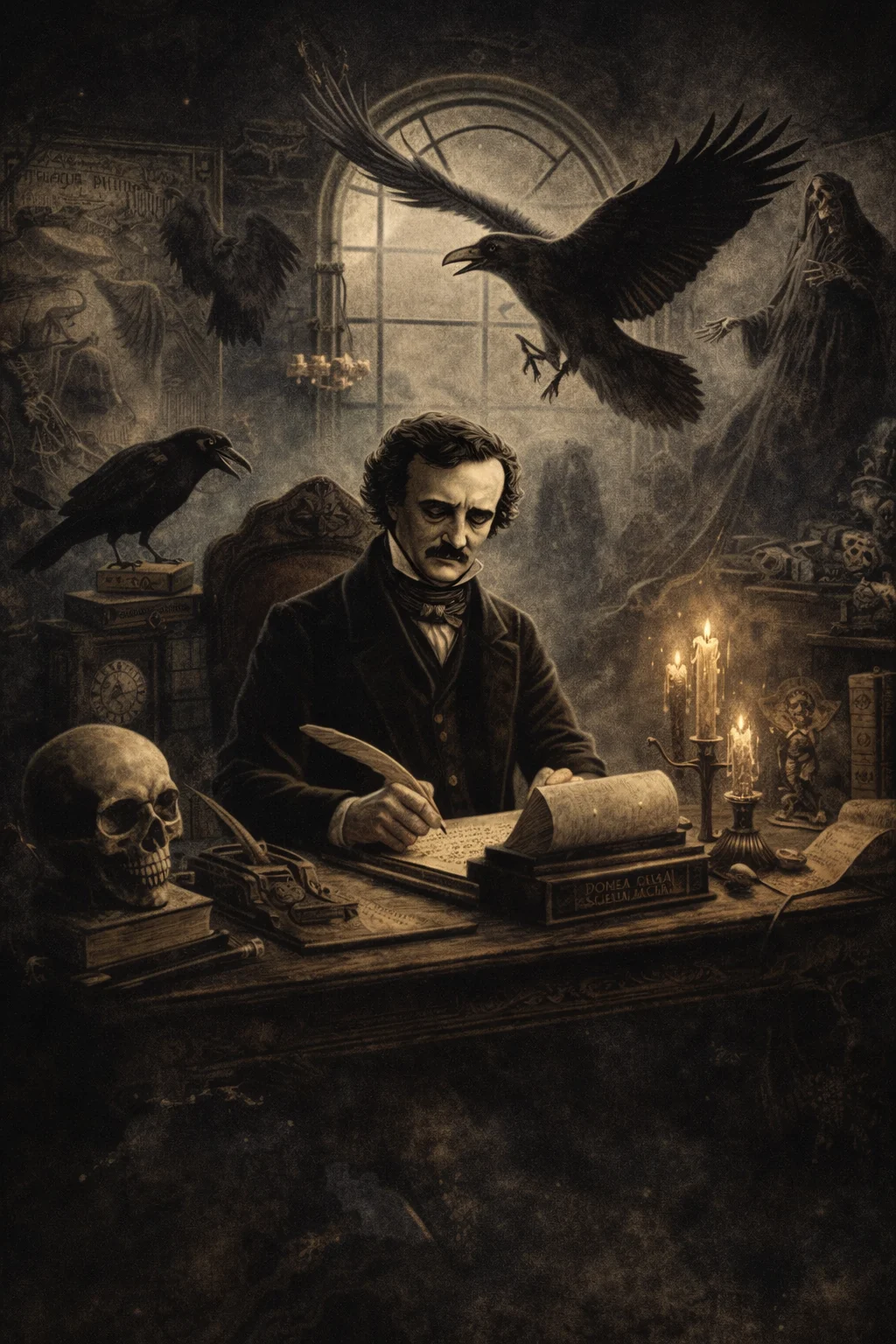
“The Raven” appeared in January 1845. The poem made Poe a celebrity, recognizable for his public readings and the refrain “Nevermore.” Fame, however, did not end his financial hardship.
That contrast is essential to understanding his life. Poe achieved recognition but never gained security equal to his influence. The poor conditions of the publishing market, his professional conflicts, and his own decisions all helped keep him in an unstable position.
By then, Virginia had been suffering from tuberculosis for several years. Her health began deteriorating in 1842, and she died in January 1847 at the age of twenty-four. Poe was devastated. It would be too simple to claim that all his literature grew from this loss, since many of his themes had appeared earlier. Virginia’s illness did, however, intensify an obsession that runs throughout his work: the impossibility of preserving what one loves.

A death transformed into legend
In October 1849, Poe was found in Baltimore in a state of severe confusion. He was taken to a hospital and died on October 7 at the age of forty. Neither a death certificate nor sufficiently detailed medical records survive to establish a definitive cause.
Many explanations have been proposed: alcohol-related complications, infectious diseases, neurological disorders, and even cooping, a form of election fraud in which victims were forced to vote repeatedly. None has been conclusively proved. Even the accounts of Poe’s supposed final words changed over the years, making them historically unreliable (Poe Museum, 2014).
The image of Poe as a permanently intoxicated and nearly insane writer was strengthened after his death by Rufus Wilmot Griswold, a literary rival who wrote a hostile obituary under the pseudonym “Ludwig.” Griswold later published a biographical account filled with exaggerations and questionable claims. His version circulated widely and shaped the public interpretation of Poe’s life for decades (Poe Museum, 2016).
This does not mean that Poe never struggled with alcohol or that his behavior was consistently stable. It means that historical sources must be examined critically and that a caricature promoted by an adversary should not be accepted as an impartial biography.
The architect of our fears
Edgar Allan Poe died poor and surrounded by uncertainty, but he transformed literature. He helped define the modern short story, created the model for detective fiction, expanded the possibilities of psychological horror, and opened paths later followed by science fiction.
His work does not depend primarily on external monsters. His characters hear heartbeats that may exist only in their consciences, turn grief into obsession, and attempt to impose rational order on experiences that overwhelm them.
The balloon deception unexpectedly summarizes that talent. Poe did not need to prove that a machine could cross the Atlantic. He only needed to understand which details the public required in order to believe that it already had.
Perhaps that is his most unsettling legacy: the knowledge that the boundary between reality and fiction is not always broken by an enormous lie. Sometimes all it takes is a carefully constructed story, published in the right place and dressed in the appearance of truth.
References
- Edgar Allan Poe Society of Baltimore. (2017). The Balloon-Hoax: New York Sun Extra, April 13, 1844.
- Edgar Allan Poe Society of Baltimore. (2025). Tales and sketches: The Balloon-Hoax.
- National Park Service. (2022, April 17). Frequently asked questions. U.S. Department of the Interior.
- National Park Service. (2023, January 30). Edgar Allan Poe. U.S. Department of the Interior.
- National Park Service. (2024, October 8). The life and times of Edgar Allan Poe. U.S. Department of the Interior.
- Poe Museum. (2014, October 8). Poe’s final mystery remains unsolved.
- Poe Museum. (2016, February 13). A gentleman, if not a Christian: The life of Rufus Griswold.
More from this collection

Miguel Hernández: The Poet Whose Voice Survived Prison
Read story →
Sylvia Plath: The Poet Who Lived Beneath a Bell Jar and Hid Spring Inside Her Final Poems
Read story →