
Alexander Wood’s mistake that Charles Hunter put to the test
Alexander Wood relieved pain with a needle. But a treatment could work even when its explanation was incomplete. Charles Hunter put that distinction to the test.
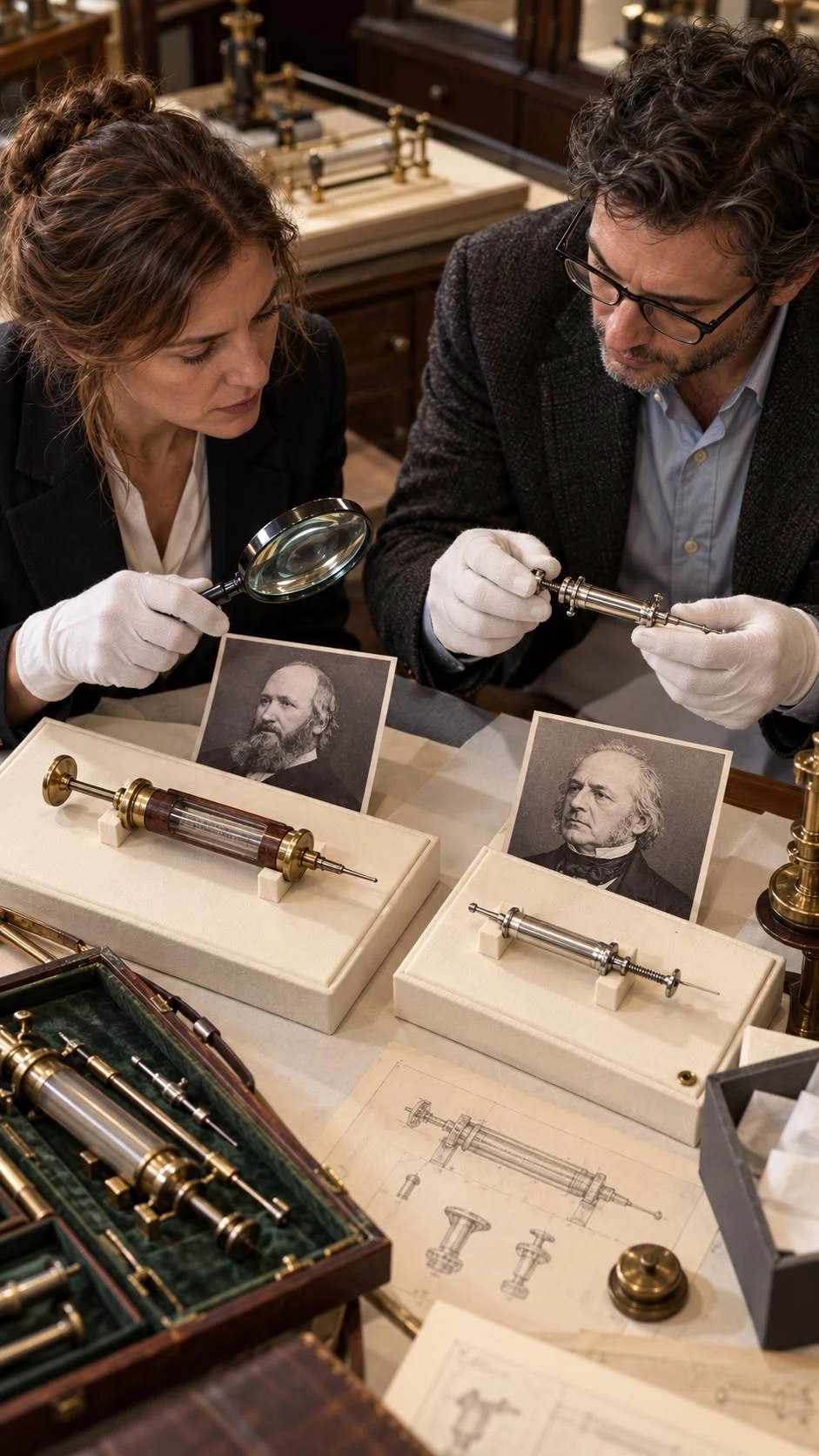
The pain was in one place; the injection was elsewhere
In the 1850s, Wood advocated injecting morphine beneath the skin near the painful spot. His interpretation placed crucial importance on the location of the injection.
Hunter observed that relief could also follow an injection given away from the affected area. The question was no longer simply how to get a medicine through the skin, but what happened afterward.
If pain diminished at a distance, proximity between needle and nerve could not adequately explain the result. Hunter argued for the general action of medicine absorbed into the body and promoted the term “hypodermic.”
The disagreement entangled two different questions: who deserved credit for developing the procedure, and which explanation best accounted for its effects. Contributing to a technique did not automatically confer the final word on how it worked.

A dispute preserved in documents
The controversy survives as more than an anecdote. Wellcome Collection holds Hunter’s correspondence and papers, including material gathered for the Royal Medical and Chirurgical Society’s Hypodermic Committee. It also holds his 1865 treatise on relieving pain through the method.
In 1867, the society published an extensive report on the physiological and therapeutic effects of hypodermic injections. The debate over local and distant administration had moved beyond the assertions of two physicians into a collective investigation.
The central finding supported systemic action: placing the narcotic beside the painful area was not essential to obtain relief. That did not make every injection safe or settle all the risks associated with opiates.
Another correction matters. The legend that Wood’s wife, Rebecca Massey, became the first person addicted to injected morphine is unsupported by the evidence. The University of Edinburgh identifies it as a false rumour and notes that Rebecca outlived her husband.
The real story needs no invented family tragedy. Its tension lies in something more revealing: a useful instrument can emerge alongside an incomplete explanation.
Wood helped open a route beneath the skin. Hunter challenged the idea that its effects ended there.
Had you heard about this dispute over a technique that now seems ordinary?
Read the full story of Alexander Wood
Sources
- Royal Medical and Chirurgical Society — Report on the hypodermic method (1867). View source
- Wellcome Collection — Charles Hunter (1835?–1878), correspondence and papers, 1863–1868. Archive reference: MS.6892.
- Wellcome Collection — Charles Hunter’s treatise on pain relief (1865). View source
- University of Edinburgh — Alexander Wood (1817–1884). View source