In this storyOpen index
Filippo Brunelleschi: The Man Who Built Over Empty Space
Florence’s dome, linear perspective, and the machines of a goldsmith who transformed Renaissance architecture.
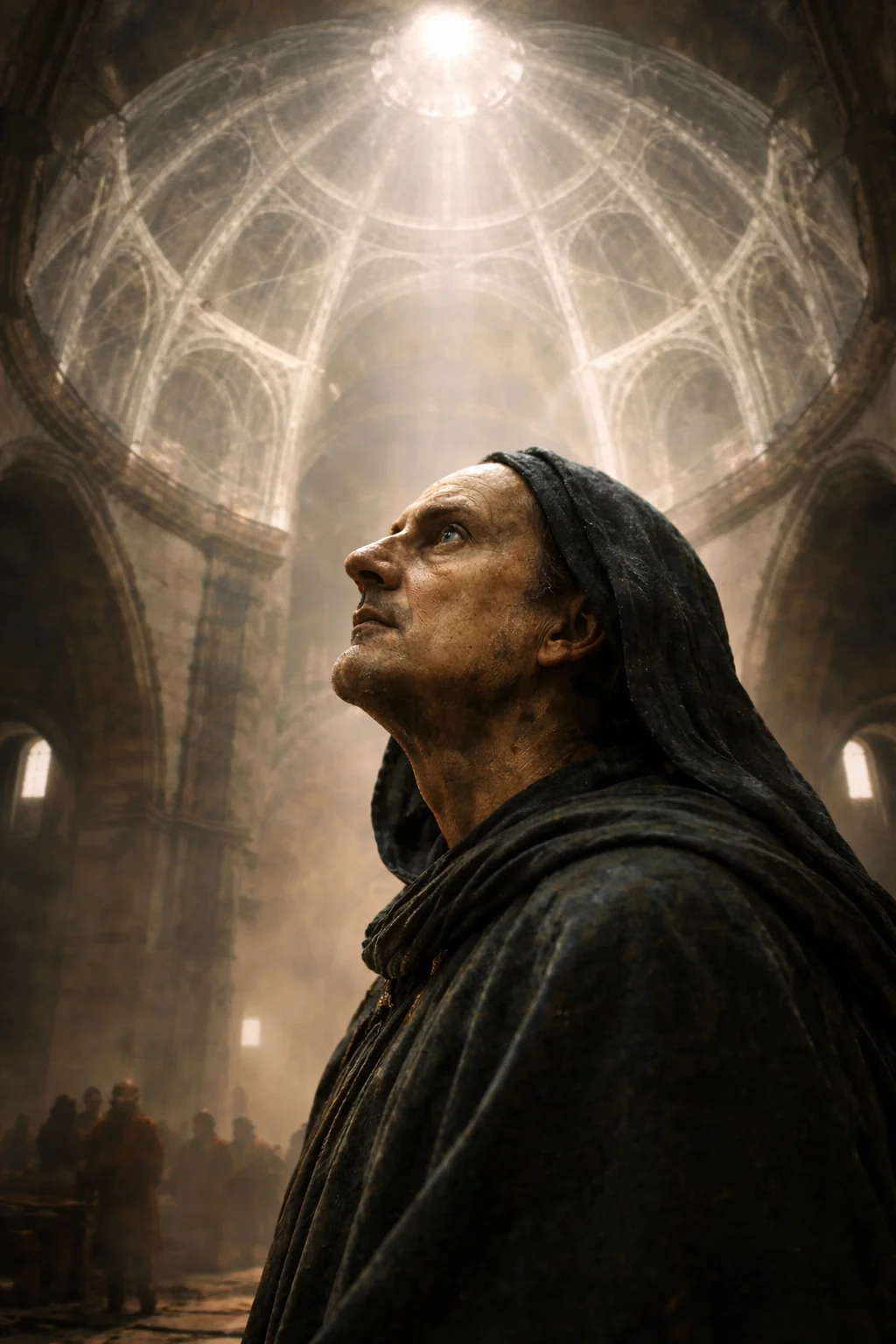
For decades, Florence Cathedral had an open wound in the sky. Its walls had been raised and its octagonal drum waited more than fifty metres above the ground, yet no one knew how to cover that enormous space. A dome of such width appeared to require an impossible quantity of timber to support it while it was being closed. The city had designed a monument that its architects did not yet know how to finish.
Then Filippo Brunelleschi appeared: a difficult-tempered goldsmith with no conventional architectural education who transformed that void into one of the boldest structures in history.
Filippo Brunelleschi
A life told through geometry and risk
The dome that changed Florence
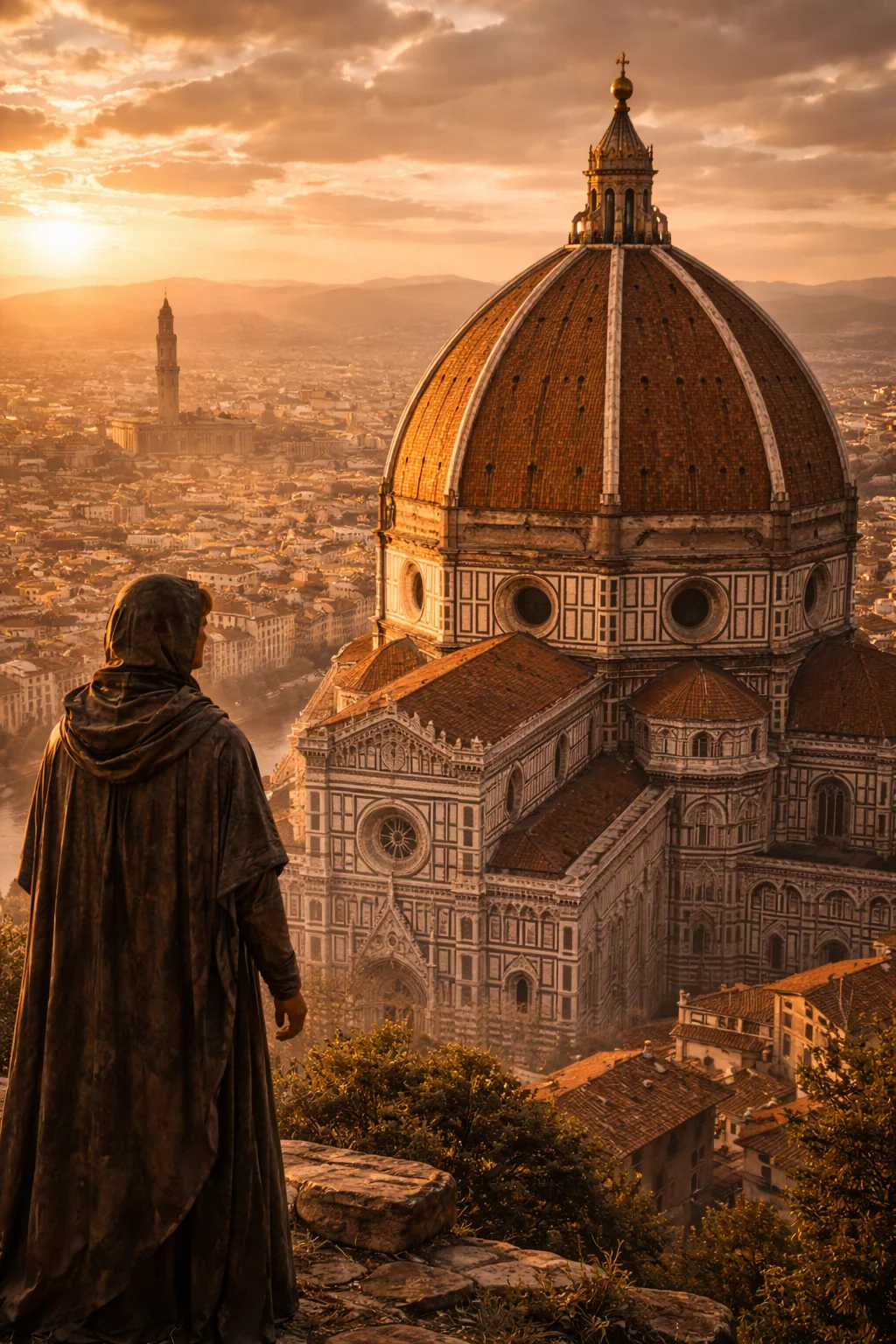
The Opera di Santa Maria del Fiore preserves and explains the monument Brunelleschi built between 1420 and 1436. Its official guide explores the double structure of brick and stone, the ribs, and the internal route toward the lantern. It offers a way to distinguish documented engineering from the legends surrounding its construction. This image is an artistic interpretation, not a photograph of the monument.
The Defeated Goldsmith

Filippo di ser Brunellesco Lapi was born in Florence in 1377. His father was a notary and expected him to pursue a respectable profession, but Filippo was drawn to drawing, sculpture, and mechanical devices. He trained as a goldsmith, a craft that demanded mastery of geometry, casting, assembly, and manual precision.
In 1401, he entered the famous competition to design a bronze door for the Florence Baptistery. The competitors were asked to depict the sacrifice of Isaac. Brunelleschi’s principal rival was Lorenzo Ghiberti, whose relief was more graceful and required less bronze. Ghiberti received the commission; the later claim that the two men were asked to share it comes from interested testimony and cannot be accepted without qualification (Krautheimer, 1956).
The defeat left a profound mark. Brunelleschi gradually abandoned monumental sculpture and turned his attention to architecture. According to his earliest biographers, he travelled to Rome with Donatello to study ancient buildings. This was not archaeology in the modern sense: they measured ruins, examined vaults, and tried to understand how the Romans had distributed enormous loads without modern structural calculations (Manetti, 1970).
What others regarded as the remains of a vanished civilisation, Brunelleschi examined as an engineering manual.
Learning How to See

Before covering the Florentine sky, Brunelleschi changed the way space could be represented. During the second decade of the fifteenth century, he produced two painted demonstrations—both now lost—associated with the Baptistery and the Palazzo della Signoria. In one experiment, the observer looked at a small painting through a hole while using a mirror to compare the image with the actual building.
These experiments are often described as the sudden “invention” of linear perspective. The reality is more nuanced. Earlier artists had already created convincing impressions of depth, but Brunelleschi appears to have systematised a geometrical procedure based on a fixed viewpoint and lines converging toward a vanishing point. Leon Battista Alberti later explained the system in writing in De pictura, written in 1435 (Edgerton, 2009).
Brunelleschi left no perspective treatise of his own. His contribution is known through later accounts and through its visible influence on artists such as Masaccio. It is therefore more accurate to say that he provided a decisive demonstration of the method than to claim that he single-handedly invented spatial representation.
A Dome No One Knew How to Build
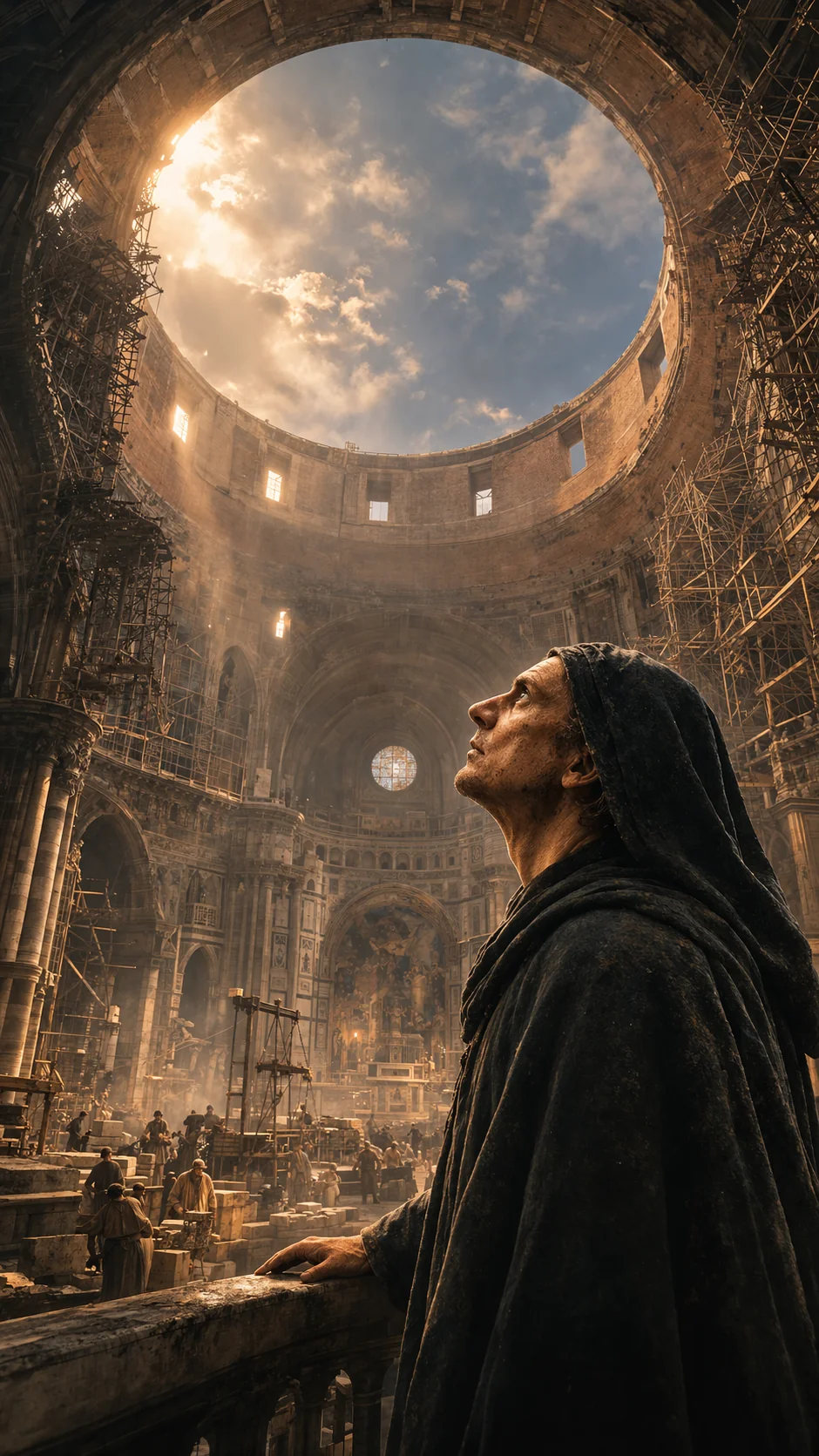
The Cathedral of Santa Maria del Fiore had been begun in 1296. Its evolving design included an enormous octagonal opening approximately forty-five metres wide. Covering it through traditional methods would have required a gigantic timber centring structure rising from the ground. Its cost would have been prohibitive, and finding beams of sufficient length presented another problem.
In 1418, the Opera del Duomo held a competition to solve the dome. Brunelleschi submitted his proposal, and construction began in 1420. Ghiberti was initially appointed alongside him as a supervisor, creating a partnership marked by rivalry. Brunelleschi eventually secured predominant technical control.
His solution combined a double-shell structure, eight principal ribs, additional intermediate ribs, and horizontal rings that helped contain the outward thrust. Bricks were laid partly in herringbone patterns, helping organise and stabilise the courses as construction advanced (King, 2000).
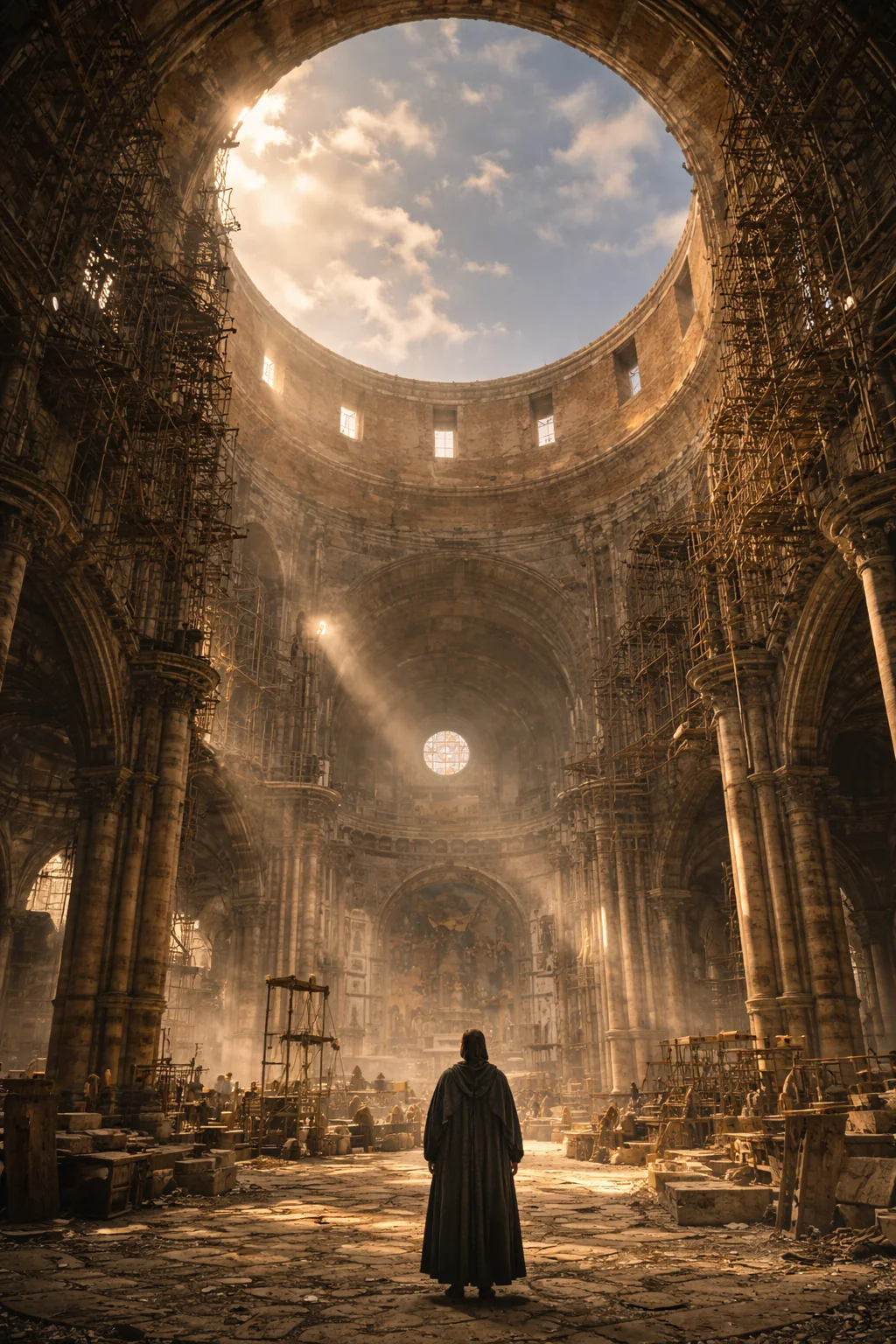
It is incorrect to say that he built the dome “without scaffolding.” Platforms, lifts, walkways, and protective barriers were installed high above the cathedral. The extraordinary achievement was that he avoided complete ground-supported centring capable of carrying the entire vault. The structure acquired stability as it rose (Opera di Santa Maria del Fiore, 2020).
Work began on 7 August 1420. By 1436 the dome had been closed, and Pope Eugene IV consecrated the cathedral. The lantern intended to crown the structure was not completed until after Brunelleschi’s death.
The Machines Behind the Miracle
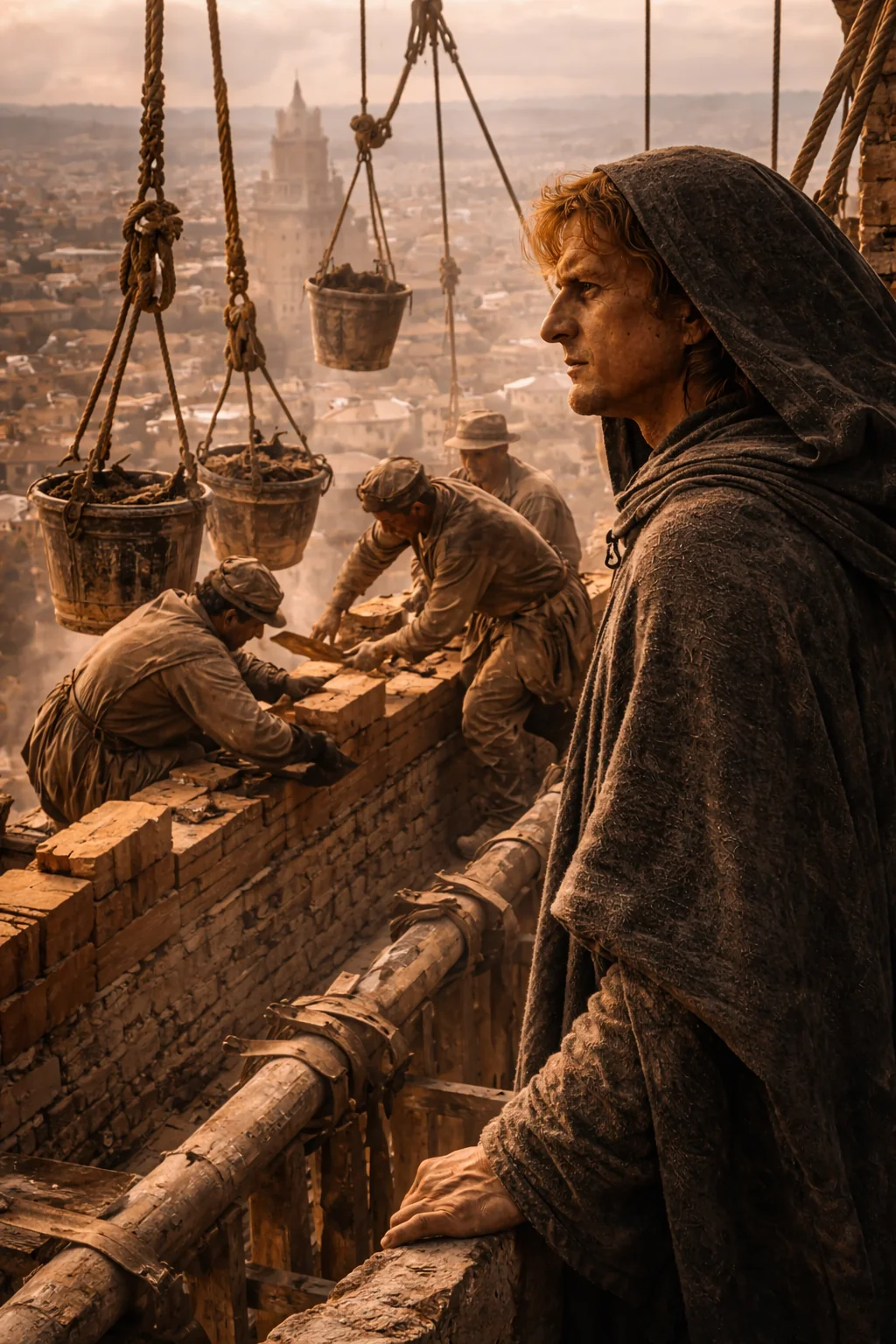
The dome was not merely an architectural achievement. It required the reinvention of the building site itself. Tonnes of brick, stone, timber, and mortar had to be raised to increasing heights using animal-powered machinery.
Brunelleschi designed hoists and cranes that could change the direction of movement through gears, without requiring the oxen to turn around. He developed carts, pulleys, and machines with adjustable speeds. His devices attracted such admiration that later engineers studied and drew them, including Leonardo da Vinci (Museo Galileo, 2004).
He also organised elevated working platforms with parapets and places where labourers could eat. Safety remained far removed from modern standards, but the planning reveals that Brunelleschi understood construction as an integrated system: structure, machinery, materials, schedules, and workers all had to function together.
The Boat That Ended Up in the Arno

One of the lesser-known episodes of his life occurred not above the cathedral but on the water. Brunelleschi designed a vessel called Il Badalone, intended to transport marble along the Arno River. In 1421, the Florentine Republic granted him a temporary privilege giving him exclusive use of the invention. The document is regarded as one of the earliest predecessors of the modern patent (Prager, 1946).
The project ended badly: the boat sank with its cargo. The man who calculated how to support a gigantic dome failed to keep his transport machine afloat.
The failure matters because it restores a human dimension to Brunelleschi. He was not an infallible visionary. He experimented, protected his ideas, took risks, and sometimes lost money. His greatness did not lie in always being right, but in continuing to work where no solution yet existed.
Architecture for a New City
Although the dome overshadowed the rest of his career, Brunelleschi also transformed the language of Western architecture. At the Hospital of the Innocents, he used a loggia of regular arches and clearly ordered proportions. In the Old Sacristy of San Lorenzo, he arranged the space through circles, squares, and surfaces of pietra serena, the grey stone that stands out against the white walls.
He also worked on San Lorenzo, Santo Spirito, and the Pazzi Chapel, although later interventions complicate the execution and attribution of parts of these buildings. In them, architecture moves away from depending primarily on the dramatic height and ornamental complexity of the Gothic tradition. Space becomes measurable, rhythmic, and intelligible to the person moving through it (The Metropolitan Museum of Art, 2002).
His architecture was not a literal copy of Rome. Brunelleschi selected ancient elements—columns, round arches, capitals, and geometrical proportions—and transformed them into a language suited to fifteenth-century Florence.
The Man Who Concealed His Solutions
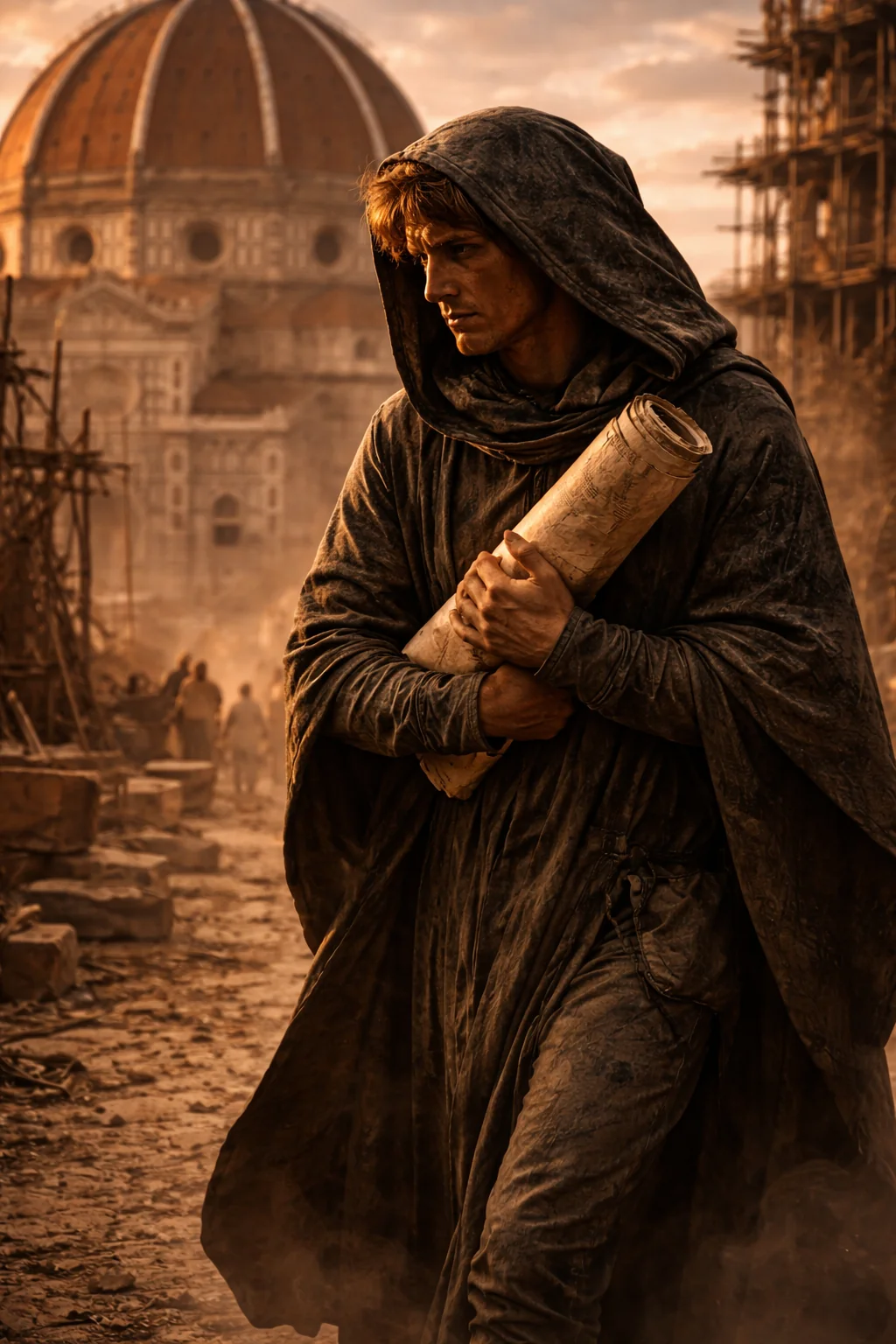
Brunelleschi was known for being secretive and suspicious. He feared that rivals would appropriate his methods, so he sometimes presented incomplete models or avoided explaining every detail of a machine. The famous story in which he supposedly made an egg stand upright by striking its base, thereby demonstrating how he would solve the dome, was popularised by Giorgio Vasari more than a century later. It is memorable, but it is not a securely documented fact.
His relationship with Florentine institutions was not always peaceful. In 1434, he was briefly imprisoned for failing to meet certain obligations to the guild of stone and wood masters. The intervention of the Opera del Duomo helped secure his release. The irony is striking: the man indispensable to completing the city’s greatest monument could be jailed by that same city’s bureaucracy.
Brunelleschi died in Florence on 15 April 1446 and was buried in Santa Maria del Fiore. His epitaph celebrated both his ingenuity and the dome rising above him.
Building What Had No Method Yet
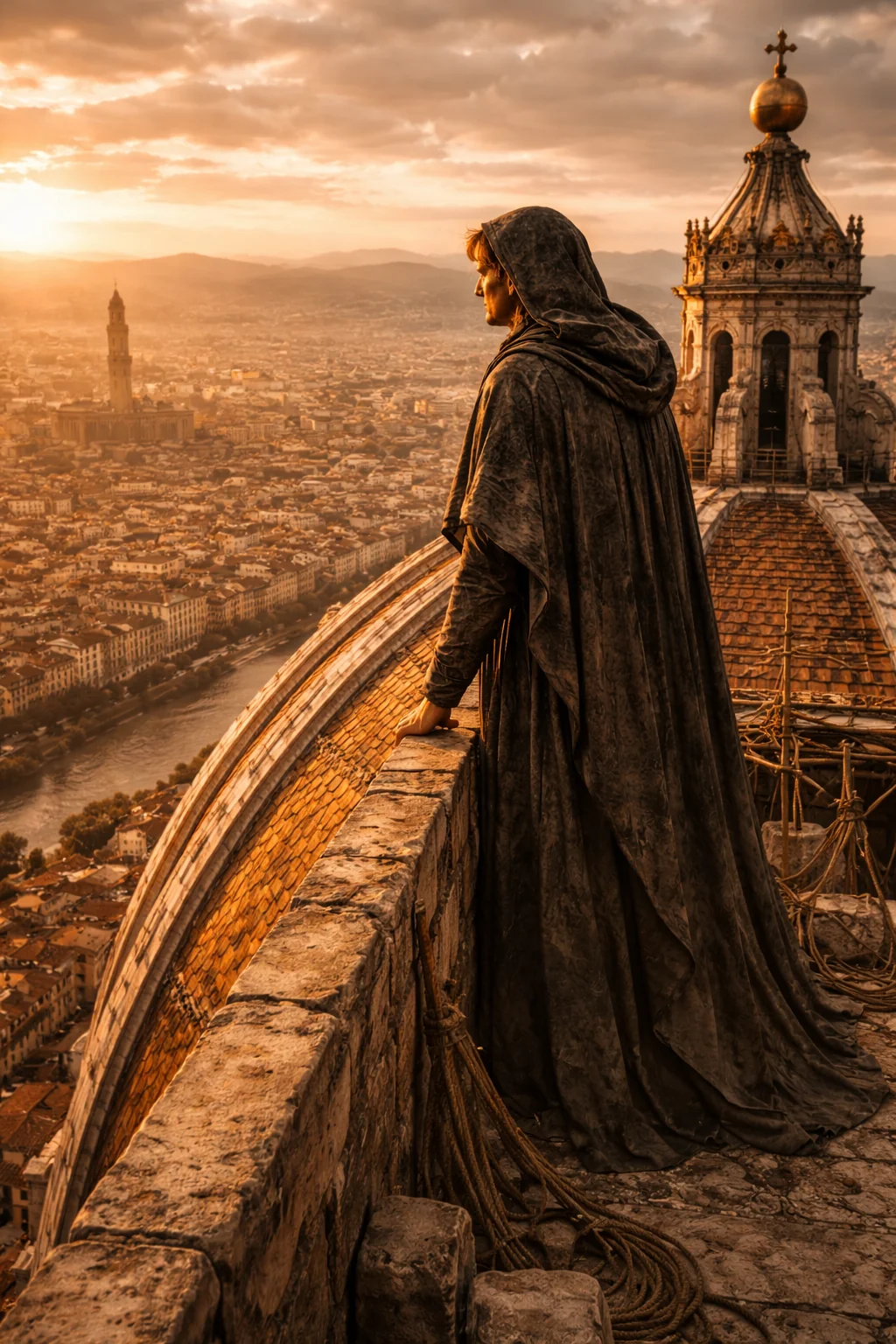
Brunelleschi belongs among the architects of the impossible because he did not merely draw an extraordinary form. He invented much of the process required to make it real. When no suitable machine existed, he designed one. When traditional procedures could not support the dome, he reorganised its structure. When painting lacked an exact rule for representing depth, he helped turn vision into geometry.
His most famous work emerged from a city that had first constructed the problem and then waited for someone to discover the solution.
The dome still dominates Florence. It does not resemble a desperately heavy mass, but a form rising with serenity. That may be Brunelleschi’s greatest victory: he made one of the most difficult undertakings of his age appear inevitable, as though it had always known how to support itself above empty space.
References
- Edgerton, S. Y. (2009). The mirror, the window, and the telescope: How Renaissance linear perspective changed our vision of the universe. Cornell University Press.
- King, R. (2000). Brunelleschi’s dome: How a Renaissance genius reinvented architecture. Walker & Company.
- Krautheimer, R. (1956). Lorenzo Ghiberti. Princeton University Press.
- Manetti, A. (1970). The life of Brunelleschi (C. Enggass, Trans.). Pennsylvania State University Press.
- Opera di Santa Maria del Fiore. (2020). August 7, 1420: The start of construction of the dome. View source
- Opera di Santa Maria del Fiore. (n.d.). Brunelleschi Dome. View source
- Prager, F. D. (1946). Brunelleschi’s patent. Journal of the Patent Office Society, 28, 109–135.
- The Metropolitan Museum of Art. (2002). Architecture in Renaissance Italy. View source
- Museo Galileo. (2004). Machines used on the dome worksite. View source