
In this storyOpen index
Fyodor Dostoevsky: The Writer Who Awaited His Execution and Turned Fear into Literature
He waited before a firing squad he believed was real and devoted the rest of his life to asking what can save a human being after the abyss.
Fyodor Dostoevsky spent what he believed were the final minutes of his life trying to understand how an entire existence could fit inside so little time.
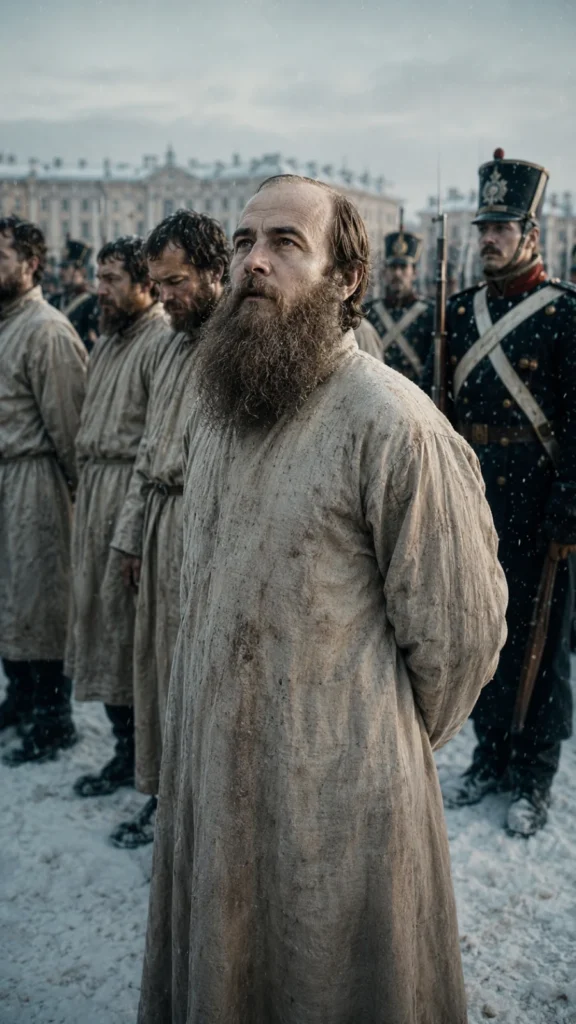
On December 22, 1849, he and several other prisoners were taken to Semyonovsky Square in Saint Petersburg. He heard his death sentence, watched as fellow prisoners were prepared for execution, and waited for his turn. When everything appeared to be over, a messenger arrived to announce that the tsar had commuted their sentences.
The supposed act of mercy was not improvised. The execution had been staged to bring the condemned men to the edge of terror before revealing their actual punishment.
Dostoevsky was twenty-eight. From that day forward, death was no longer a philosophical abstraction. It became an intimate experience that returned through his characters, his epileptic seizures, his obsession with guilt, and the question running through his entire body of work: what can save a human being after that person has crossed his own abyss?
Dostoevsky: writing after awaiting death
Discover this story on our YouTube channel.
A life told through places and turning points

Enter the archive
An authentic object preserved by a cultural institution brings us closer to the world behind this life.
- Collection
- Wikimedia Commons
- Rights
- Public domain
http://www.picture.art-catalog.ru/picture.php?id_picture=12511
Growing Up Beside Suffering
Fyodor Mikhailovich Dostoevsky was born in Moscow on November 11, 1821, according to the modern calendar. His father worked as a physician at the Mariinsky Hospital for the Poor, and the family lived within the hospital grounds.
The boy grew up near sick patients, impoverished families, and people displaced by destitution. Although his own family did not belong to the poorest classes, he observed from an early age the distance separating the privileged from those surviving at society’s edges.
His mother died of tuberculosis in 1837. Soon afterward, Fyodor and his brother Mikhail were sent to study military engineering in Saint Petersburg. Dostoevsky felt no genuine vocation for the profession. He preferred reading Shakespeare, Schiller, Pushkin, Gogol, and French writers.
His father died in 1839. For years, a story circulated that he had been murdered by his own serfs, but the surviving evidence does not establish this with certainty. Some scholars consider death from natural causes more likely. The legend influenced psychological interpretations of Dostoevsky, but it should not be presented as proven fact.
Dostoevsky completed his engineering studies but soon left military service to devote himself to literature.
Success That Arrived Too Soon
His first novel, Poor Folk, appeared in 1846. The critic Vissarion Belinsky praised it enthusiastically and introduced Dostoevsky as a new literary voice capable of depicting humiliation, poverty, and the inner lives of people ignored by society.
The young writer moved from obscurity to literary celebrity almost overnight.
His subsequent works did not receive the same acclaim. The Double, now regarded as a fundamental narrative about fractured identity, bewildered many readers. Dostoevsky acquired a reputation as a difficult, nervous, and excessively sensitive author.
He also moved closer to intellectual circles interested in social reform. Russia remained under autocratic government, serfdom still existed, and the circulation of certain political ideas was severely restricted.
Dostoevsky began attending meetings organized around Mikhail Petrashevsky. Participants discussed utopian socialism, the abolition of serfdom, and the need to transform Russian society. The circle was not a unified revolutionary organization, but the authorities considered it dangerous.
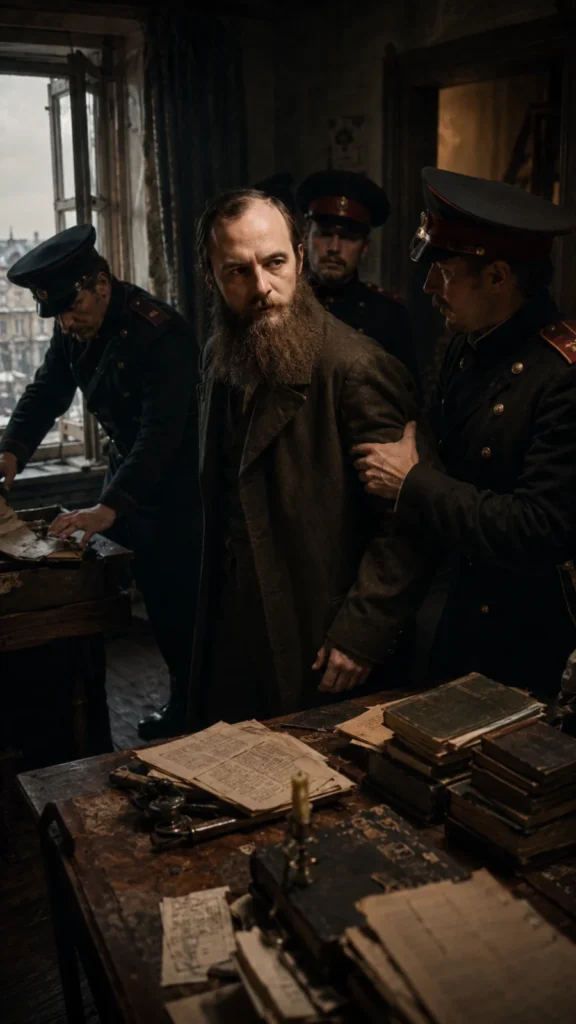
In April 1849, Dostoevsky was arrested.
The Minutes Before the Firing Squad
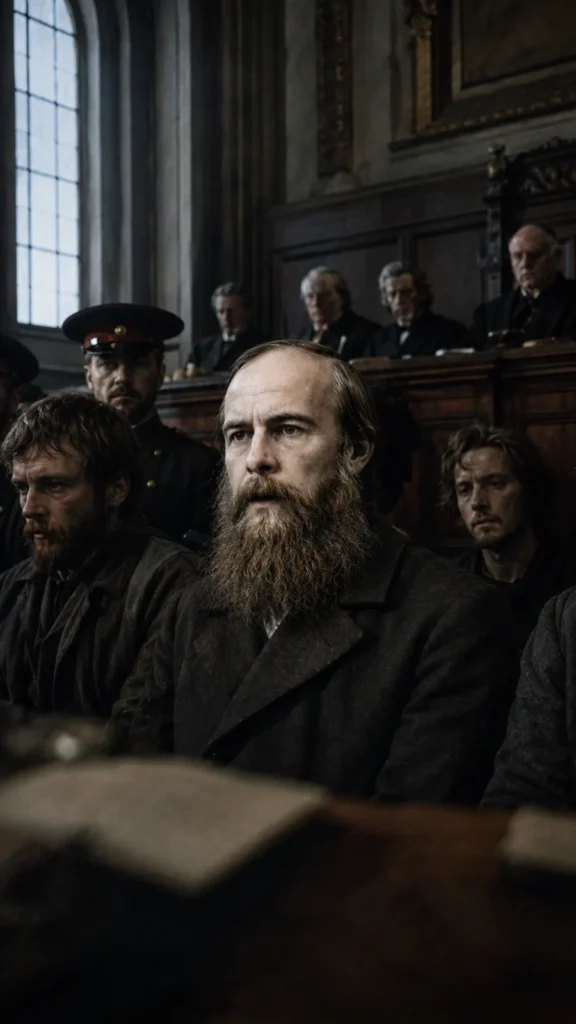
The writer spent approximately eight months imprisoned in the Peter and Paul Fortress. He was interrogated and prosecuted for participating in the meetings and for publicly reading a banned letter by Belinsky criticizing the Orthodox Church and the Russian system.
He and other members of the circle were eventually sentenced to death.
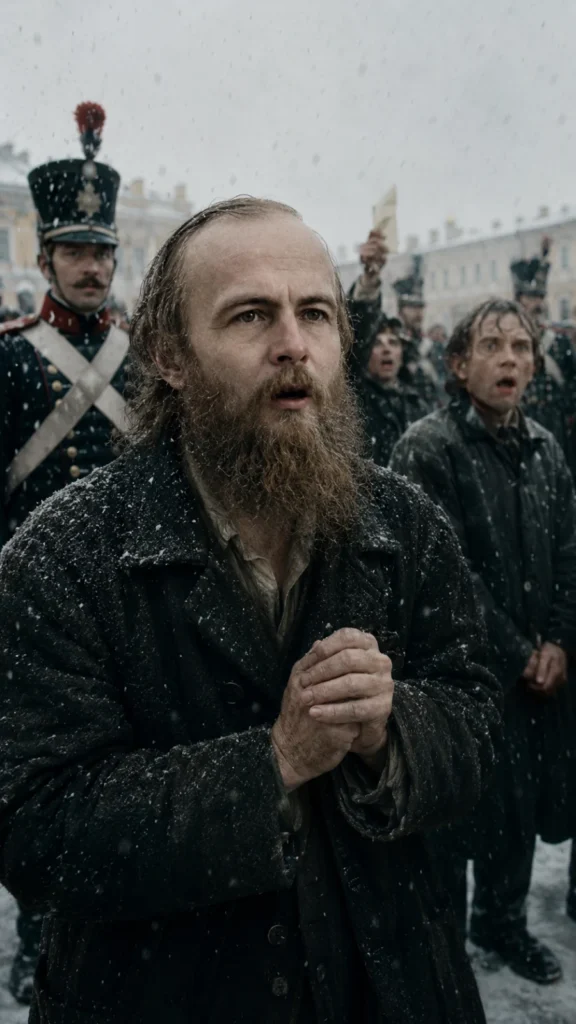
At Semyonovsky Square, the prisoners were dressed in white garments and listened to their sentences. Some were placed before the soldiers. Dostoevsky waited, convinced that he would be shot within minutes.
Then the commutation arrived.
Tsar Nicholas I had replaced the death sentences before the ceremony but ordered that the prisoners remain unaware until the final moment. The performance was intended to break them psychologically and demonstrate the state’s absolute power.
Soon afterward, Dostoevsky wrote to his brother. Rather than describing only terror, he expressed an intense desire to live. Every future instant seemed like a gift. That exhilaration, however, could not erase what had happened.
Decades later, he recreated a similar experience in The Idiot. Prince Myshkin describes how a condemned prisoner divides his final minutes and discovers that the certainty of death makes every second unbearably precious.
It was not merely an invention. Dostoevsky was describing his own wait.
Four Years in Chains
The sentence was replaced by four years of hard labor in Omsk, Siberia, followed by compulsory military service.
Inside the prison camp, Dostoevsky lived alongside murderers, thieves, and peasants convicted of various offenses. As a former nobleman and political prisoner, he initially encountered hostility from some inmates. He slept in crowded barracks and endured cold, filth, insects, and constant supervision.
The only book he was permitted to keep was a copy of the New Testament.
Those years transformed his political and religious outlook. The experience did not instantly turn him into the conservative thinker of his later life, but it destroyed much of his earlier faith in abstract theories of humanity. He became suspicious of every system that reduced people to a formula.
In prison, he discovered that a criminal capable of great cruelty could also display compassion. He also understood that suffering did not necessarily improve anyone. It might awaken solidarity, but it could also produce resentment, violence, and degradation.
Those contradictions shaped Notes from the House of the Dead, his fictionalized account of prison life.
Illness and Moments of Clarity
Dostoevsky experienced epilepsy throughout much of his adult life. The precise date of his first major seizures remains disputed, but the attacks became evident during or after his Siberian imprisonment.
On some occasions, the seizure was preceded by an intense sensation of clarity and harmony. Then came unconsciousness, exhaustion, and confusion.
The condition entered his fiction. Prince Myshkin in The Idiot and Smerdyakov in The Brothers Karamazov both have epilepsy, although it functions very differently in each character.
Dostoevsky did not turn illness into a merely romantic symbol. He knew its physical violence, the fear of suffering an attack in public, and the uncertainty of not knowing when the next seizure would come.
He wrote from within a body that could betray him without warning.
Returning to a Different Country
After completing his hard labor, Dostoevsky served in the military at Semipalatinsk. In 1857, he married Maria Isaeva, a widow he had met during exile. Their marriage was difficult and burdened by illness, financial problems, and emotional incompatibility.
In 1859, he was permitted to return to European Russia. He resumed publishing and joined his brother Mikhail in editing literary journals.
His life collapsed again in 1864. His wife and brother died within months of each other. Dostoevsky assumed family debts and financial obligations that placed him under constant pressure.
That same year, he published Notes from Underground. Its narrator is a resentful man who attacks the belief that human behavior can be explained through rational calculation. A person, the narrator insists, may act against his own interests merely to prove that he remains free.
One of modern literature’s most disturbing voices had been born.
Roulette and the Contract That Nearly Took His Books
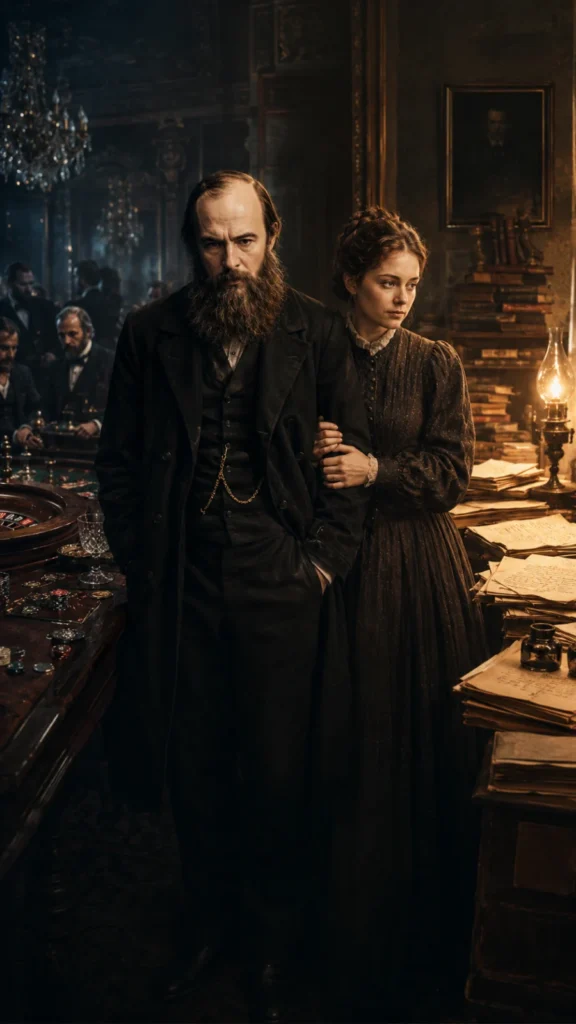
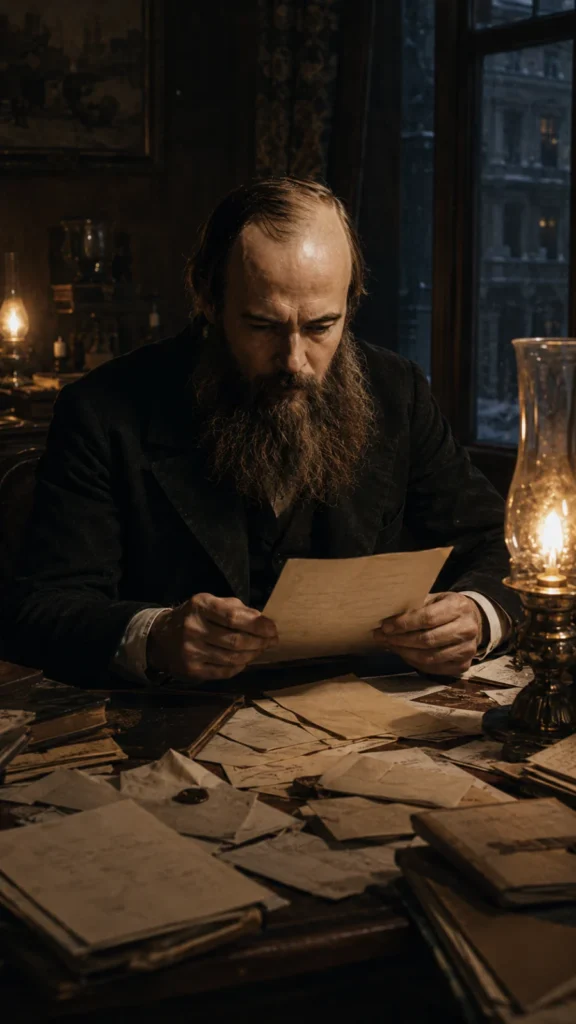
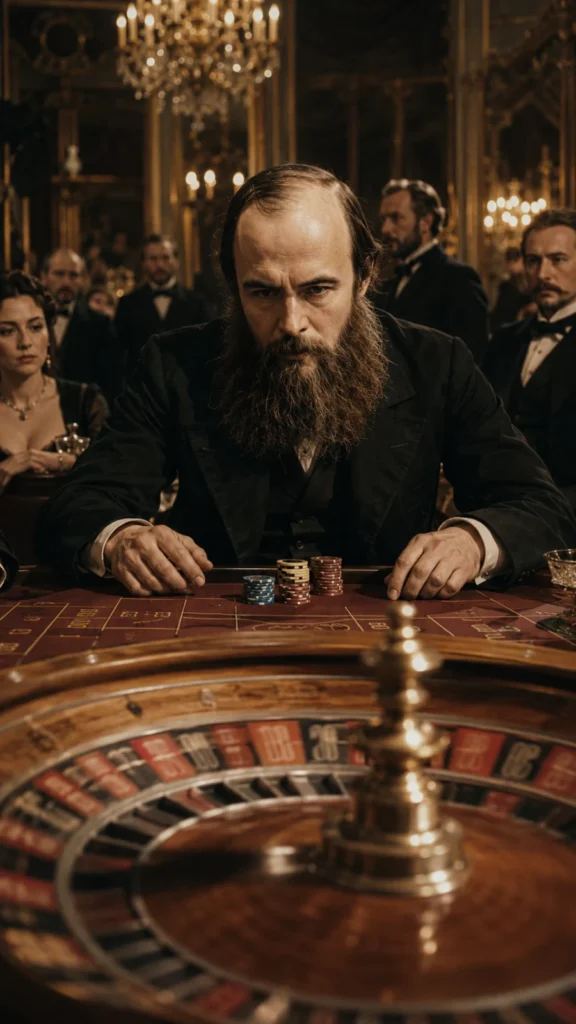
Dostoevsky began visiting European casinos and developed a compulsion for roulette. He gambled, lost, borrowed money, promised to stop, and gambled again. At times he pawned possessions and wrote desperate letters asking for assistance.
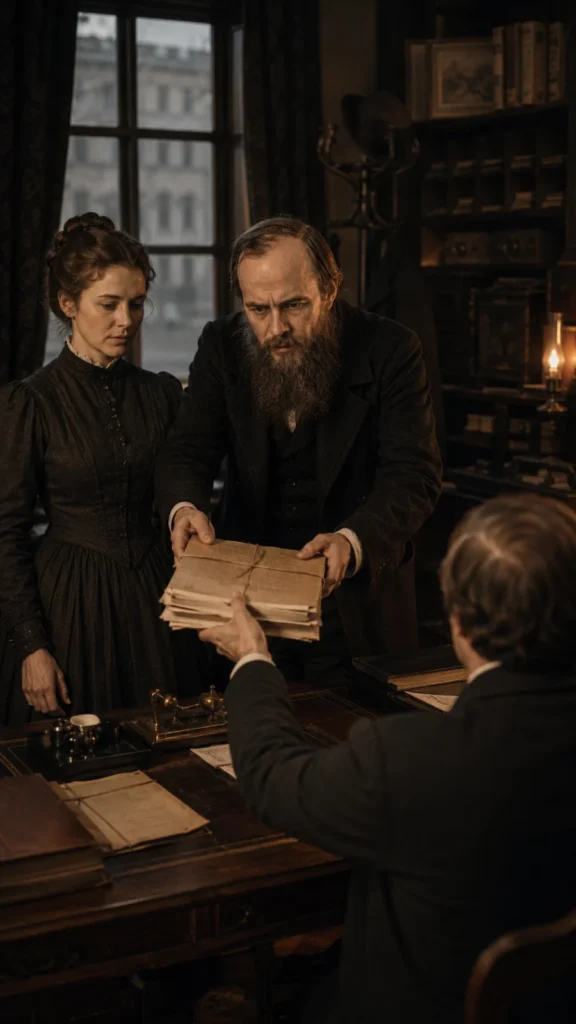
His debts drove him to accept an extremely unfavorable contract with the publisher Fyodor Stellovsky in 1865. Dostoevsky had to deliver a new novel by a specific deadline in 1866. If he failed, Stellovsky would obtain extensive rights over his work for years without adequately compensating him.
At the same time, Dostoevsky was writing Crime and Punishment in installments and could not complete the second book.
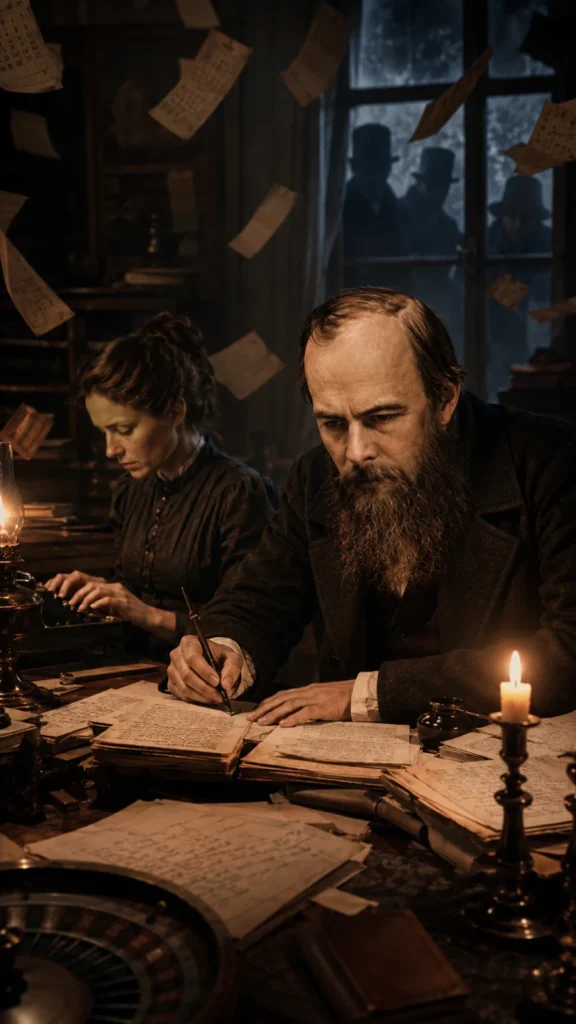
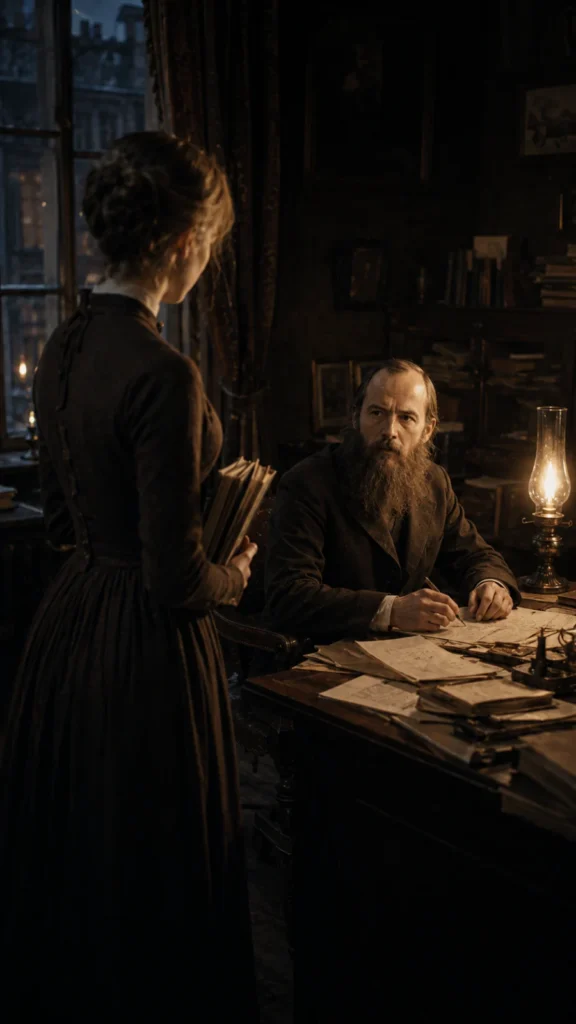
To accelerate the work, he hired a young stenographer named Anna Snitkina. Dostoevsky dictated The Gambler, a novel shaped by his own experience at the roulette table. They worked with extraordinary intensity and completed the manuscript in less than a month, just before the deadline.
The publisher attempted to avoid accepting it, but the manuscript was officially deposited on time.
Dostoevsky had saved his literary rights. He had also met the woman who would reorganize his life.
Anna and the Reconstruction of a Life
Dostoevsky and Anna married in 1867. He was forty-five; she was twenty.
The age difference was considerable, but Anna was not simply an assistant. She became his manager, editor, copyist, negotiator, and the defender of his work. She organized their finances, confronted creditors, and later helped publish his books without complete dependence on intermediaries.
The couple spent several years outside Russia while escaping their debts. Dostoevsky continued gambling during part of this period, although he eventually abandoned roulette.
They also endured devastating losses. Their first daughter, Sonya, died in infancy. Years later, their son Alexei died shortly before his third birthday, probably after a convulsive seizure. Dostoevsky was deeply affected and visited the Optina Monastery in search of consolation.
The child’s death is often connected to the meditation on childhood suffering that runs through The Brothers Karamazov, although the novel cannot be reduced to a single biographical experience.
Entering the Mind of the Guilty
In Crime and Punishment, published in 1866, Dostoevsky did not create a detective novel based on discovering the murderer. The reader knows from the beginning that Raskolnikov committed the crime.
The real question is what happens inside someone attempting to justify murder morally.
Dostoevsky places the reader within the guilty mind: its arguments, fever, pride, fear, and need to confess. Legal punishment matters less than the psychological prison that begins before the arrest.
In The Idiot, he explored what might happen if a radically compassionate person entered a society governed by desire, money, and vanity. In Demons, he examined how political ideas could become fanaticism and violence. In The Brothers Karamazov, he brought together his central obsessions: parricide, faith, doubt, freedom, guilt, and the suffering of the innocent.
His characters do not represent a single opinion. They argue, contradict themselves, and carry their ideas toward dangerous extremes. Dostoevsky allowed every voice to defend its own truth, even when that truth horrified him.
The Writer Who Returned from Death
In 1880, during the unveiling of a monument to Pushkin in Moscow, Dostoevsky delivered a speech that received an extraordinary public response. The former prisoner who had lived under debt and ridicule had become a central figure in Russian culture.
He died in Saint Petersburg on February 9, 1881, after suffering a pulmonary hemorrhage. Thousands participated in his funeral.
His work emerged from many wounds: the poverty he observed in childhood, failure, the mock execution, imprisonment, epilepsy, debt, gambling, and the deaths of his children. Dostoevsky, however, did not merely transform suffering into personal confession.
He used it to enter places literature had barely dared to explore.
He understood that the same person could love and destroy, believe and doubt, seek goodness and desire his own downfall. He did not write about coherent human beings, but about divided creatures at war with themselves.
On that day in 1849, the authorities attempted to demonstrate that his life could be ended by an order.
Dostoevsky devoted the rest of that life to demonstrating that no human being can be reduced to a sentence.
References
- Birmingham, K. (2021). The sinner and the saint: Dostoevsky and the gentleman murderer who inspired a masterpiece. Penguin Press.
- Dostoevsky, F. (1988). Complete letters (J. L. Meier & S. S. Koteliansky, Eds.). Ardis.
- Frank, J. (2010). Dostoevsky: A writer in his time. Princeton University Press.
- Lantz, K. A. (Ed.). (2004). The Dostoevsky encyclopedia. Greenwood Press.
- Leatherbarrow, W. J. (Ed.). (2002). The Cambridge companion to Dostoevskii. Cambridge University Press.
- Mochulsky, K. (1967). Dostoevsky: His life and work. Princeton University Press.
- Scanlan, J. P. (2002). Dostoevsky the thinker. Cornell University Press.
More from this collection
Arthur Conan Doyle: The Man Who Invented Reason and Sought Comfort in the Invisible
Read story →
William Shakespeare: The Man Who Turned the Human Wound into Words
Read story →