
In this storyOpen index
Joan of Arc: The Young Woman Burned as a Heretic Whose Trial Was Overturned Twenty-Five Years Later
They used her voices, her clothing, and her refusal to submit against her. Twenty-five years later, another court acknowledged that the justice used to destroy her had been a political construction.
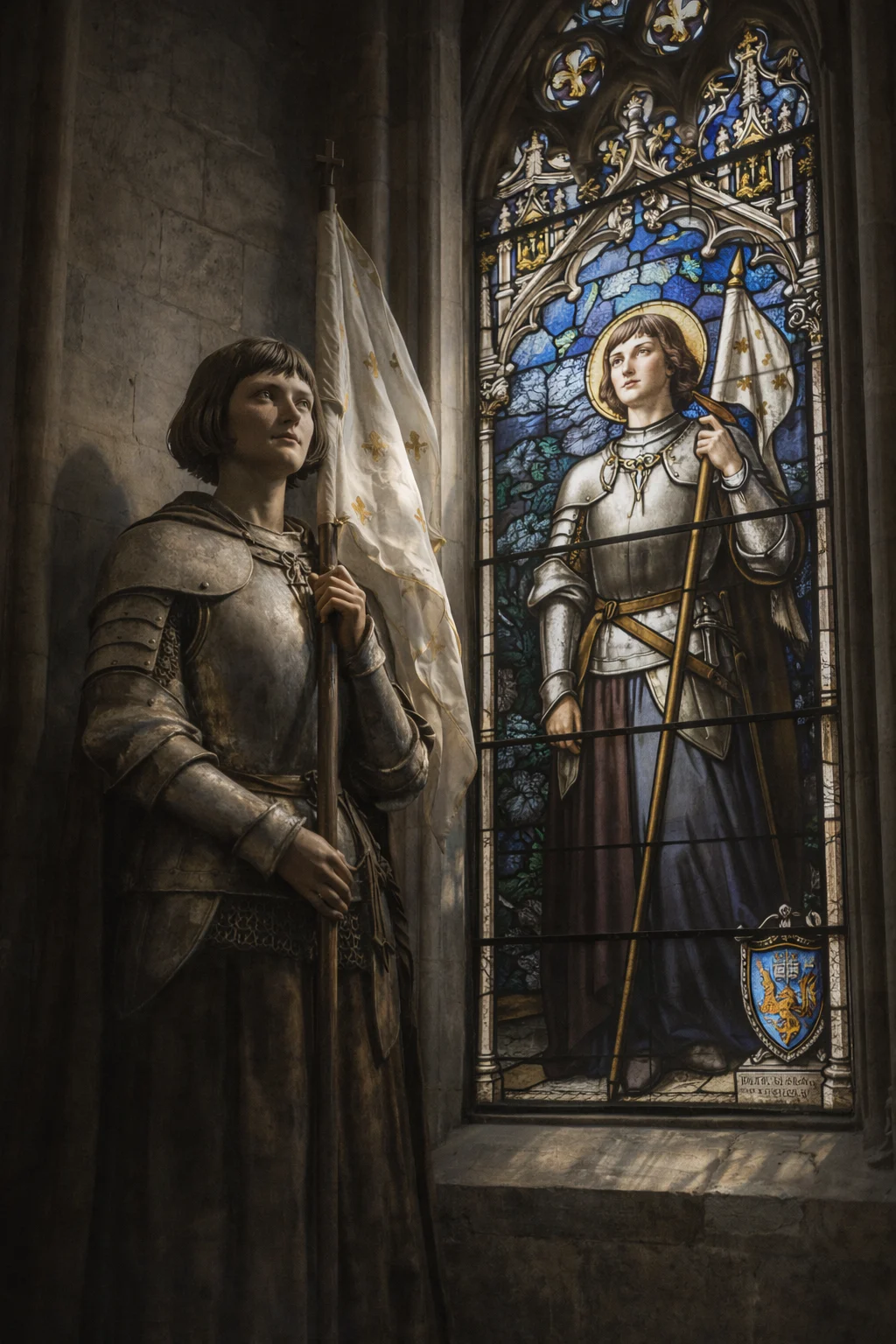
They used her voices, her clothing, and her refusal to submit as evidence against her. She was approximately nineteen when she was publicly burned at Rouen. The judgment, however, did not survive forever.
Twenty-five years later, another court examined the interrogations, searched for those who had known her, and heard more than one hundred witnesses. Its conclusion was devastating: the proceedings had been corrupted by partiality, pressure, and serious irregularities. The conviction was overturned, and a copy of the accusations was publicly torn apart.
The court could not restore her life, but it acknowledged that the justice used to destroy her had been a political construction.
Joan of Arc on video
Discover this story on our YouTube channel.
A life told through places and turning points
A girl born inside a war
Joan was born around 1412 in Domrémy, a small community on the eastern frontier of the Kingdom of France. Her exact birth date is undocumented. Her parents, Jacques d’Arc and Isabelle Romée, belonged to a farming family that owned land and held a degree of standing within the village.
France had been fighting England for decades in the Hundred Years’ War. This was not a modern conflict between perfectly defined nations but a dynastic struggle involving kings, nobles, territories, and shifting alliances.
France’s situation was further weakened by civil war between the Armagnacs and Burgundians. Under the 1420 Treaty of Troyes, Charles VI recognized Henry V and his descendants as heirs to France, excluding his own son. After both kings died in 1422, the infant Henry VI was proclaimed king of England and France by his supporters, while Dauphin Charles maintained his claim from the south.

Voices that could not be interrogated
During her 1431 trial, Joan testified that at approximately thirteen she began hearing voices that she identified as Saint Michael, Saint Catherine, and Saint Margaret. According to her, they instructed her to assist Dauphin Charles and liberate the kingdom from its enemies.
There is no historical method for determining the nature of these experiences. What can be established is that Joan believed in them with a conviction that survived interrogations, threats, and months of imprisonment.
In 1428, she approached Robert de Baudricourt at Vaucouleurs and requested an escort to the dauphin’s court. After an initial rejection, she persisted until she gained local support. In February 1429, she set out for Chinon. To cross dangerous territory, she cut her hair and wore male clothing. That practical decision later became one of the principal legal weapons used against her.

The victory that changed France
Orléans was under English siege, and its fall could have opened the way into central and southern France. Joan arrived in late April 1429 with troops and supplies.
She was not the army’s sole commander, nor did she personally design every operation. Experienced nobles and captains led the forces. Joan nevertheless participated in councils, supported an aggressive strategy, accompanied assaults, and provided a powerful moral and religious focus.
She carried a large banner and later said that she preferred it to a sword because she wished to avoid killing anyone herself. Wounded by an arrow at Les Tourelles, she returned to the fighting. On May 8, the English abandoned the siege. Further victories followed at Jargeau, Meung-sur-Loire, Beaugency, and Patay.

Joan insisted that Charles travel to Reims. On July 17, 1429, Charles VII was crowned in the cathedral, with Joan near the altar and her banner displayed. Within months, a girl unable to read or write fluently had helped transform an uncertain claimant into a consecrated king.
From triumph to abandonment
An attack on Paris failed in September 1429, and Joan was wounded. Charles VII increasingly favored negotiation. On May 23, 1430, near Compiègne, Joan was separated from the town’s defenses and captured by Burgundian troops.
The English negotiated her transfer and paid a substantial sum. They needed more than her imprisonment: Charles VII’s legitimacy had become connected to the young woman who promoted his coronation. If she could be portrayed as a heretic, her mission could be discredited.
Joan attempted to escape several times. At Beaurevoir, she jumped from a tower into a dry moat and survived, injured. She was eventually transferred to Rouen, the center of English power in France.

A religious trial under political control
The trial began in January 1431. It was directed by Pierre Cauchon, Bishop of Beauvais and a supporter of the English cause. Although formally ecclesiastical, Joan was held in a secular prison guarded by English soldiers. She had no defense attorney and was repeatedly questioned by educated clerics.
The questions concentrated on her voices, obedience to the Church, certainty of divine grace, and male clothing. Asked whether she knew herself to be in God’s grace, she replied that if she was not, may God place her there, and if she was, may God keep her there.

On May 24, facing immediate execution, Joan signed or marked an abjuration whose precise content remains disputed. She agreed to wear women’s clothing and received perpetual imprisonment. Within days, she resumed male dress. Later testimony said her female garments may have been removed and male clothing fastened with cords offered greater protection from guards. The court declared her a relapsed heretic.
The fire and its warning
Joan of Arc was executed on May 30, 1431, in Rouen’s Old Market Square. She was approximately nineteen. Her remains were burned again and cast into the Seine to prevent relics from being preserved.
The execution carried a political warning: a young woman without rank, formal education, or institutional authority had challenged the established order, influenced a military campaign, and spoken directly before a future king.

The trial of the trial
After recovering Rouen, Charles VII authorized a preliminary investigation in 1450. The definitive review emerged through Joan’s family. Her mother, Isabelle Romée, and her brothers petitioned the pope. Callixtus III authorized a commission, and nullification proceedings began in 1455.
Investigators heard approximately 115 witnesses, including relatives, villagers, soldiers, nobles, clergy, and people connected to the original trial. They reconstructed her childhood, military campaign, and imprisonment.
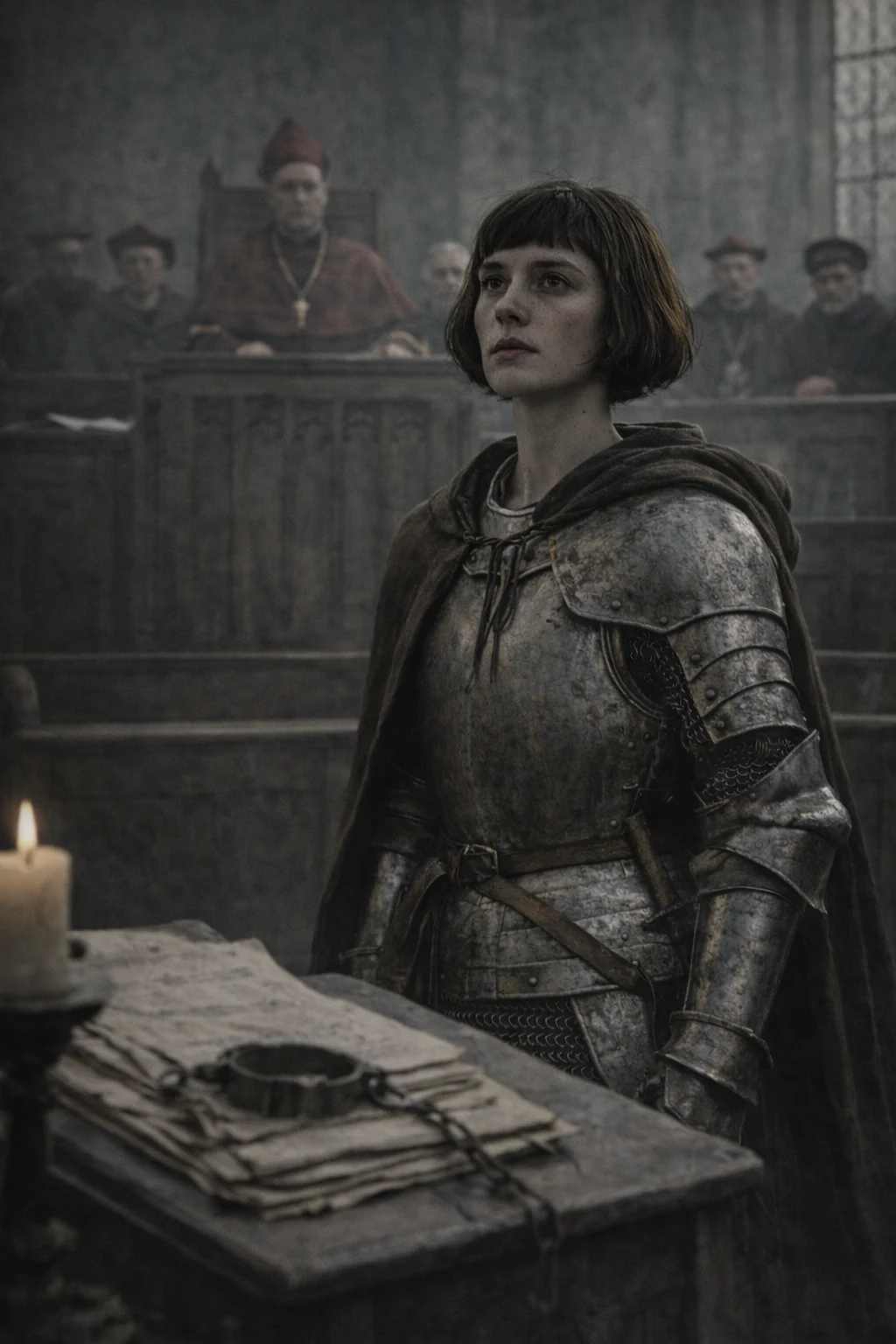
On July 7, 1456, the court overturned the conviction. It determined that the 1431 proceedings had been unjust, deceitful, and contrary to legal norms. A copy of the accusations was publicly torn apart, and a cross was ordered for the place of execution.
The rehabilitation answered her family’s demand for justice but also benefited Charles VII. Recognizing that political interest does not invalidate the legal findings; it reminds us that both trials were connected to power.
The woman behind the symbol
Joan was beatified in 1909 and canonized by the Catholic Church in 1920. By then, competing movements had made her a symbol of nationalism, faith, monarchy, resistance, or French unity.

Behind these appropriations remains an exceptional historical person. She persuaded officers to hear her, gained access to a royal claimant, endured theological examination, accompanied military campaigns, promoted a coronation, and resisted one of the best-documented interrogations of the Middle Ages.
The first court attempted to reduce her to a heretic. The second made her the victim of an unjust proceeding. Later centuries transformed her into a saint and national heroine.

Before becoming any of those images, Joan of Arc was a teenager who entered spaces forbidden to someone of her sex and status, spoke when expected to remain silent, and refused to accept the fate others had chosen for her.
References
- Barrett, W. P. (1932). The trial of Jeanne d’Arc. Gotham House.
- Castor, H. (2015). Joan of Arc: A history. HarperCollins.
- DeVries, K. (1999). Joan of Arc: A military leader. Sutton Publishing.
- Hobbins, D. (2005). The trial of Joan of Arc. Harvard University Press.
- Pernoud, R., & Clin, M.-V. (1986). Joan of Arc: Her story. St. Martin’s Press.
- Rouen Tourisme: On the steps of Joan of Arc.
- Taylor, C. (2006). Joan of Arc: La Pucelle. Manchester University Press.
- The Holy See: Saint Joan of Arc.
More from this collection
Queen Victoria: The Young Woman Who Escaped a Cage and Became the Symbol of an Empire
Read story →
Joanna la Beltraneja: The Princess Robbed of a Kingdom Who Never Stopped Signing Herself as Queen
Read story →