In this storyOpen index
Radia Perlman: The Woman Who Taught Networks to Find Their Way
From a robotic turtle to Ethernet bridges: the ideas behind networks that organize themselves.
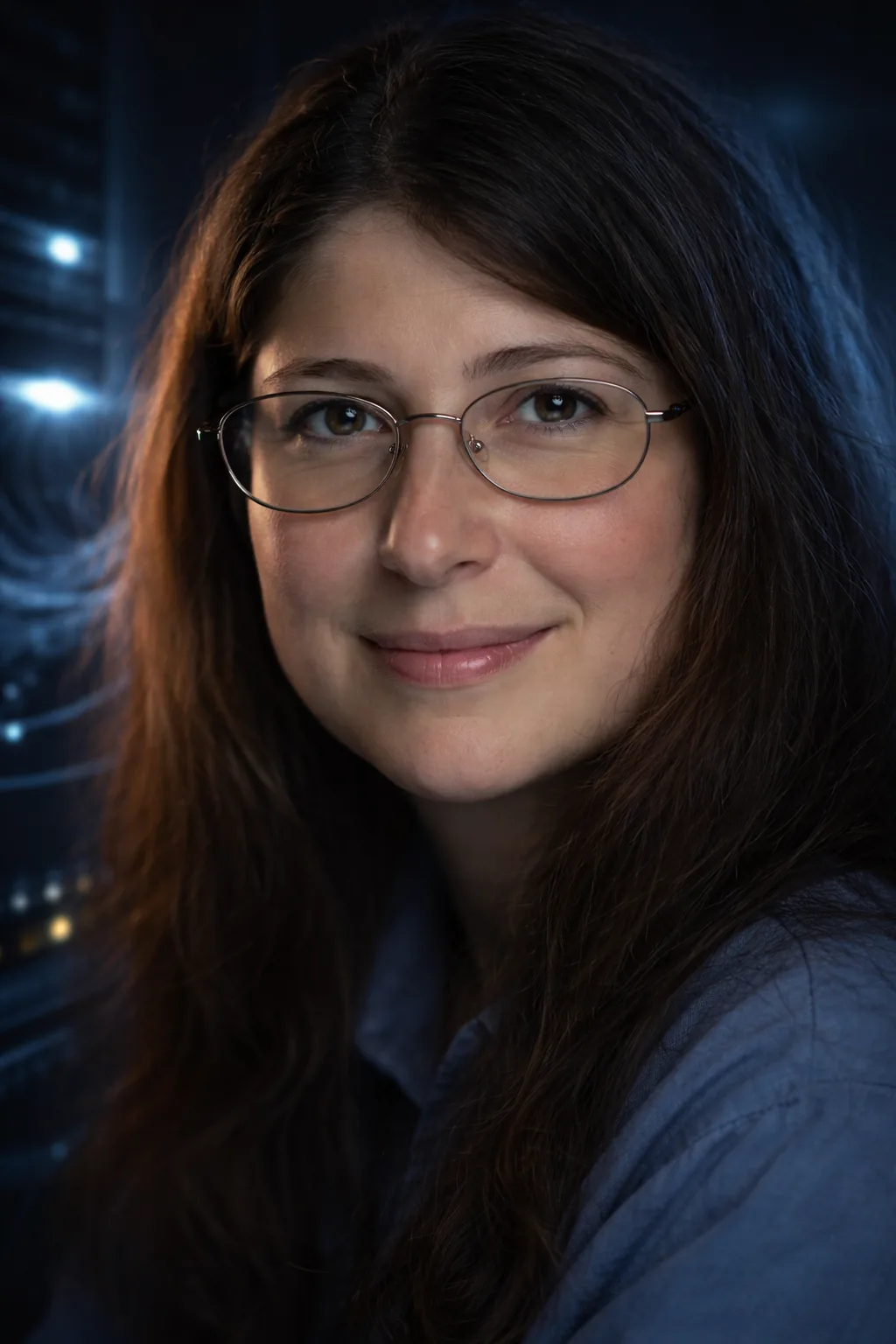
Connecting more cables does not always make a network safer. Sometimes it creates the loop that brings communication to a halt. Radia Perlman designed rules for avoiding that trap—and her work reached far beyond a single protocol. This story follows the evidence, from her 1974 TORTIS report to the spanning-tree paper of 1985.
Radia Perlman
From buttons to bridges
The paper of 1985
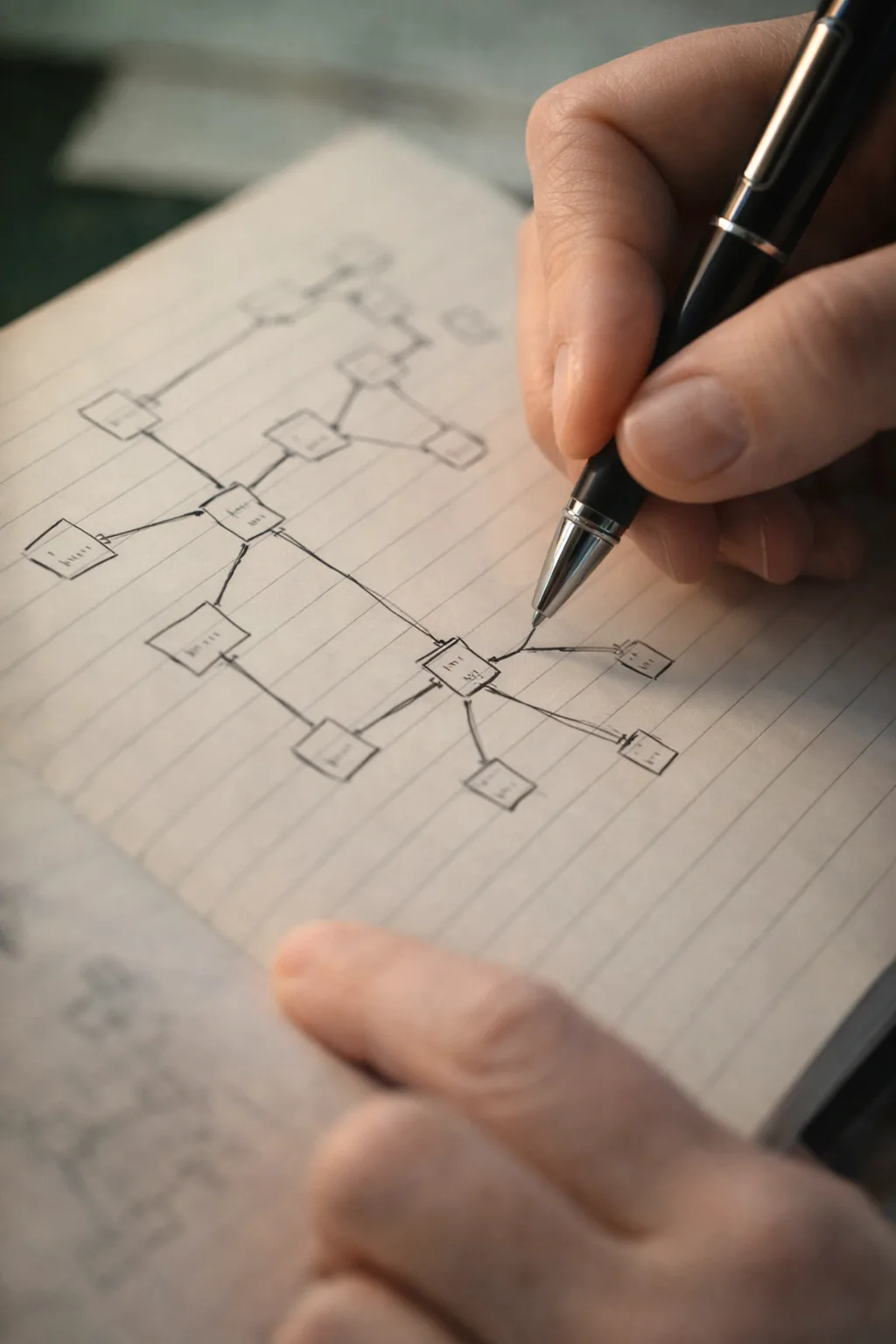
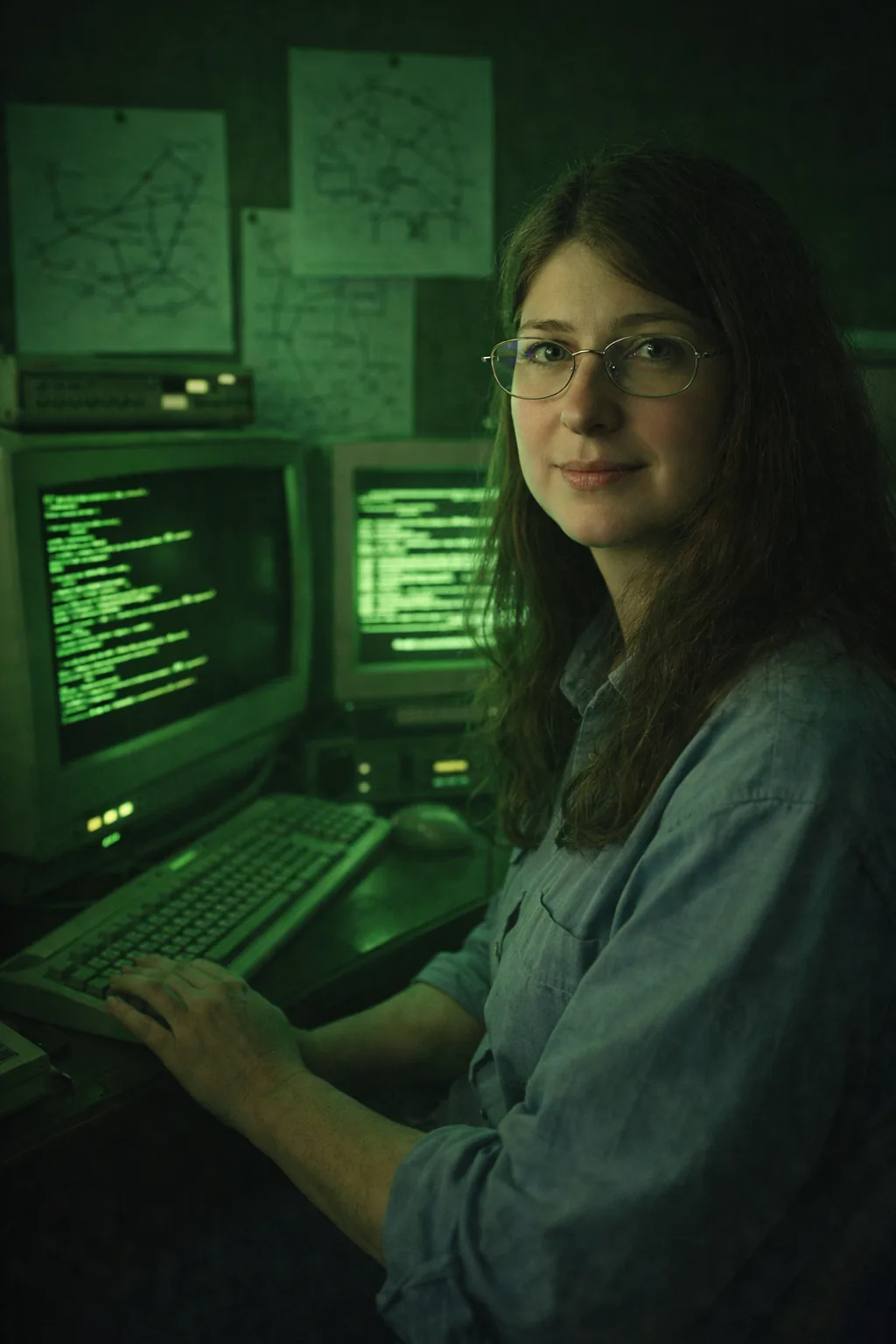
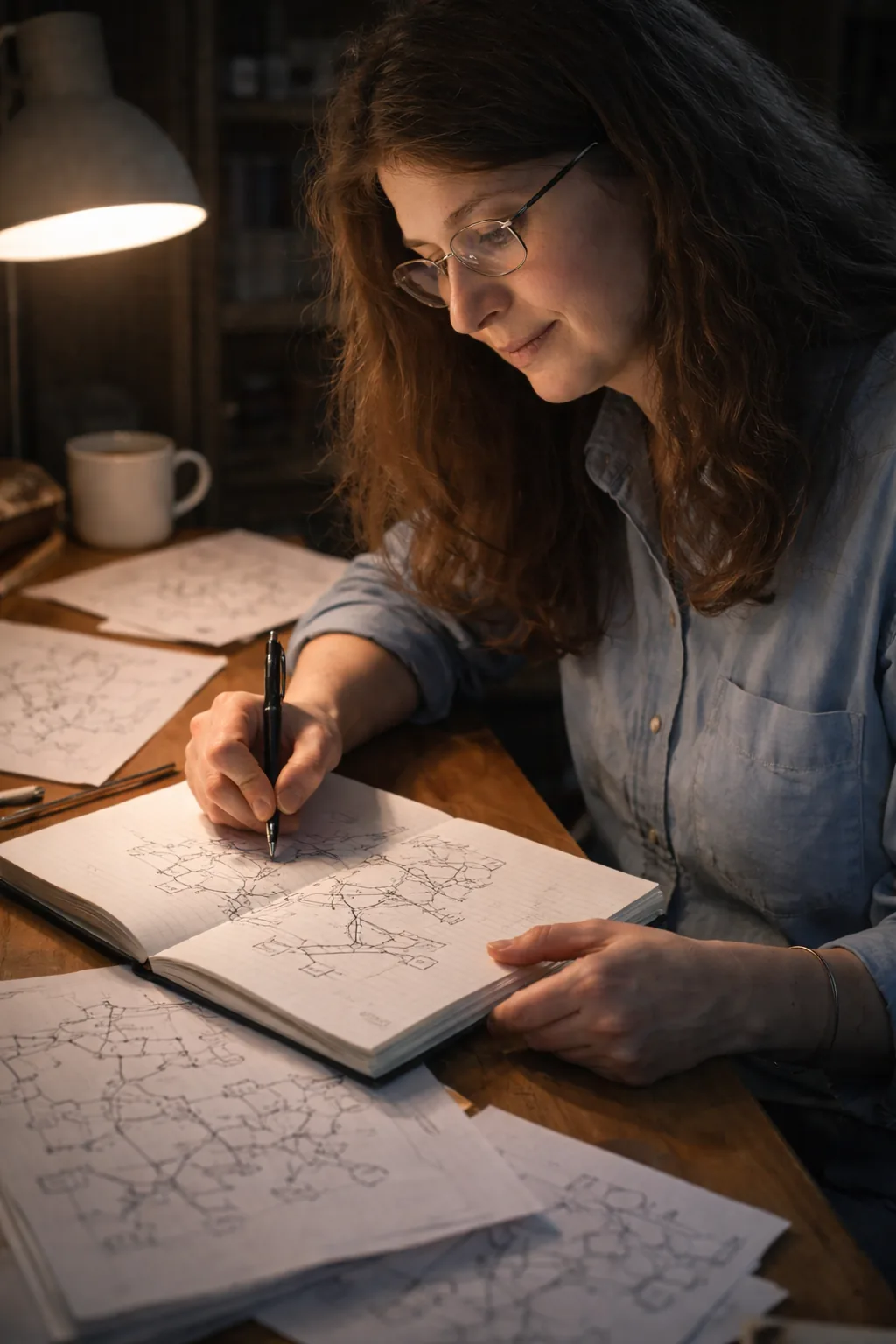
Perlman’s published paper preserves both the algorithm and Algorhyme. It lets us distinguish the author’s technical proposal from later accounts of its importance. The image alongside is illustrative: it is not a reproduction of her manuscript or a verified network diagram (Perlman, 1985).
1. The invisible problem
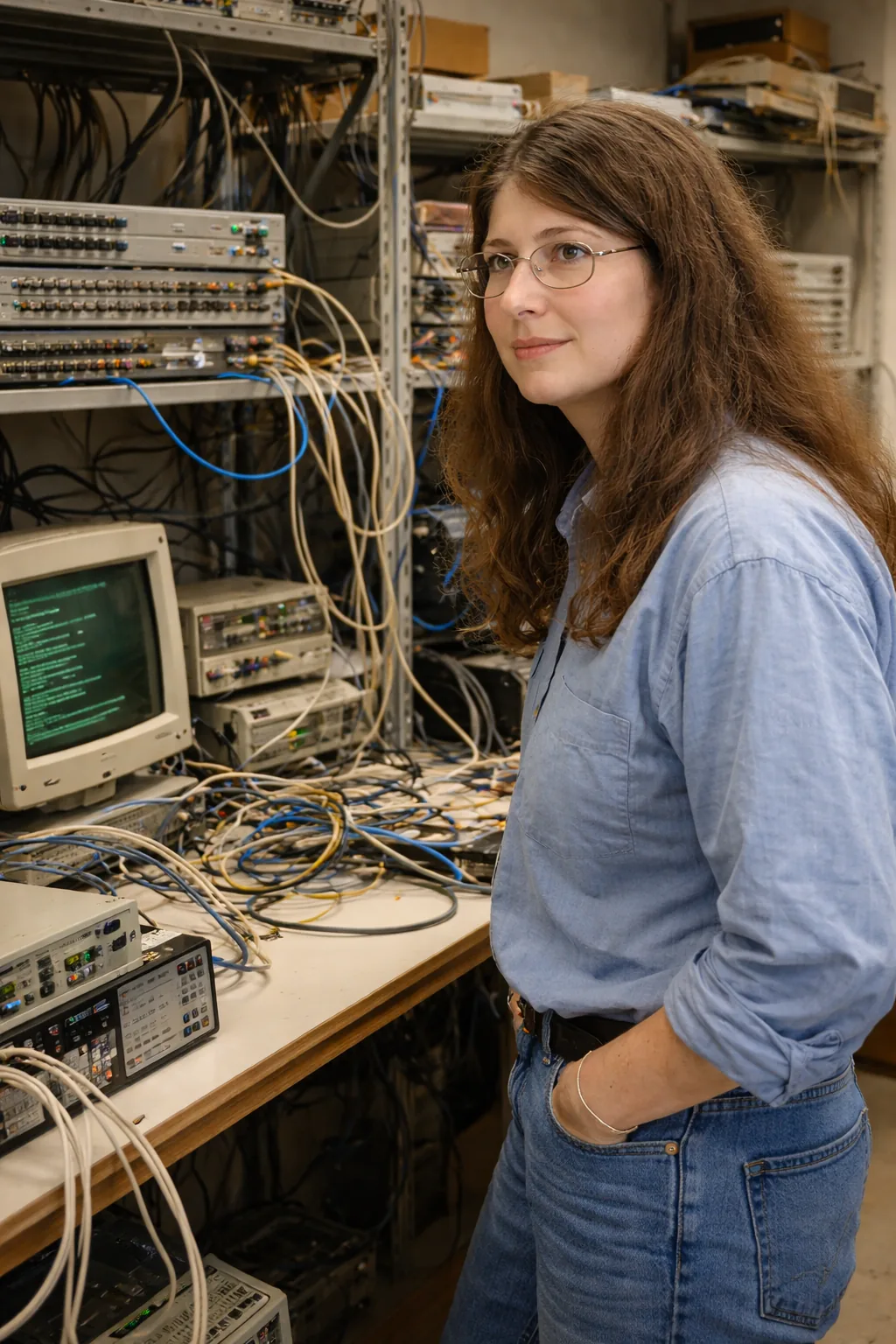
A network can have too many paths. When Ethernet bridges form a cycle and forward broadcast frames without a loop-prevention mechanism, copies can circulate and multiply until they overwhelm the network. Redundancy, intended to protect against a broken connection, can become the source of failure.
Radia Perlman devised a solution that did not require replacing the computers already installed. Her algorithm established a logical topology without cycles while retaining alternative physical connections. She did not invent every component of networking. She solved a particular coordination problem that made interconnecting Ethernet segments far more practical (Perlman, 1985).
2. Learning without feeling excluded
Radia Perlman was born in 1951 and grew up in New Jersey. Her father worked on radar and her mother was a programmer. Yet growing up around engineering did not automatically make her confident that computing was a world in which she belonged.
A programming class at the Stevens Institute of Technology intimidated her: other students discussed amateur radio and used unfamiliar technical vocabulary. Later, at MIT, a physics teaching assistant offered her programming work on a project. She discovered that she could learn. That experience helped shape her commitment to teaching clearly and making students feel able to ask questions without embarrassment (National Inventors Hall of Fame, n.d.).
3. Three degrees and a difficult question
At MIT she earned mathematics degrees in 1973 and 1976, followed by a doctorate in computer science in 1988. Her career was not a straight line toward a single invention. It combined research, industrial experience, and a return to university.
Her doctoral research examined protocols that could function despite maliciously behaving components. An accidental failure and a participant deliberately sending misleading information are not precisely the same problem. Understanding that distinction requires asking what each machine can safely trust about the others. This reaches beyond eliminating loops and helps explain her later work on network security. The challenge is to describe assumptions carefully enough that a system’s apparent resilience does not depend on cooperation that cannot actually be guaranteed (Lemelson-MIT Program, n.d.).
4. TORTIS: programming before reading
Before STP, Perlman worked with MIT’s LOGO group. Her March 1974 report describes TORTIS, a system of button boxes through which young children could control a robotic turtle. Moving, turning, drawing, and repeating instructions did not require typing code.
The report distinguishes equipment already available from extensions she still hoped to build. That distinction matters: proposed features should not all be presented as completed achievements. It also records informal observations of children using the system, rather than proving that every preschooler could master recursion.
The contribution was an accessible way to explore programming ideas through physical actions and visible responses. The interface removed barriers that were not necessarily limits on a child’s ability to understand a concept (Perlman, 1974).
5. From BBN to Digital Equipment Corporation
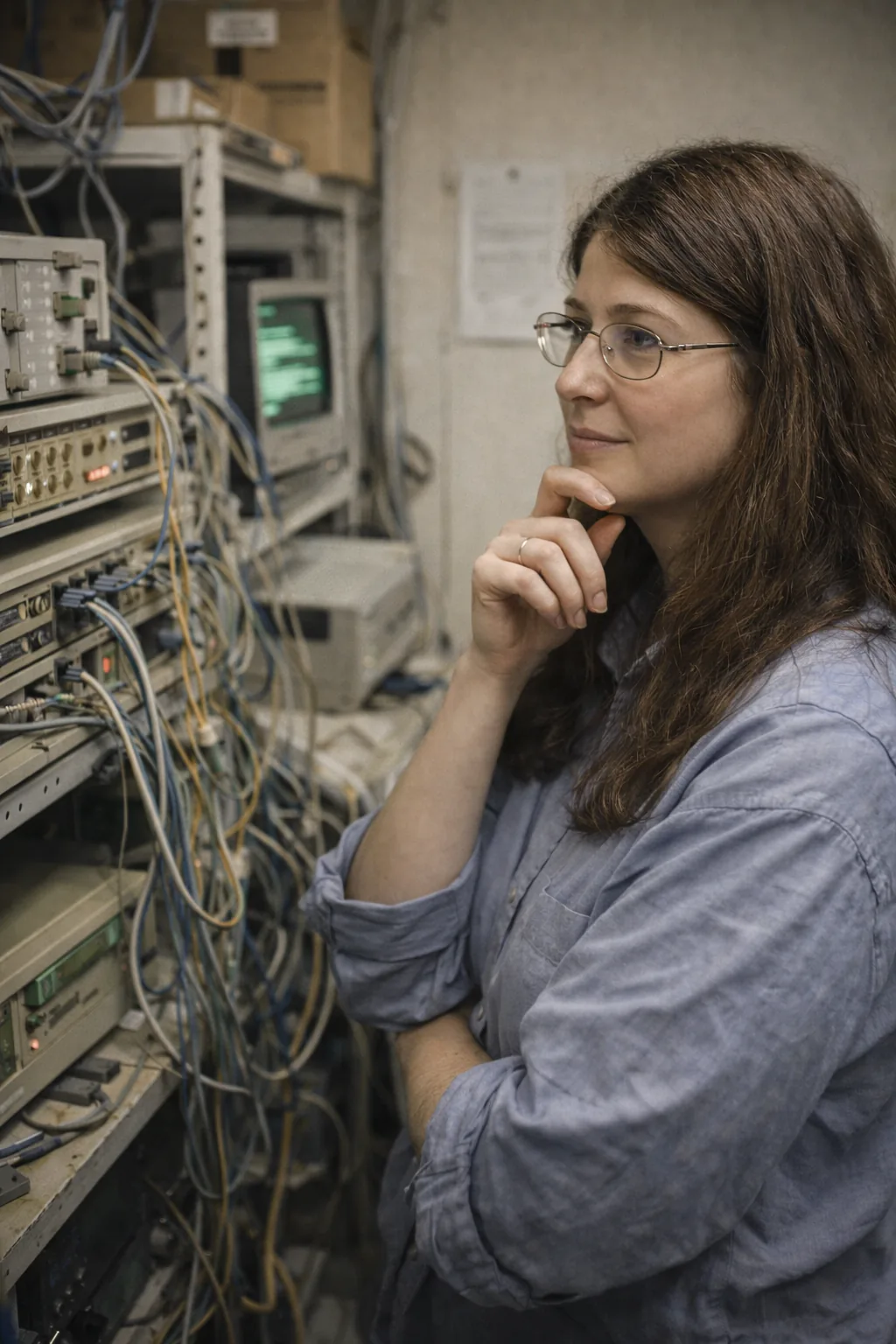
After her master’s degree, Perlman worked at BBN and joined Digital Equipment Corporation, DEC, in 1980. There she designed routing mechanisms for DECnet. The challenge was not simply finding a route when everything worked; it was preventing local mistakes from disrupting an entire system.
Her contributions helped make link-state routing robust and scalable, particularly through IS-IS. In this approach, devices exchange information about connectivity and calculate routes using that information.
Self-recovery mattered. If an expert needed to send messages through a broken network to repair it, the very failure could prevent those instructions from arriving. Recovering without constant intervention therefore belonged in the design itself. A useful protocol had to cope with changing conditions, rather than depend on a permanently accurate manual arrangement (Internet Hall of Fame, 2014).
6. The tree that organized Ethernet
At DEC she was asked to connect Ethernet networks without requiring changes to existing computers. In her ACM interview, she recalls devising the algorithm over a long weekend; the specification was finished by the end of the Tuesday following the assignment (Association for Computing Machinery, 2020).
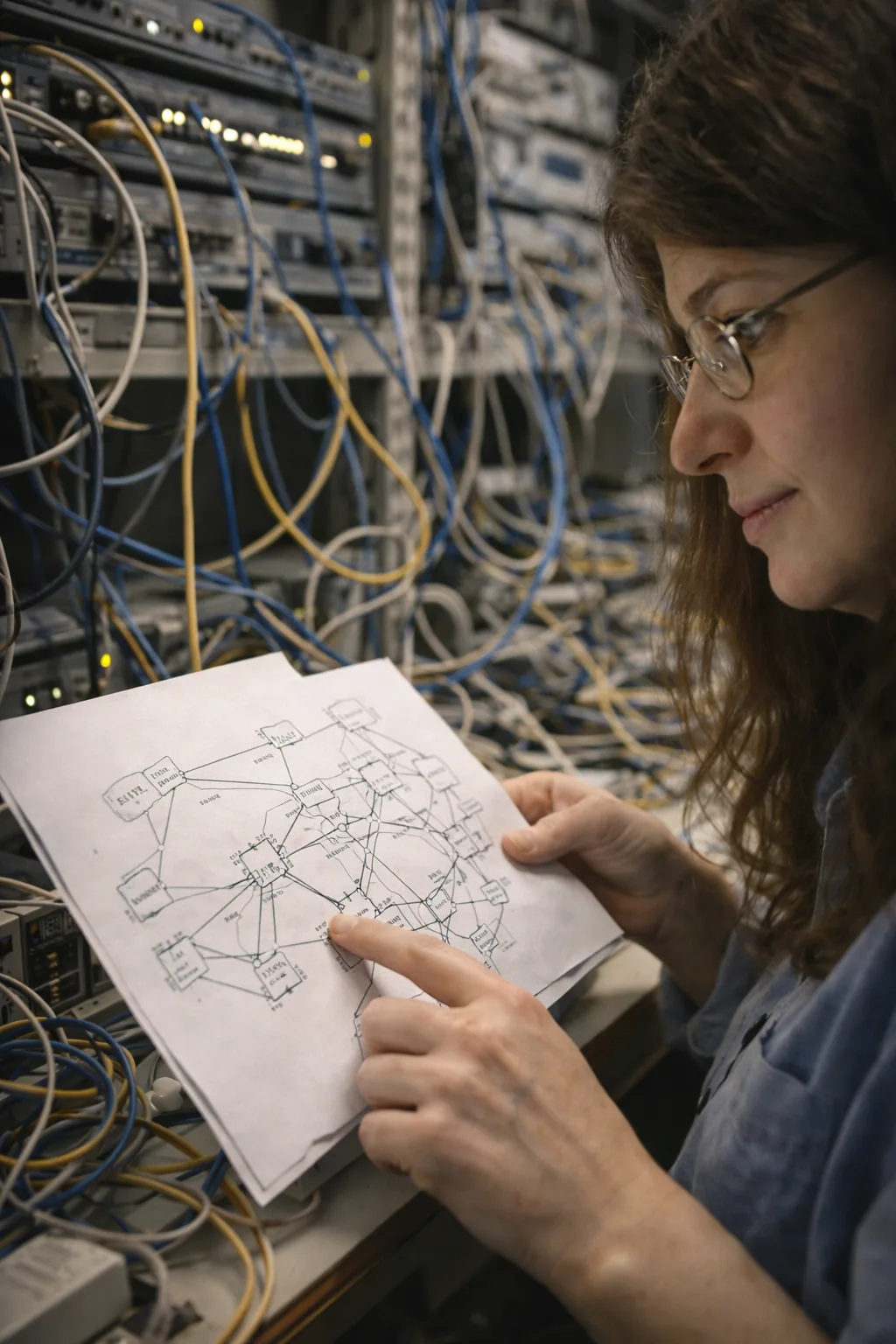
Bridges exchange control messages, elect a root, and select lowest-cost paths toward it. Certain ports stop forwarding data traffic so that the active topology contains no cycles. Redundant physical connections remain available and can be used after reconfiguration.
Recovery is not instantaneous, nor can the protocol guarantee survival of every possible failure. Its achievement is a set of distributed rules through which devices can reach a coherent arrangement without an administrator directing every individual step (Perlman, 1985).
7. An explanation that could be sung
Perlman accompanied her algorithm with Algorhyme, a poem inspired by Joyce Kilmer’s Trees. Its rhymes describe selecting a root and establishing the tree’s paths. The poem appears in her 1985 paper, where readers can examine it alongside the technical explanation.
Years later, her daughter Dawn sang it with Perlman accompanying her on the piano. The Internet Hall of Fame documented that performance in a 2015 post. The publication date should not automatically be treated as the date when the poem itself was written.
The episode offers two complementary ways to communicate an idea. One makes it memorable; the other allows readers to inspect its rules and test its limits. Poetry illustrates the mechanism, but does not replace its specification (Perlman, 1985; Internet Hall of Fame, 2015).
8. Improving on her own solution
STP prevents loops by giving up simultaneous use of some paths. That decision works, but leaves part of the physical network outside the active forwarding topology. Perlman also helped develop TRILL, combining properties of bridges and routers to make use of multiple paths.
RFC 6325, published in 2011, lists her as a coauthor alongside four other specialists. It describes encapsulation, a hop count, and IS-IS routing: mechanisms for approaching the problem differently. This was collaborative standards work, not an isolated invention detached from other engineers (Perlman et al., 2011).
In security, she also explored the ephemerizer: rendering encrypted information inaccessible by destroying the corresponding keys. That does not erase plaintext copies someone may already have retained. The distinction keeps an appealing concept within its actual security assumptions (Lemelson-MIT Program, n.d.).

9. Why a nickname cannot explain the Internet
Calling her the “Mother of the Internet” conveys admiration, but compresses a collective history too far. Ethernet, bridging, IP routing, and the Web are different components. No spanning-tree algorithm alone explains how that entire infrastructure came into existence.
Recognizing the distinction does not diminish Perlman. It allows precise credit for verifiable contributions: self-organizing bridges, resilient routing, security proposals, and educational tools. Her Internet Hall of Fame profile emphasizes that range, as well as her books Interconnections and Network Security (Internet Hall of Fame, 2014).
It also avoids the story of a miraculous universal solution. Network design involves choices among compatibility, capacity, complexity, and recovery. Her career becomes more interesting when those decisions are understood than when they are replaced by an impressive nickname.
10. Clarity as an engineering principle
TORTIS and computer networks may seem far apart. Yet both invite a useful question: how much knowledge should users need before a system can work correctly? In one case, children faced an unfamiliar machine. In the other, devices and administrators faced networks that kept growing.
Clarity does not remove technical difficulty. It helps identify where that difficulty lies, explain what should happen, and recognize when something has gone wrong. This is a lesson readers can draw from her designs, rather than a quotation being attributed to Perlman.
Her legacy encourages us to look behind an everyday connection. Before a message can reach its destination, someone must establish how machines choose paths, avoid errors, and try again when conditions change. The invisible rules deserve attention alongside the visible devices.
Timeline
| Year | Event |
|---|---|
| 1951 | Born. |
| 1973 | Earns her mathematics bachelor’s degree at MIT. |
| 1974 | Publishes her TORTIS report. |
| 1976 | Earns her mathematics master’s degree. |
| 1980 | Joins DEC. |
| 1985 | Publishes her spanning-tree paper. |
| 1988 | Earns her doctorate at MIT. |
| 2011 | Coauthors RFC 6325 on TRILL. |
| 2014 | Inducted into the Internet Hall of Fame. |
Sources
- Association for Computing Machinery. (2020, July 7). Radia Perlman—Episode 3 [ACM ByteCast].
- Internet Hall of Fame. (2014). Radia Perlman.
- Internet Hall of Fame. (2015, November 12). ‘Algorhyme’ set to music at MIT’s Lincoln Lab.
- Lemelson-MIT Program. (n.d.). Radia Perlman.
- National Inventors Hall of Fame. (n.d.). Radia Perlman: Robust network routing and bridging.
- Perlman, R. (1974). TORTIS (Toddler’s Own Recursive Turtle Interpreter System) (LOGO Memo 9). MIT Artificial Intelligence Laboratory.
- Perlman, R. (1985). An algorithm for distributed computation of a spanning tree in an extended LAN. ACM SIGCOMM Computer Communication Review, 15(4), 44–53.
- Perlman, R., Eastlake, D., Dutt, D., Gai, S., & Ghanwani, A. (2011). Routing bridges (RBridges): Base protocol specification (RFC 6325). Internet Engineering Task Force.
More from this collection
Maryam Mirzakhani: The Mathematician Who Drew Paths Across Invisible Worlds
Read story →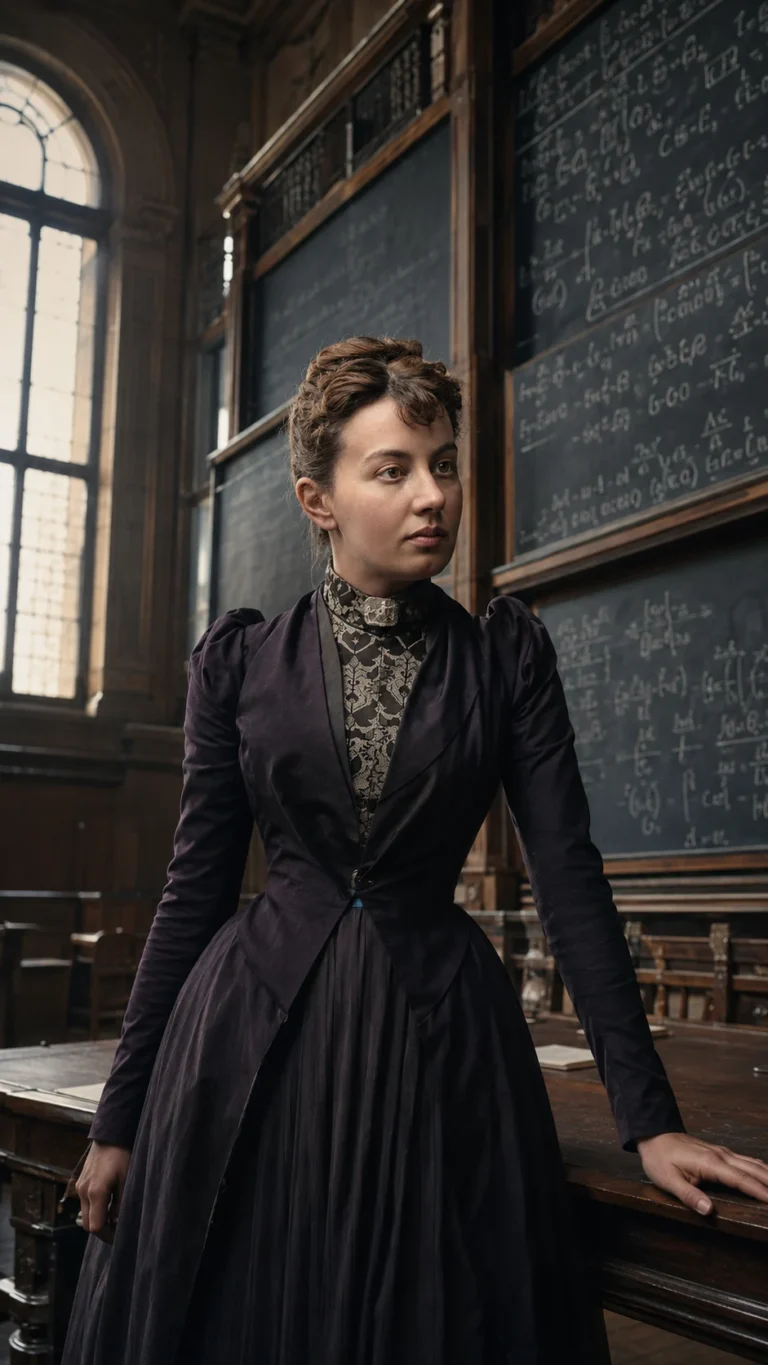
Sofia Kovalevskaya: The Woman Who Had to Marry to Study Mathematics
Read story →