In this storyOpen index
Mel Blanc: The Actor Nobody Saw Who Gave Face, Character, and Memory to an Entire Generation
From radio to Bugs Bunny: the unseen actor who turned drawings into unforgettable personalities.
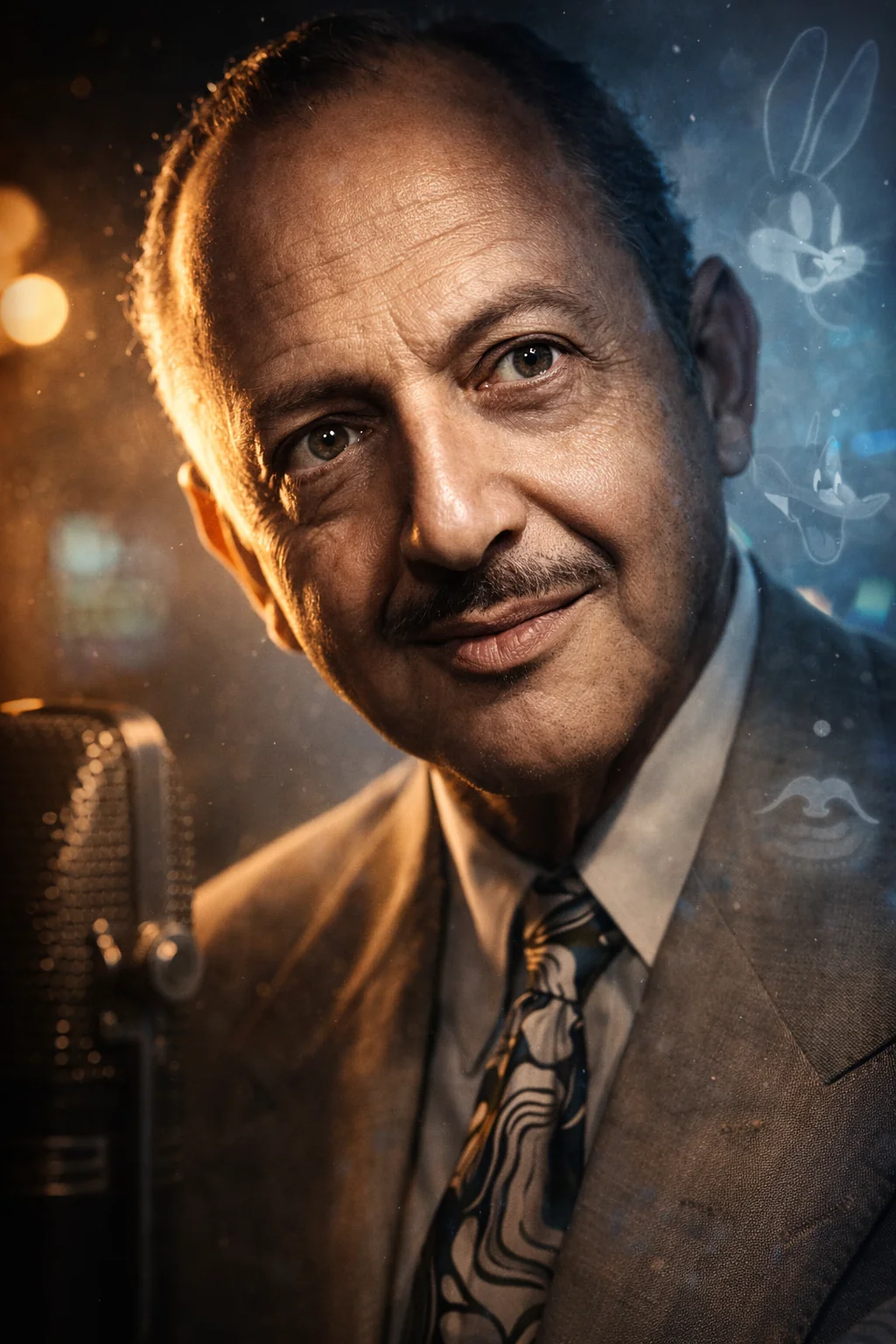
His face could go unnoticed. His voice never did. Mel Blanc built a world of distinct characters and fought for the performer’s name to appear on screen too.
Mel Blanc
The life behind the voices
The Mel Blanc Project · 2011
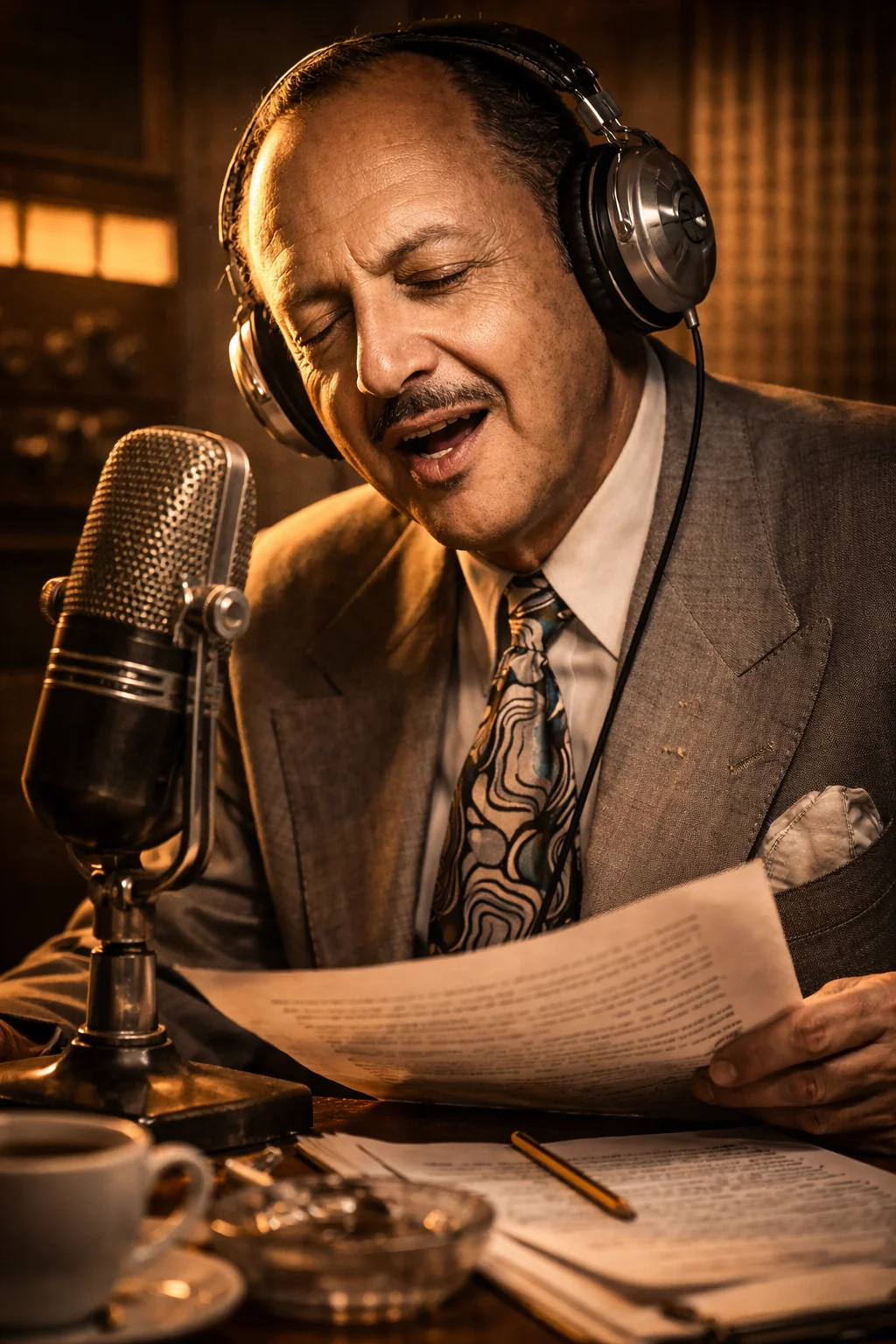
The Oregon Cartoon Institute devoted this project to Blanc’s career and his Portland roots. Its page documents the initiative and connects local radio history with Hollywood animation. The image is a reconstruction of the actor, not an archival item from the institute. (Oregon Cartoon Institute, 2011).
1. The Man Who Awakened as a Rabbit
On January 24, 1961, another automobile collided head-on with Mel Blanc’s car on Sunset Boulevard in Los Angeles. The actor suffered fractures to his legs and pelvis, internal injuries, and severe head trauma. Early newspaper reports described him as critically injured but beginning to show slight improvement (Associated Press, 1961).

Blanc remained unconscious for a period whose duration varies in later accounts. His autobiography and his family’s recollections popularized an extraordinary scene: a physician, unable to obtain a response from the patient, supposedly stopped addressing Mel and asked Bugs Bunny how he was feeling. From the bed, not yet fully conscious, Blanc allegedly answered in the rabbit’s voice.
The story has been repeated as though it were documented word for word in medical records. It is not. It comes mainly from memories shared by Blanc and his family years later. The accident, coma, and recovery are established facts; the precise exchange belongs to a family recollection that cannot be independently verified (UPI, 1989; Radiolab, 2012).

The anecdote nevertheless captures a truth about his craft: Blanc had constructed those voices so completely that they seemed capable of existing separately from his face.
2. The Boy Who Discovered a Crowd Inside His Throat
Melvin Jerome Blank was born on May 30, 1908, in San Francisco to a Jewish family. He spent much of his childhood in Portland, Oregon, where he developed interests in music, dialects, and imitation. He played instruments and carefully observed how people around him spoke.
According to a story he frequently told, a teacher said he would never amount to anything because he was “just like his name: blank.” The young performer supposedly began spelling it “Blanc.” The episode became part of his public autobiography, although no known school record verifies the exact remark.
In 1927, he joined The Hoot Owls, a radio program broadcast by Portland station KGW. He sang, wrote material, and began playing different characters. Radio was a demanding school: without gestures or scenery, every personality had to emerge through rhythm, pitch, breathing, and pronunciation alone (Adams, n.d.).
Blanc also worked on Cobwebs and Nuts, writing, producing, and portraying numerous roles. Before entering animation, he had learned to create entire scenes using nothing but his voice.
3. The Radio Years and the Art of Being Invisible
Blanc moved to Los Angeles during the 1930s. He found work at local stations and eventually appeared on national programs. His best-known radio association was with Jack Benny.
On The Jack Benny Program, he did not play one consistent supporting role. He became the Mexican character Sy, Professor LeBlanc, a railroad announcer, a clerk, and numerous impatient employees. He also produced the noises of Benny’s decrepit Maxwell automobile. A malfunctioning engine, horns, and explosions could become a comic conversation without words.
This versatility taught Blanc to construct personalities through small irregularities: an excessive pause, a distorted consonant, a laugh interrupting a sentence, or a sudden change in volume. The voice did not merely accompany the character; it was the character.
In 1946, he received his own program, The Mel Blanc Show. His radio career continued alongside his film work, although Bugs Bunny’s later fame eventually obscured much of it.
4. The Door Warner Bros. Was Slow to Open
Blanc repeatedly sought an audition at Leon Schlesinger’s animation studio, which produced theatrical shorts distributed by Warner Bros. His earliest performances in shorts released in 1937 included Porky’s Road Race and Picador Porky. That year he assumed the voice of Porky Pig, an existing character in need of a new performer (Adams, n.d.; Scott, 2016).
That same year, he appeared in Porky’s Duck Hunt, which introduced Daffy Duck. Blanc gave the duck a rapid, wet, explosive voice whose pronunciation appeared unable to contain the character’s energy.
The creation of these figures was collaborative. Directors such as Tex Avery, Bob Clampett, Friz Freleng, Chuck Jones, and Robert McKimson defined designs, movements, and situations. Writers constructed dialogue. Blanc contributed performances that helped determine how each creature should move and react.
It is therefore inaccurate to claim that he individually “created” every character. His contribution was different and fundamental: he transformed sequences of drawings into personalities recognizable even with one’s eyes closed.
5. Bugs Bunny and a Voice Belonging Nowhere
Several versions of an insolent rabbit appeared before Bugs Bunny assumed his classic form. A Wild Hare, directed by Tex Avery and released in 1940, is generally regarded as the character’s definitive emergence.

Blanc developed a voice combining features associated with Brooklyn and the Bronx. Bugs needed to sound urban, confident, and difficult to intimidate. His calmness contrasted with the absurd violence surrounding him. The rabbit normally responded after someone invaded his space, preventing his superiority from becoming simple cruelty.
To produce the sound of Bugs eating, Blanc bit real carrots before the microphone and then stopped recording to spit them out, since swallowing would interrupt the dialogue. The claim that he was allergic to carrots is a legend. Blanc denied it, and colleagues explained that he simply did not enjoy repeatedly eating them (Adams, 2008).
Bugs was more than a funny accent. He was a performance built upon control, irony, and timing. Blanc knew when to accelerate a sentence and when to let silence complete the insult.
6. One Throat, Completely Different Characters
Blanc’s characters included Porky Pig, Daffy Duck, Bugs Bunny, Tweety, Sylvester, Yosemite Sam, Foghorn Leghorn, Speedy Gonzales, Pepé Le Pew, and Marvin the Martian. He also temporarily or selectively performed characters whose principal voices belonged to other actors.
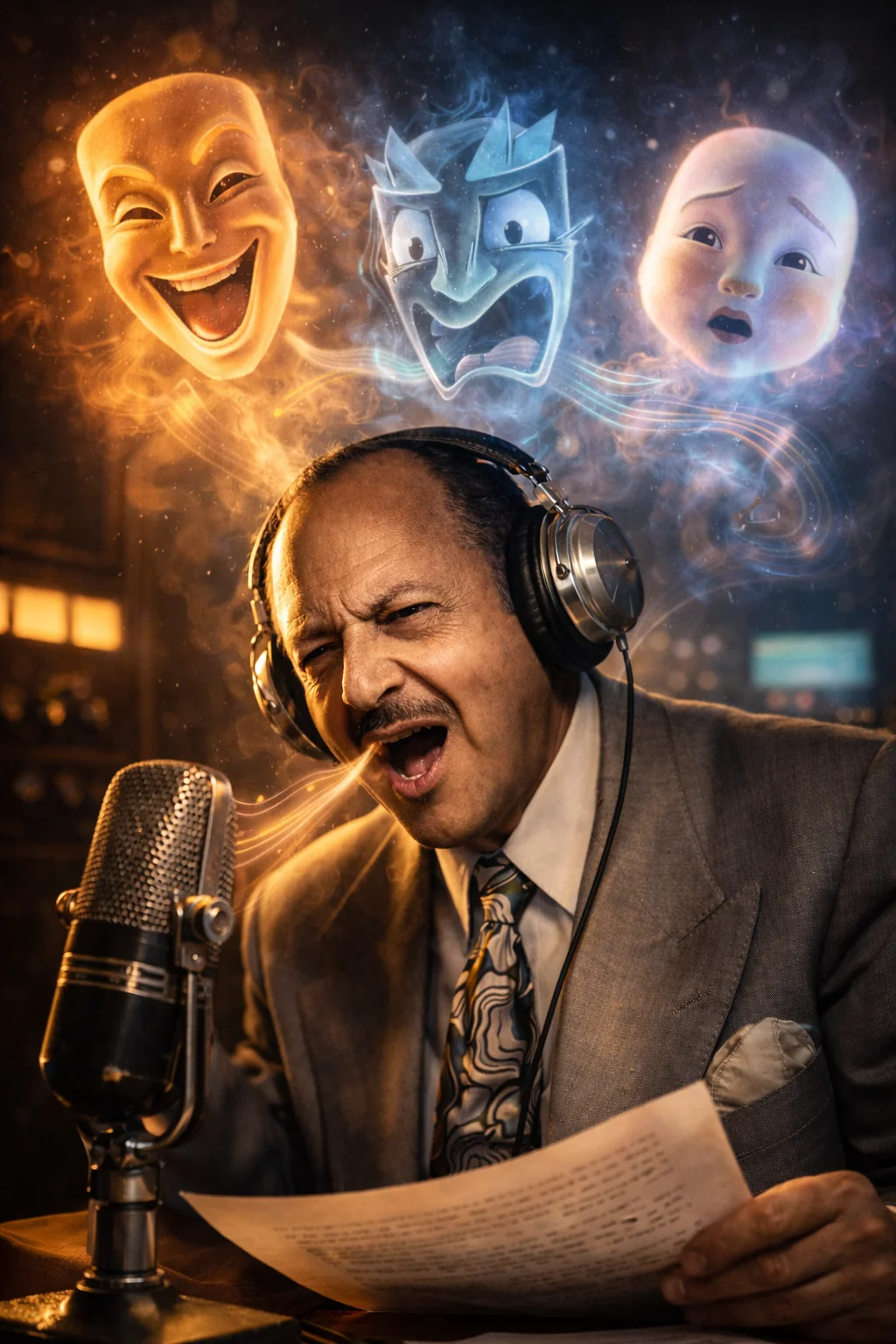
To prevent them all from sounding like variations of one person, he constructed internal rules. Porky struggled against words but eventually found an exit. Daffy appeared to collide with his own thoughts. Sylvester shared vocal qualities with Daffy but spoke with a heavier rhythm. Yosemite Sam existed as a continuous explosion, while Marvin remained calm even when planning to destroy a planet.
“The Man of a Thousand Voices” was a promotional title, not a literal inventory. In 1984, Blanc said that after his accident he attempted to list his characters and fell asleep after reaching approximately four hundred (Shales, 1984). An exact total is impossible because it depends on whether imitations, incidental roles, variations, and sound effects are counted separately.
His greatness did not depend upon reaching a magical number. It rested upon making audiences immediately remember who was speaking.
7. The Little-Known Fact: The Fight to Appear in the Credits
During the early years of sound animation, voice performers rarely received screen recognition. Studios preferred to preserve the illusion that characters spoke for themselves and avoided turning actors into stars capable of demanding higher salaries.
Blanc worked for years without audiences seeing his name. His 1943 contract opened the negotiation, and beginning in 1944, he received billing on selected Bugs Bunny shorts. Later renewals expanded recognition to productions starring Porky, Daffy, and other characters in which he performed a major share of the voices (Scott, 2016).
The familiar story that he simply rejected a salary increase in exchange for credit does not fully match the surviving contracts. The process was gradual and connected to his increasing value to the studio.
The name displayed beneath the phrase “Voice Characterization” helped transform voice acting from invisible labor into a recognizable profession. Blanc did not secure credit for all his colleagues, but he demonstrated that the performer behind the drawing could possess an artistic identity.
8. Woody, Barney, and a Career Beyond Warner
Before his exclusive contract restricted certain outside work, Blanc developed the original laugh of Woody Woodpecker for Walter Lantz. He also recorded material for Disney’s Pinocchio, although nearly everything was removed, leaving only a small sound associated with Gideon the cat (Los Angeles Times, 1989).
When restrictions in his Warner contract decreased, he worked for Hanna-Barbera. His most important television role was Barney Rubble in The Flintstones, which premiered in 1960. He also voiced Dino and other characters.

Following the 1961 accident, Daws Butler temporarily replaced him as Barney. Once Blanc was capable of working, recording equipment was installed near his bed. He recorded episodes while immobilized and later continued from a temporary studio inside his home (Encyclopedia.com, n.d.).
The image of an actor surrounded by microphones while unable to rise reveals the central contradiction of his work: his body was gravely injured, but his voice could continue living in the Stone Age.
9. The Voice at the Service of War and Advertising
During the Second World War, Blanc performed Private Snafu, a soldier used in animated training shorts produced for the United States armed forces. These films taught safety, hygiene, and discipline through adult humor and situations not intended for children.
He also worked extensively in advertising, records, and television. Character voices became products capable of leaving movie theaters and appearing on radio, toys, and commercial campaigns.
That expansion raised questions about ownership and performance. Blanc even attempted to protect legally the distinctive laugh he had developed for Woody Woodpecker. A later lawsuit was dismissed after the court held that he could not prevent others from imitating the sound (UPI, 1989).
He had helped create identities recognized around the world, but the legal boundaries separating actor, character, and studio remained complicated.
10. “That’s All Folks!”
Mel Blanc died in Los Angeles on July 10, 1989, at the age of eighty-one, following cardiovascular complications. His career had lasted more than six decades.

His grave at Hollywood Forever Cemetery bears the phrase “That’s All Folks!”, the closing line associated with Porky Pig. It is a humorous epitaph, but also an exceptionally appropriate one: the man who was rarely visible on screen ultimately said farewell through one of his characters.
Blanc helped invent the faces of cinema without drawing eyes, ears, or expressions. He gave every figure breath, intention, and a history that animators could follow.
Audiences saw a rabbit, duck, pig, or cat. Behind them all stood an invisible actor proving that a cinematic face could also be constructed entirely from sound.
Timeline
| Year | Event |
|---|---|
| 1908 | Born in San Francisco. |
| 1927 | Works on The Hoot Owls in Portland. |
| 1937 | Voices Porky and Daffy. |
| 1940 | A Wild Hare establishes the classic Bugs Bunny. |
| 1944 | His name appears in Bugs Bunny shorts’ credits. |
| 1946 | The Mel Blanc Show premieres. |
| 1960 | Voices Barney in The Flintstones. |
| 1961 | Suffers a serious accident and begins recovery. |
| 1989 | Dies in Los Angeles at 81. |
Sources
- Adams, C. (n.d.). Mel Blanc (1908–1989). The Oregon Encyclopedia.
- Adams, C. (2008). Did Mel Blanc hate carrots? The Straight Dope.
- Associated Press. (1961, January 26). Mel Blanc still on critical list. The Bend Bulletin.
- Encyclopedia.com. (n.d.). Blanc, Mel (1908–1989).
- Los Angeles Times. (1989, July 11). Mel Blanc dies; gave voice to cartoon world.
- Oregon Cartoon Institute. (2011). The Mel Blanc Project.
- Radiolab. (2012, November 6). What’s up, Doc? WNYC Studios.
- Scott, K. (2016, September 12). Mel Blanc: From anonymity to offscreen superstar (The advent of on-screen voice credits). Cartoon Research.
- Shales, T. (1984, March 29). Mel Blanc: 50 years of animated talk. The Washington Post.
- UPI. (1989, July 10). Mel Blanc, voice of a thousand cartoons, dies at 81.
More from this collection
Boris Karloff: The Gentle Man Who Taught Cinema How to Look at the Monster
Read story →
Ben Turpin: The Man Who Turned an Impossible Gaze into Cinematic Language
Read story →