In this storyOpen index
James Dean: The Actor Who Needed Only Three Films to Become a Legend
Only one of his three starring films had opened when he died. The next two expanded his legend after his death.
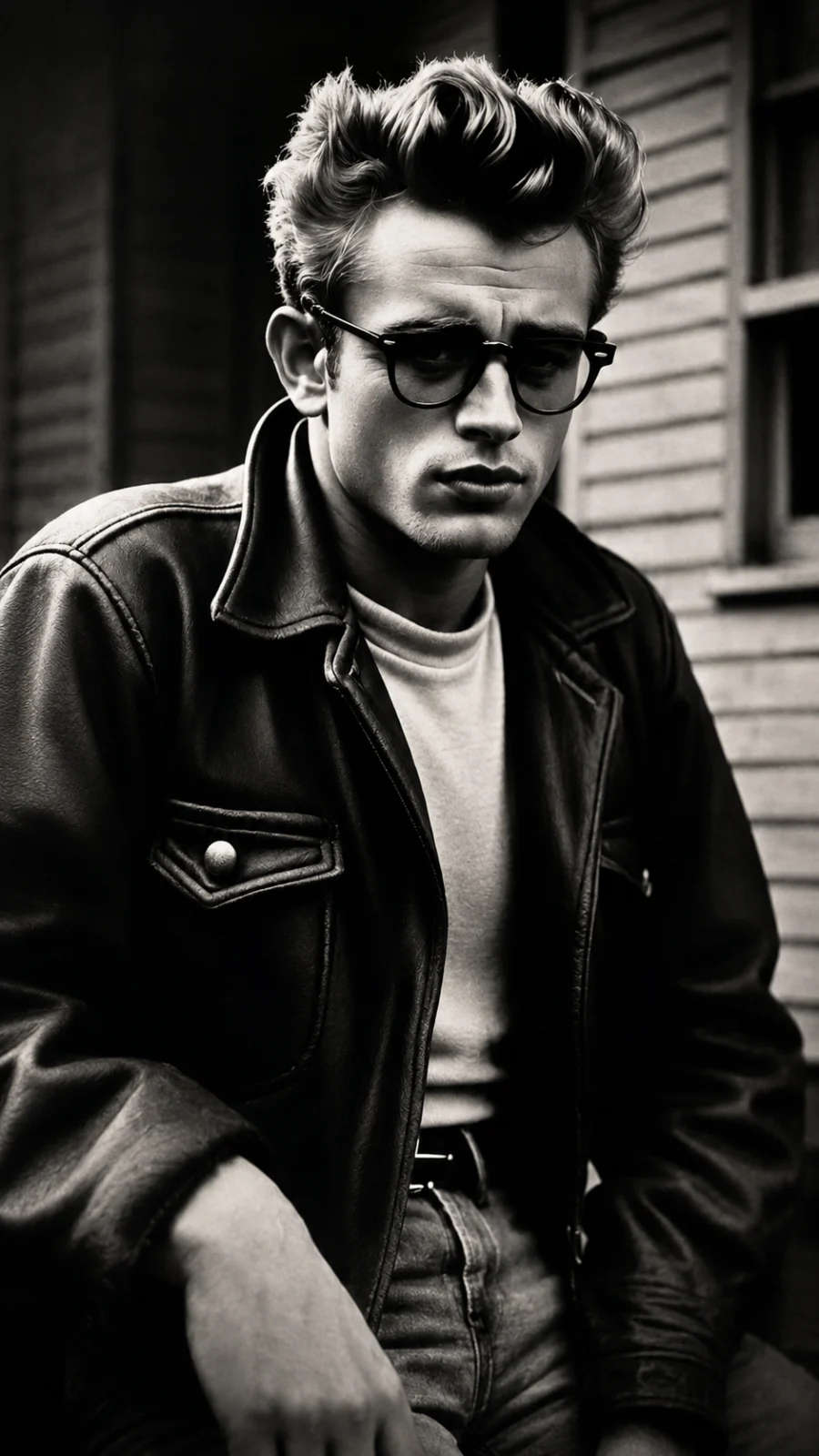
When James Dean died on September 30, 1955, only one of the three films he had starred in had reached theaters. He was twenty-four and not yet the universal myth we know today.
Rebel Without a Cause opened less than a month after his death. Giant appeared the following year. Audiences therefore discovered an actor who could no longer give interviews, accept new roles, or grow old in front of a camera.
In 1956, Dean became the first performer officially recognized with a posthumous Academy Award nomination for a leading performance. In 1957, he received a second nomination for Giant. He remains the only actor posthumously nominated twice for two different performances.
Hollywood never had time to discover everything he might have accomplished. That absence was precisely what helped transform him into an eternal figure.
James Dean on video
Discover this story on our YouTube channel.
A life told through places and turning points
The boy who returned to Indiana
James Byron Dean was born on February 8, 1931, in Marion, Indiana. His parents were Winton Dean, who left farming to become a dental technician, and Mildred Wilson Dean.
When James was approximately six, the family moved to California. His closest relationship appears to have been with his mother, who encouraged his interest in art and expression. Mildred died of cancer in 1940, when he was nine.
After her death, Winton sent the boy to live with his sister Ortense and her husband, Marcus Winslow, on a farm near Fairmount, Indiana. Dean grew up there within a Quaker community, played sports, entered public-speaking competitions, and developed an interest in theater.
The loss of his mother and separation from his father have been used to explain every character he portrayed. His biography should not be turned into a retrospective diagnosis. Nevertheless, it is difficult to ignore that all three of his major characters search for recognition, belonging, or paternal approval.
Dean did not appear to represent pain from a distance. He seemed to understand its language.
From a Pepsi commercial to the Actors Studio
After graduating in 1949, Dean returned to California. He studied first at Santa Monica City College and then at the University of California, Los Angeles, where he appeared in a production of Macbeth.
His decision to pursue acting full-time caused tension with his father. Dean left university and obtained minor jobs: a Pepsi commercial, television appearances, and film parts so small that some went uncredited.
Hollywood did not offer him an immediate path. He therefore moved to New York in 1951.

There he worked in live television, appeared in stage productions, and was accepted into the Actors Studio, associated with the teaching of what became known as “the Method.” The institution encouraged acting grounded in emotional experience, concentration, and believable behavior.
Dean did not invent that approach, nor was he its only representative. Marlon Brando had already demonstrated its power in film. Dean, however, introduced something different: a restless fragility, as though the character were improvising not only his movements but also his identity.
His Broadway performance in The Immoralist attracted director Elia Kazan, who was searching for the leading actor in East of Eden.
The son who could not obtain an embrace
In East of Eden, a partial adaptation of John Steinbeck’s novel, Dean portrayed Cal Trask, a young man convinced that something inside him is fundamentally wrong. Cal competes with his brother for the love of a rigid father who seems incapable of understanding him.
During one crucial scene, the father rejects money Cal offers him as a gift. According to the script, the young man was supposed to withdraw. Dean did something else: he lunged toward actor Raymond Massey, embraced him, and began to cry. Massey’s surprise was genuine, and Kazan preserved the moment in the completed film.
The improvisation summarizes much of Dean’s talent. He did not attempt to make the character appear elegant. He allowed his body to contract, stumble, or react before the words arrived.
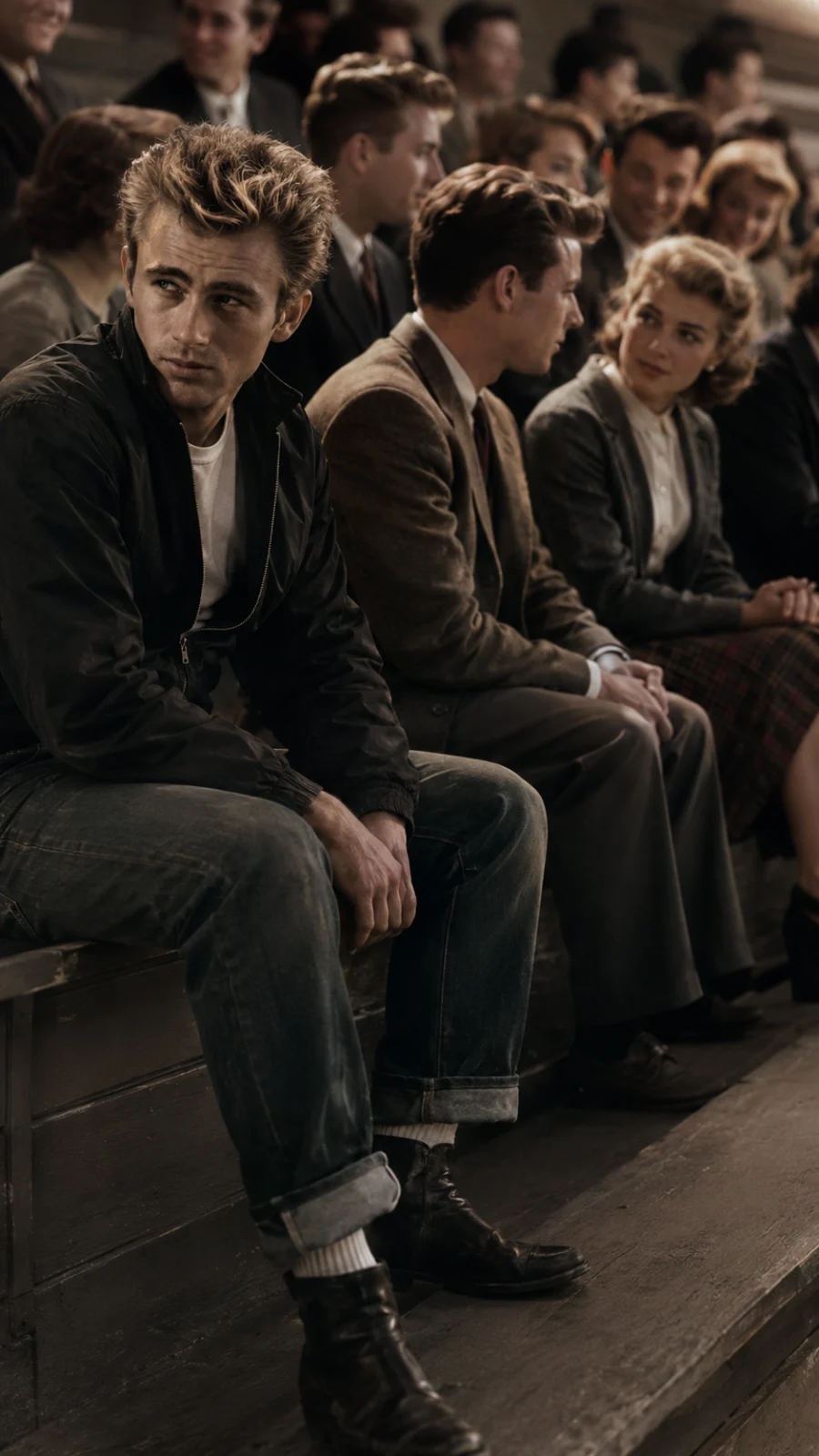
East of Eden opened in March 1955. It was the only one of Dean’s three starring films that he lived to see completed and presented to the public. His performance received the posthumous 1956 Academy Award nomination recorded by the Academy (Academy of Motion Picture Arts and Sciences, 1956).
The teenager adults refused to hear
Dean next portrayed Jim Stark in Rebel Without a Cause, directed by Nicholas Ray. The title helped transform him into a symbol of supposedly instinctive youthful rebellion, but Jim does have causes: parents unable to guide him, a society demanding obedience without providing security, and a profound fear of being considered a coward.
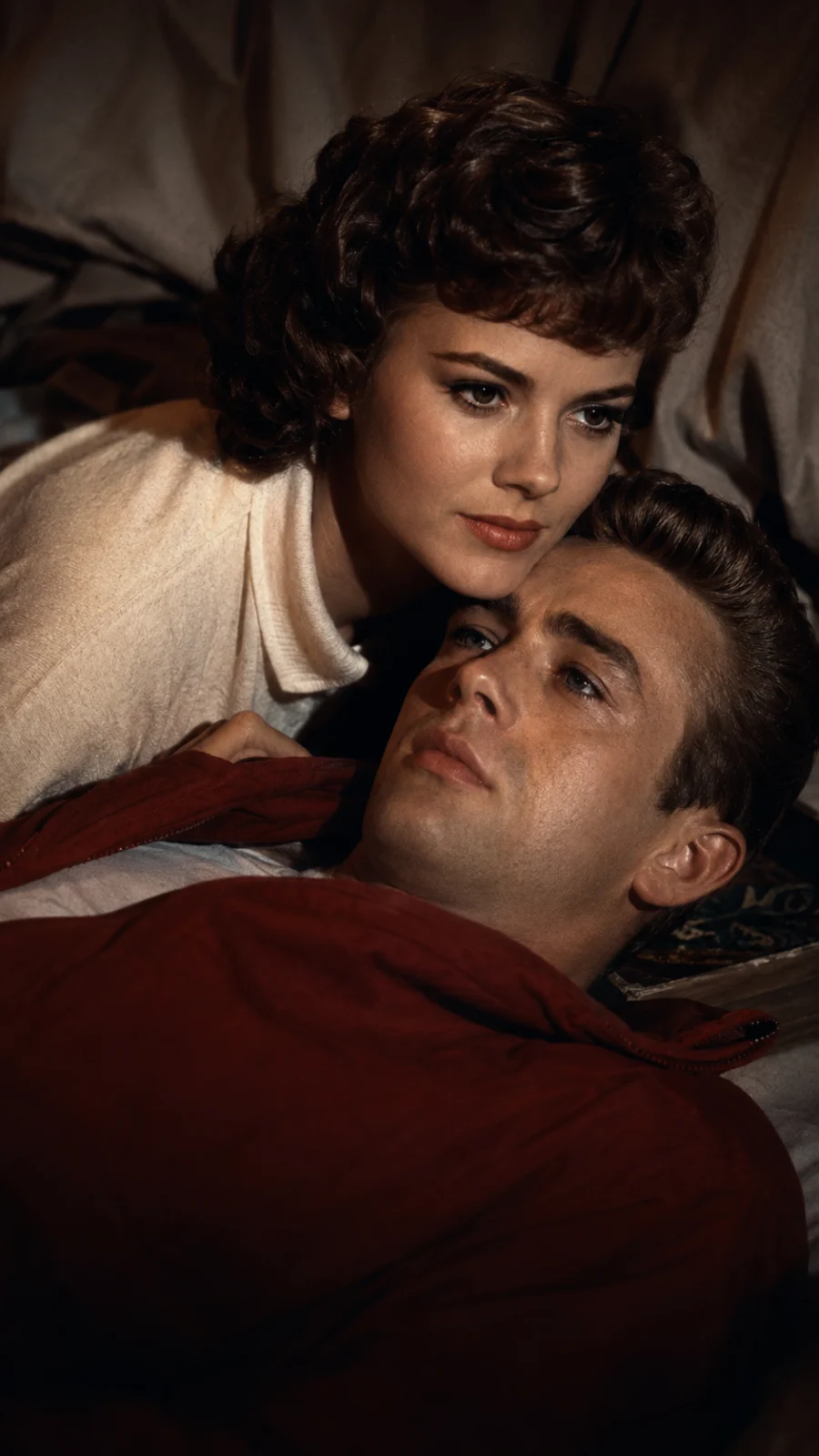
The film treated teenagers as people with emotional conflicts of their own, not simply as incomplete versions of adults. Dean, Natalie Wood, and Sal Mineo formed a temporary family within the story: three young people seeking from one another the understanding missing from their homes.
Dean’s red jacket, jeans, and white T-shirt became cultural symbols. Yet his performance is more vulnerable than defiant. Jim Stark does not want to destroy the adult world; he wants that world to explain how he is supposed to live in it.
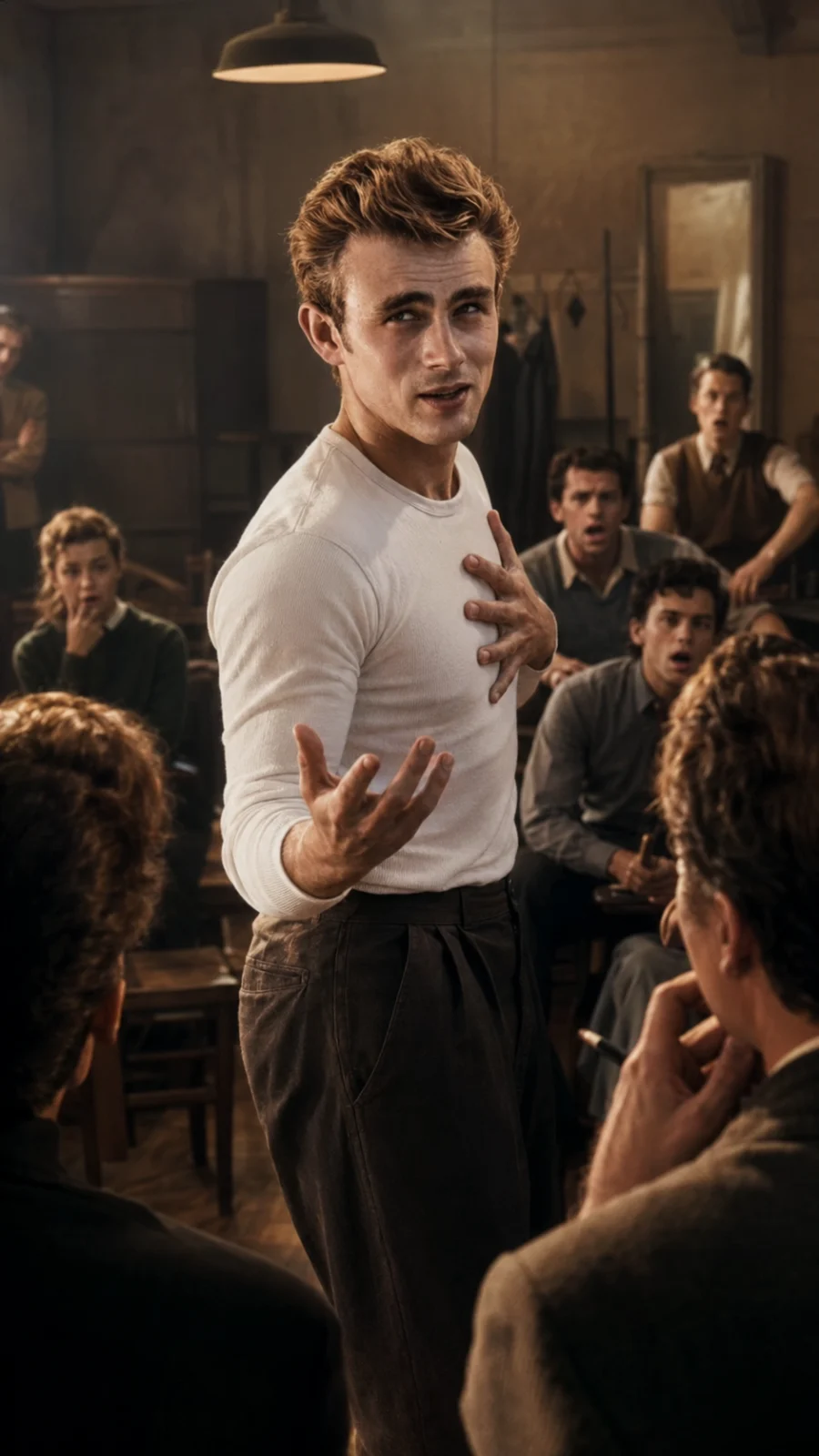
The film opened on October 27, 1955, less than a month after Dean’s death. Audiences already knew the actor had no future. Every youthful gesture was consequently colored by knowledge of his end.
Growing old in a film he never saw
His third major role was Jett Rink in Giant, directed by George Stevens. Dean initially portrayed him as a poor and resentful ranch hand and later had to show him as an aging oil magnate still unable to overcome his earlier humiliations.
It was a different kind of character. Cal Trask and Jim Stark still seek love; Jett Rink attempts to replace it with money and power.
Dean completed his principal scenes before the accident, although some of his dialogue had to be dubbed during postproduction. Giant opened in November 1956. The performance earned him his second posthumous Academy Award nomination in 1957 (Academy of Motion Picture Arts and Sciences, 1957).

He won neither award. The achievement nevertheless remains exceptional: two best-actor nominations produced by a leading film career consisting of only three pictures.
The road-safety interview
During the production of Giant, Dean participated in a filmed interview with actor Gig Young about safe driving. Dean competed in motor races and explained that driving at high speed on public highways could be more dangerous than doing so on a racetrack.
At the end, he was expected to repeat a familiar safety message: “The life you save may be your own.” Instead, he improvised a variation: “Take it easy driving; the life you might save might be mine.”
The recording has often been presented as a supernatural prediction. In reality, it shows that Dean distinguished between organized racing and highway driving. It also adds an unavoidable irony to what happened shortly afterward.
The final journey
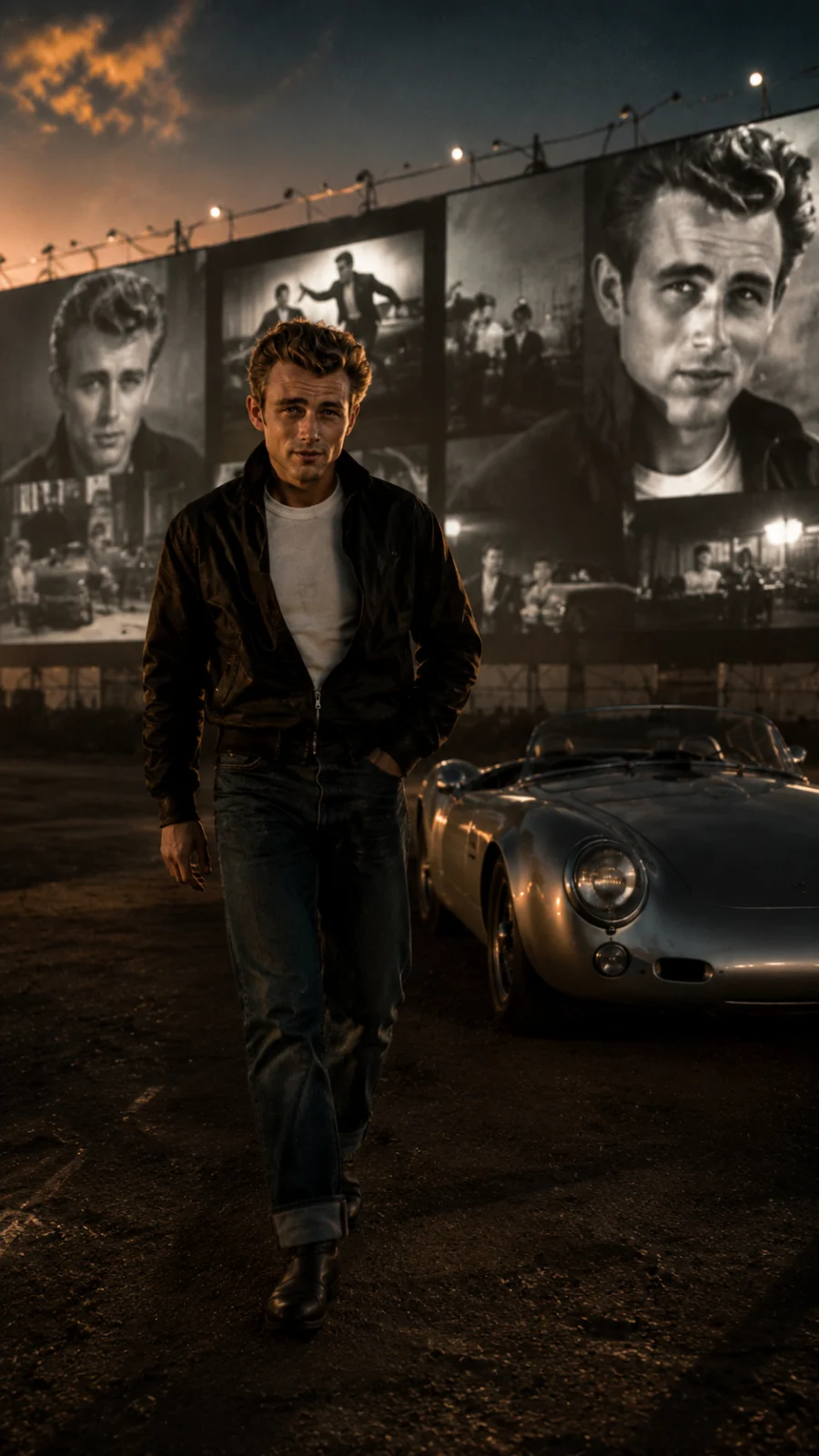
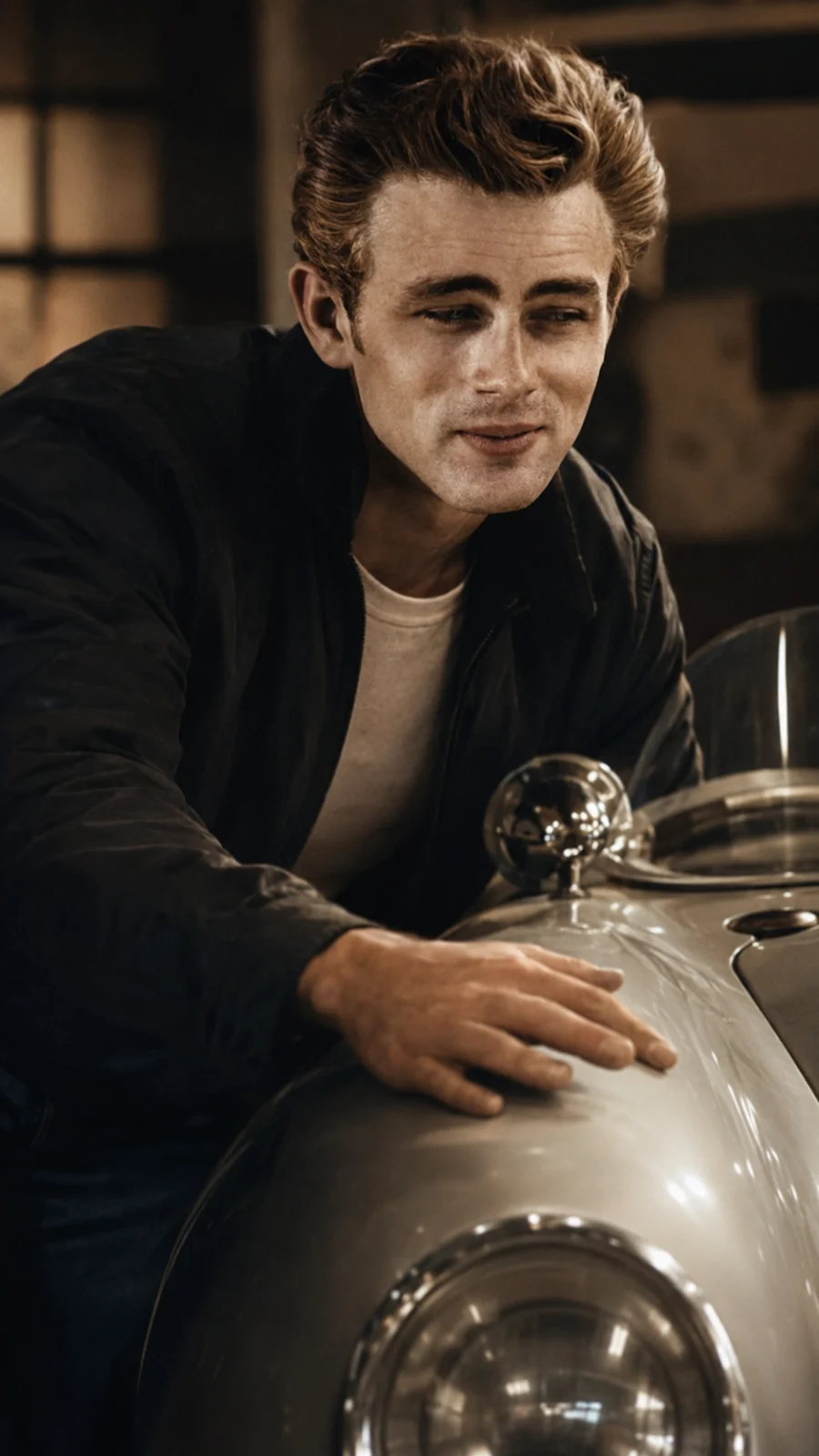
On September 30, 1955, Dean was driving his new Porsche 550 Spyder toward Salinas, where he planned to enter a race. Porsche mechanic Rolf Wütherich traveled beside him. Earlier that day, Dean had received a speeding ticket.
Near Cholame, California, a Ford driven by Donald Turnupseed began making a left turn across the Porsche’s path. Dean could not avoid the collision. Wütherich survived with serious injuries; Dean was transported to a hospital and pronounced dead.
The investigation classified the death as accidental and assigned no criminal responsibility to Turnupseed. Estimates of the Porsche’s exact speed at impact have varied, so it is not historically responsible to state that Dean died simply because he was traveling at extreme speed.
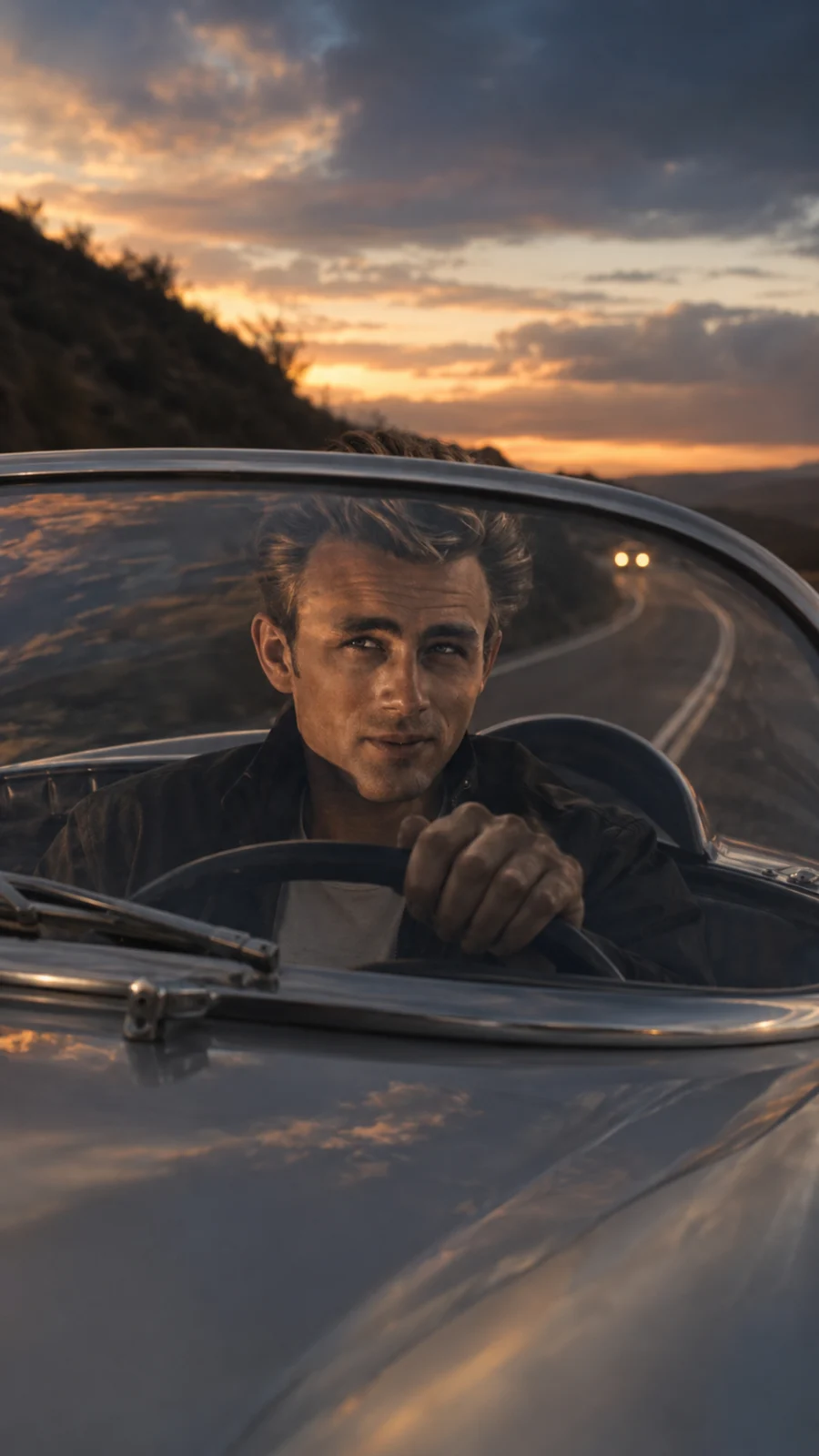
What can be established is that Dean was driving a low-profile car that was difficult to see, that the other vehicle crossed in front of him, and that he had very little time to react.
The false curse of “Little Bastard”
After the crash, a legend emerged that the Porsche, nicknamed “Little Bastard,” was cursed. Its parts supposedly caused other accidents, the wreck allegedly fell on people during exhibitions, and the car was eventually said to have vanished from sealed transportation.
Many of these stories were promoted years later by automobile customizer George Barris, who exhibited the wreck as part of road-safety campaigns. Subsequent research has identified contradictions, exaggerations, and events that cannot be documented in his account (Raskin, 2005).
Some authentic mechanical components were reused in other cars, but there is no historical evidence of a curse. The myth transformed a traffic accident into a supernatural narrative that was easier to market.
Dean did not need a cursed automobile to become a legend. Hollywood, publicity, and the public were already constructing a story around his interrupted youth.
The actor who could never disappoint the myth
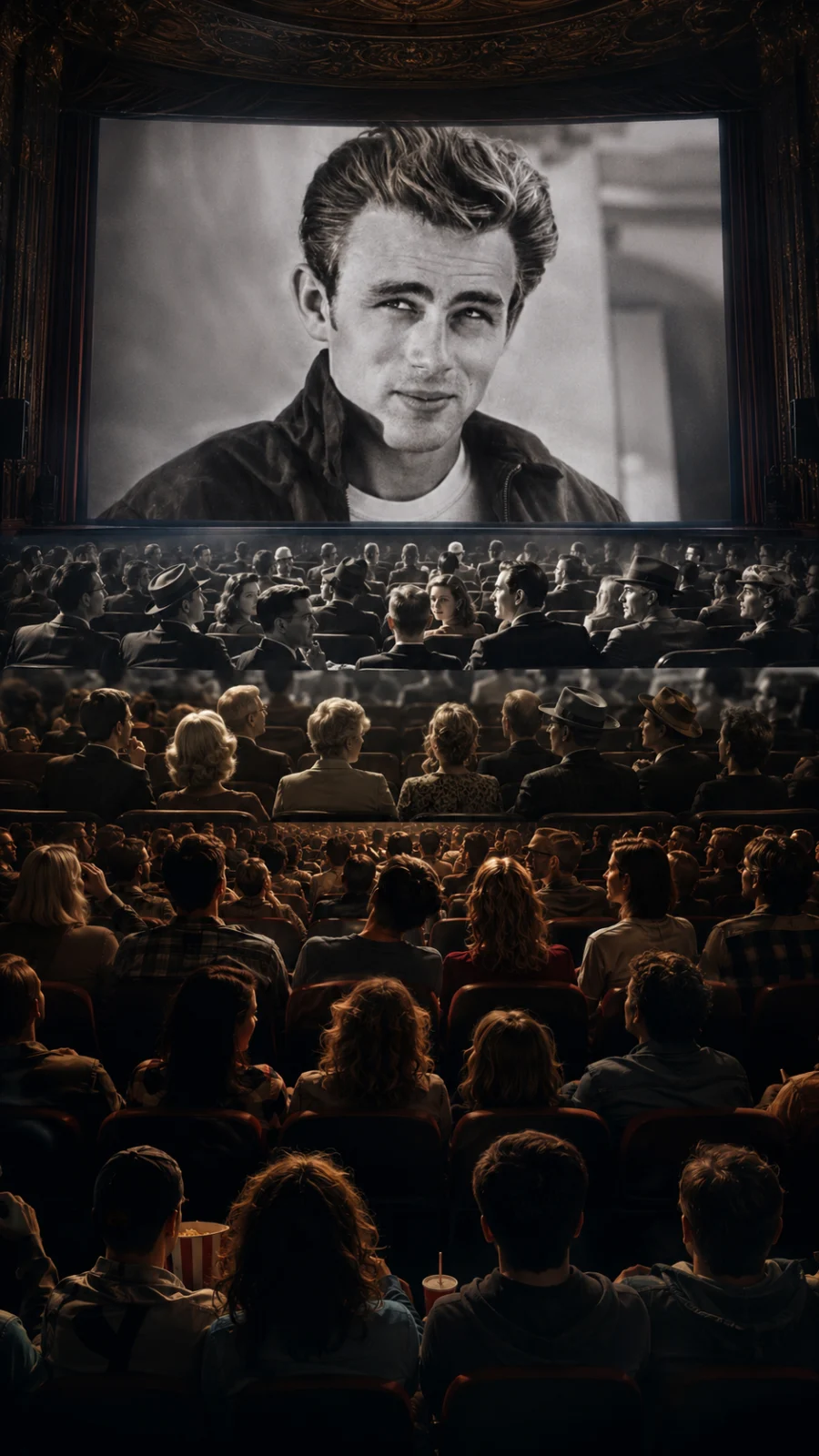
James Dean was not a fully established celebrity before he died. Only East of Eden had been released. His fame expanded dramatically when the remaining two films reached theaters and the public began consuming photographs, biographies, and objects associated with him (Cosgrove, 2014).
Death froze his image. He never portrayed a middle-aged man, experienced a period of professional failure, or had to adapt to a changing Hollywood. He remained forever the young man who seemed to need something he did not know how to request.
Reducing him to a red jacket, a destroyed automobile, and a phrase about living fast, however, also means forgetting his work.
Dean knew how to use silence, posture, and uncomfortable gestures to reveal what a character could not say. In only three films, he created three men seeking affection in different ways: Cal begs for it, Jim attempts to build it, and Jett decides to replace it with power.
His career was too brief to show how far he might have gone. It was intense enough, however, to create something even rarer: an actor who continued growing before the public after he was dead.
References
- Academy of Motion Picture Arts and Sciences. (1956). The 28th Academy Awards: 1956.
- Academy of Motion Picture Arts and Sciences. (1957). The 29th Academy Awards: 1957.
- Academy of Motion Picture Arts and Sciences. (2015). James Dean: Collection highlights.
- Cosgrove, B. (2014, September 30). What price fame: James Dean was “barely a celebrity” before he died. Time.
- Gehring, W. D. (2005). James Dean: Rebel with a cause. Indiana Historical Society Press.
- Indiana Historical Society. (2020, July 8). Jimmy and Marty on the town.
- Raskin, L. (2005). James Dean: At speed. David Bull Publishing.
More from this collection
Alain Delon: Cinema’s Most Beautiful Man Turned His Face Into a Threat
Read story →
Romy Schneider: The Actress Who Escaped a Princess and Lent Her Name to a Rebellion
Read story →