In this storyOpen index
Francisco de Goya: The Painter Who Heard the Noise of His Age After Becoming Deaf
From the royal court to the walls of the Quinta del Sordo: a life shaped by reason, war, and images nobody had commissioned.
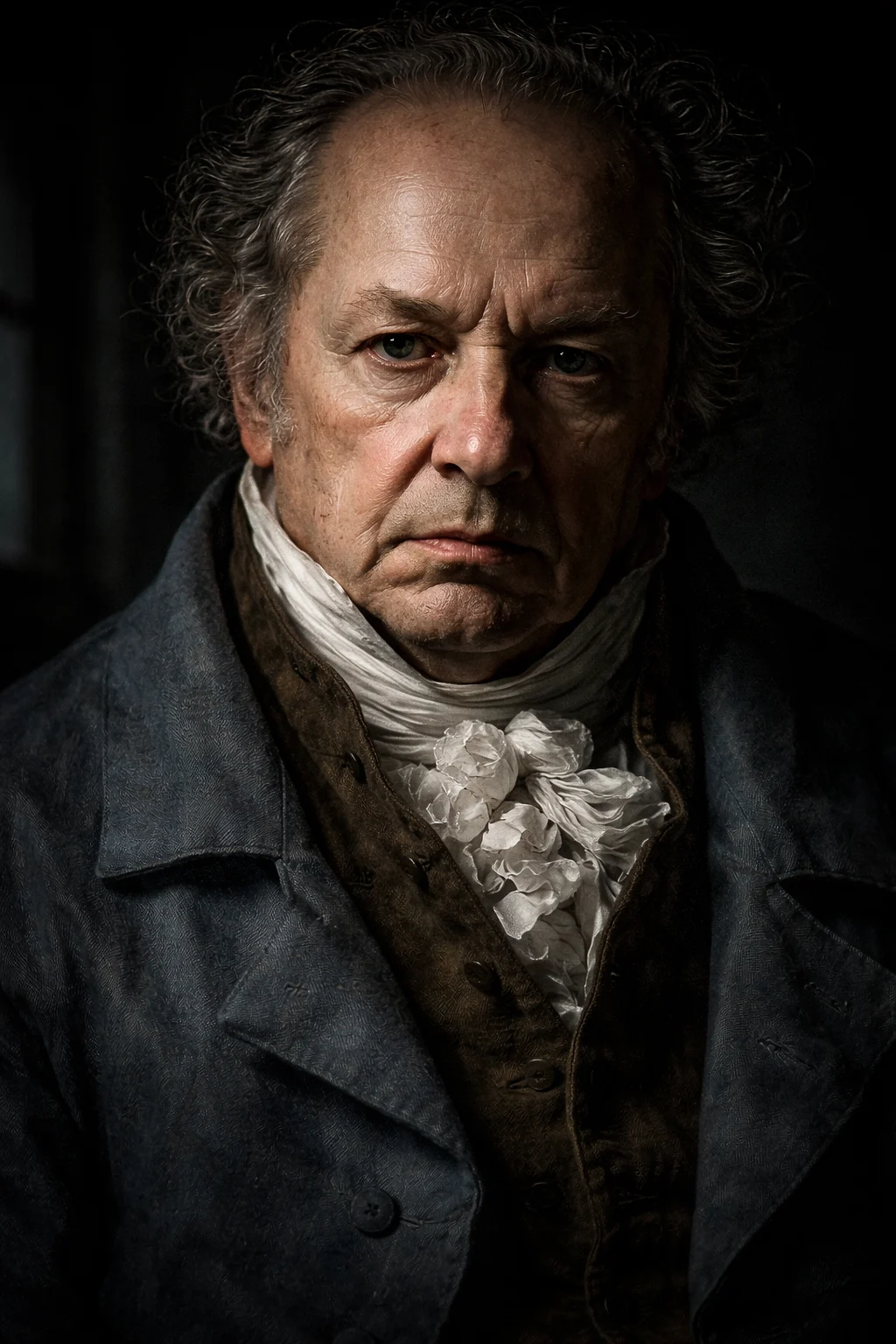
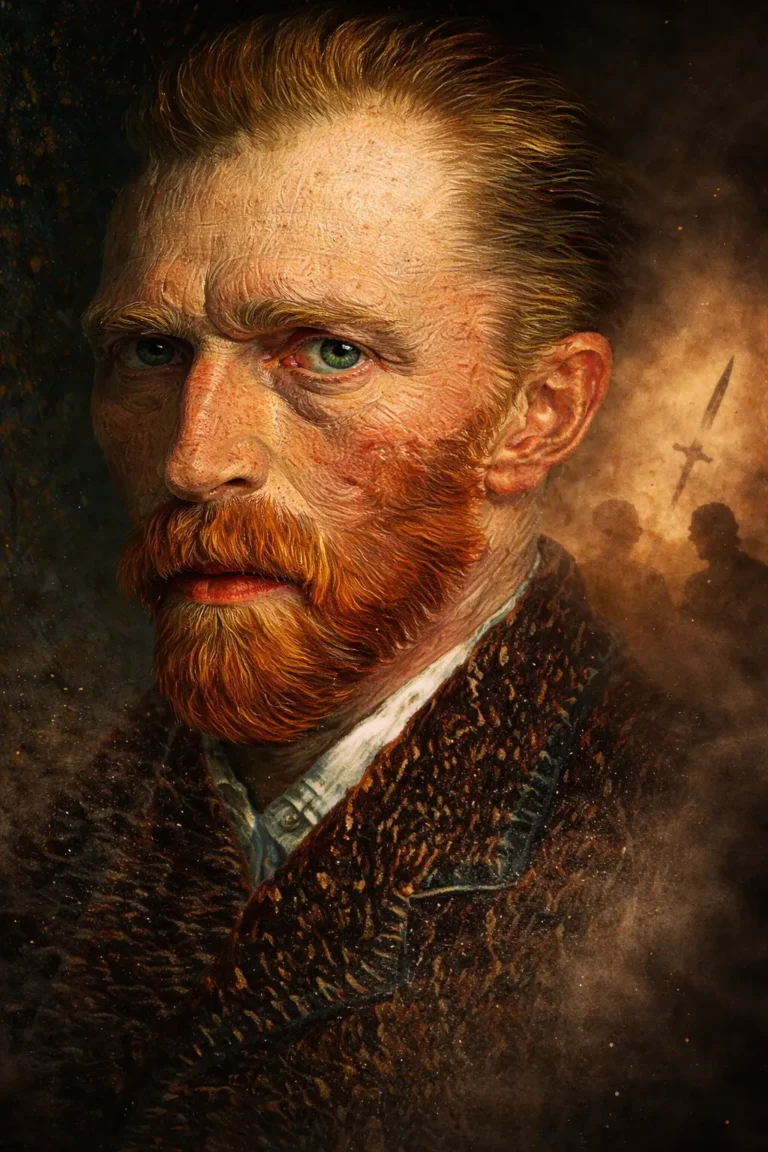
Francisco de Goya painted popular celebrations, royal families, firing squads, witches, and creatures that seemed to emerge from nightmares. He lived among palaces and wars, worked for rulers with opposing loyalties, and ended by covering the walls of his home with scenes he never intended to exhibit.
During the first half of his career, he learned to represent the world his patrons wanted to see. After an illness left him deaf, he also began painting what they preferred not to see.
He was not isolated from the beginning, nor was he a rebel who rejected every official honor. He sought prizes, commissions, and court recognition. He achieved a privileged position within the Spanish monarchy and portrayed the most powerful people of his time.
Yet the closer he came to power, the more clearly he observed its deformities.
Goya: Facing Horror
A Life Between the Court and Darkness
The Sleep of Reason Produces Monsters
Plate 43 of Los caprichos brings reason face to face with creatures of the imagination. Published in 1799 as part of a series of eighty prints, it preserves one of Goya’s central questions. The link opens the Prado catalogue; the displayed image is a reconstruction.
AI-generated visual reconstruction; not a historical document.
The Young Artist Who Lost Competitions Before Painting Kings
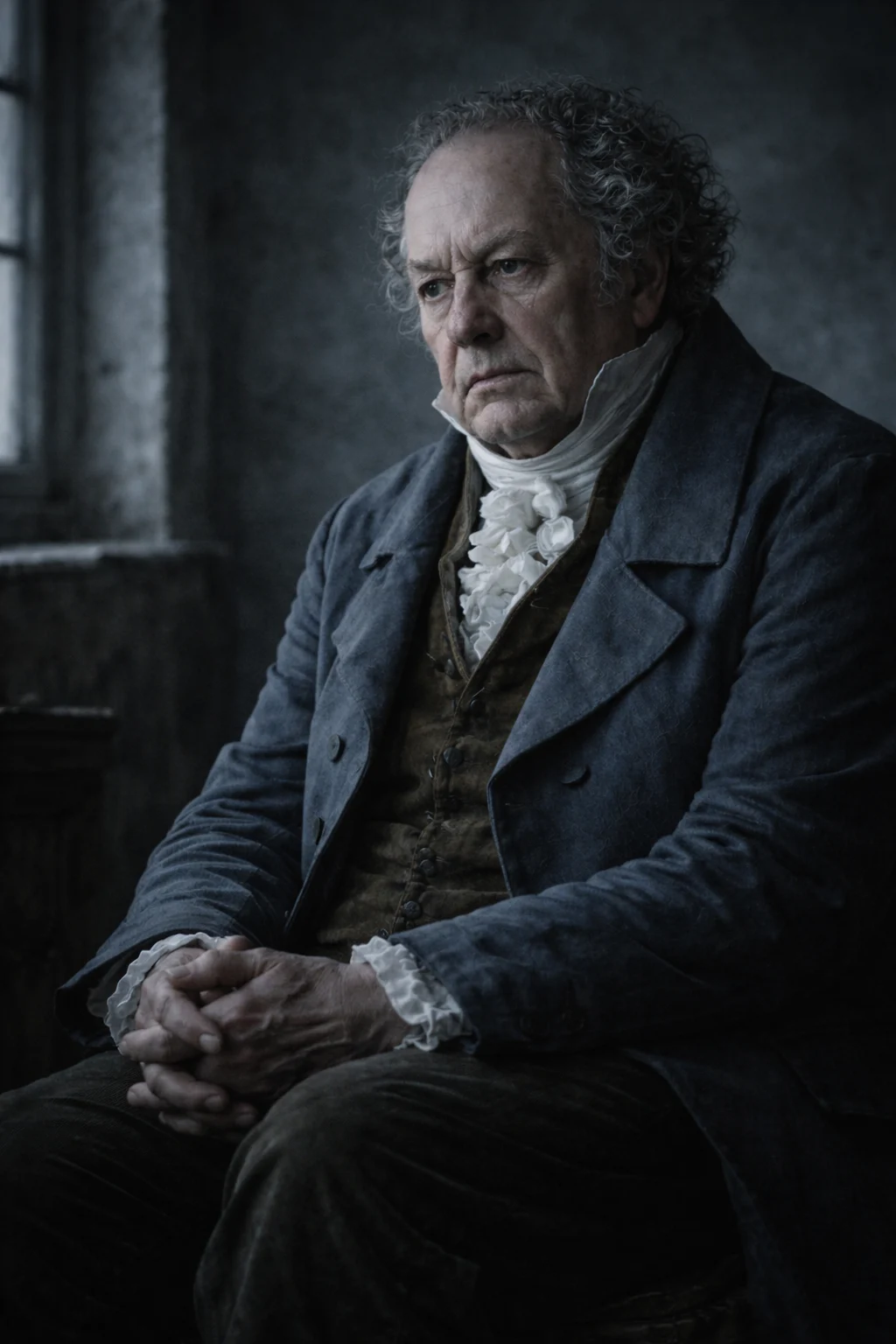
Francisco José de Goya y Lucientes was born on March 30, 1746, in Fuendetodos, a small town in Aragon. His father, José Goya, was a master gilder, while his mother, Gracia Lucientes, belonged to an impoverished minor-aristocratic family.
The family moved to Zaragoza, where Goya studied under José Luzán. He later attempted to gain recognition in Madrid, but his early academic ambitions ended in failure. He entered competitions at the Royal Academy of Fine Arts of San Fernando in 1763 and 1766 without receiving the prizes he sought (Tomlinson, 2020).
Those defeats contradict the image of a genius recognized from childhood. Goya had to construct his career gradually through travel, family connections, and commissions.
Around 1769, he traveled to Italy at his own expense. He studied ancient and modern art, entered a competition organized by the Academy of Parma, and returned to Zaragoza in 1771. There he received important religious commissions, including work for the Basilica of Our Lady of the Pillar.
In 1773, he married Josefa Bayeu, sister of the painters Francisco and Ramón Bayeu. That family connection helped him enter Madrid’s artistic establishment, although Goya would develop a language increasingly independent of his brothers-in-law (Museo Nacional del Prado, n.d.).
The Colors of a Spain Designed for the Palace
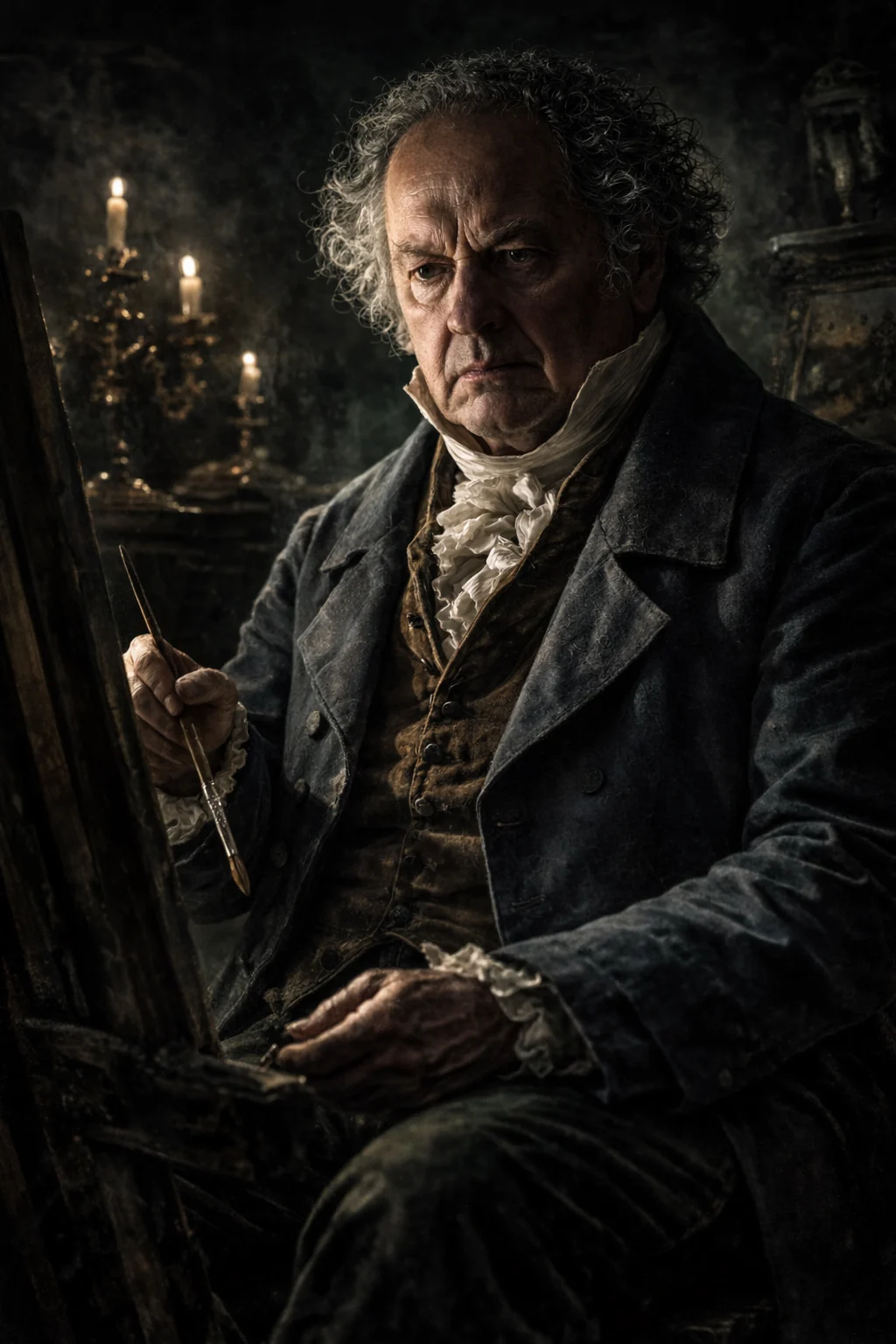
In 1775, Goya began working for the Royal Tapestry Factory of Santa Bárbara. His task was to prepare cartoons—full-sized paintings used as models for tapestries intended for royal residences.
He depicted picnics, games, dances, vendors, hunters, and scenes of popular life. Works such as The Parasol projected a bright and orderly vision of society. These images, however, were not simple documents of everyday life. They were carefully constructed representations designed for the court’s enjoyment.
The tapestry cartoons allowed Goya to master movement, color, and the observation of human types. They also taught him how to navigate a structure in which art depended upon officials, aristocrats, and royal decisions.
His rise was steady. He entered the Royal Academy of San Fernando in 1780, became painter to the king in 1786, court painter to Charles IV in 1789, and first court painter in 1799 (Bozal, 2005).
The son of a gilder from Fuendetodos had reached the center of power.
The Illness That Changed His Relationship With the World
Late in 1792, while staying in Andalusia, Goya suffered a severe illness. He experienced dizziness, balance problems, visual disturbances, weakness, and other symptoms whose cause remains disputed. Diagnoses including lead poisoning, autoimmune disease, infection, and neurological disorders have been proposed, but none can be conclusively established.
He survived but was left profoundly deaf.
Deafness did not instantly transform all his work, nor is there a perfect boundary between an earlier cheerful Goya and a later dark one. It nevertheless changed his daily experience. Conversation became difficult, his isolation increased, and he had to depend more heavily on gestures, writing, and visual observation (Hughes, 2003).
In 1793, he explained that he had produced small paintings in which “caprice and invention” could operate more freely than in commissioned work. His art began opening a private space where shipwrecks, fires, madness, violence, and fear could appear.
The painter had not stopped observing the world. He had begun distrusting its surface.
Los Caprichos: Monsters Born From Reason
In 1799, Goya published Los Caprichos, a series of eighty prints satirizing superstition, ignorance, marriages of convenience, educational abuse, prostitution, and social corruption.
Its best-known image, The Sleep of Reason Produces Monsters, shows a man asleep as nocturnal creatures gather around him. It is often interpreted as a simple condemnation of imagination. The work suggests a more complicated tension: reason left unguarded produces monsters, but imagination joined with reason can also create art.
Goya presented the series as a criticism of common errors and vices, carefully avoiding explicit accusations against named individuals. Even so, sales were halted shortly after publication. Fear of the Inquisition and possible retaliation probably influenced that decision.
In 1803, Goya gave the printing plates and remaining copies to the king in exchange for a pension for his son Javier. This was not necessarily artistic surrender. It was a survival strategy within a system where royal protection could prevent dangerous art from becoming evidence against its creator (Symmons, 2004).
Goya had discovered that an image could denounce power while simultaneously requiring its protection.
Painting the Family That Ruled Spain
Goya was an exceptional portraitist because he did not necessarily turn his sitters into caricatures, yet he refused to erase their vulnerability.
In The Family of Charles IV, painted in 1800–1801, members of the royal household appear surrounded by sumptuous fabrics, jewelry, and decorations. It has often been claimed that Goya deliberately portrayed them as grotesque or foolish. That interpretation is too simple.
The painting follows conventions of court portraiture and was accepted by the royal family. Goya displayed his sitters’ rank and placed Queen María Luisa in a central position. At the same time, his direct treatment of faces prevents ceremony from completely concealing individuality, age, and family tension (Tomlinson, 1992).
Goya did not need to deform the powerful. He only needed to let them remain recognizable.
A War Without Untarnished Heroes
In 1808, Napoleon’s forces occupied Spain and Joseph Bonaparte was installed as king. The Madrid uprising of May 2 and its repression the following day began a war marked by guerrilla violence, executions, starvation, and atrocities committed by multiple sides.
Goya remained in Madrid. He preserved his professional position under the Bonapartist administration and carried out official work while maintaining connections with Spaniards opposed to the occupation. His behavior has been interpreted in contradictory ways: collaboration, caution, liberalism, or simple survival.
The reality does not fit neatly into one label. Goya was a court employee, depended upon his income, and lived in a city controlled by changing authorities. When Ferdinand VII returned in 1814, Goya had to explain his behavior during the occupation but retained his position (Hughes, 2003).
That same year, he painted The Second of May 1808 in Madrid and The Third of May 1808 in Madrid. In the latter, a man in white opens his arms before a firing squad whose faces remain invisible. There is no military victory—only the moment before another death.
The painting does not present war as a noble composition. It portrays it as a mechanism that turns human beings into victims and executioners.
The Images He Chose Not to Publish
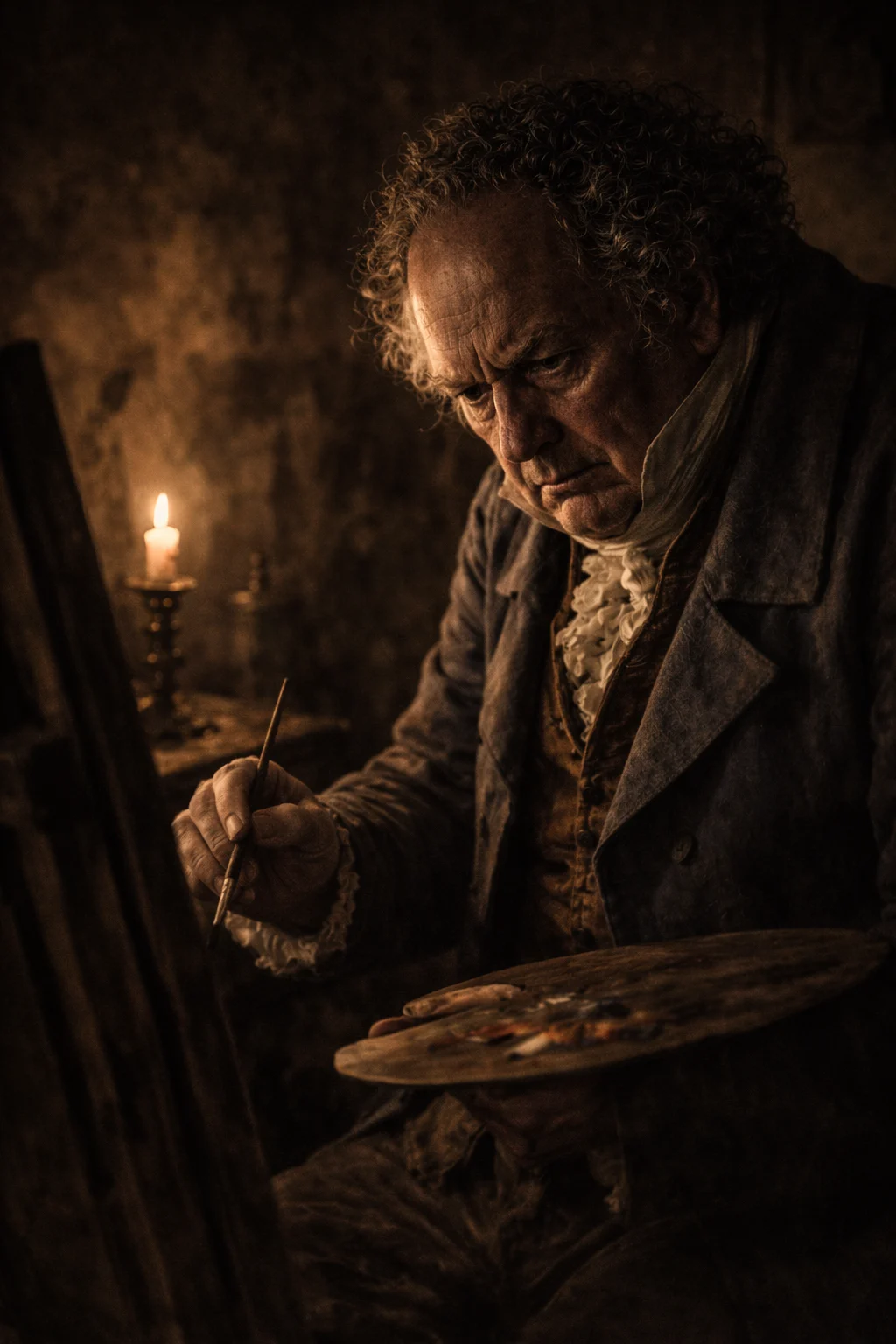
Between approximately 1810 and 1820, Goya worked on the prints later known as The Disasters of War. They show mutilated bodies, starvation, rape, executions, and people unable to help those suffering around them.
The images offer no comfortable division between innocent Spaniards and monstrous Frenchmen. Some condemn violence by Napoleon’s troops; others depict atrocities committed by Spanish combatants. The victim occupies the center, not the flag.
The brief captions—I Saw It, One Cannot Look, This Is Worse—create the voice of a witness refusing to beautify what occurred. Not every scene should be understood as a direct eyewitness record, but the series possesses the urgency of someone who knew war’s consequences.
Goya did not publish the prints. Their indictment of violence, hunger, and restored absolutism made them dangerous during the reign of Ferdinand VII. The first edition appeared in 1863, thirty-five years after his death (Metropolitan Museum of Art, 2003).
One of history’s most powerful visual denunciations of war remained largely hidden during its creator’s lifetime.
The King’s Return and the Failure of Hope
Ferdinand VII returned to Spain in 1814, abolished the liberal Constitution of 1812, restored absolutism, and persecuted liberals, reformers, and people associated with the previous government.
Goya officially retained the title of court painter, but his relationship with the royal household became less important. He continued producing portraits and religious commissions while his private art grew more difficult to interpret.
The Inquisition questioned him about The Nude Maja, an exceptionally daring painting because it depicted a naked woman without giving her a mythological identity that could justify the image. No definitive explanation from Goya survives, and the model’s identity cannot be established with certainty.
Goya’s Spain alternated between promises of reform and authoritarian restoration. During the Liberal Triennium beginning in 1820, the Constitution was temporarily restored. In 1823, French intervention returned absolute power to Ferdinand VII.
Goya had survived Charles III, Charles IV, Joseph Bonaparte, and Ferdinand VII. That survival does not prove that he lacked convictions. It demonstrates that he learned to protect them within a system where expressing them openly could be dangerous.
The House Whose Name Became a False Coincidence
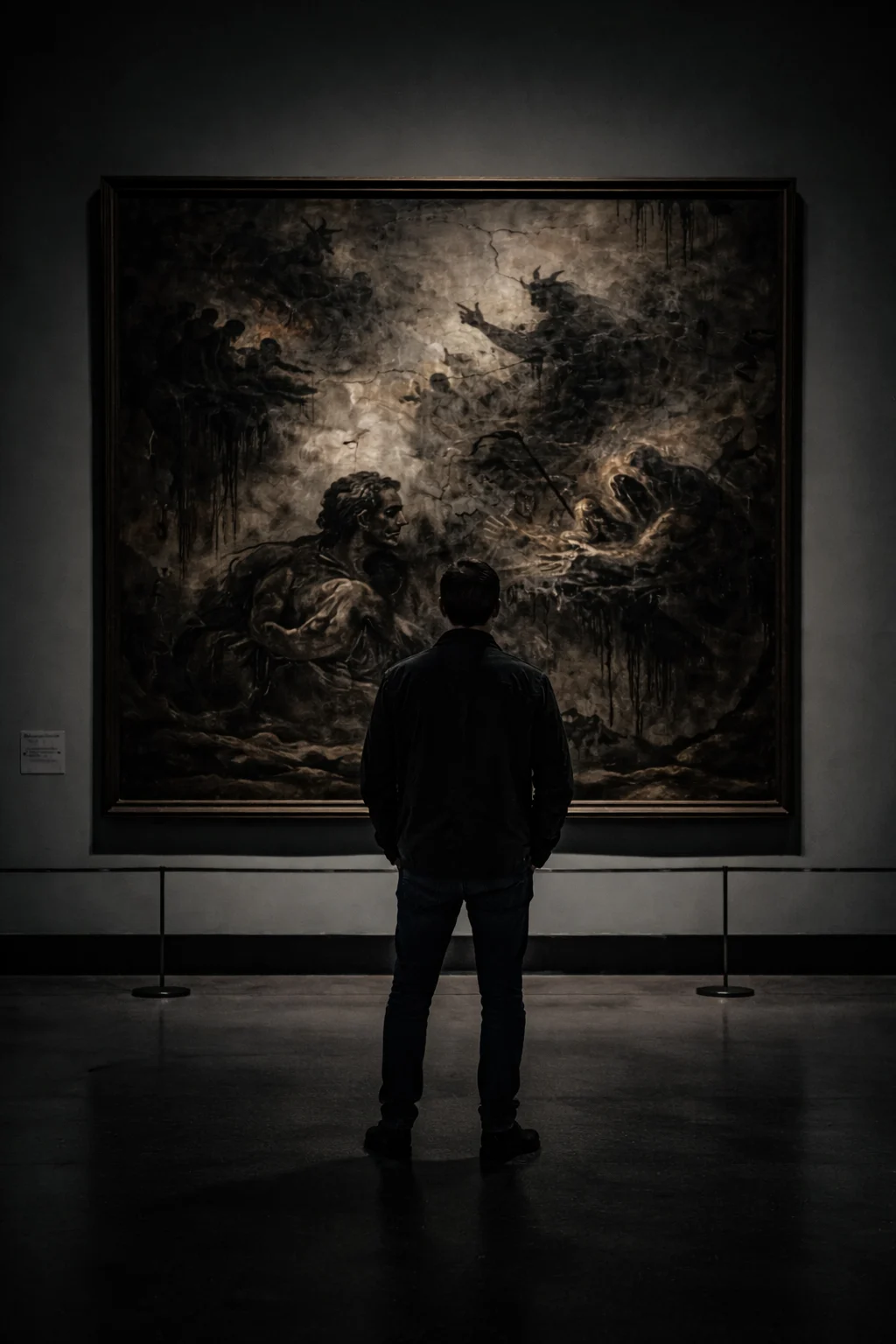
In 1819, Goya purchased a country property outside Madrid known as the Quinta del Sordo—the House of the Deaf Man. The name appears perfectly suited to a painter who had been unable to hear for more than two decades.
The estate, however, was not named after Goya. It was already called the Quinta del Sordo because its previous owner, Pedro Marcelino Blanco, was also deaf.
The coincidence sounds invented by a novelist: a deaf painter purchased a house named for another deaf man. Over time, the earlier owner disappeared from popular memory, and the name became associated exclusively with the artist.
On the walls of two rooms in that house, Goya painted in oils the fourteen scenes now known as the Black Paintings (Museo Nacional del Prado, n.d.).
They were not commissions. They were not created for a church, palace, or public exhibition. Goya lived surrounded by them.
The Black Paintings Did Not Have Their Modern Titles
Among the images were an old man consuming a body, figures gathered around a goat, two men confronting one another, and a dog whose head emerges beneath an almost empty space.
Today, they are known as Saturn Devouring His Son, Witches’ Sabbath, Fight With Cudgels, and The Dog. There is no evidence, however, that Goya assigned those titles. The names were established or consolidated later through inventories and subsequent interpretation.
Nor did he call the group the “Black Paintings.” The modern description refers both to their dark palette and to the disturbing nature of their subjects.
We cannot know with certainty what each scene meant to him. Treating them as a direct diary of depression or insanity reduces extremely complex works to a retrospective psychological diagnosis. They contain mythology, old age, violence, religion, politics, and grotesque humor.
The painting called Saturn may evoke the god devouring his children, time destroying everything it creates, political power consuming its subjects, or a private anxiety that can no longer be reconstructed.
Goya left no guide. He painted the questions directly onto the walls.
The Works We No Longer See Exactly as He Painted Them
The Black Paintings were not created on transportable canvases. They formed part of the plastered walls of the Quinta del Sordo.
Decades after Goya’s death, Baron Frédéric Émile d’Erlanger acquired the property and commissioned Salvador Martínez Cubells to transfer the murals to canvas. The operation, conducted during the 1870s, preserved them but also resulted in alterations and losses.
Photographs taken before the transfer reveal differences from the works as they appear today. Certain areas were cropped, details changed, and surfaces suffered during removal. The paintings were exhibited in Paris in 1878 but failed to achieve the hoped-for commercial success. In 1881, the baron donated them to the Spanish state, and they entered the Prado Museum (Museo Nacional del Prado, n.d.).
The Black Paintings we see today are therefore Goya’s works, but they are also objects that survived a complicated material transformation. They were removed from the house to prevent their disappearance, and in the process they ceased to be exactly the walls that had surrounded the painter.
Bordeaux and the Old Man Who Continued Learning
In 1824, Goya obtained permission to travel to France for reasons of health. He settled primarily in Bordeaux, where he lived with Leocadia Zorrilla and her daughter, Rosario Weiss.
He did not stop working. He experimented with lithography and produced The Bulls of Bordeaux, images of remarkable energy created when he was nearly eighty. He also continued drawing old people, crowds, and scenes from everyday life.
Goya is often associated with a drawing of a very old man walking with the aid of sticks beneath the words “I am still learning.” Although its dating and circumstances have generated debate, the phrase convincingly summarizes the artist’s final years.
Goya briefly returned to Madrid but went back to Bordeaux. He died there on April 16, 1828, at the age of eighty-two.
His body was buried in France and later transferred to Madrid. When the remains were exhumed, the skull was missing. What happened to it has never been established with certainty.
Even his body became a mystery.
The Fire That Never Went Out
Goya was not merely the last great painter of a courtly tradition or the first modern artist. He was both, and much more.
He painted for the monarchy without ceasing to observe its weaknesses. He condemned French violence without transforming Spaniards into flawless heroes. He defended reason while filling his images with witches, demons, and nocturnal creatures. He achieved official honors yet reserved some of his most radical works for closed portfolios and private walls.
His deafness separated him from sound, not from the world. He continued looking with an intensity capable of turning a celebration into social observation, a portrait into revelation, and a war into accusation.
Other painters represented the victories of their age. Goya painted what remained after the speeches ended: corpses, starvation, terror, and human beings attempting to understand why reason had once again produced monsters.
He burned within because he never found a final answer. He continued painting because looking was his way of refusing to let horror disappear.
References
- Bozal, V. (2005). Francisco Goya: Vida y obra. Tf Editores.
- Glendinning, N. (1977). Goya and his critics. Yale University Press.
- Hughes, R. (2003). Goya. Alfred A. Knopf.
- Metropolitan Museum of Art. (2003). Francisco de Goya (1746–1828) and the Spanish Enlightenment. The Metropolitan Museum of Art.
- Museo Nacional del Prado. (n.d.). Francisco de Goya y Lucientes. Museo Nacional del Prado Collection.
- Museo Nacional del Prado. (n.d.). Pinturas negras. Museo Nacional del Prado Encyclopedia.
- Symmons, S. (2004). Goya: A life in letters. Pimlico.
- Tomlinson, J. A. (1992). Goya in the twilight of Enlightenment. Yale University Press.
- Tomlinson, J. A. (2020). Goya: A portrait of the artist. Princeton University Press.
More from this collection
Egon Schiele: The Painter Who Watched a Judge Burn His Drawing
Read story →
Caravaggio: The Knight Expelled Before His Own Masterpiece
Read story →