In this storyOpen index
Hypatia of Alexandria: The Mathematician Whose Authority Became Dangerous
Hypatia of Alexandria was not murdered for discovering that Earth revolved around the Sun or for defending a burning library. Nor did she invent the astrolabe, as is still frequently claimed. Her real story is less simple and, for that reason, more disturbing.

Hypatia of Alexandria was not murdered for discovering that Earth revolved around the Sun or for defending a burning library. Nor did she invent the astrolabe, as is still frequently claimed. Her real story is less simple and, for that reason, more disturbing.
She was a mathematician, astronomer, and philosopher in a city divided by religious and political conflict. She taught pagans and Christians, advised powerful men, and achieved a degree of public authority exceptional for a woman in antiquity. That influence eventually placed her at the center of a struggle between the imperial prefect Orestes and Cyril, bishop of Alexandria.
In March 415, a Christian mob pulled her from her carriage and killed her. No surviving evidence proves that Cyril personally ordered the murder, but a Christian source writing close to the events stated that her death brought shame upon both the bishop and the Alexandrian church (Socrates Scholasticus, ca. 439/1892).
Hypatia died not because her knowledge was secret, but because knowledge had given her something even more dangerous: influence.
Hypatia: Knowledge and Power in Alexandria
A Life Told Through Numbers and Power
Synesius’s letter
Synesius asked his former teacher to have an instrument made to measure the density of liquids. The image is a reconstruction, not the original manuscript.
AI-generated visual reconstruction; not a historical document.
A Life Reconstructed from Fragments

Hypatia’s year of birth is uncertain. Modern estimates generally place it between approximately 350 and 370. The earlier date would make her around sixty when she died; the later one would make her approximately forty-five.
This uncertainty matters because later art and literature often portrayed her as a beautiful young woman sacrificed at the height of her youth. Ancient sources praised her appearance and dignity, but they do not allow us to determine her age precisely (Dzielska, 1995).
She was the daughter of Theon of Alexandria, a mathematician and astronomer known for his commentaries on the works of Euclid and Claudius Ptolemy. Theon participated in preserving, explaining, and teaching fundamental scientific texts. Hypatia therefore grew up in an environment where mathematics involved more than producing new theorems. It also meant comparing manuscripts, correcting errors, clarifying demonstrations, and preparing texts for new generations.
We know nothing about her mother and possess no autobiographical writings. Almost everything known about Hypatia comes from contemporaries or later authors, particularly the letters of her student Synesius of Cyrene, the Ecclesiastical History of Socrates Scholasticus, and accounts by Damascius and John of Nikiu.
These sources are not neutral. They were written from different philosophical, religious, and political positions. Reconstructing Hypatia requires comparing where they agree and remaining cautious about their exaggerations.
Teaching People to See the Universe Through Numbers
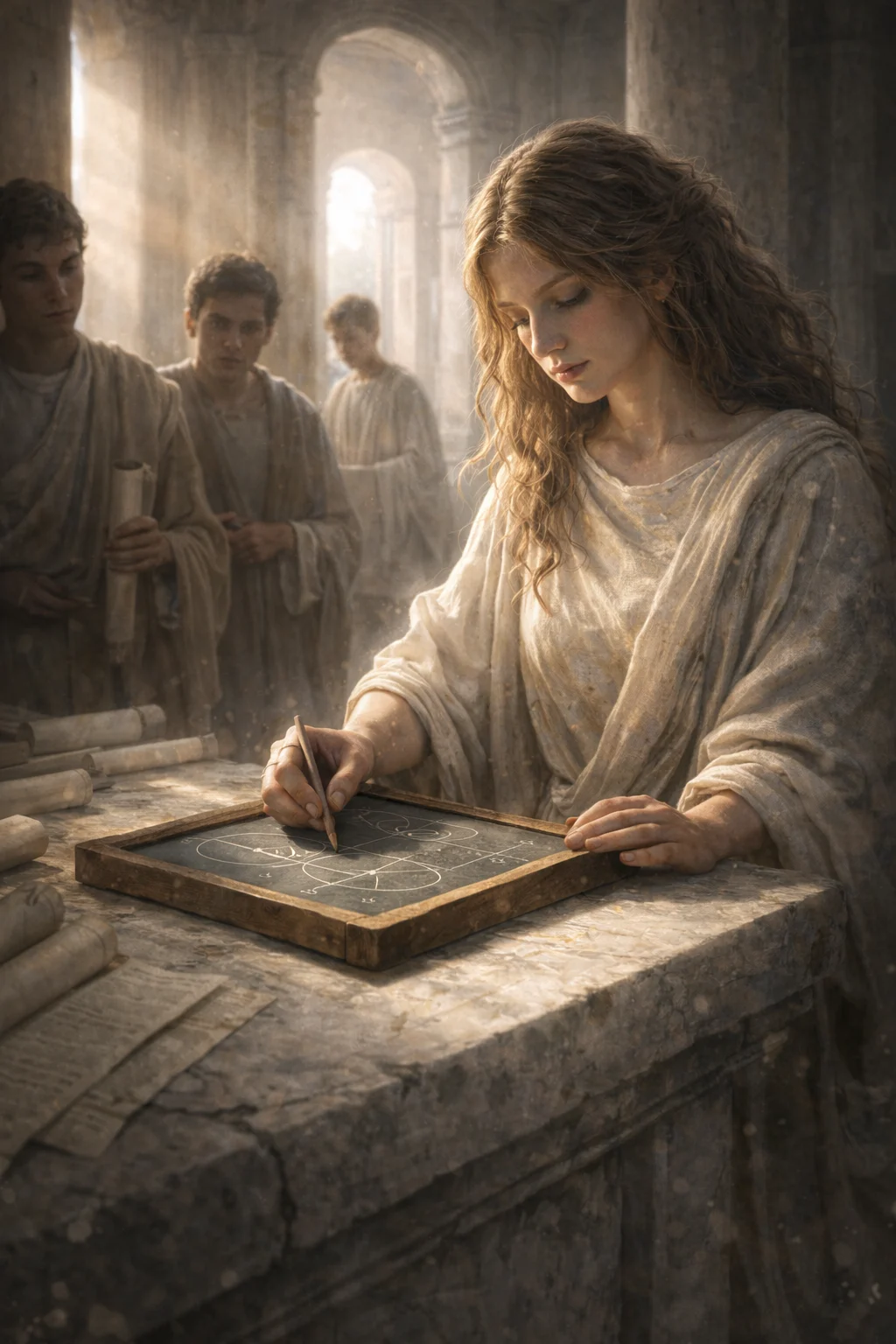
Hypatia taught mathematics, astronomy, and Neoplatonic philosophy. Neoplatonism understood reality as a hierarchy proceeding from a supreme principle, the One, and treated philosophy as a path toward intellectual purification.
For her students, mathematics was not separate from spiritual questions. Geometry, arithmetic, and the movement of celestial bodies trained the mind to recognize an order transcending the material world.
Socrates Scholasticus wrote that Hypatia surpassed the philosophers of her time and that people traveled from distant places to hear her. He also reported that she appeared publicly before magistrates with the dignity and confidence for which she was respected (Socrates Scholasticus, ca. 439/1892).
Some sources portray her wearing a philosopher’s cloak and publicly explaining the works of Plato and Aristotle. Her school probably did not resemble a modern university with dedicated buildings and formal enrollment. It likely combined public instruction with a more intimate circle of students from prosperous and influential families (Watts, 2017).
The Books That Did Not Survive Under Her Name

No complete work by Hypatia survives. Later writers attributed to her commentaries on Diophantus’s Arithmetica, Apollonius’s Conics, and an astronomical work commonly called the Astronomical Canon.
An ancient mathematical commentary was not merely a summary. It could reorganize a text, supply omitted steps, provide alternative demonstrations, correct errors, and add examples to make the work easier to teach.
Some scholars have suggested that portions of the surviving textual traditions of Diophantus or Apollonius may preserve Hypatia’s interventions. Yet identifying her exact contributions within manuscripts copied and altered over many centuries is extremely difficult (Deakin, 2007).
Hypatia has also been associated with an edition of her father’s commentary on Book III of Ptolemy’s Almagest. A manuscript note refers to a version revised by “the philosopher Hypatia, my daughter,” although scholars debate the precise extent of that collaboration.
Her importance should not be measured exclusively through discoveries that can be attached to a particular formula. Hypatia belonged to a tradition in which preserving knowledge and making it understandable were themselves essential forms of scientific creation.
The Astrolabe She Did Not Invent

Synesius of Cyrene, one of her best-known students, continued corresponding with Hypatia after leaving Alexandria. He eventually became the Christian bishop of Ptolemais, demonstrating that a pagan philosopher’s school could include Christian students without requiring them to abandon their faith.
In his writings, Synesius described an astrolabe built using knowledge associated with his philosophical education. He also wrote to Hypatia asking her to have a hydroscope or hydrometer made for him, an instrument used to measure properties of liquids (Synesius of Cyrene, ca. 400/2020).
These references demonstrate that Hypatia understood such instruments and could supervise their construction. They do not prove that she invented them. The astrolabe had Hellenistic precedents dating from before her birth, while instruments used to measure liquid density also existed earlier.
Crediting her with their invention may appear complimentary, but it ultimately weakens her history. Hypatia does not need false achievements. Teaching, refining, or explaining scientific instruments during the fourth century was already an extraordinary contribution.
A Woman with Public Authority

Synesius addressed his former teacher with profound respect and requested her advice on personal and intellectual matters. In one letter, he called her his mother, sister, and teacher. Other students later occupied positions within the imperial administration or the church.
This network made Hypatia more than an instructor. She could connect members of Alexandria’s elite and influence public affairs.
Writing more than a century later, Damascius stated that Hypatia appeared before the city’s rulers and was respected by all for her judgment. Although his account contains literary elements and must be handled cautiously, it agrees with Socrates Scholasticus in depicting a woman visible within the spaces of power (Dzielska, 1995).
Her authority crossed several boundaries simultaneously. She was a woman speaking publicly, a pagan respected by Christians, and an intellectual maintaining direct relationships with senior officials.
As long as Alexandria preserved a degree of balance among rival groups, her position could function as a bridge. Once that balance collapsed, it made her suspicious to those who needed a human obstacle.
She Was Not Alexandria’s Last Librarian
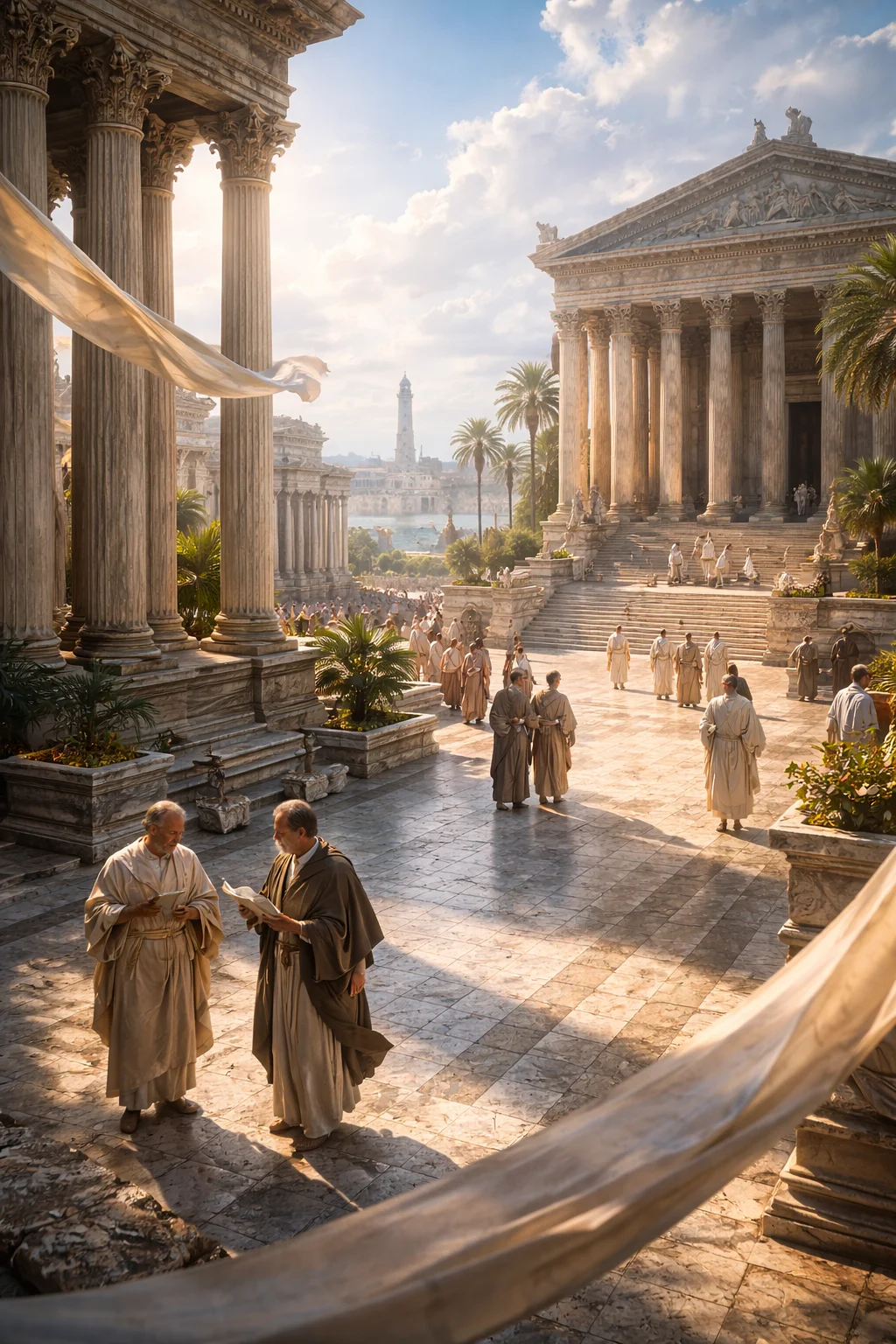
One of the most popular images presents Hypatia as director of the Great Library of Alexandria or as its final librarian. No ancient evidence supports this claim.
The famous library associated with Alexandria’s Mouseion had suffered losses and transformations long before Hypatia’s birth. Another collection connected with the temple of Serapis may have survived longer, but the Serapeum was destroyed in 391 following conflict between pagan and Christian groups.
There is no evidence that Hypatia directed that library, worked within it, or died attempting to save its scrolls. By the time of her murder, approximately twenty-four years had passed since the destruction of the Serapeum (Watts, 2017).
The confusion arose because Hypatia belonged to Alexandria’s intellectual culture and participated in the transmission of scientific texts. Turning her into the guardian of a burning library, however, combines separate events and replaces history with a symbolic scene.
The real loss was different: her death eliminated a teacher capable of sustaining a community of learning in an increasingly polarized city.
A City Where Religion and Power Could Not Be Separated

Alexandria was one of the great cities of the Eastern Roman Empire. Christian, Jewish, and pagan communities lived there, but coexistence was repeatedly interrupted by violence.
In 412, Cyril became bishop of Alexandria. The episcopal office was not merely religious. It provided social influence, economic resources, and the ability to mobilize urban groups.
The principal representative of imperial authority in the city was the prefect Orestes, a Christian responsible for civil administration. Cyril and Orestes entered into conflict over the boundaries of their respective powers.
Tensions intensified after disturbances between Christian and Jewish residents. Cyril acted against the Jewish community, while Orestes rejected what he regarded as an invasion of his jurisdiction. A group of monks later attacked the prefect. One of them, Ammonius, struck him with a stone and subsequently died after being arrested and tortured.
Hypatia maintained a close relationship with Orestes. Her prestige and access to the prefect led to a rumor that she was preventing a reconciliation between the two men (Socrates Scholasticus, ca. 439/1892).
The accusation did not need to be proven. In a city governed by rivalry, it only needed to be useful.
The Murder
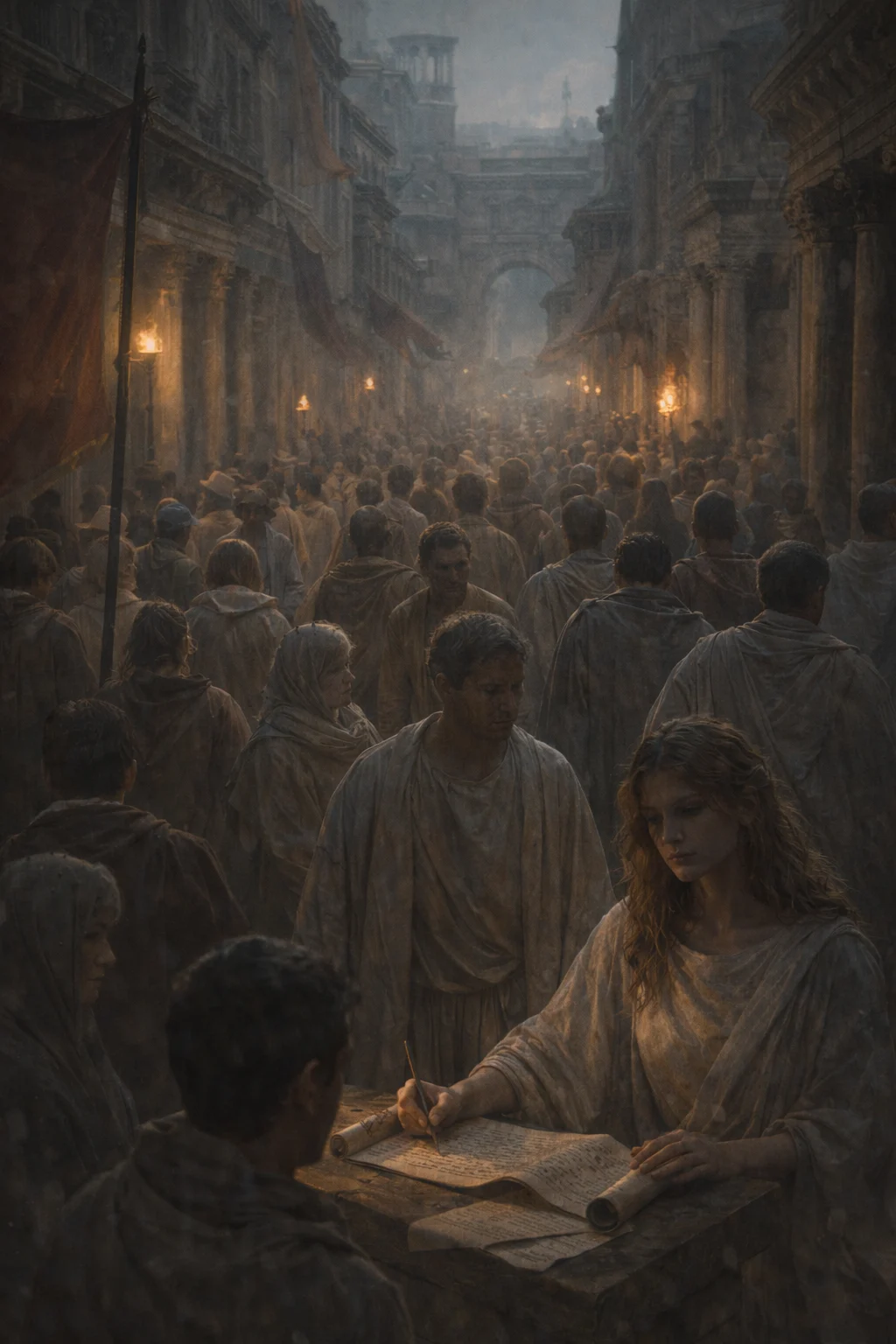
In March 415, a group of Christians led by a lector named Peter intercepted Hypatia’s carriage. They dragged her into a building called the Caesareum, which was then being used as a church.
There they stripped and killed her with hard fragments described by the Greek source as ostraka. The term can mean pieces of pottery, roof tiles, or similar materials; the popular image of sharpened oyster shells is not the only possible translation. Her body was then dismembered, and the remains were burned outside the city (Socrates Scholasticus, ca. 439/1892).
Socrates Scholasticus was himself a Christian. He did not present the murder as a victory for his faith but as an act incompatible with Christianity that brought disgrace upon Cyril and the Alexandrian church.
No surviving evidence proves that Cyril directly ordered the killing. It is equally unconvincing, however, to separate him completely from the environment that made it possible. Hypatia had been transformed into an enemy within a conflict in which Cyril’s episcopal power was one of the central forces.
Historical responsibility must be expressed precisely: we know that her attackers were a Christian mob shaped by the city’s political and religious climate; we know that hostility had been directed against her; but we do not possess a document proving a personal order from the bishop.
Was She Killed for Being a Scientist?
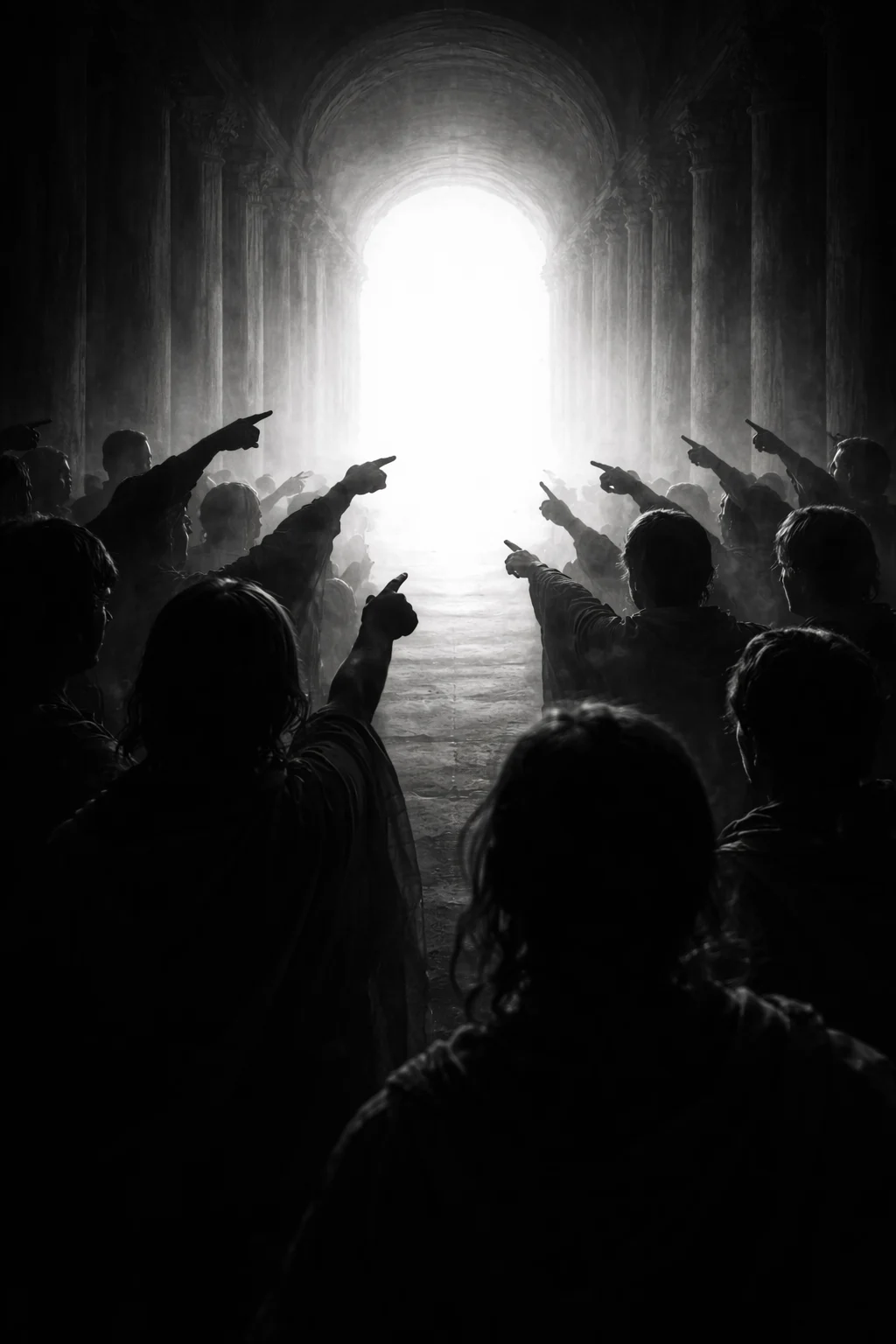
The statement that “the church killed Hypatia because she taught that Earth orbited the Sun” is not supported by historical evidence.
There is no evidence that she defended a heliocentric model. Her astronomical work operated primarily within the tradition of Ptolemy, whose system placed Earth at the center of the cosmos.
Nor was she attacked simply for practicing mathematics. She had taught for years, counted Christians among her students, and was admired by the Christian historian who described her death.
Yet it would be equally mistaken to claim that her intellectual identity was irrelevant. Her position as a pagan philosopher, independent woman, and public adviser made it easier for opponents to portray her as dangerous. Later hostile authors even accused her of magic and satanic deception.
Hypatia did not die in an abstract war between “science” and “religion.” She died when religious intolerance, political rivalry, misogyny, and the struggle to control Alexandria converged upon one highly visible individual.
The more complex explanation does not diminish the crime. It explains how it became possible.
The Woman Posterity Turned into a Symbol
For centuries, different groups reconstructed Hypatia according to their own needs. Some Christian writers attempted to justify or minimize her murder. Enlightenment authors transformed her into a martyr of reason confronting fanaticism. Nineteenth-century poets and painters depicted her as a sensual young woman threatened by a brutal mob.
In modern times, she has become a symbol of women in science, intellectual freedom, and resistance to religious extremism. These meanings have value, but they can conceal the historical person behind them.
The documented Hypatia was not a modern research scientist or a revolutionary opposed to every Christian. She was a Neoplatonic philosopher from an intellectual elite, a teacher of Christians and pagans, a commentator on mathematical texts, and a respected participant in the public life of a late Roman city.
That reality is precisely what makes her career exceptional. She did not need to serve as the imaginary director of the Library of Alexandria to challenge the expectations of her age.
Knowledge as a Form of Power
We do not know exactly how much of the surviving mathematical tradition passed through Hypatia’s hands. Nor can we reconstruct all her lectures or hear her own voice. Her works disappeared or were absorbed into later manuscript traditions.
The letters of her students nevertheless reveal that her teaching inspired loyalty, respect, and an intellectual community capable of crossing religious boundaries. Her career proves that a woman could achieve scientific and philosophical authority in antiquity, even though that authority remained vulnerable to profoundly political violence.
Her murder did not end mathematics in Alexandria or immediately destroy all ancient philosophy. Other scholars continued working after 415. Presenting her as “the last scientist of the ancient world” once again simplifies a long and complicated history.
What ended was a particular life and a particular kind of influence: that of a teacher who could enter the spaces of government without surrendering her philosophical identity.
Hypatia was not dangerous because she possessed a forbidden formula. She was dangerous because people listened to her.
And when a society decides that thinking, teaching, and advising have given too much power to the wrong person, even mathematics can become the center of a battle.
References
- Deakin, M. A. B. (2007). Hypatia of Alexandria: Mathematician and martyr. Prometheus Books.
- Dzielska, M. (1995). Hypatia of Alexandria (F. Lyra, Trans.). Harvard University Press.
- Socrates Scholasticus. (1892). The ecclesiastical history of Socrates Scholasticus (A. C. Zenos, Trans.). In P. Schaff & H. Wace (Eds.), Nicene and post-Nicene fathers, Second Series (Vol. 2). Christian Literature Publishing Co. (Original work written ca. 439). https://www.newadvent.org/fathers/26017.htm
- Synesius of Cyrene. (2020). Letter 15: To the philosopher. Livius.org. (Original letter written ca. 400). https://www.livius.org/sources/content/synesius/synesius-letter-015/
- Watts, E. J. (2017). Hypatia: The life and legend of an ancient philosopher. Oxford University Press.
More from this collection

Emmy Noether: The Woman Who Found the Laws Hidden Behind Symmetry
Read story →
Georg Cantor: The Man Who Discovered That Some Infinities Are Larger Than Others
Read story →