In this storyOpen index
Galileo Galilei: The Man Who Pointed a Military Instrument at the Sky
He did not invent the telescope, but he turned a military instrument into evidence capable of transforming humanity’s view of the universe.
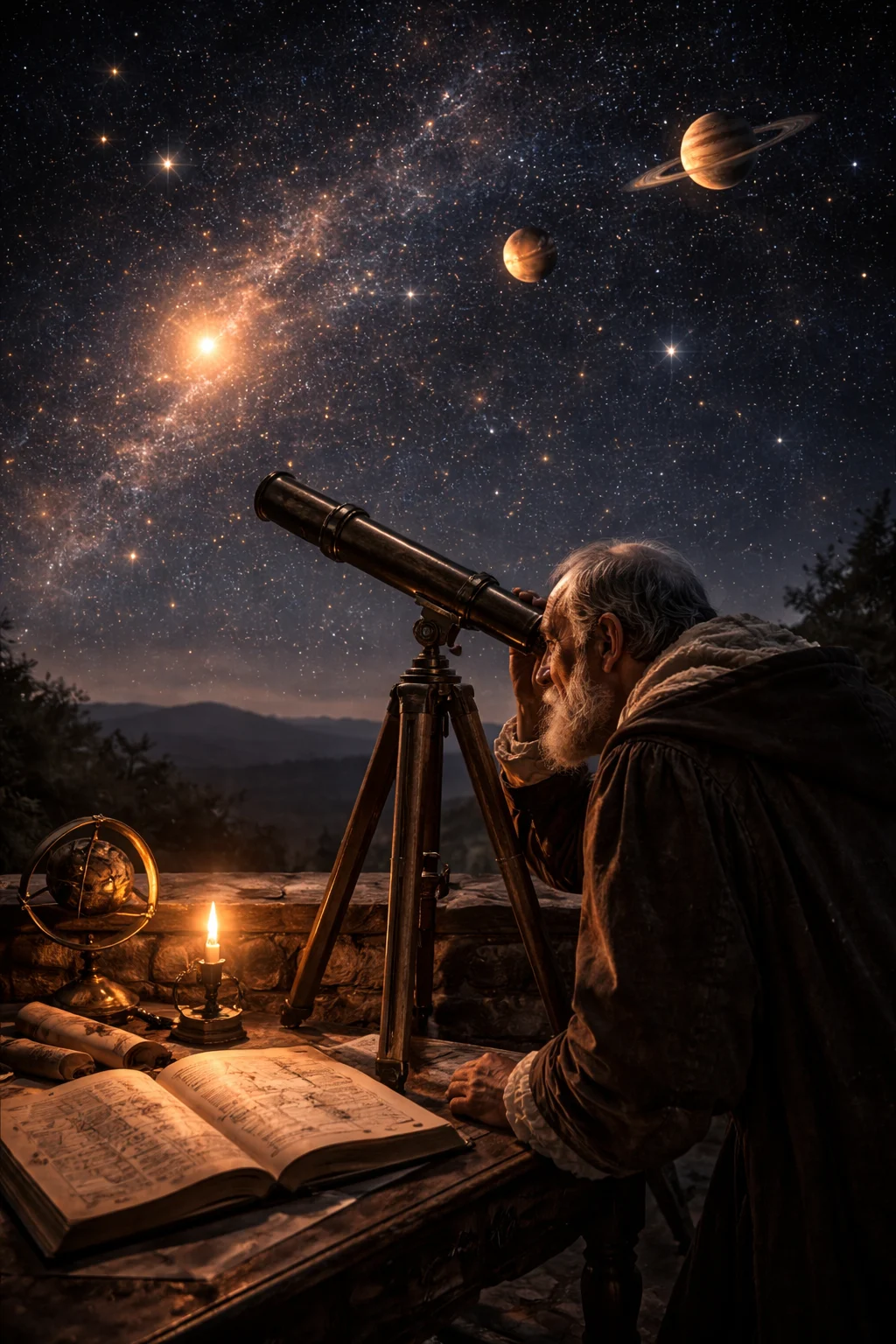
The instrument that transformed humanity’s vision of the universe was
not originally created to study the stars. It had been designed to spot
ships, recognize armies, and observe distant objects from solid ground.
Galileo Galilei did not invent the telescope, but he understood
something others had not yet seen: if that tube could reveal what lay
farther away on Earth, it might also uncover what the sky concealed.
When he directed it toward the Moon, he discovered that it was not a
perfect sphere. When he observed Jupiter, he found four bodies that did
not revolve around Earth. When he studied the Milky Way, he confirmed
that its pale glow consisted of countless stars invisible to the unaided
eye.
Galileo did more than observe a different sky. He demonstrated that
instruments could extend the human senses and that an ancient authority
could be mistaken when confronted by something anyone, with the proper
device, could learn to see.
Galileo Galilei on video
Discover this story on our YouTube channel.
A life told through places and decisive moments
Enter the archive
Museo Galileo preserves the objective lens associated with the observations of 1609–1610 and the discovery of Jupiter’s four satellites.
- Collection
- Galileo’s instruments
- Institution
- Museo Galileo
Institutional record from Museo Galileo, Florence.
The student who abandoned
medicine
Galileo was born in Pisa on February 15, 1564. His father, Vincenzo
Galilei, was a musician, composer, and musical theorist. He also
questioned traditional explanations of harmony and used experiments with
strings to study the relationship between tension, length, and sound.
That combination of music, mathematics, and suspicion toward
intellectual authority profoundly influenced his son (Heilbron,
2010).
In 1581, Galileo entered the University of Pisa to study medicine.
The profession could provide financial stability, an important
consideration for a family with limited resources. He became
increasingly interested in mathematics and natural philosophy, however,
and eventually left the university without receiving a degree.
He later obtained positions teaching mathematics in Pisa and, in
1592, at the University of Padua. There he taught geometry, astronomy,
and mechanics for eighteen years. He also designed instruments, offered
private lessons, and manufactured a geometric and military compass that
could perform calculations involving artillery, fortifications,
currency, and proportions (Drake, 1978).
The image of Galileo dropping objects from the Leaning Tower of Pisa
to demonstrate that they fell independently of their weight became
famous. The story, however, comes mainly from a biography written
decades later by his student Vincenzo Viviani. Although Galileo
certainly investigated falling bodies, it cannot be established that he
performed that public experiment from the tower (Heilbron, 2010).

The
little-known fact: he did not invent the telescope
In 1608, reports began circulating in the Netherlands about an
instrument made from lenses that allowed distant objects to appear
closer. Spectacle maker Hans Lipperhey applied for a patent, although he
was not the only craftsman connected with its invention. The optical
principle quickly spread through Europe (Van Helden, 1977).
Galileo heard about the device in 1609. Initially without having seen
one of the Dutch models, he experimented with combinations of lenses and
constructed his own version. The earliest examples provided little
magnification, but he continued working until he could produce much more
powerful and stable instruments.
In August 1609, he demonstrated one to the authorities of the
Venetian Republic. From a tower, senators could observe ships that were
still too distant to distinguish with the unaided eye. Its military and
commercial value was obvious: an approaching fleet could be detected
before it reached the harbor (Biagioli, 1993).
The demonstration improved Galileo’s professional position and helped
increase his salary. He soon discovered, however, that other
manufacturers could also produce telescopes. His true revolution would
not come from selling the instrument but from changing the direction in
which it pointed.
A Moon covered with
mountains
During the final months of 1609, Galileo began systematically
observing the sky. When he pointed the telescope toward the Moon, he saw
shadows and illuminated regions that changed according to the Sun’s
position. He concluded that its surface contained mountains,
depressions, and irregular terrain (Galilei, 1610/1989).
That observation challenged a fundamental principle of Aristotelian
cosmology. According to the traditional model, the heavens consisted of
perfect and incorruptible matter, different from the terrestrial world
of change and imperfection. A rugged Moon suggested that celestial
bodies were not completely unlike Earth.
Galileo used shadows to estimate the height of some lunar mountains.
He did not merely contemplate dark patches; he interpreted what he saw
through geometry. Instrumental observation and mathematical reasoning
began to function as parts of the same method (Drake, 1978).
He also pointed the telescope toward the Milky Way. What appeared to
be a luminous cloud resolved into an immense number of stars. The
visible universe suddenly expanded, not because it had changed, but
because an instrument allowed human beings to perceive what had always
been there.
Four lights around Jupiter
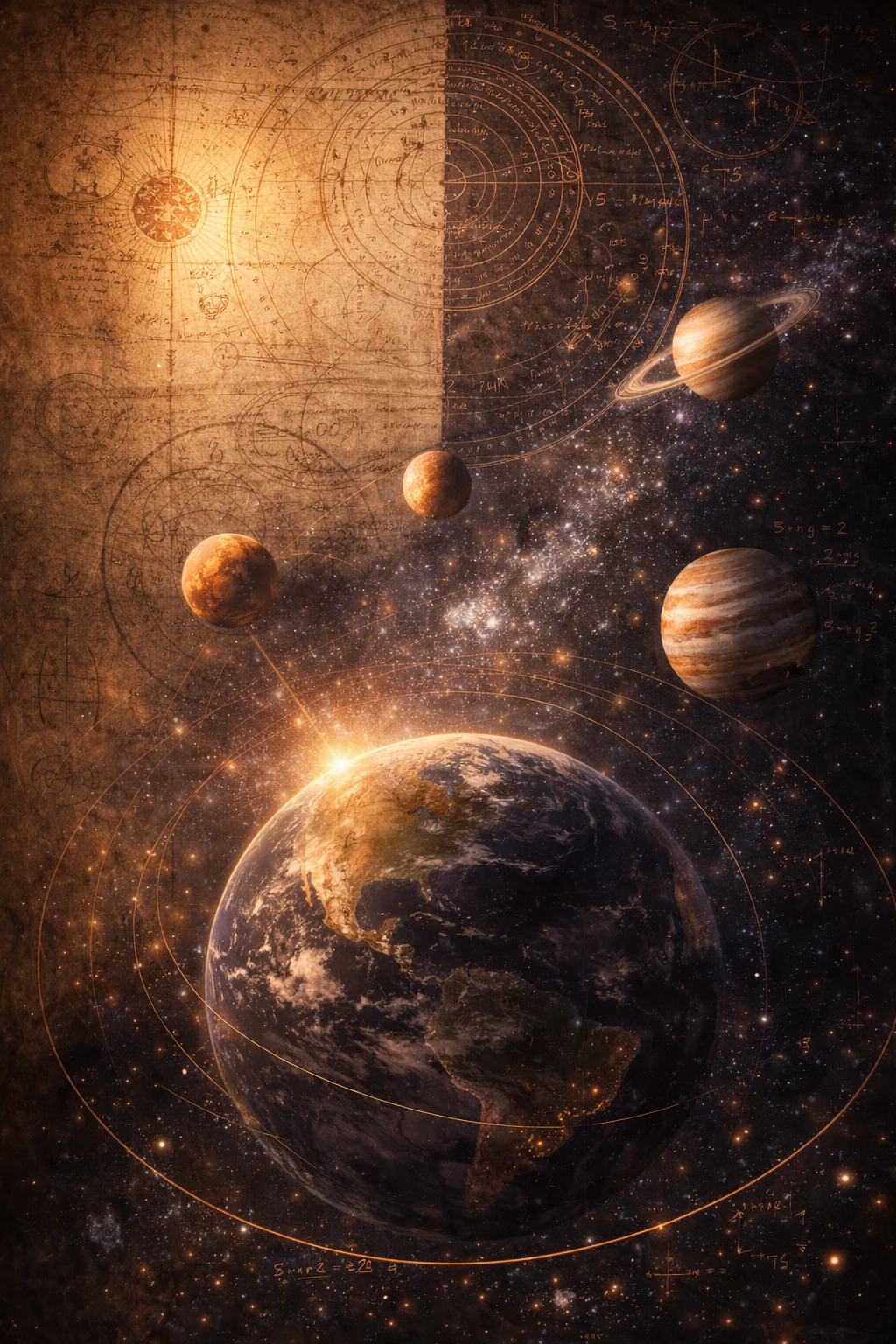
On January 7, 1610, Galileo observed three small points of light near
Jupiter. He initially believed they were fixed stars. During the
following nights, he discovered that they changed position and that a
fourth point sometimes appeared. He eventually realized that those
bodies were revolving around the planet (Galilei, 1610/1989).
They are now known as Io, Europa, Ganymede, and Callisto. Galileo
called them the “Medicean stars” in honor of the Medici family, hoping
to transform his discovery into an opportunity for patronage. The
strategy succeeded: that same year, he left Padua and moved to Florence
as mathematician and philosopher to the grand duke of Tuscany (Biagioli,
1993).
Jupiter’s moons did not directly prove that Earth revolved around the
Sun. They did destroy an important objection to heliocentrism: the claim
that every celestial body had to orbit Earth. Jupiter constituted a
center of motion of its own.
Galileo rapidly published his discoveries in March 1610 under the
title Sidereus nuncius, known in English as The Sidereal
Messenger. The book made him famous throughout Europe and provoked
debate about the telescope’s reliability. Some critics distrusted an
instrument that introduced images invisible to the naked eye; others
attempted the same observations and confirmed his results (Galilei,
1610/1989; Heilbron, 2010).
Venus, the Sun,
and an incomprehensible Saturn
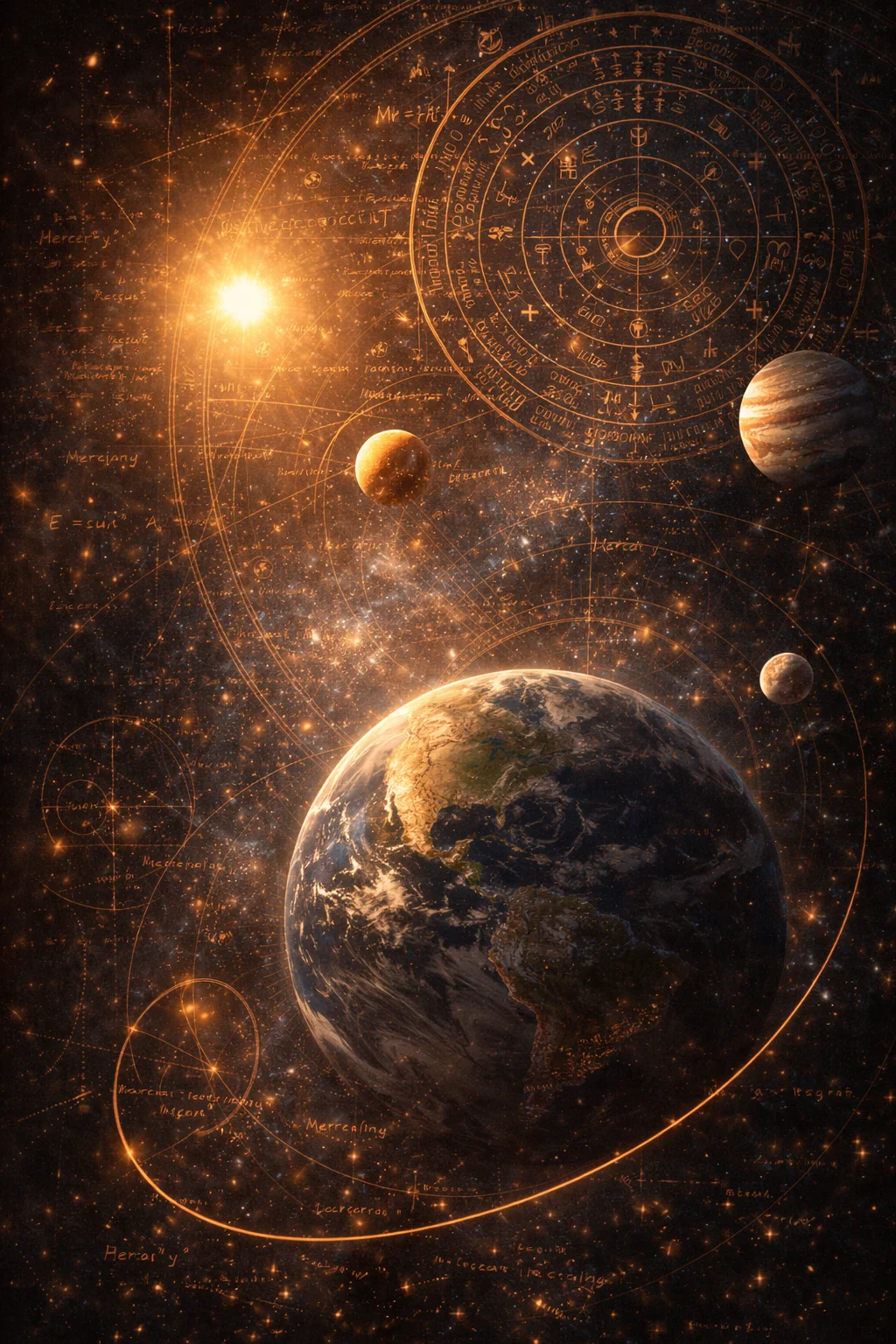
Galileo continued observing. He discovered that Venus displayed a
complete series of phases similar to those of the Moon. That phenomenon
was incompatible with the traditional Ptolemaic system, in which Venus
was supposed to remain permanently between Earth and the Sun (Sharratt,
1994).
The phases of Venus did not independently prove the Copernican model
because they could also be explained by Tycho Brahe’s geoheliocentric
system, in which the planets orbited the Sun while the Sun moved around
a stationary Earth. Nevertheless, they eliminated one of the oldest and
most widely accepted versions of the geocentric universe.
Galileo also observed sunspots and argued that they were located on
or near the Sun’s surface. Their appearance and movement suggested that
the Sun rotated and was not a perfect, unchanging body (Galilei,
1613/1957).
When he examined Saturn, he saw a strange form on either side of the
planet and thought it consisted of three bodies almost joined together.
His telescope lacked sufficient resolution to reveal the rings. Galileo
had seen something real, but he did not yet possess the means to
understand it.
Scripture, nature, and a
warning
Galileo’s public defense of heliocentrism began to generate
opposition. The issue was not limited to determining which body occupied
the center. Certain biblical passages appeared to describe a stationary
Earth and a moving Sun.
In his Letter to the Grand Duchess Christina, written in
1615, Galileo argued that Scripture and nature could not contradict each
other because both came from God. He maintained, however, that Scripture
used language adapted to human understanding and should not be
interpreted literally when observation demonstrated how the physical
world operated (Galilei, 1615/1957).
In 1616, the Catholic Church declared that the immobility of the Sun
and the movement of Earth were contrary to Scripture. Copernicus’s book
was suspended until corrected, and Galileo was ordered not to hold or
defend heliocentrism (Finocchiaro, 1989).
He was not imprisoned at that time. He continued working and retained
important relationships within the Church. Cardinal Maffeo Barberini, an
admirer of his, became Pope Urban VIII in 1623. Galileo interpreted the
change as an opportunity to discuss the competing world systems
again.
The book that led to the
trial
In 1632, Galileo published the Dialogue Concerning the Two Chief
World Systems. The book presented a conversation among three
characters: Salviati, who defended many Copernican ideas; Sagredo, an
intelligent and open-minded participant; and Simplicio, who represented
Aristotelian cosmology.
Although Galileo claimed to discuss heliocentrism as a hypothesis,
the dialogue clearly favored Earth’s movement. Moreover, one of Urban
VIII’s arguments appeared in the mouth of Simplicio, the character
frequently placed at an intellectual disadvantage. The pope believed
that he had been ridiculed (Finocchiaro, 1989; Heilbron, 2010).
The conflict was not a simple battle between science and religion.
Religious figures, mathematicians, and astronomers could be found among
both Galileo’s opponents and supporters. The proceedings combined
scientific observations, biblical interpretation, institutional
authority, personal rivalries, and the question of whether Galileo had
disobeyed the warning issued in 1616.
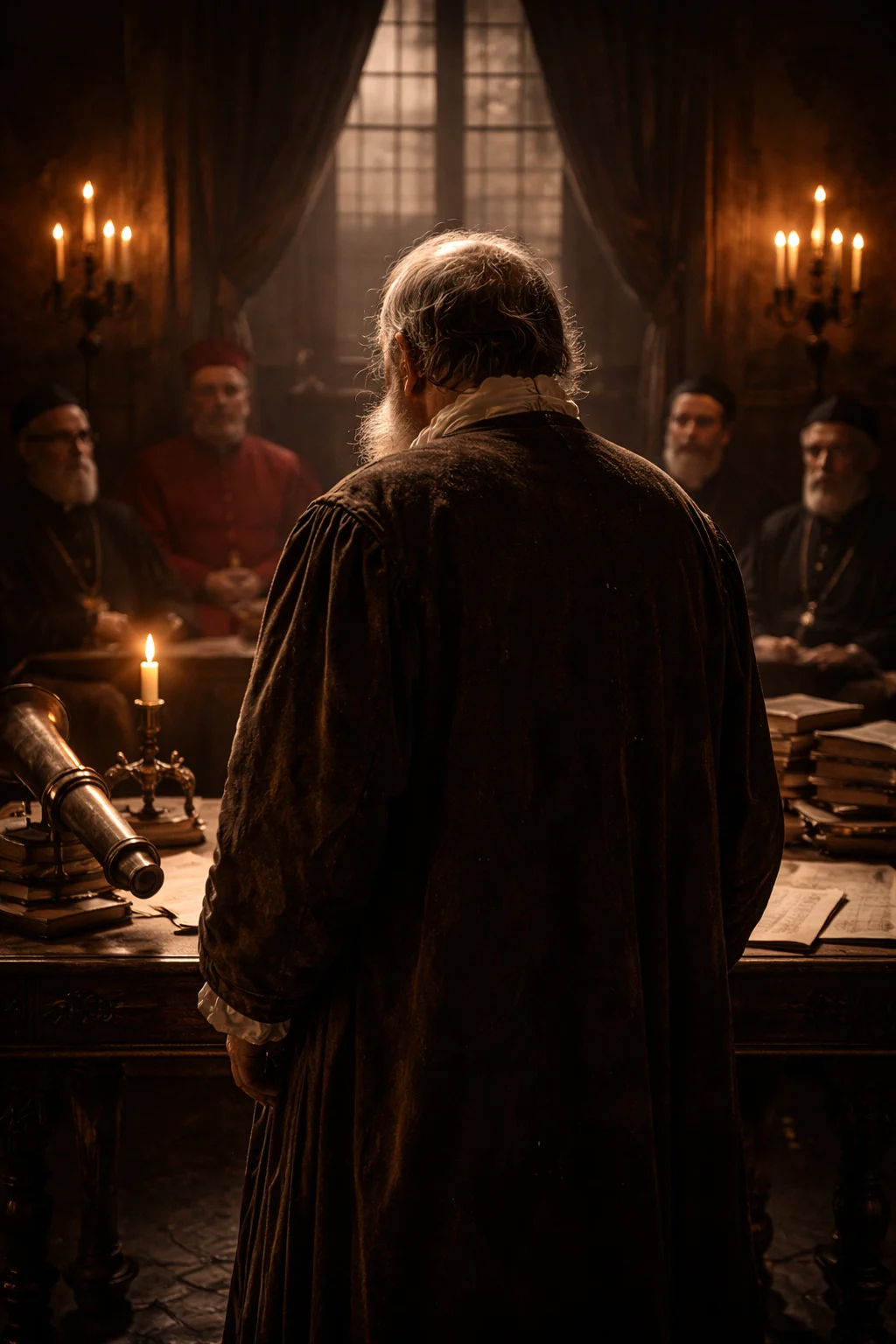
In 1633, the Roman Inquisition tried him and declared him “vehemently
suspected of heresy.” He was forced to abjure the belief that Earth
moved and received a prison sentence that was commuted to house arrest.
The Dialogue was prohibited (Finocchiaro, 1989).

The words he probably never
spoke
One of the most famous stories claims that after recanting, Galileo
murmured, “Eppur si muove”—“And yet it moves.”
No contemporary record indicates that he spoke those words. The
phrase became associated with Galileo more than a century after the
trial and must be considered apocryphal (Heilbron, 2010).
The myth survived because it perfectly summarizes the modern image of
a scientist yielding to authority without inwardly abandoning the truth.
The historical Galileo, however, was more complicated. He knew how to
negotiate with princes, seek patrons, ridicule opponents, and present
his discoveries with enormous literary skill. He was not a silent martyr
but an active participant in the political and cultural structures of
his time (Biagioli, 1993).

The
man who continued working without being allowed to leave
Galileo spent the rest of his life under house arrest, principally at
his villa in Arcetri near Florence. There he endured the death of his
daughter Virginia, Sister Maria Celeste, in 1634. As the years passed,
he became almost completely blind.
Despite isolation and blindness, he continued working. In 1638, he
published Discourses and Mathematical Demonstrations Relating to Two
New Sciences in Leiden, beyond the reach of Italian censorship. The
work brought together decades of research on motion, acceleration,
projectiles, and the strength of materials (Galilei, 1638/1974).
His analysis of falling bodies showed that, under ideal conditions,
the distance traveled increases according to the square of elapsed time.
He also studied projectile motion as a combination of horizontal
movement and vertical fall. These investigations helped establish
foundations upon which Isaac Newton later built.
Galileo died in Arcetri on January 8, 1642.
He did not invent the telescope. He did not single-handedly prove
that Earth revolved around the Sun. He probably never dropped objects
from the Leaning Tower of Pisa or uttered the words “And yet it
moves.”
His true achievement was more profound. He transformed a tube of
lenses into an argument, observation into a form of challenge, and the
invisible into evidence. After Galileo, the sky could no longer be
explained solely through ancient books. It also had to be observed.

References
Biagioli, M. (1993). Galileo, courtier: The practice of science
in the culture of absolutism. University of Chicago Press.
Drake, S. (1978). Galileo at work: His scientific biography.
University of Chicago Press.
Finocchiaro, M. A. (Ed. & Trans.). (1989). The Galileo
affair: A documentary history. University of California Press.
Galilei, G. (1957). Discoveries and opinions of Galileo (S.
Drake, Trans.). Doubleday. (Original works published 1613–1615)
Galilei, G. (1974). Two new sciences (S. Drake, Trans.).
University of Wisconsin Press. (Original work published 1638)
Galilei, G. (1989). Sidereus nuncius, or The sidereal
messenger (A. Van Helden, Trans.). University of Chicago Press.
(Original work published 1610)
Heilbron, J. L. (2010). Galileo. Oxford University
Press.
Sharratt, M. (1994). Galileo: Decisive innovator. Cambridge
University Press.
Van Helden, A. (1977). The invention of the telescope.
American Philosophical Society.
More from this collection
Nicolaus Copernicus: The Man Who Moved the Earth Without a Telescope
Read story →
Isaac Newton: The Man Who Turned the Universe’s Invisible Forces Into Mathematical Laws
Read story →