In this storyOpen index
Rembrandt: The Painter Who Lost His Fortune but Not His Genius
In 1656, he surrendered nearly everything to his creditors. Ruin did not end his career—it opened the most deeply human period of his painting.
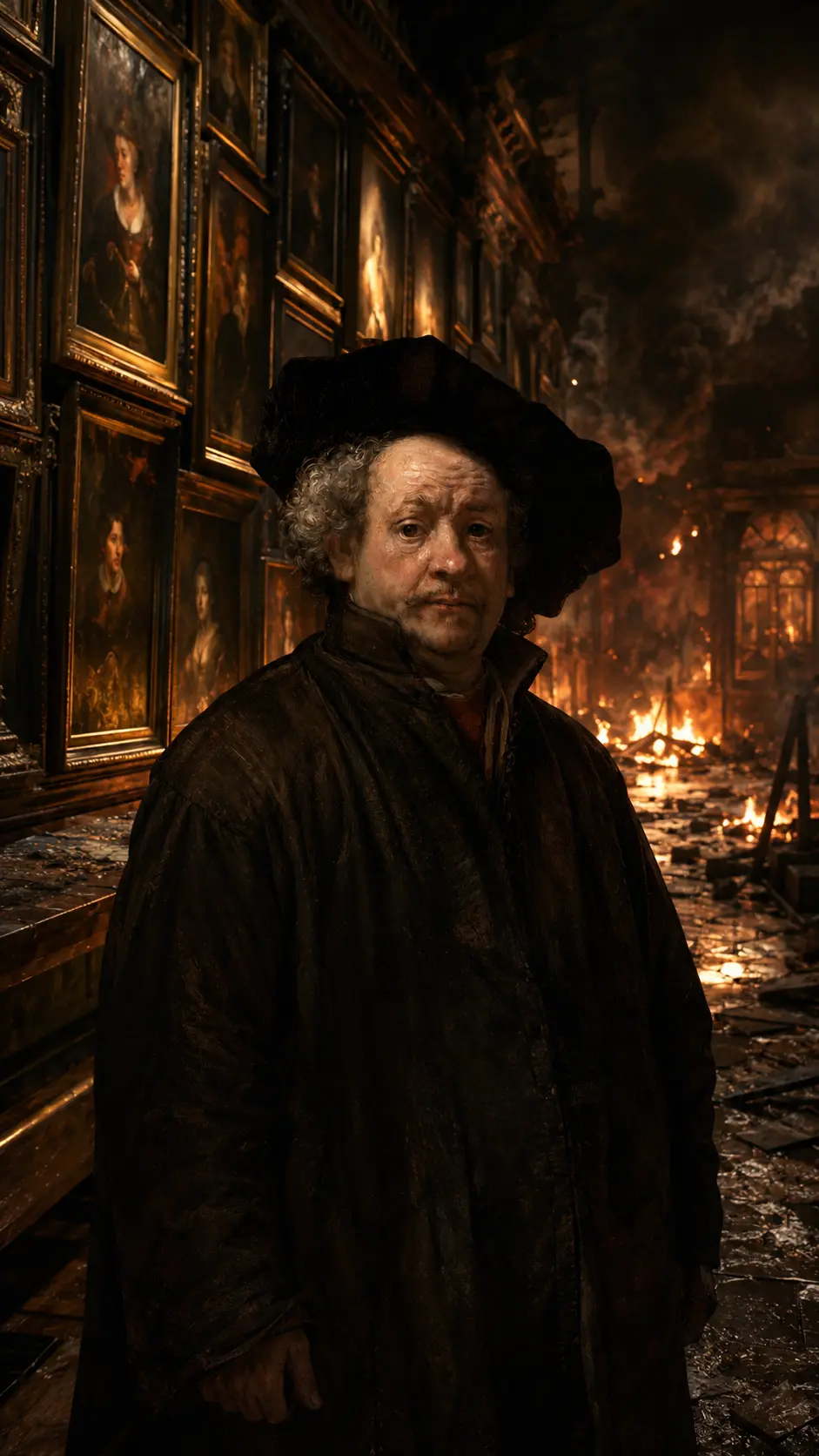
Rembrandt van Rijn once owned an imposing house, an extraordinary collection, and one of Amsterdam’s most prestigious artistic workshops. Yet in 1656, he was forced to surrender nearly everything he possessed to his creditors. Remarkably, financial ruin did not destroy his career. During the most difficult period of his life, he produced some of the most humane and emotionally profound works in the history of art.
Rembrandt on video
Discover this story on our YouTube channel.
A life told through places and turning points
Enter the archive
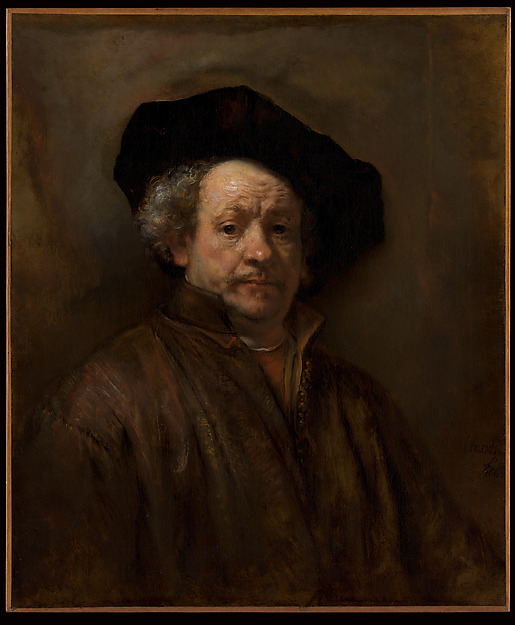
An authentic object preserved by a cultural institution brings us closer to the world behind this life.
- Collection
- The Metropolitan Museum of Art
- Rights
- Public Domain / Open Access
Bequest of Benjamin Altman, 1913
From a Miller’s Son to a Celebrated Painter
Rembrandt Harmenszoon van Rijn was born in Leiden on July 15, 1606. He was the son of Harmen Gerritszoon van Rijn, who owned a mill, and Neeltgen Willemsdochter van Zuijtbrouck, the daughter of a baker. His family’s relative prosperity allowed him to receive an education that was unusual for the son of a tradesman. He attended the Latin School in Leiden and briefly enrolled at the university, but soon abandoned academic studies to become a painter (National Gallery, n.d.).
Rembrandt initially trained with Jacob van Swanenburg in Leiden and later spent several months in Amsterdam studying under Pieter Lastman, who was known for his biblical and historical scenes. Rembrandt adopted this interest in stories from the past, but developed a language of his own: he used light to reveal emotions and direct the viewer’s attention. In his paintings, illumination does more than make a face visible. It can suggest fear, guilt, compassion, or authority.
During his early professional years, Rembrandt worked in Leiden and shared a studio with Jan Lievens. His talent soon attracted collectors and influential patrons. Around 1631, he moved to Amsterdam, a city enriched by international commerce and a growing market for portraiture.
Success came quickly. In 1632, he painted The Anatomy Lesson of Dr. Nicolaes Tulp, transforming the conventional group portrait into a scene filled with movement and psychological tension. In 1634, he married Saskia van Uylenburgh, who came from a well-connected family. They had four children, but only their son Titus survived infancy (Rijksmuseum, n.d.).
The House That Represented Both Success and Ruin
In 1639, at the height of his career, Rembrandt purchased a large house on what is now Jodenbreestraat for 13,000 guilders. It contained his family residence, his studio, and rooms where his pupils worked. Now preserved as the Rembrandt House Museum, the property represented his rise in social status, but it also became one of the financial obligations that followed him for years (Rembrandt House Museum, n.d.).
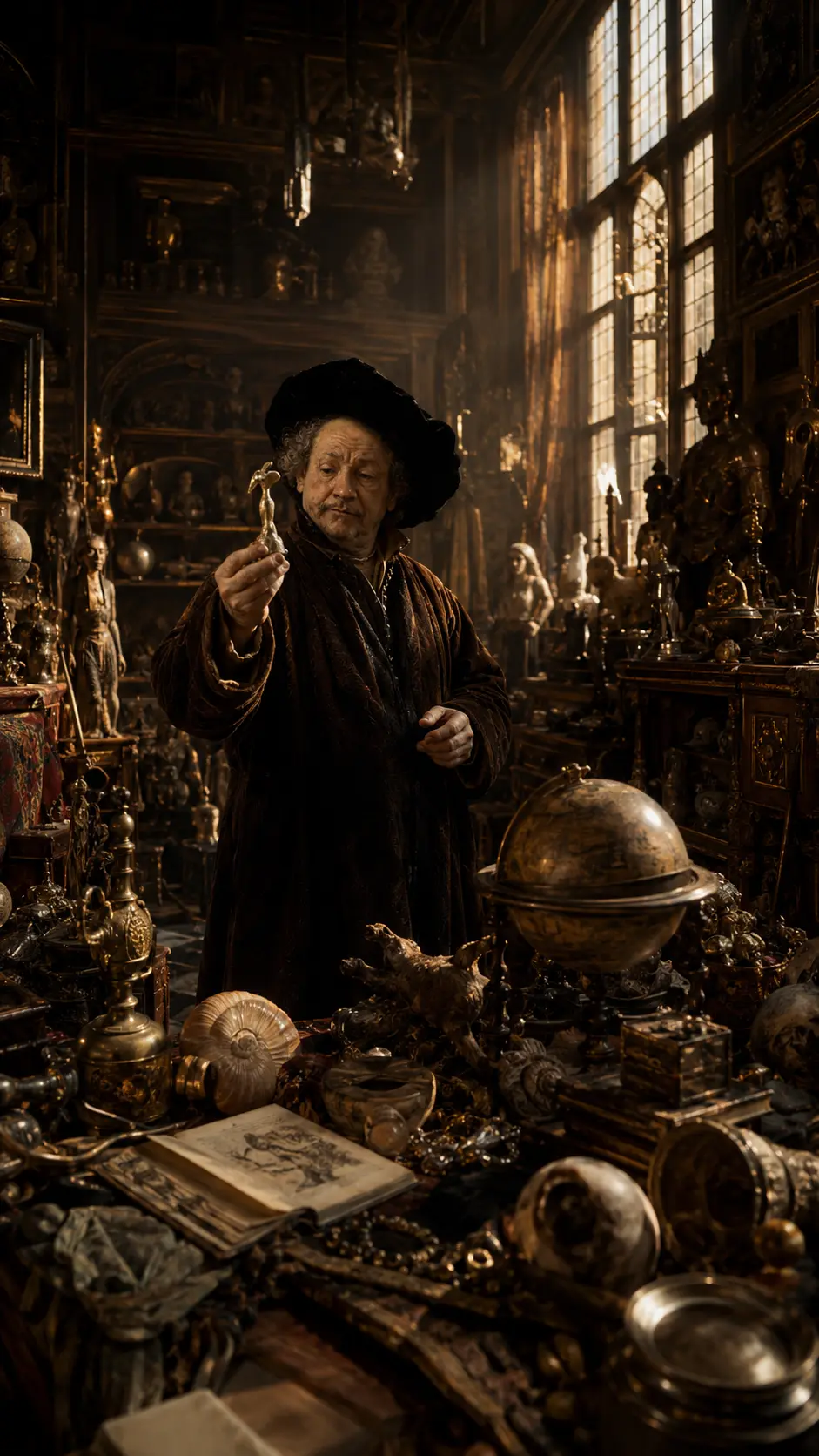
Rembrandt purchased much more than pigments and painting tools. He assembled paintings, prints, sculptures, weapons, antique clothing, shells, preserved animals, and objects from distant parts of the world. This collection served as an enormous visual archive. Rembrandt and his pupils could examine armor, an Eastern textile, or an ancient bust and later incorporate it into a biblical or historical composition.
In 1642, he completed his monumental portrait of an Amsterdam civic guard company, now known as The Night Watch. The title is misleading: the scene was not conceived as a nighttime event. Darkened layers of varnish and centuries of accumulated dirt eventually made it appear nocturnal.
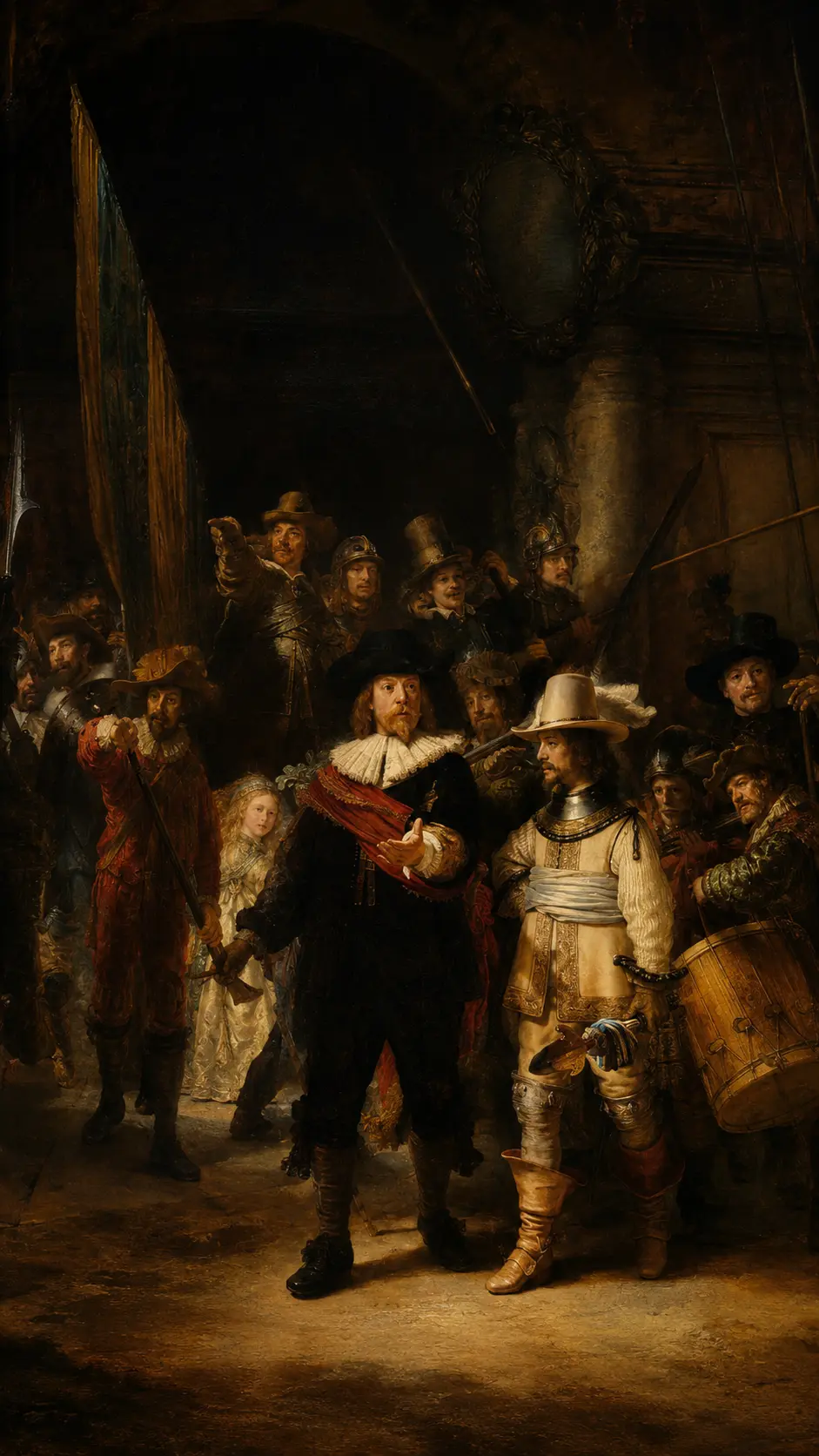
It has also been claimed that the painting was rejected and immediately destroyed Rembrandt’s career. There is insufficient evidence to support that popular story. Although his artistic preferences and those of the market gradually moved apart, Rembrandt continued to receive important commissions after 1642 (National Gallery, n.d.).
That same year, Saskia died after a prolonged illness. Rembrandt was left to care for Titus and later began a relationship with Hendrickje Stoffels. She became his companion, the possible model for several paintings, and a crucial figure in the survival of his professional activity.
The Inventory That Revealed Rembrandt’s Secret World
A lesser-known episode of his life began in July 1656. Rembrandt had accumulated substantial debts, still owed part of the money used to purchase his house, and lacked the cash required to meet his obligations.
He therefore applied for cessio bonorum, a legal procedure through which a debtor voluntarily surrendered his possessions to creditors. It was not identical to bankruptcy in the modern sense. His application was accepted, allowing him to avoid imprisonment for debt, although he was required to surrender nearly everything he owned (National Gallery, n.d.; Leiden University, 2021).
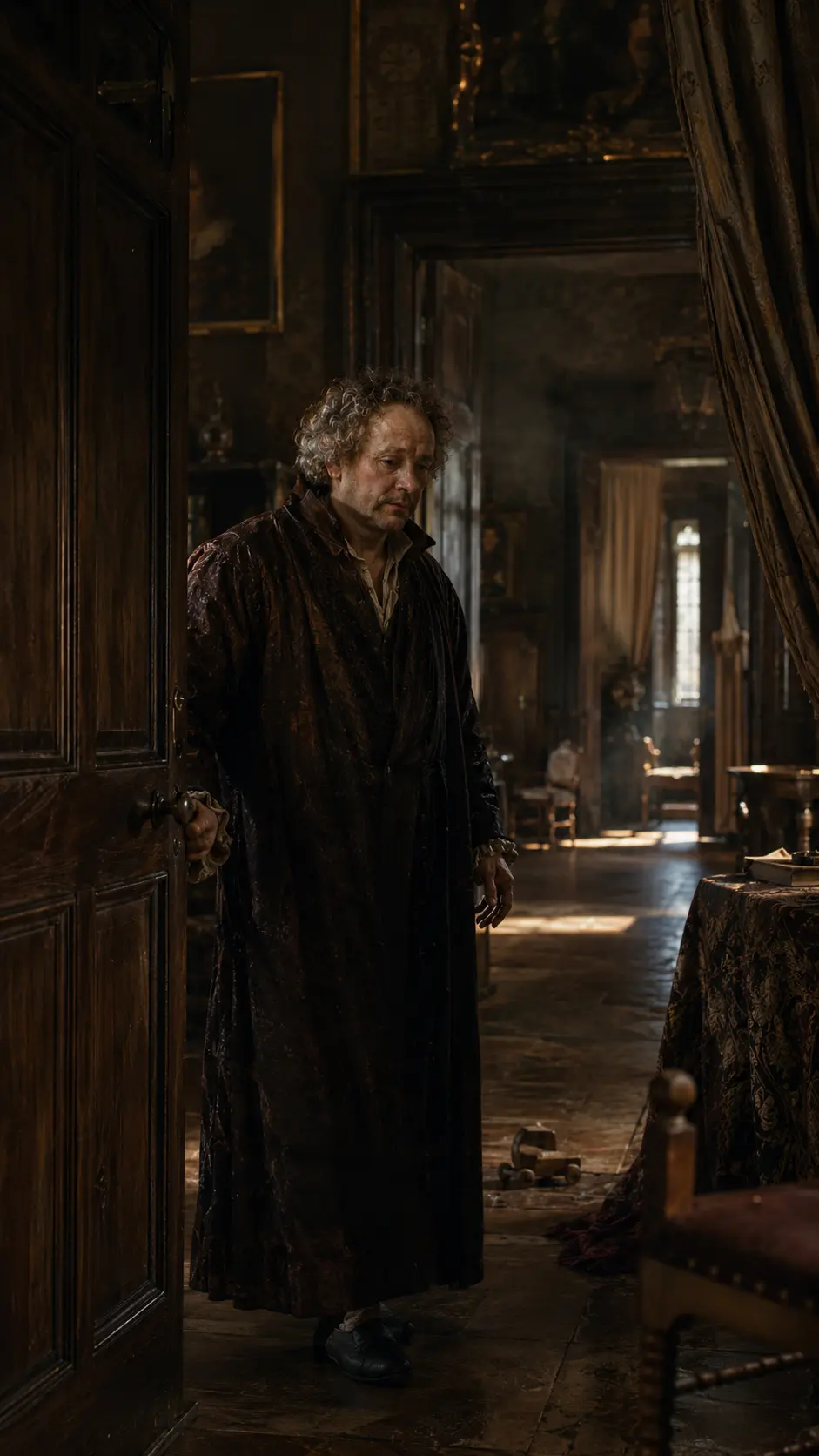
As part of the proceedings, an official moved through Rembrandt’s house and recorded the objects found in each room. The resulting 1656 inventory survives and allows historians to reconstruct the building’s layout and learn remarkable details about Rembrandt’s artistic and intellectual world. A document created to liquidate his possessions eventually became one of the most valuable sources for understanding his imagination (Rembrandt House Museum, n.d.).
The record of a financial collapse ultimately became an extraordinary map of Rembrandt’s imagination.
The list includes paintings and prints by different masters, busts of Roman emperors, weapons, helmets, musical instruments, minerals, shells, marine specimens, and various natural curiosities. It also records garments and objects that could be used as models in the workshop.
Rembrandt did not collect these things merely to display his wealth. Many of them reappeared, transformed, as turbans, jewelry, armor, and architectural details in his works. His collection allowed him to construct distant worlds without leaving Amsterdam.
His belongings were sold between 1656 and 1658, but the auctions produced far less money than expected. Rembrandt eventually lost the house and moved with Hendrickje and Titus to a more modest home on Rozengracht.
The Son Who Became His Father’s Protector
Another little-known development followed the financial crisis. Hendrickje and Titus established a business that dealt in artworks. Rembrandt was connected to the company as its artist, while they managed contracts and sales.
This arrangement allowed him to continue working without every payment being immediately claimed by his former creditors. In effect, Rembrandt’s son and companion became his commercial protectors. The structure also reveals the extent to which the artist needed his family’s intervention to continue practicing his profession (Rijksmuseum, n.d.).
Greatness After the Fall
The loss of his house and collection did not diminish the force of Rembrandt’s art. His later paintings became freer, more intimate, and more psychologically intense. Instead of concealing the surface beneath a perfectly smooth finish, he increasingly left brushstrokes visible and applied paint in thick layers. His faces seem to be constructed from light, physical substance, and accumulated experience.
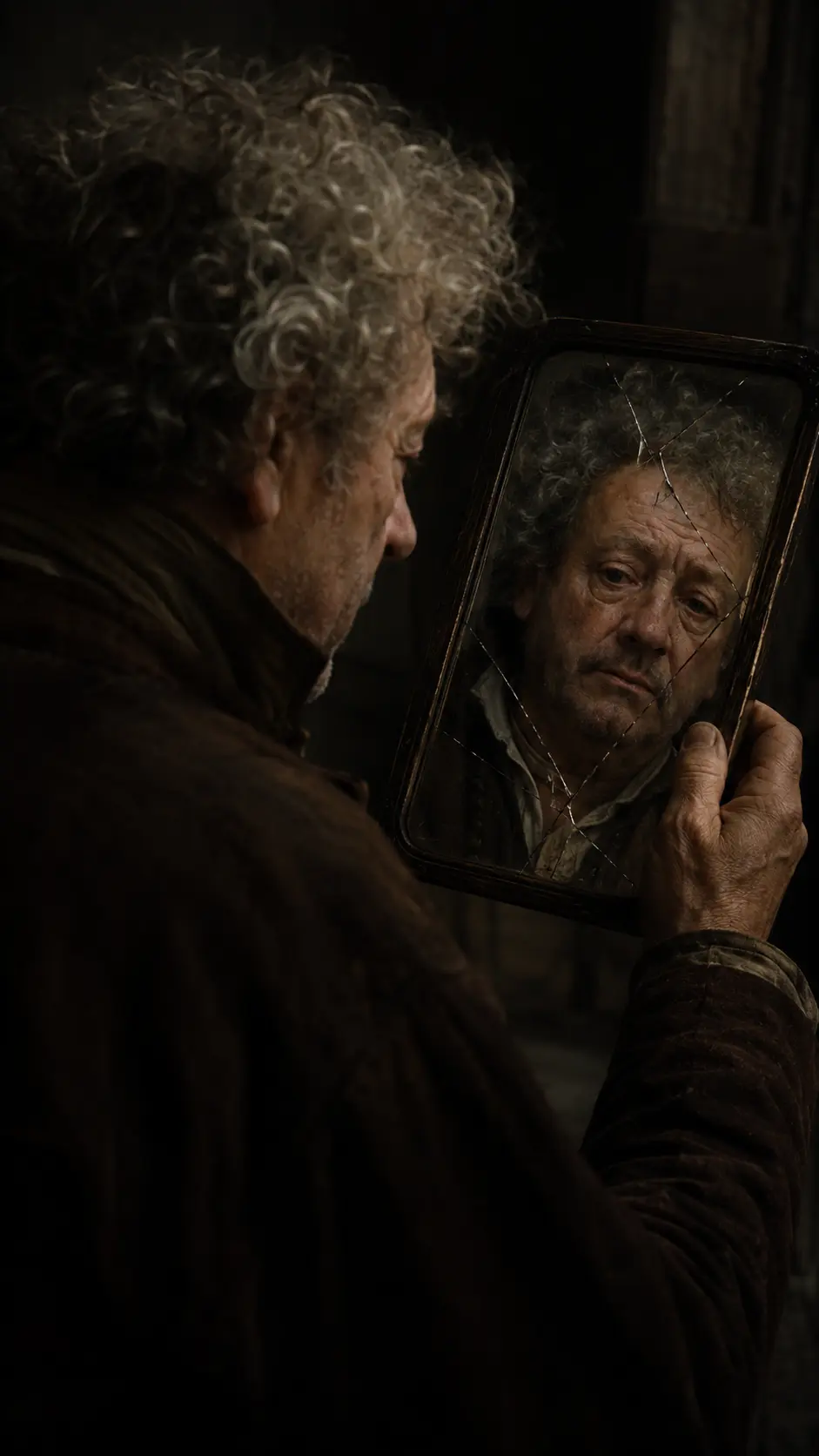
During these years, he produced works such as The Syndics of the Drapers’ Guild and several of his most powerful self-portraits. Rembrandt examined his own face throughout almost his entire career: as an ambitious young man, a successful master, a weary adult, and finally a vulnerable old man. He did not always present himself as a heroic figure. He recorded wrinkles, aging, and uncertainty with extraordinary honesty.
Hendrickje died in 1663. Titus died in 1668, only months after his marriage. Rembrandt survived them both and died in Amsterdam on October 4, 1669. He was buried in a rented grave in the Westerkerk. The precise location of his remains was later lost, a circumstance that was not exceptional in seventeenth-century Amsterdam (National Gallery, n.d.).
Rembrandt never recovered the wealth he had once enjoyed. His financial collapse, however, did not amount to an artistic defeat. The inventory of 1656 shows that his imagination drew upon an entire world of images and physical objects. His final paintings reveal something even more important: when the house, the collection, and much of his social standing had disappeared, his ability to look deeply into the human condition remained untouched.
References
- Leiden University. (2021, November 16). Rembrandt made a mess of his legal and financial life.
- National Gallery. (n.d.). Rembrandt (1606–1669).
- Rembrandt House Museum. (n.d.). Rembrandt van Rijn: His life, work and house in Amsterdam.
- Rijksmuseum. (n.d.). Rembrandt van Rijn.
More from this collection

Francisco de Goya: The Painter Who Heard the Noise of His Age After Becoming Deaf
Read story →
Egon Schiele: The Painter Who Watched a Judge Burn His Drawing
Read story →