In this storyOpen index
Cleopatra: The Queen Rome Turned into a Seductress
Rome reduced her to a seductress to obscure the sovereign who fought to preserve Egypt.
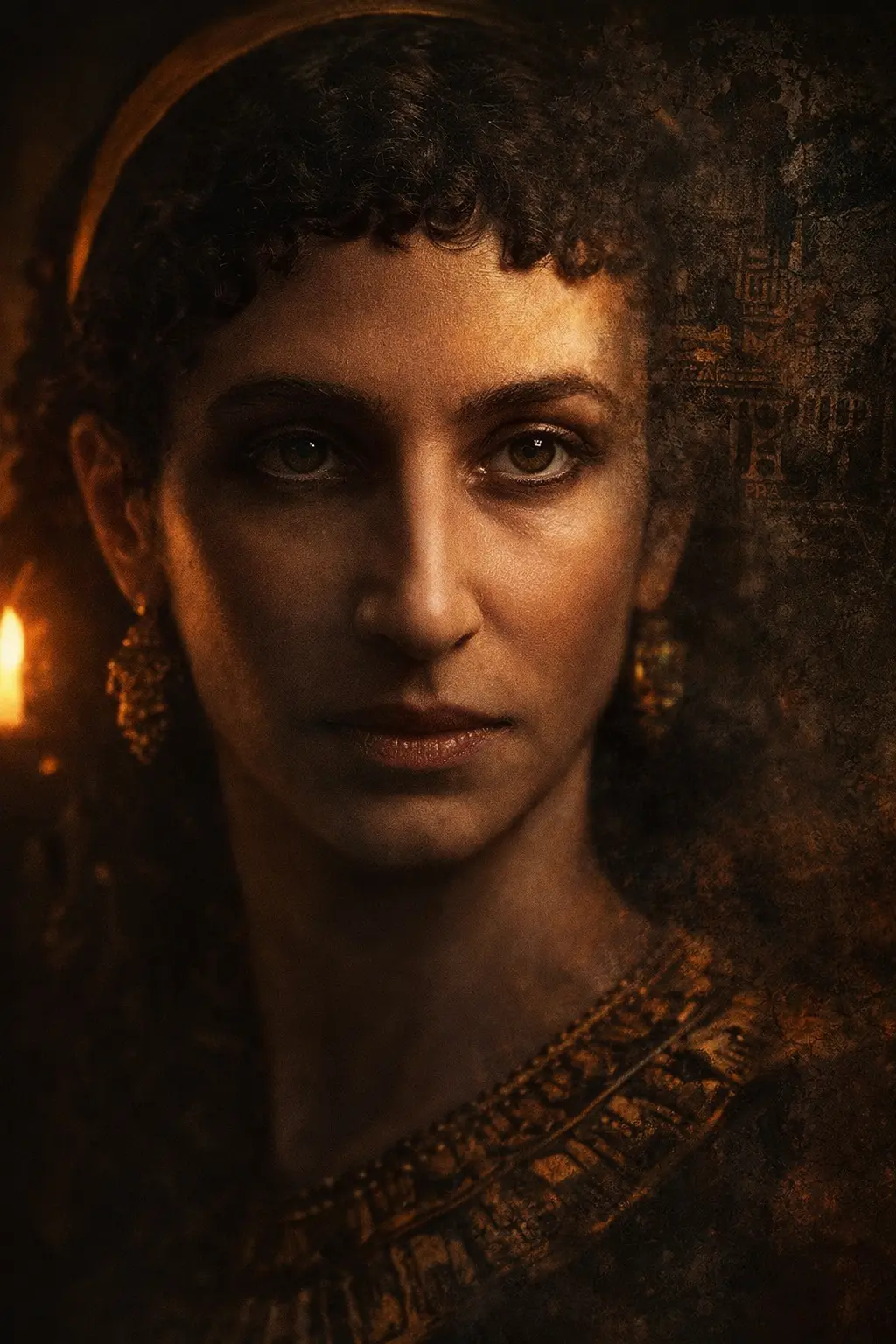
Rome needed to turn her into a dangerous woman to justify the war that would destroy her kingdom. She was portrayed as a foreign seductress who had enchanted two powerful men, but Cleopatra did not rule Egypt for more than twenty years because of her beauty. She survived rebellions, family wars, famines, and the advance of a power that was absorbing the entire Mediterranean.
She was a diplomat, administrator, naval commander, and one of the last rulers capable of negotiating with Rome before Egypt became an imperial province. Her relationships with Julius Caesar and Mark Antony were personal, but they were also political alliances intended to preserve a kingdom whose independence was collapsing.
History remembered her for the men she was with. Rome feared her for the power she attempted to preserve.
Cleopatra on video
Discover this story on our YouTube channel.
A life told through decisive places and moments
Enter the archive
The British Museum preserves coins of Cleopatra VII that show the image of authority circulated during her own reign.
- Collection
- Coins and Medals
- Institution
- British Museum
Institutional record of numismatic objects associated with Cleopatra VII.
A Greek queen in Egypt
Cleopatra VII was born in Alexandria in 69 BCE. She was the daughter of King Ptolemy XII and belonged to the Ptolemaic dynasty, founded by Ptolemy I, one of Alexander the Great’s Macedonian generals. Although the family had ruled Egypt since 305 BCE, its court culture remained fundamentally Greek (Roller, 2010).
The Ptolemies preserved many Egyptian institutions and presented themselves as pharaohs, but they lived primarily in Alexandria and used Greek as their administrative language. They also practiced marriage between siblings to retain power within the family, a custom connected both to dynastic tradition and to the need to limit potential rivals.
The precise ethnic identity of Cleopatra’s mother remains uncertain. Most of her known ancestry was Macedonian Greek, but the surviving records do not allow her maternal line to be reconstructed completely. Applying modern racial categories directly to her simplifies an identity formed within a Hellenistic, African, and Mediterranean kingdom (Roller, 2010; Tyldesley, 2008).
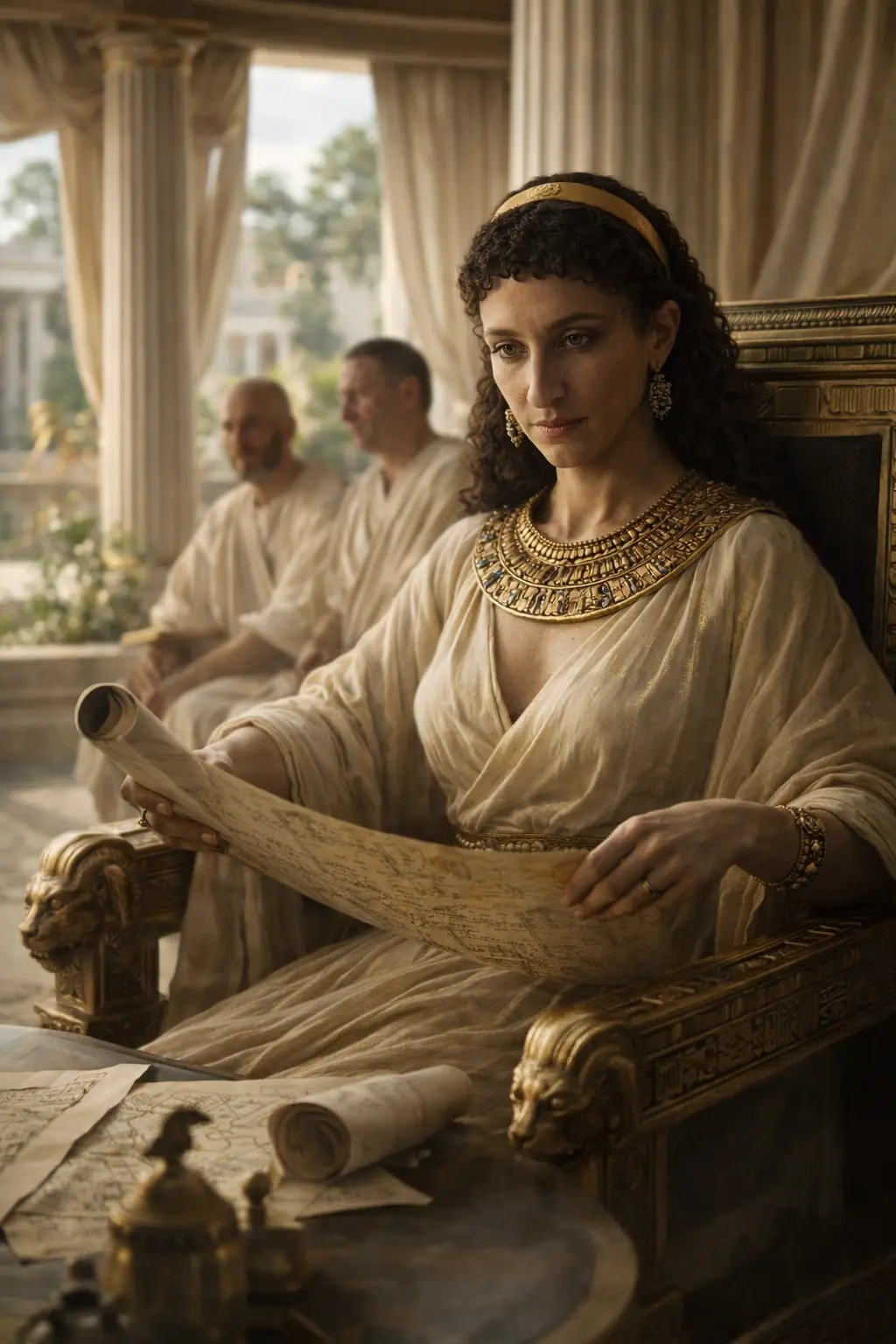
Cleopatra received an education intended to prepare her for government. She studied rhetoric, philosophy, literature, administration, and probably subjects connected with medicine and mathematics. Her principal instrument, however, was language.
The little-known fact: she spoke the language of her subjects
Cleopatra was the first ruler of her dynasty said to have learned the Egyptian language. Plutarch, writing more than a century after her death, claimed that she could communicate with numerous peoples without always relying upon interpreters. The exact number of languages she mastered cannot be verified, but her knowledge of Greek and Egyptian is widely accepted (Plutarch, 1920; Roller, 2010).
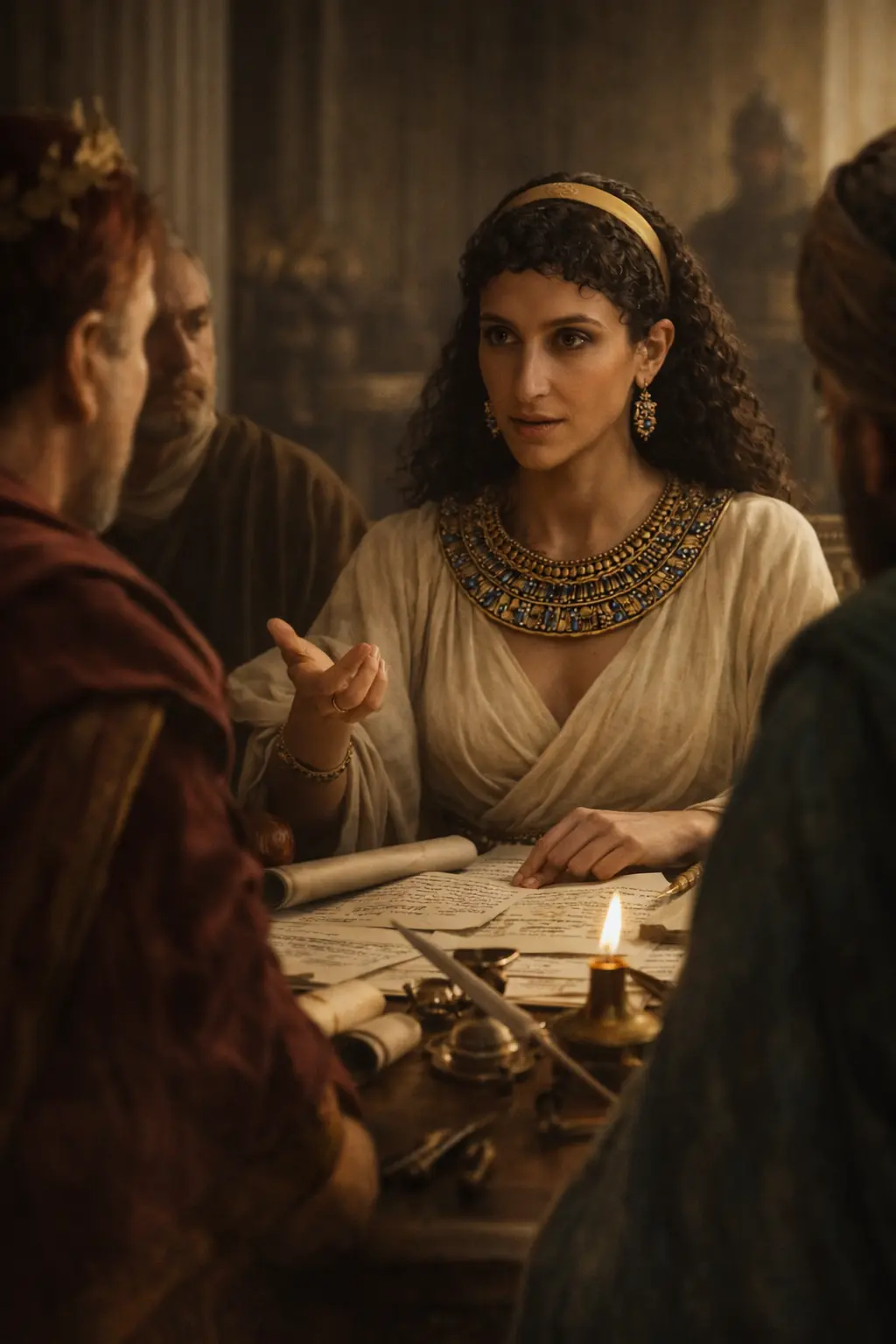
That ability had political significance. Her ancestors had ruled for generations without completely overcoming the cultural distance separating them from much of the population. Cleopatra, by contrast, participated actively in Egyptian religious ceremonies and identified herself with the goddess Isis.
She was not rejecting her Greek heritage. She was constructing an identity that could function in two ways: as a Hellenistic queen before the Mediterranean world and as a pharaoh before the Egyptians (Ashton, 2008).
Her portraits reveal this duality. In sculptures created according to Egyptian tradition, she appears young, serene, and symbolically perfect. On her coins, she adopted a more severe image: a prominent nose, firm chin, and features associated with dynastic authority. Those coins were not designed to present delicate beauty but to make a legitimate sovereign recognizable (Walker & Higgs, 2001).
A throne shared with an enemy
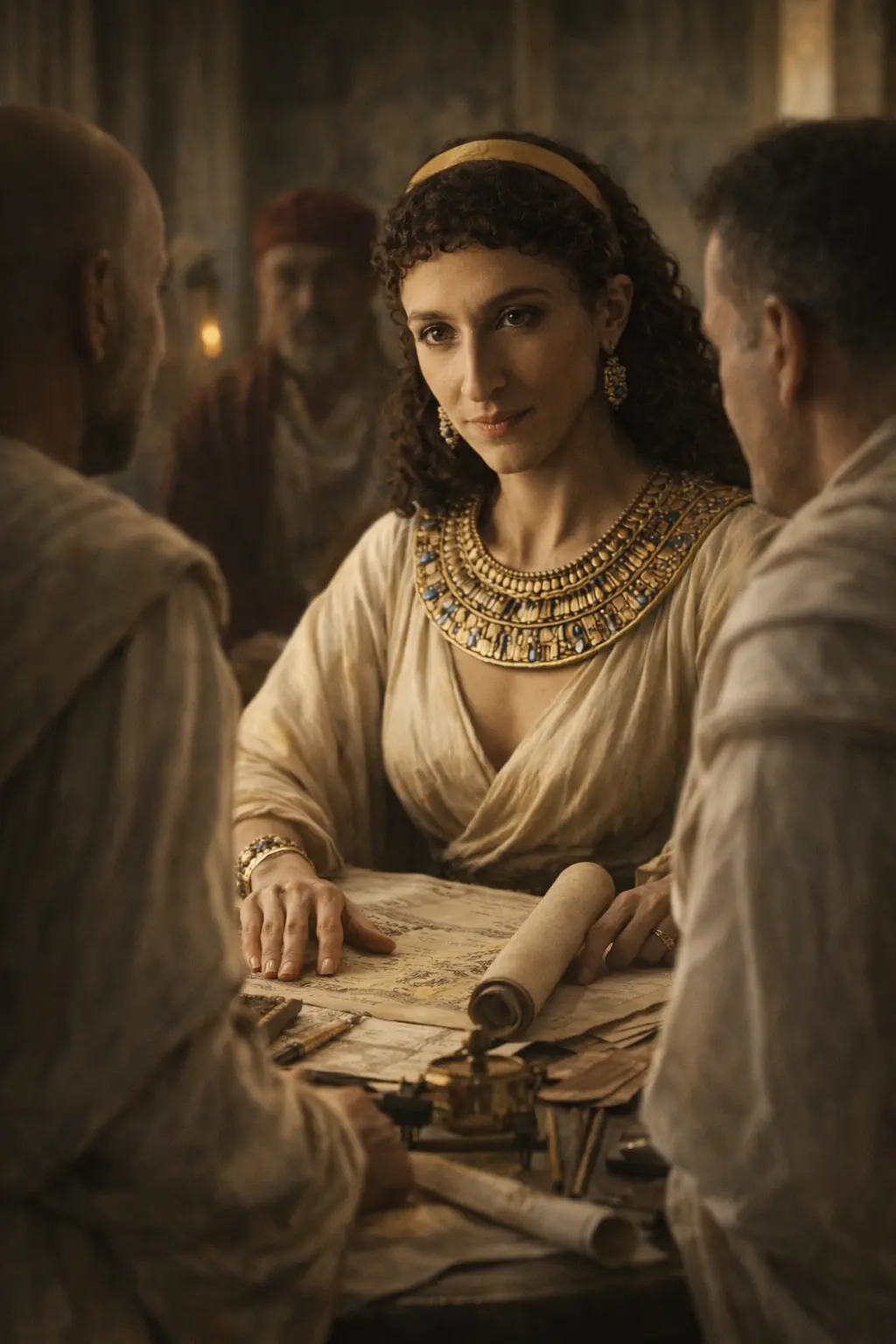
Ptolemy XII died in 51 BCE. Cleopatra, approximately 18 years old, inherited the throne with her younger brother Ptolemy XIII. In accordance with dynastic custom, they were presented as spouses and joint rulers.
The alliance quickly failed. Ptolemy XIII’s advisers attempted to reduce Cleopatra’s authority, and by 49 BCE she had been forced to leave Alexandria. She took refuge outside the capital and began assembling an army to recover power (Burstein, 2004).
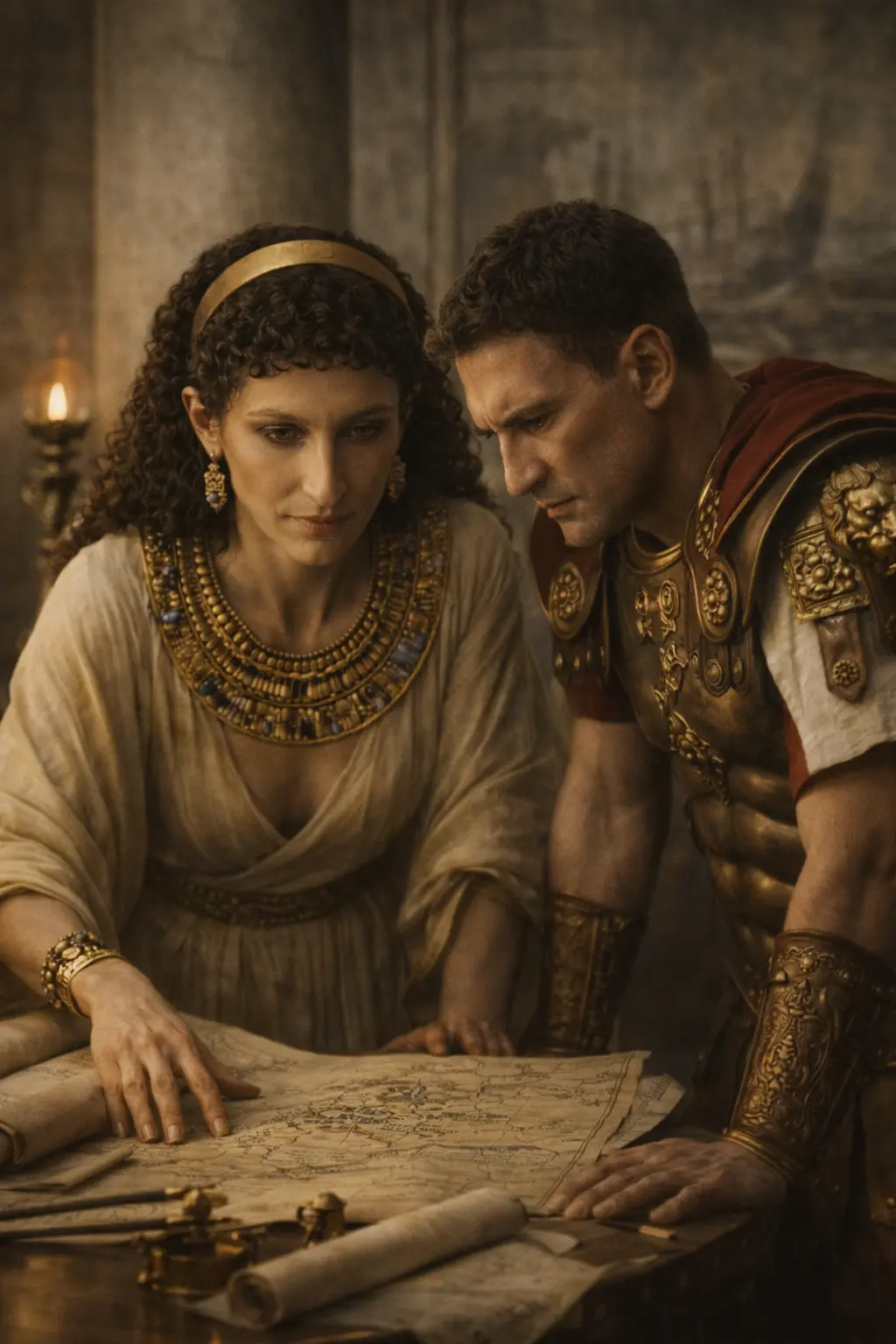
At that moment, the Roman civil war reached Egypt. Pompey, defeated by Julius Caesar, sought refuge in Ptolemaic territory. Supporters of Ptolemy XIII murdered him and presented his head to Caesar, expecting to win Roman favor.
The decision produced the opposite result. Caesar arrived in Alexandria in 48 BCE and decided to intervene in the dynastic dispute. Cleopatra understood that her survival depended upon meeting him.
The famous scene in which she was secretly carried before Caesar rolled inside a carpet comes from later retellings. Plutarch wrote that she was concealed in a sack or bundle of bedding, while the carpet belongs primarily to modern artistic recreations (Plutarch, 1919; Tyldesley, 2008).

What mattered was not the object but the maneuver. Cleopatra succeeded in passing through enemy lines and speaking directly with the man capable of restoring her to the throne.
The alliance with Julius Caesar
Caesar supported the restoration of joint rule, but the dispute led to the Alexandrian War. Ptolemy XIII died in 47 BCE, probably drowning while fleeing after a military defeat. Cleopatra recovered the throne and began ruling with another younger brother, Ptolemy XIV (Burstein, 2004).
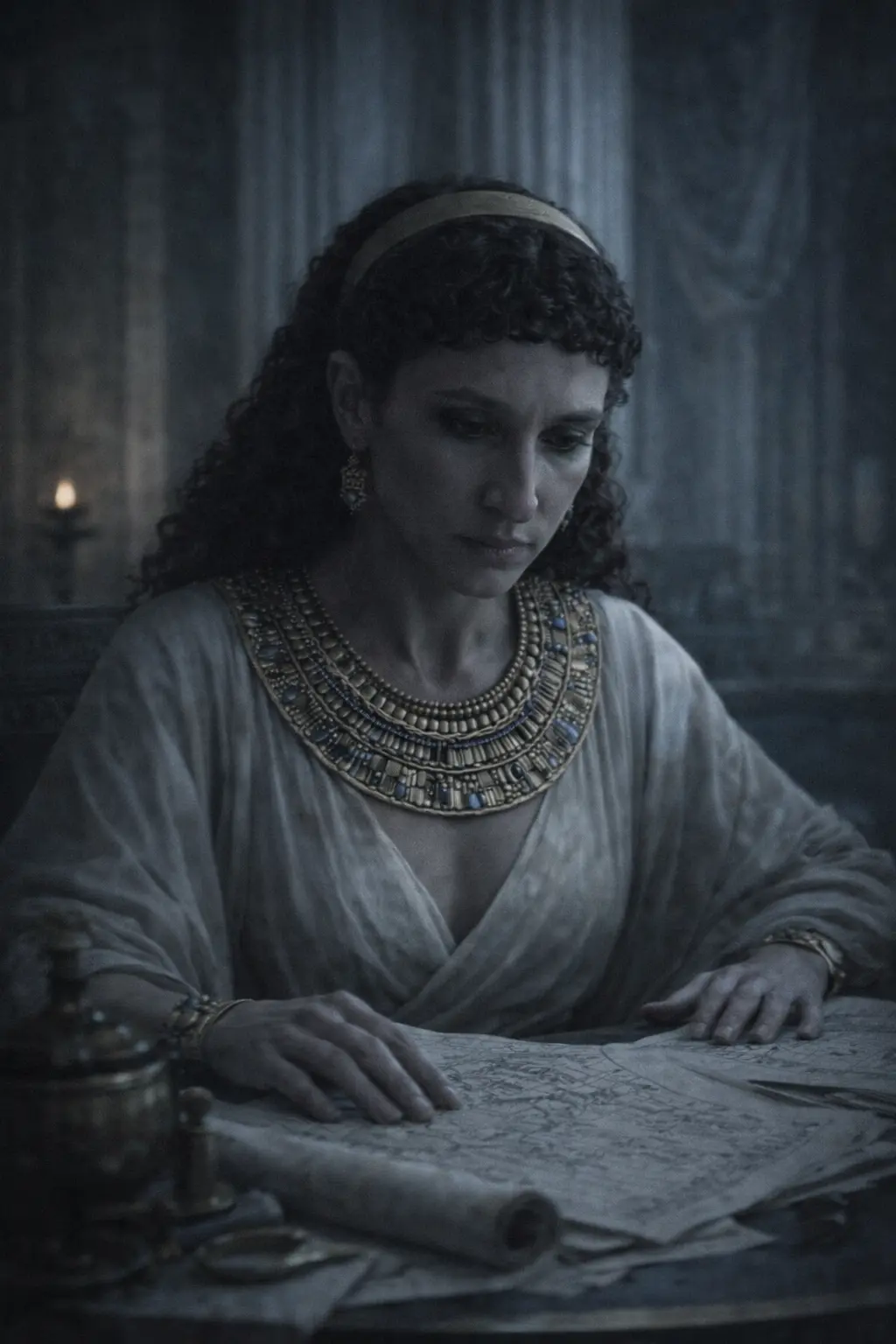
That same year, Ptolemy XV, known as Caesarion, was born. Cleopatra maintained that Julius Caesar was his father. Caesar never formally recognized him as his Roman heir, although he permitted Cleopatra and the child to reside in Rome for a time.
The queen did not become a powerless dependent. Egypt formally preserved its independence and remained an essential source of grain, wealth, and tax revenue. Caesar needed stability in the country; Cleopatra needed Roman support to prevent another dynastic rebellion.
After Caesar’s assassination in 44 BCE, Cleopatra returned to Egypt. Ptolemy XIV died soon afterward, and Caesarion was proclaimed joint ruler. Some ancient sources blamed Cleopatra for the young king’s death, but there is no conclusive evidence proving that she ordered him poisoned (Roller, 2010).
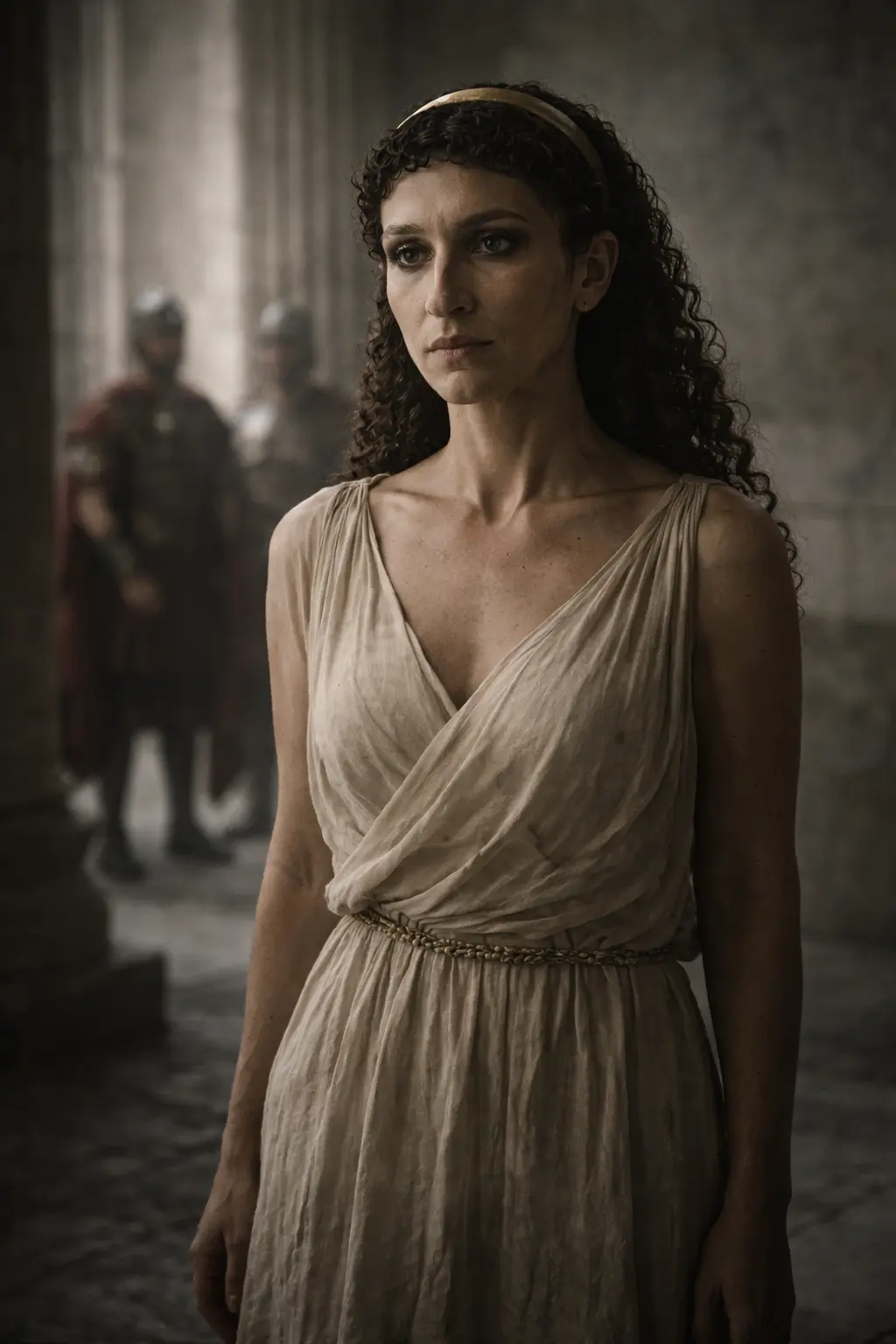
While Rome entered another civil war, Cleopatra governed a country affected by poor harvests, inflation, and economic difficulties. Administrative documents reveal efforts to protect food supplies and maintain taxation, reminding us that her reign did not consist only of banquets and romantic alliances (Tyldesley, 2008).
Mark Antony and the politics of the eastern Mediterranean
In 41 BCE, Mark Antony summoned Cleopatra to Tarsus to answer accusations that she had assisted his enemies. The queen arrived in a carefully organized display of wealth and religious symbolism. She came not as a helpless defendant but as the ruler of one of the wealthiest kingdoms in the eastern Mediterranean (Roller, 2010).
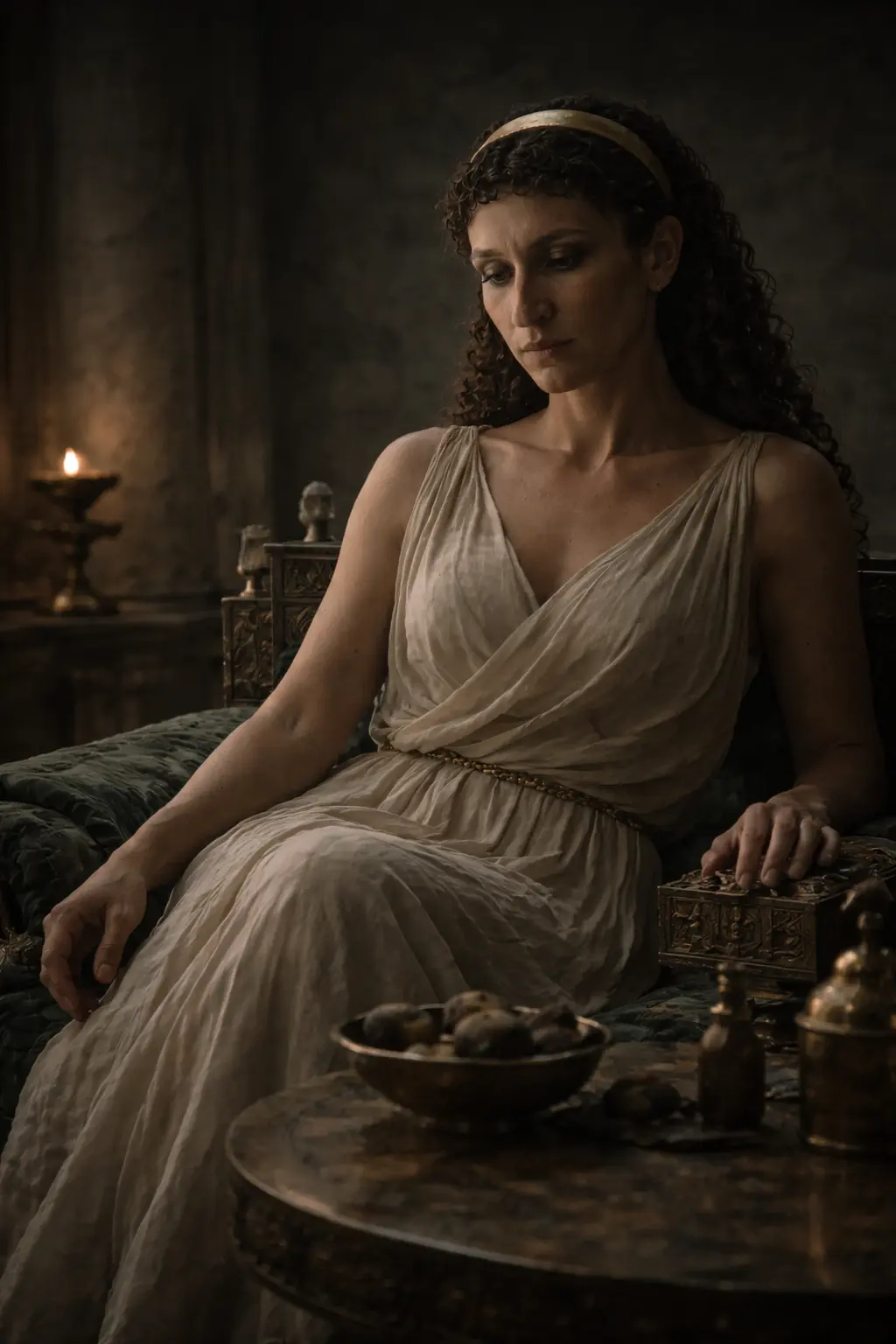
Their relationship became both political and personal. Cleopatra required Roman protection and hoped to recover territories that had belonged to the former Ptolemaic empire. Antony needed Egyptian money, ships, and food to finance his campaigns.
They had three children: the twins Alexander Helios and Cleopatra Selene, born in 40 BCE, and Ptolemy Philadelphus, born later. For several years, their alliance helped Cleopatra rebuild part of Egypt’s regional influence (Burstein, 2004).
In 34 BCE, during the so-called Donations of Alexandria, Antony distributed titles and territories among Cleopatra and their children. Caesarion was proclaimed the legitimate son of Julius Caesar and received the title king of kings alongside his mother.
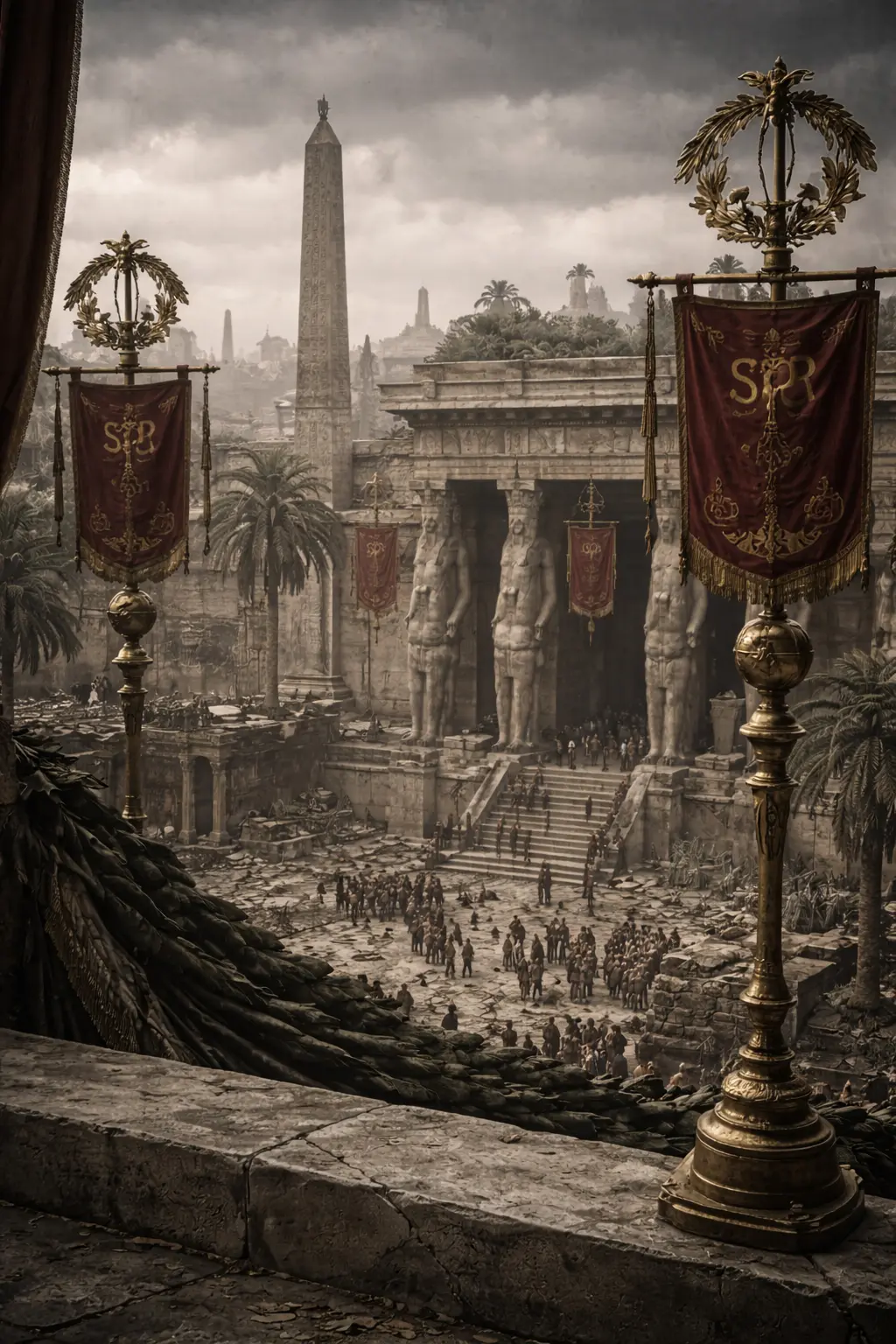
That declaration directly challenged Octavian, Caesar’s adopted son and political heir. If Caesarion were accepted as the dictator’s biological son, he could become a dangerous rival.
The propaganda war
Octavian avoided presenting the conflict as another civil war against Mark Antony. It was politically more useful to claim that Rome was fighting a foreign queen who had enslaved a Roman through desire.
His propaganda described Cleopatra as lustful, manipulative, decadent, and hostile to Roman customs. Antony was portrayed as a man who had betrayed his identity under the influence of an eastern woman (Roller, 2010; Walker & Higgs, 2001).
The strategy worked. The Senate formally declared war on Cleopatra rather than Antony. A struggle between Roman leaders was thereby presented as the defense of Rome against an external threat.
Many descriptions that determined her reputation were written by authors belonging to Octavian’s victorious world. Even Plutarch, one of the most important sources, was born decades after the events. His account contains valuable information but also anecdotes that cannot be verified.
Plutarch did not claim that Cleopatra possessed incomparable beauty. Instead, he emphasized her conversation, intelligence, voice, and personal presence (Plutarch, 1920). The image of a woman who ruled exclusively through seduction was largely a later political and artistic construction.
Actium and the fall of a kingdom
The decisive confrontation occurred near Actium, on the western coast of Greece, on September 2, 31 BCE. Antony and Cleopatra’s naval forces fought Octavian’s fleet, commanded by Marcus Vipsanius Agrippa.
During the battle, the Egyptian squadron passed through an opening and left the area. Antony followed it. Ancient authors interpreted the withdrawal as an impulsive reaction caused by Cleopatra, but it may have formed part of a planned attempt to preserve part of the fleet, the treasury, and the possibility of continuing the war from Egypt (Burstein, 2004; Roller, 2010).
The plan failed. Many troops abandoned Antony, and Octavian advanced toward Alexandria. In August 30 BCE, the city fell.
Antony received a false report that Cleopatra had died and inflicted a mortal wound upon himself. He was carried to the place where she had taken refuge and died there. Cleopatra attempted to negotiate with Octavian, probably hoping to retain the throne or protect her children’s succession, but she realized that she would be taken to Rome and displayed in her victor’s triumph (Plutarch, 1920).
A death transformed into spectacle
Cleopatra died in August 30 BCE at the age of 39. Tradition claims that she allowed an Egyptian cobra to bite her. The ancient sources, however, acknowledged that the method was uncertain. They also considered the possibility of poison concealed in a container or applied with some form of instrument (Cassius Dio, 1917; Plutarch, 1920).
The snake was symbolically perfect: it was associated with Egyptian royalty and allowed her death to be portrayed as the final theatrical act of an exotic queen. But it cannot be established with certainty as the actual cause.
Octavian ordered Caesarion’s execution, eliminating a possible heir of Caesar. Cleopatra and Mark Antony’s three children were taken to Rome. Cleopatra Selene survived, married King Juba II, and eventually ruled Mauretania, where she preserved part of her mother’s cultural inheritance (Roller, 2010).
Cleopatra’s death ended the Ptolemaic dynasty. Egypt lost its independence and came under the direct control of Octavian, who would soon become Emperor Augustus.
The woman behind the legend
Cleopatra was not simply a misunderstood victim. She participated in dynastic wars, removed rivals, and used her kingdom’s resources to retain power. She governed within a system in which defeat could mean death.
Neither was she the caricature created by her enemies. Her decisions must be understood as those of a sovereign attempting to preserve Egyptian independence against a much larger power. Her relationships with Caesar and Antony formed part of that strategy, although they probably also involved affection, desire, and personal loyalties that the surviving documents cannot measure.
She did not ask permission to rule, intervene in Mediterranean diplomacy, command a fleet, or present herself as the embodiment of a goddess. Rome defeated her militarily, but it needed to reduce her to a seductress to diminish the significance of what it had faced.
Cleopatra lost her kingdom. Octavian won the war. Yet more than two thousand years later, the woman who was supposed to be displayed as a prisoner still occupies the center of the story.
References
- Ashton, S.-A. (2008). Cleopatra and Egypt. Blackwell Publishing.
- Burstein, S. M. (2004). The reign of Cleopatra. University of Oklahoma Press.
- Cassius Dio. (1917). Roman history (E. Cary, Trans.; Vol. 5). Harvard University Press.
- Plutarch. (1919). Lives (B. Perrin, Trans.; Vol. 7). Harvard University Press.
- Plutarch. (1920). Lives (B. Perrin, Trans.; Vol. 9). Harvard University Press.
- Roller, D. W. (2010). Cleopatra: A biography. Oxford University Press.
- Tyldesley, J. (2008). Cleopatra: Last queen of Egypt. Basic Books.
- Walker, S., & Higgs, P. (Eds.). (2001). Cleopatra of Egypt: From history to myth. Princeton University Press.
More from this collection

Queen Victoria: The Young Woman Who Escaped a Cage and Became the Symbol of an Empire
Read story →
Joanna la Beltraneja: The Princess Robbed of a Kingdom Who Never Stopped Signing Herself as Queen
Read story →