

In this storyOpen index
Ludwig van Beethoven: The Man Who Wrote His Farewell and Chose to Continue
When deafness led him to write a farewell, the certainty that he still had works to create made him continue.

Featured historical fact: In 1802, tormented by his progressive hearing loss, Beethoven wrote a farewell letter in which he admitted that he had considered taking his own life. He never sent it. The document, known as the Heiligenstadt Testament, was discovered among his possessions after his death.
Ludwig van Beethoven began disappearing from the world of sound long before the world was prepared to stop listening to him.
He had built his identity around hearing. He was a pianist, improviser, and composer—a man capable of transforming a small musical idea into a storm. Yet before reaching the age of thirty, he began to notice a persistent ringing in his ears and increasing difficulty distinguishing certain sounds. At first, he concealed the problem. For a musician trying to establish himself in Vienna, admitting that he was losing his hearing could mean the end of his career.
That ending never came, at least not in the way Beethoven feared.
Beethoven: composing after the farewell
Discover this story on our YouTube channel.
A life told through places and turning points

Enter the archive
An authentic object preserved by a cultural institution brings us closer to the world behind this life.
- Collection
- Wikimedia Commons
- Rights
- Public domain
web.archive.org/web/20160623080009
A child presented as a prodigy
Beethoven was baptized in Bonn on December 17, 1770. He is traditionally believed to have been born the previous day, although no surviving document establishes the date with complete certainty.
His father, Johann van Beethoven, was a court singer who hoped to turn his son into a child prodigy comparable to Mozart. When Ludwig gave his first public concert, Johann advertised him as a six-year-old even though he was already seven. Making the boy appear younger made his abilities seem more remarkable.
His musical education was demanding and, according to several accounts, frequently severe. Beethoven later found a decisive teacher in Christian Gottlob Neefe, who recognized his abilities, introduced him to the works of Johann Sebastian Bach, and helped him publish his earliest compositions.
Childhood ended quickly. His mother died in 1787, while his father’s alcoholism further destabilized the family. Beethoven assumed responsibility for his younger brothers before he was ready. The proud young musician learned early that talent offered no protection against poverty or grief.
Conquering Vienna
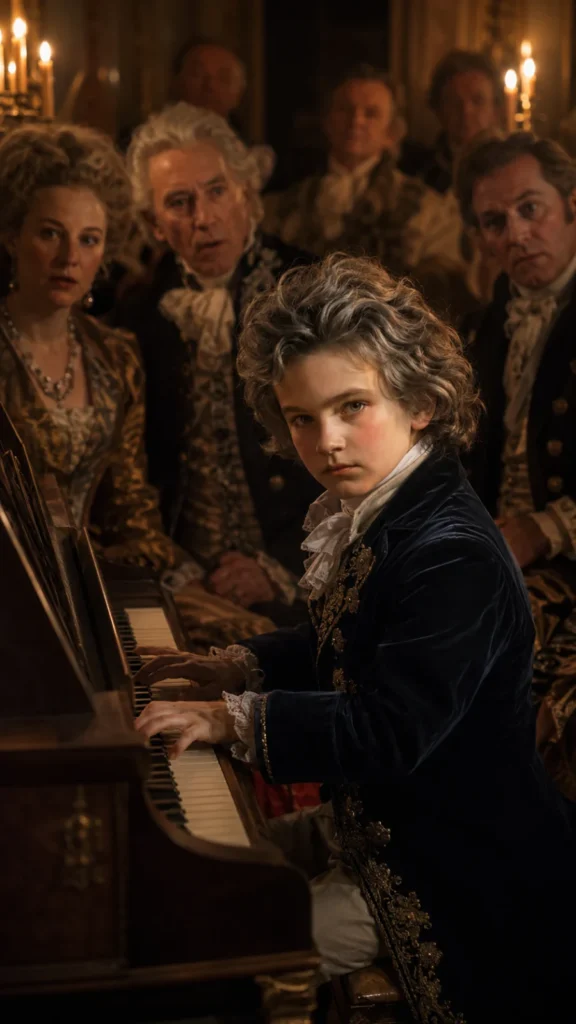
In 1792, Beethoven moved to Vienna, one of Europe’s great musical capitals. He studied with Joseph Haydn and also received instruction from Johann Georg Albrechtsberger and Antonio Salieri.
He first attracted attention as a pianist and improviser. In aristocratic salons, he could take a melody suggested by a listener and transform it into an entire musical structure. His playing was known not only for its power but also for its delicacy, unpredictability, and emotional intensity.
With the support of several patrons, Beethoven achieved something unusual for a composer of his generation: a considerable degree of artistic independence without holding a permanent position in a church or royal court. He was never entirely free from financial worries, but he could determine what to compose with an autonomy rarely enjoyed by Mozart or Haydn.
Just as he was beginning to succeed, silence entered his life.

The retreat of sound
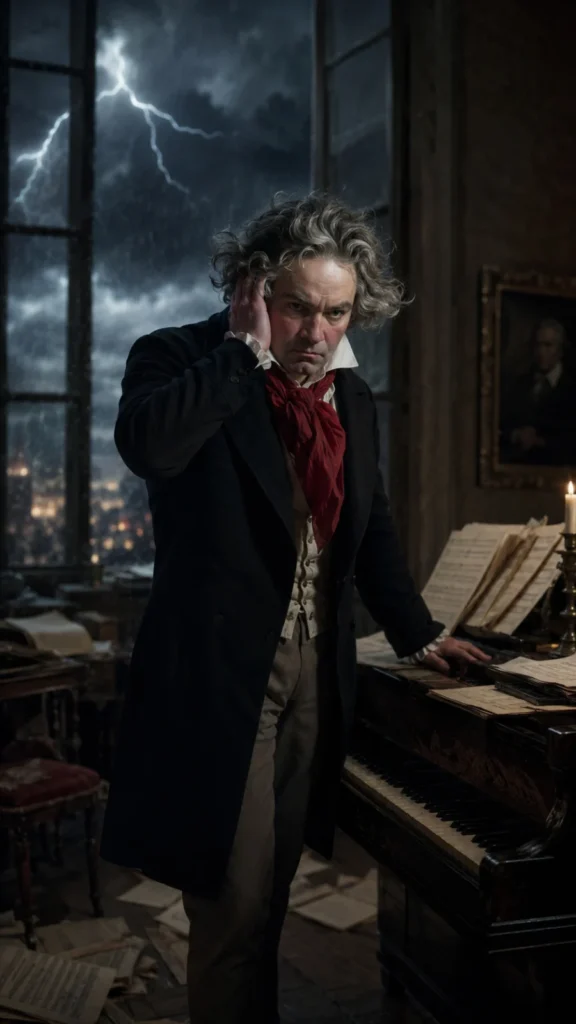
The first serious symptoms of Beethoven’s hearing disorder appeared during the final decade of the eighteenth century. He had difficulty understanding voices at a distance and hearing the higher sounds of musical instruments. He also suffered from tinnitus—noises that seemed to originate inside his own ears.
He consulted physicians, tried different treatments, and spent time in the countryside on medical advice. Nothing stopped the condition from progressing. The precise cause of his deafness remains uncertain. Disorders of the inner ear, inflammatory diseases, and exposure to toxic substances have all been proposed, but none has been definitively established.
His hearing did not disappear at once. For years, Beethoven retained some auditory ability and continued to perform, although doing so became increasingly difficult. The need to pretend that nothing was wrong caused particular anguish. He avoided conversations and withdrew from gatherings, appearing arrogant or inattentive to people who knew nothing about his condition.
In 1802, he spent several months in Heiligenstadt, then a rural village outside Vienna. It was there that he understood his hearing would probably never recover.
The letter he never sent
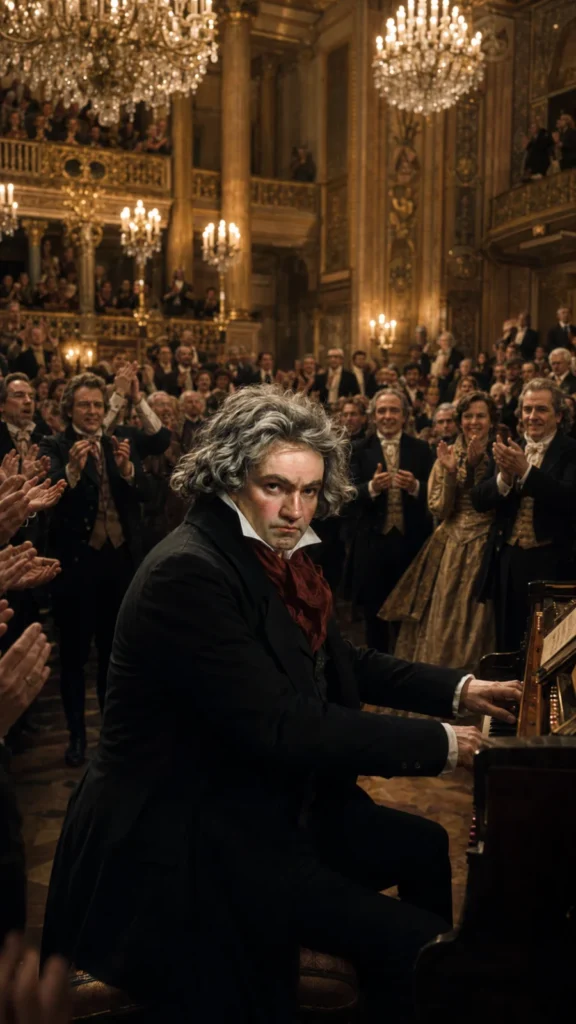
On October 6, 1802, Beethoven began writing a letter addressed to his brothers. He attempted to explain why he had become distrustful, irritable, and solitary. He wanted to approach other people, he wrote, but feared that they would discover his deafness. For a musician, the disability seemed especially humiliating.
He also admitted that he had come close to ending his life. What stopped him was the conviction that he still had works to create.
Beethoven added a few final lines four days later, folded the document, and kept it. He never delivered it to his brothers or made it public. The manuscript was discovered among his papers after his death and became known as the Heiligenstadt Testament.
It was not a legal will. It was the farewell of a man who ultimately decided not to leave.
The document helps us understand his later music without turning his suffering into a comforting legend. Beethoven did not “conquer” deafness. He endured it for the rest of his life. It caused isolation, frustration, and a loss of independence. What was extraordinary was his ability to work within that reality.
Composing after the farewell
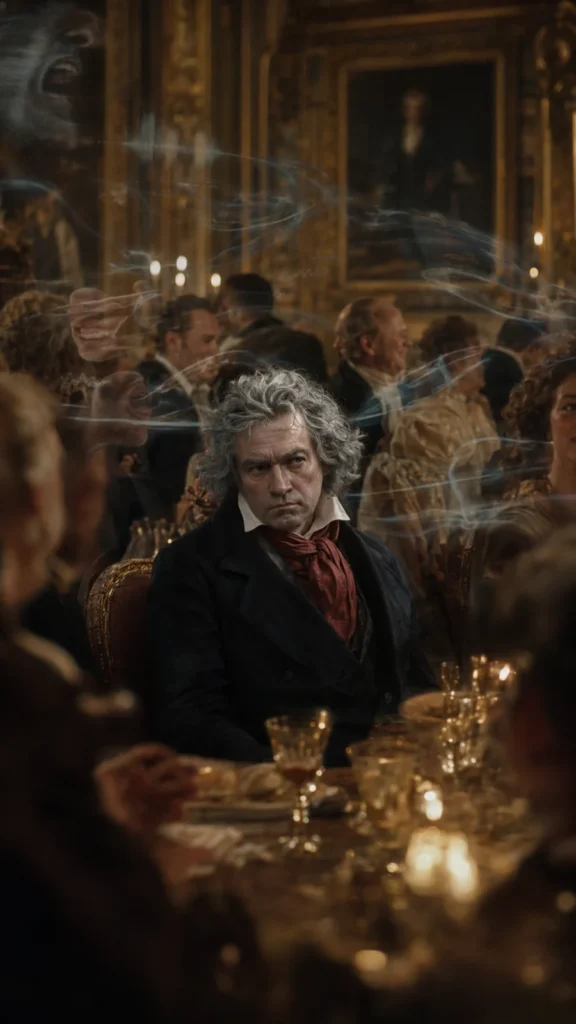
Soon after the Heiligenstadt crisis, Beethoven began producing works that would transform Western music. His Symphony No. 3, known as the Eroica, radically expanded the scale and expressive ambitions of the symphony. It was followed by the Fifth Symphony, the Pastoral, the Appassionata Sonata, the Fifth Piano Concerto, and his only opera, Fidelio.
His music increasingly demanded more from instruments, performers, and audiences. Contrasts became more violent, silences more tense, and conclusions less predictable. Beethoven turned the symphony into a space in which conflict, resistance, and transformation could be enacted.
In December 1808, he organized a concert in Vienna lasting approximately four hours. It included the premieres of his Fifth and Sixth symphonies, along with several other works. The hall was cold, the musicians had received insufficient rehearsal, and the performance suffered a number of mishaps. Yet the program—now an almost unimaginable gathering of masterpieces—reveals the intensity of Beethoven’s creative activity.
Eventually, he could no longer perform as a pianist. He began using notebooks in which visitors wrote their questions and observations while he generally answered aloud. These “conversation books” are invaluable but incomplete historical sources. Beethoven’s secretary and early biographer, Anton Schindler, destroyed some of them and altered others, leaving later scholars with a distorted record.

The man behind the monument
The familiar image of the heroic genius can conceal a difficult human being. Beethoven was capable of generosity and profound loyalty, but he could also be impulsive, suspicious, and controlling.
After his brother Kaspar Karl died in 1815, Beethoven began a prolonged legal struggle for custody of his nephew Karl. He intended to educate and protect the boy, but imposed suffocating expectations and attempted to separate him from his mother. In 1826, Karl attempted suicide. That act cannot responsibly be reduced to a single cause, but the relationship reveals how Beethoven’s affection could become entangled with his need for control.
He also failed to establish a lasting romantic partnership. In 1812, he wrote an impassioned letter to a woman he addressed as his “Immortal Beloved.” Her identity remains unresolved despite extensive investigation and numerous proposed candidates.
Beethoven could write music celebrating universal brotherhood while repeatedly failing at everyday intimacy. The contradiction does not diminish his achievements, but it prevents us from turning him into a flawless monument.
An ovation he could not hear
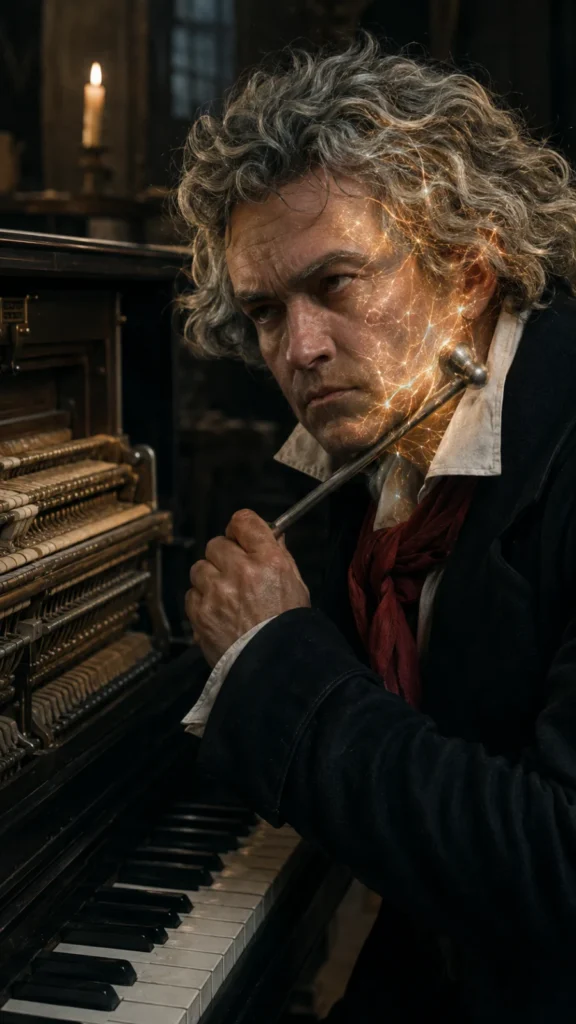
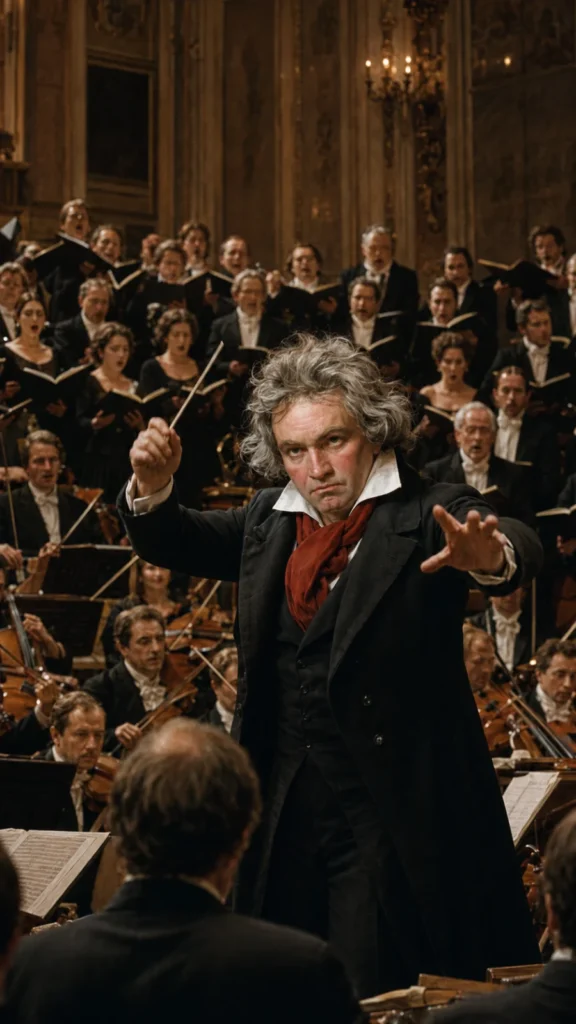
Beethoven’s Symphony No. 9 premiered in Vienna on May 7, 1824. He appeared onstage and followed the performance, but Michael Umlauf exercised practical control over the orchestra after instructing the musicians to follow his own beat.
When the music ended, Beethoven continued facing the performers, unaware of the audience’s response. Several recollections agree that someone had to turn him around so that he could see the applause. Tradition usually identifies that person as the singer Caroline Unger, although the surviving accounts do not agree on every detail.
The essential fact remains: the composer of one of music’s most powerful affirmations of humanity could not hear the ovation it inspired.
The scene is moving, but it should not turn the Ninth Symphony into a story of supernatural triumph. Beethoven could imagine complex music because he possessed decades of training, an exceptional musical memory, and a profound command of composition. Deafness did not grant him a mysterious power. It deprived him of an essential faculty and forced him to develop other ways of working.

Beyond silence
During his final years, Beethoven created works that even some of his contemporaries found bewildering: the Missa solemnis, the final piano sonatas, the Diabelli Variations, and the late string quartets. In them, he moved beyond many of the conventions he had already helped transform.
Beethoven died in Vienna on March 26, 1827, following a prolonged illness. He was fifty-six. His precise medical history remains debated, although strong evidence points to serious liver disease. Thousands of people participated in his funeral.
Among his belongings was the letter written twenty-five years earlier in Heiligenstadt. The man who had prepared his farewell had continued composing almost until the end.
Beethoven’s life was not a simple story of overcoming adversity. He lost his hearing, became isolated, wounded people close to him, and passed through periods of despair. Yet he did not allow tragedy to have the final word.
As the external world faded from his hearing, he constructed an inner one vast enough for us to enter even now.
References
- Beethoven-Haus Bonn. (n.d.). The Heiligenstadt Testament. Digital Archives, Beethoven-Haus Bonn. beethoven.de
- Cooper, B. (2008). Beethoven. Oxford University Press.
- Kinderman, W. (2009). Beethoven (2nd ed.). Oxford University Press.
- Lockwood, L. (2003). Beethoven: The music and the life. W. W. Norton & Company.
- Solomon, M. (1998). Beethoven (Rev. 2nd ed.). Schirmer Books.
- Swafford, J. (2014). Beethoven: Anguish and triumph. Houghton Mifflin Harcourt.
- Wallace, R. (2018). Hearing Beethoven: A story of musical loss and discovery. University of Chicago Press.
More from this collection

Antonio Lucio Vivaldi: The Red Priest Who Made Storms Resound and Died in Silence
Read story →
Franz Schubert: The Musician Who Composed as Though Time Were Chasing Him
Read story →