
Willis Carrier and the air conditioner born from a printing plant’s misaligned colors
One of the most important inventions of the twentieth century was not created to cool people down. It was created because heat and humidity were ruining magazines.
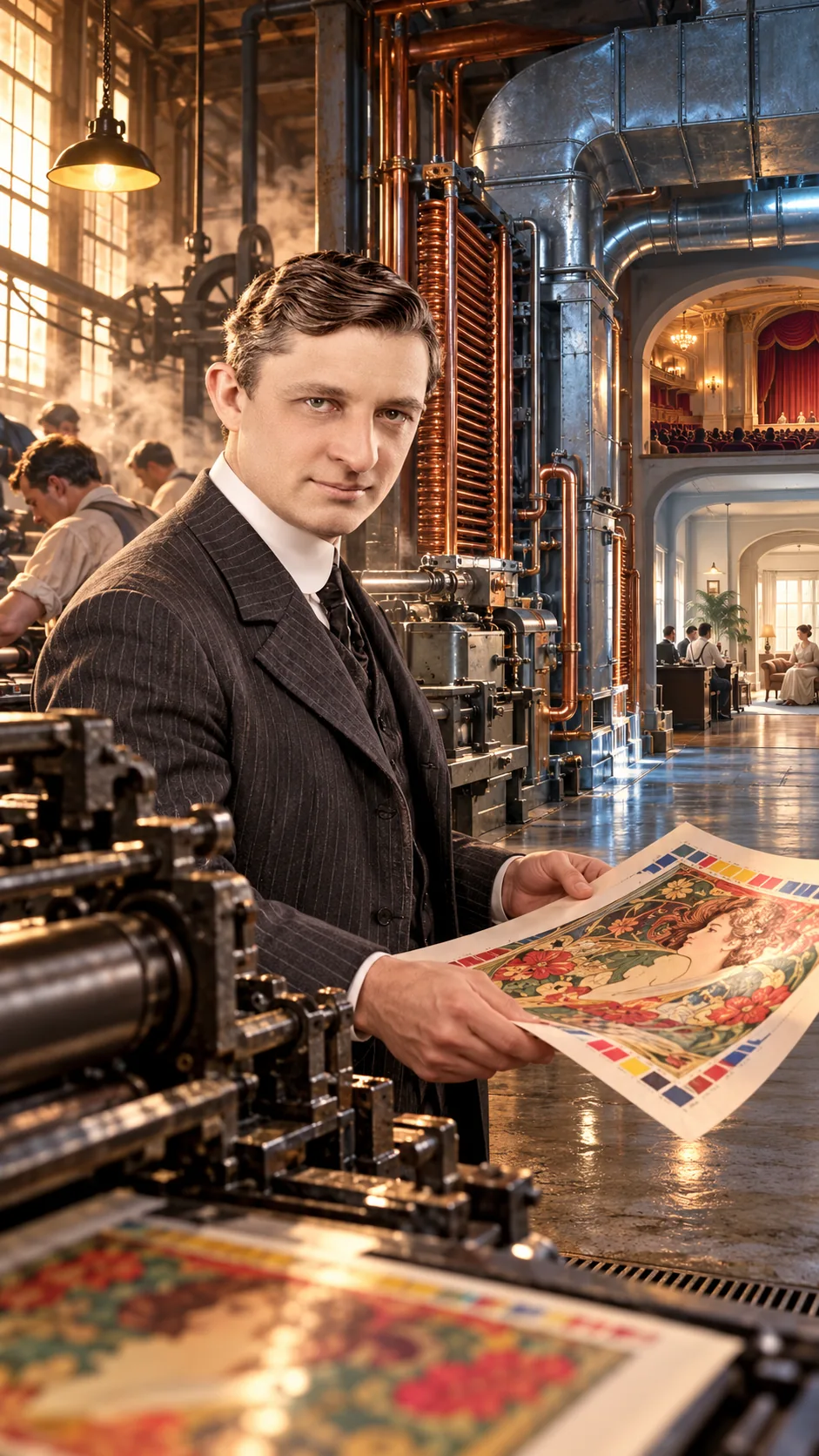
During the summer of 1902, the Sackett & Wilhelms printing plant in Brooklyn faced a problem that seemed impossible to solve.
Humidity slightly changed the size of the paper.
As printers applied yellow, red, blue and black inks in successive passes, the images no longer lined up. The colors appeared displaced, and large amounts of material had to be discarded.
The Buffalo Forge Company sent one of its young engineers to find a solution.
His name was Willis Haviland Carrier. He was 25 years old and had been working for the company for only about a year.
Carrier understood that lowering the temperature would not be enough. He also needed to control the amount of moisture in the air.
On July 17, 1902, Carrier prepared drawings for a system designed to control the environment inside the printing plant.
The equipment circulated air over chilled coils. As the air cooled, some of its water vapor condensed and could be removed.
The installation also included steam pipes to add moisture when necessary.
The printing plant could keep its paper at a stable size and align the different inks correctly.

According to a well-known account later shared by his company, in late fall 1902—after those first drawings—Carrier had another decisive insight while waiting for a train at a fog-covered station in Pittsburgh.
Carrier observed that the fog was air saturated with moisture. He reasoned that controlling the air’s temperature in that state would let him obtain the moisture level he needed.
The station scene belongs to the company’s traditional account. It relates to the subsequent development of his water-spray system, completed in 1903, which could wash the air and humidify or dehumidify it.
The technical work turned air treatment into the control of four essential properties: temperature, humidity, circulation and cleanliness.
The expression “air conditioning” was not yet widely used. Textile engineer Stuart Cramer coined the term in 1906.
Nor was Carrier the first person to attempt to cool a space artificially. Decades earlier, inventors such as John Gorrie had experimented with ice and mechanical refrigeration.
Carrier’s contribution was to turn air treatment into a controllable system based on scientific calculation.
In 1911, he presented his Rational Psychrometric Formulae, mathematically relating temperature and humidity. The work became a foundational reference for generations of engineers.
The technology began spreading through textile mills, pharmaceutical laboratories, tobacco plants, film studios and food factories.
The public would later assume that air conditioning had been created as an escape from summer.
In fact, it began as a young engineer’s answer to sheets of paper that changed size and four inks that refused to stay aligned.
Did you imagine that modern air conditioning had begun as a way to print a magazine correctly?