
In this storyOpen index
Emmy Noether: The Woman Who Found the Laws Hidden Behind Symmetry
Symmetry, algebra, and a mind that transformed science against the barriers of her time.

For years, Emmy Noether taught university courses without a salary, without an official position, and sometimes under a man’s name. She then discovered one of the deepest principles in physics: each continuous symmetry of a physical system’s action, under the theorem’s conditions, corresponds to a conservation law.
If the laws of physics do not change with the passage of time, energy is conserved. If they work identically at different locations, linear momentum is conserved. If they remain unchanged when a system is rotated, angular momentum is conserved.
That relationship supports much of modern physics. Yet the theorem bearing her name represented only one part of her work. Among mathematicians, Noether was even more revolutionary for changing how algebra was understood: she stopped concentrating on particular operations and began revealing the structures that governed them.
The woman whom a university did not want to allow to teach ultimately provided a language that mathematicians and physicists still use to describe the universe.
Emmy Noether
A life told between symmetry and barriers
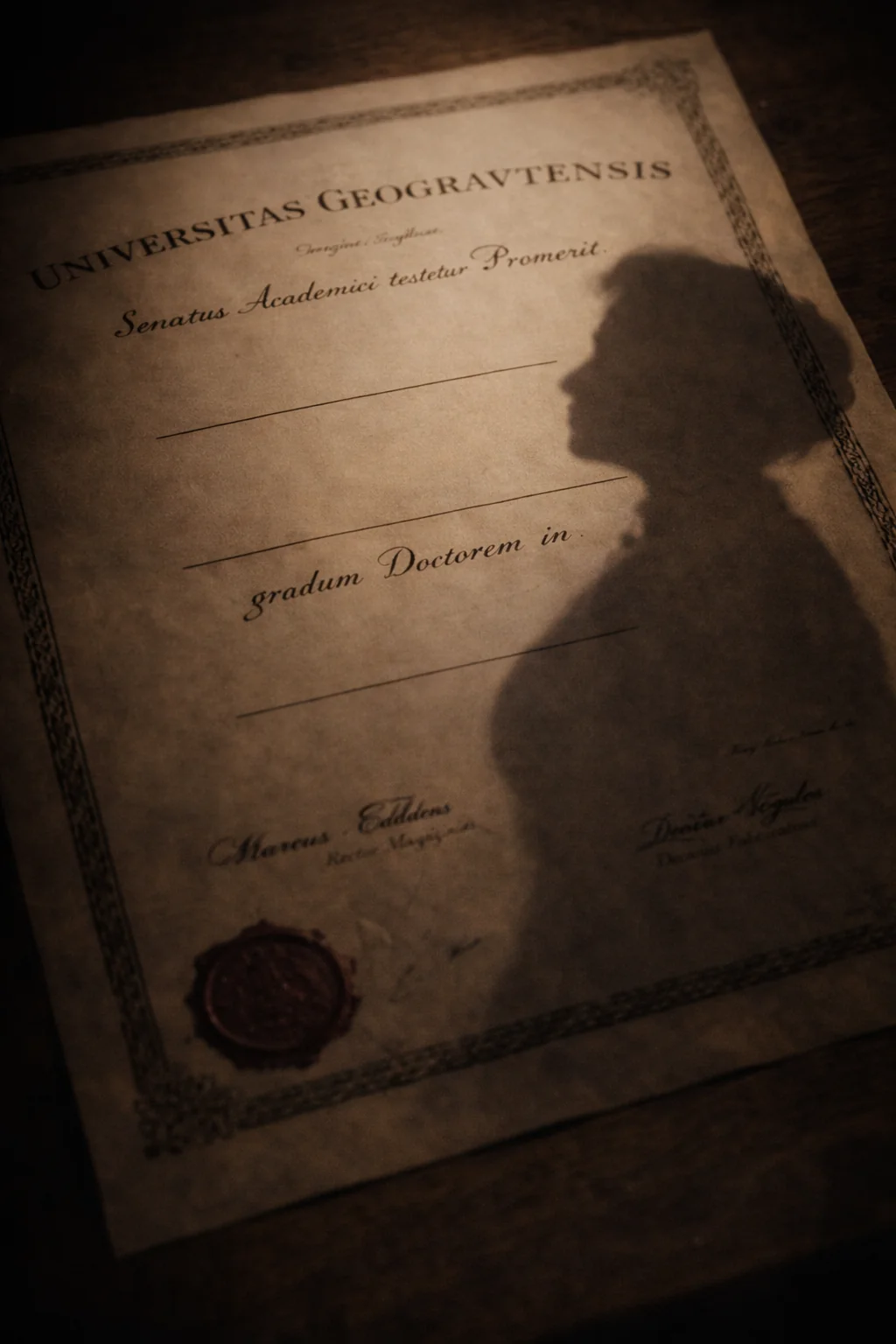
The paper that connected symmetry and conservation
Invariante Variationsprobleme appeared in Göttingen’s scientific proceedings in 1918, pages 235–257. The digital mathematics library provides a record of the publication containing her two theorems. This card uses an AI illustration: it does not reproduce the paper or an authentic Noether document.
AI-generated illustration; an artistic representation, not a historical document.
A young woman trained to teach languages
Amalie Emmy Noether was born on March 23, 1882, in Erlangen, Germany. Her father, Max Noether, was a distinguished mathematician specializing in algebraic geometry. Her mother, Ida Amalia Kaufmann, came from a family of merchants.
Emmy was not initially regarded as a mathematical prodigy. She attended a school for middle-class girls and studied French, English, piano, and domestic subjects. In 1900, she passed the examinations that qualified her to teach French and English in girls’ schools.
She could have followed a path considered relatively acceptable for a woman of her time. Instead, she decided to study mathematics.
German universities still placed enormous obstacles before women. Noether could attend certain classes only as an auditor and needed the individual permission of every professor. At the University of Erlangen, she was one of only two women among approximately one thousand students (Dick, 1981).
She also studied for a semester at Göttingen, where she attended courses taught by figures such as David Hilbert, Felix Klein, and Hermann Minkowski. When Bavaria finally permitted women to enroll regularly, she returned to Erlangen and formally completed her education.
In 1907, she earned her doctorate under Paul Gordan with a dissertation on algebraic invariants.
Seven years of unpaid work
The doctorate did not remove the barriers. Women were generally prevented from obtaining the habilitation, the credential required to teach independently at a German university. Nor could they easily compete for salaried academic appointments.
Noether remained at Erlangen for approximately seven years. She conducted research, occasionally substituted for her father as his health declined, and collaborated with other mathematicians, but received neither an official position nor a regular salary for that work (Rowe, 2021).
During this period, her way of doing mathematics began to change. Her dissertation had followed Gordan’s computational style, known for solving problems through lengthy symbolic manipulations. Gradually, Noether moved toward more conceptual and abstract methods.
Instead of asking only how to calculate an answer, she began searching for the kind of structure that made the calculation possible.
Göttingen needed her mind but resisted recognizing it

In 1915, David Hilbert and Felix Klein invited her to the University of Göttingen, one of the world’s leading centers of mathematics. Both men were studying problems connected with Albert Einstein’s new general theory of relativity and needed Noether’s expertise in invariant theory.
Her arrival provoked resistance within the faculty. Some professors refused to accept that a woman could obtain the habilitation and teach future male civil servants or academics. Hilbert is often credited with replying that a university was not a bathhouse and that the candidate’s sex should not determine her admission. The remark survives in different versions, and its exact wording cannot be documented with complete certainty, but the institutional opposition is well established (Dick, 1981).
During her first years at Göttingen, Noether’s courses were announced and delivered under Hilbert’s name. Officially, he appeared as the professor and she as his assistant.
The university used her knowledge while denying her the full right to claim it.
The problem of energy in relativity

General relativity had transformed gravity into a geometrical property of spacetime. Its structure, however, created difficulties when physicists attempted to express the conservation of energy in the traditional manner.
Hilbert, Klein, and Einstein wanted to understand this apparent anomaly. Noether analyzed the problem from a far more general perspective and discovered that conservation laws were connected to symmetries in physical equations.
In 1918, she published Invariante Variationsprobleme, a paper containing two theorems. The first, now generally known as Noether’s theorem, establishes a relationship between continuous symmetries of a physical action and conserved quantities. The second deals with symmetries depending upon arbitrary functions and is especially relevant to theories such as general relativity (Noether, 1918/1971; Kosmann-Schwarzbach, 2011).
The discovery extended far beyond the original problem. Noether had not merely found another conservation law; she had explained why such laws exist.
When symmetry becomes a law

The word “symmetry” here does not mean only that an object possesses visually matching sides. In physics, a symmetry means that the laws governing a system remain invariant under a particular transformation.
If an experiment obeys the same laws today and tomorrow, there is symmetry under translations in time. Noether’s theorem connects that symmetry with the conservation of energy.
If the laws are the same at different points in space, linear momentum is conserved. If they remain unchanged when the system is rotated, angular momentum is conserved.
This does not mean that the object being studied must itself appear symmetrical. An irregular asteroid can conserve angular momentum while spinning. The relevant symmetry belongs to the laws describing its motion, not necessarily to its shape.
The result became fundamental to classical mechanics, field theory, particle physics, and the study of fundamental interactions. Noether’s work established a two-way connection between symmetries and conservation laws that remains essential when physicists formulate and test theories.
Einstein quickly recognized the depth of her intelligence. Years later, after Noether’s death, he described her as one of the most significant creative mathematical geniuses to emerge since women had begun receiving higher education.
A famous theorem that was not the center of her career
Although the public now associates her name primarily with physics, most of Noether’s work concerned abstract algebra.
Before her influence, many researchers studied expressions, equations, and systems through particular calculations. Noether promoted a structural perspective. She wanted to identify the general properties of objects such as rings, ideals, and modules and determine which results could be proved without depending upon specific examples.
Her 1921 paper Idealtheorie in Ringbereichen played a decisive role in the modern formulation of ideal theory. In it, she developed conditions that make it possible to control ascending chains of ideals and to study when a structure can be described using a finite number of generators (Noether, 1921).
Rings, modules, and other mathematical objects satisfying certain finiteness conditions connected with her ideas are now called “Noetherian.” Her surname became part of the discipline’s fundamental vocabulary.
In simple terms, Noether taught mathematicians to stop looking only at the numbers visible in an operation and to search for the invisible system determining how they could relate to one another.
The professor whose courses evolved as she spoke

Noether was not known for delivering carefully prepared introductory lectures. Her courses could be difficult, improvised, and extremely abstract. She developed new ideas while speaking and expected her students to participate actively in constructing the argument.
An international group of young researchers gathered around her and became informally known as the Noetherknaben, or “Noether boys.” The expression reflects the academic language of the period, although her influence was not limited to male students.
She shared ideas with remarkable generosity. At times, she allowed students to develop and publish results emerging from their conversations. This strengthened her mathematical school but also caused some of her contributions to become dispersed through papers bearing other people’s names (Kimberling, 1981).
Her priority appears to have been the advancement of mathematics rather than the jealous protection of authorship.
Recognition arrived without real security
After the First World War, university regulations changed, and Noether finally obtained her habilitation in 1919. In 1922, she received the title of an unofficial extraordinary professor, but the appointment did not provide the security of a regular chair or an appropriate salary.
She eventually received modest compensation for her teaching, far below the academic status justified by her contributions.
Her international reputation nevertheless grew. She spent the 1928–1929 academic year as a visiting professor in Moscow and maintained relationships with mathematicians from many countries. In 1932, she shared the Ackermann–Teubner Memorial Prize with Emil Artin for their contributions to mathematics.
That same year, she delivered a plenary lecture at the International Congress of Mathematicians in Zürich, one of the discipline’s highest honors. After decades of exclusion, her scientific authority could no longer be ignored, even though her employment remained insecure (Rowe, 2021).
Expulsion and the fracture of her academic world

In 1933, the Nazi regime enacted laws allowing universities to remove Jewish professors and people considered politically suspect. Noether was Jewish, had expressed social-democratic sympathies, and maintained international intellectual relationships.
Her right to teach at Göttingen was revoked.
Werner Weber, a former student connected with her academic circle, aligned himself with the Nazi movement inside the university and participated in campaigns against Jewish academics. The institution that had used her work for years without granting her equality finally expelled her because of her ancestry.
Noether continued meeting students in her apartment for a time. She later received assistance to relocate to the United States and accepted a temporary appointment at Bryn Mawr College, a women’s institution in Pennsylvania (Dick, 1981).
Within months, Göttingen lost numerous Jewish or politically persecuted scientists. A center that had dominated much of European mathematics and physics was intellectually devastated by its own policies.
An exile that lasted too briefly

At Bryn Mawr, Noether found a more welcoming environment and a group of female students eager to learn modern algebra. She also lectured weekly at the Institute for Advanced Study in Princeton.
The Institute for Advanced Study and Princeton University must be distinguished: they were independent institutions. The Institute welcomed women researchers, including Noether; Princeton University maintained restrictions on women. Inequalities nevertheless persisted at the Institute: Noether received no honorariums for her lectures, unlike other male visiting lecturers (Institute for Advanced Study, 2017).
Her American period lasted less than two years. In April 1935, she underwent surgery to treat a pelvic tumor or cyst. She initially appeared to recover but developed postoperative complications and died on April 14 at the age of 53 (Dick, 1981).
Albert Einstein wrote a tribute published in The New York Times, emphasizing the greatness of her mathematical thought. Public recognition arrived when she could no longer receive it.
The woman behind the invisible laws

Emmy Noether did not work at the edge of the human limit because she was obsessed with solving a single equation. She lived at a boundary imposed by institutions that accepted her results while questioning her right to produce them.
First she studied as an auditor. Then she worked without pay. Later, she taught under Hilbert’s name. When she finally received recognition, she was given a position inferior to the one she deserved. And when her prestige had become international, the Nazi regime expelled her for being Jewish.
None of those barriers diminished her thought.
Her theorem revealed that the conservation of energy, momentum, and other quantities is not an accidental collection of rules. They are consequences of nature’s deepest symmetries.
Her algebra taught mathematicians to look beyond visible calculations and recognize general structures. Many branches of modern mathematics use concepts bearing her name, even when those applying them know little about her life.
Noether found order behind the movement of the universe. The irony is that she had to do so within an academic world incapable of recognizing the simplest order of all: a mind should be judged by what it discovers, not by the sex or ancestry of the person thinking.
References
- Byers, N. (1998). E. Noether’s discovery of the deep connection between symmetries and conservation laws. arXiv:physics/9807044. View source
- Dick, A. (1981). Emmy Noether, 1882–1935. Birkhäuser. View source
- Kimberling, C. (1981). Emmy Noether and her influence. In J. W. Brewer & M. K. Smith (Eds.), Emmy Noether: A tribute to her life and work (pp. 3–61). Marcel Dekker. View source
- Kosmann-Schwarzbach, Y. (2011). The Noether theorems: Invariance and conservation laws in the twentieth century. Springer. View source
- Noether, E. (1921). Idealtheorie in Ringbereichen. Mathematische Annalen, 83, 24–66. View source
- Noether, E. (1971). Invariant variation problems (M. A. Tavel, Trans.). Transport Theory and Statistical Physics, 1(3), 186–207. (Original work published 1918). View source
- Quigg, C. (2019). Colloquium: A century of Noether’s theorem. arXiv:1902.01989. View source
- Rowe, D. E. (2021). Emmy Noether—Mathematician extraordinaire. Springer. View source
- Institute for Advanced Study. (2017). Emmy Noether’s Paradise. View source
- Noether, E. (1918). Invariante Variationsprobleme. Nachrichten von der Gesellschaft der Wissenschaften zu Göttingen, Mathematisch-Physikalische Klasse, 235–257. View source
More from this collection

Hypatia of Alexandria: The Mathematician Whose Authority Became Dangerous
Read story →
Georg Cantor: The Man Who Discovered That Some Infinities Are Larger Than Others
Read story →