
In this storyOpen index
Hannah Arendt: The Woman Who Refused to Think as She Was Told
From exile to political theory: totalitarianism, responsibility, and the difficult task of thinking for oneself.
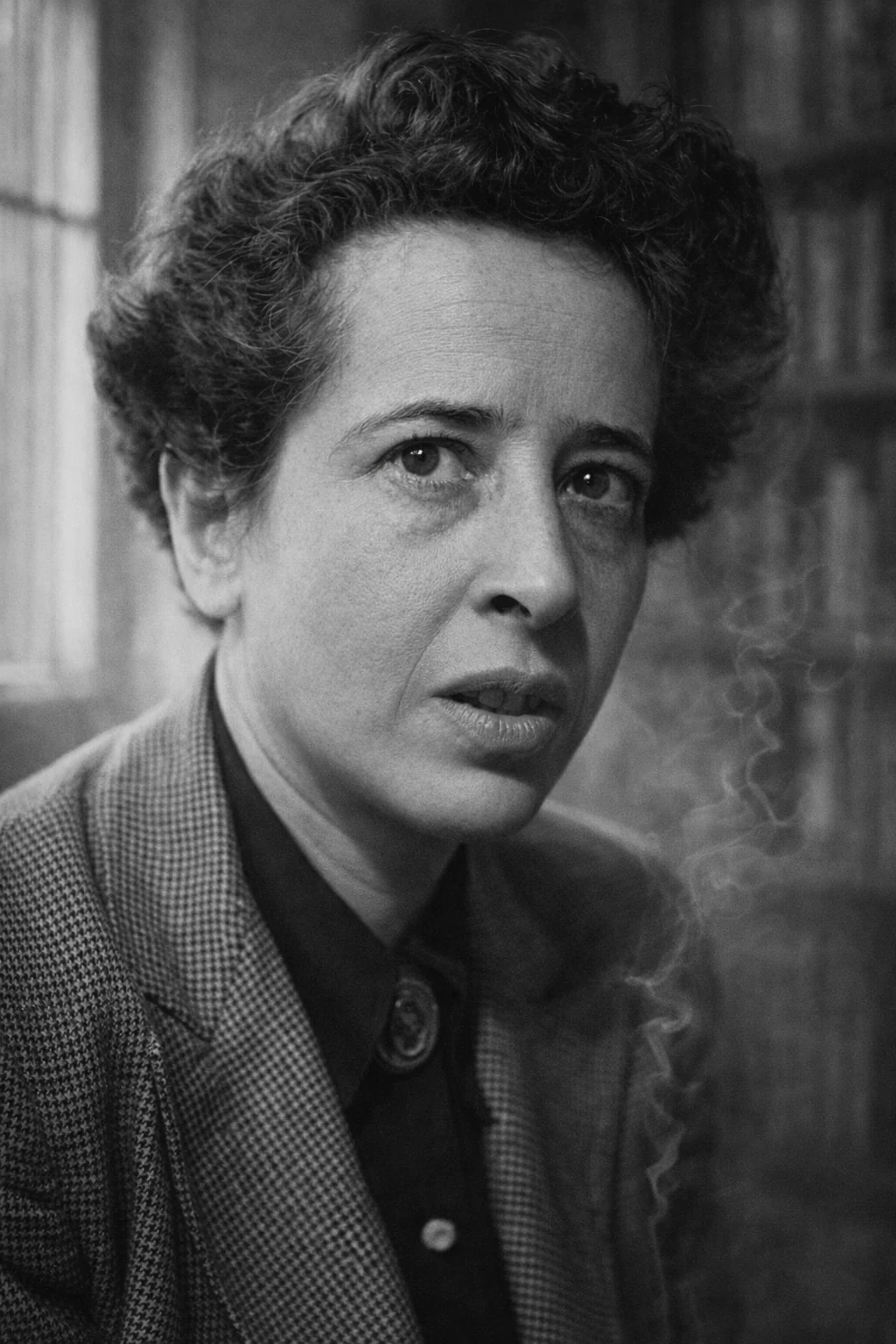
In 1933, a young Jewish philosopher was arrested by the Gestapo while collecting evidence of the antisemitic propaganda distributed by Germany’s new Nazi regime. For eight days, she endured interrogation without revealing who had assigned her the work. When she regained her freedom, she understood that she could no longer limit herself to studying the world. She would have to confront it.
That woman was Hannah Arendt. She escaped Germany, lived as a refugee in France, was interned by the same country that had offered her asylum, escaped once more, and reached the United States without citizenship. From those experiences, she wrote about totalitarianism, statelessness, individual responsibility, and the ease with which an ordinary person can participate in a criminal system.
She never agreed to belong completely to a school, party, or intellectual identity. Nor did she ask permission to question her opponents, her allies, or her own community. That independence made her one of the twentieth century’s most influential and controversial political thinkers.
Hannah Arendt
A life devoted to understanding

Hannah Arendt Papers
The Library of Congress preserves manuscripts, correspondence, lectures, and personal documents that illuminate Arendt’s work. Spanning 1898–1977, the collection contains about 25,000 items. It helps place her books and controversies in context, beyond quotations circulated in isolation. This card’s image is an artistic recreation, not an archival photograph.
A Jewish Childhood Without Religious Education
Johanna Arendt was born on October 14, 1906, in Linden, near Hannover, into a prosperous and largely secular German Jewish family. She grew up mainly in Königsberg, Immanuel Kant’s city, then part of East Prussia.
Her father, Paul Arendt, suffered from syphilis and died in 1913, when Hannah was seven. Her mother, Martha Cohn Arendt, was a woman of social democratic convictions who raised her daughter with a combination of intellectual freedom and firmness. When Hannah encountered antisemitic remarks from other children, Martha taught her not to accept humiliation silently and to demand that the school respond.
Arendt later recalled understanding very early that she was Jewish, although she received no traditional religious education. For her, Jewish identity was not a doctrine she had chosen but a historical reality imposed upon her by the world. Years later, she insisted that when someone is attacked as a Jew, that person must respond as a Jew rather than hide behind a universal abstraction.
From adolescence, she read philosophy, Greek literature, and German poetry. She was brilliant, defiant, and unwilling to accept academic authority as a sufficient argument.
Heidegger: Admiration, Love, and Contradiction
In 1924, Arendt entered the University of Marburg and studied with Martin Heidegger, one of the era’s most important philosophers. He was thirty-five, married, and a father. She was eighteen.
A secret romantic relationship began between them. The inequality was clear: Heidegger was her professor and controlled the conditions under which they met. Arendt, however, was not intellectually passive. His classes introduced her to a new way of questioning existence, time, and human experience, although she would later distance herself from his contempt for ordinary politics and public life.
The affair ended, but it never disappeared from her story. In 1933, Heidegger joined the Nazi Party and, as rector of the University of Freiburg, participated in adapting the institution to the new regime. Arendt broke off contact for years. After the war, she renewed her intellectual and personal relationship with him and even contributed to his public rehabilitation.
That decision remains one of the most difficult contradictions in her life. The woman who analyzed political responsibility with extraordinary severity maintained a lasting loyalty toward a man who had supported Nazism. Her defenders point to an emotional and intellectual bond that could not easily be erased. Her critics observe that she extended a degree of indulgence to Heidegger that she denied to others.
Reducing Arendt to that relationship would be unjust. Ignoring it would be equally so.

Jaspers and the Education of Responsibility
Arendt left Marburg and continued her studies with Edmund Husserl in Freiburg. She eventually moved to Heidelberg, where she completed her doctorate under Karl Jaspers. Her dissertation, published in 1929, examined the concept of love in Saint Augustine.
Jaspers represented a different influence from Heidegger. He defended dialogue, communication, and moral responsibility between persons. He became Arendt’s mentor, friend, and correspondent for decades.
In 1929, she married Günther Stern, later known as Günther Anders. Both belonged to a generation of young Jewish intellectuals attempting to find a place within an increasingly hostile German society. Their marriage ended in divorce in 1937, but Stern would later help obtain documents necessary for Arendt’s escape from Europe.
During the early 1930s, Arendt worked on a biography of Rahel Varnhagen, a Jewish woman who had conducted an influential literary salon in nineteenth-century Berlin. Through Varnhagen, she studied the desire for assimilation and the cost of attempting to escape an identity rejected by society. The book would not appear until 1957, but it anticipated many of her later concerns.
Eight Days in Gestapo Custody
When Hitler came to power in January 1933, Arendt ceased believing that philosophy could remain separate from events. At the request of Zionist leader Kurt Blumenfeld, she began collecting examples of antisemitic propaganda in state libraries that could be used abroad to demonstrate what was happening in Germany.
Arendt was arrested and interrogated for eight days. She persuaded the officer handling her case that she did not belong to a structured political organization and was released. Soon afterward, she and her mother escaped Germany illegally, passing through Czechoslovakia and Switzerland before reaching Paris (PBS, 2025).
The lesser-known fact is not merely that the Gestapo arrested her, but the nature of her mission: she was documenting words. She had understood that persecution did not necessarily begin with camps and deportations. It began when repeated lies, normalized insults, and administrative categories prepared a society to exclude part of its population.

A Refugee in Paris
In France, Arendt worked with Jewish organizations that helped young refugees emigrate to Palestine. Between 1935 and 1939, she held a position with Youth Aliyah and later assisted operations intended to rescue Jewish children from Austria and Czechoslovakia (Library of Congress, n.d.-a).
She was not yet the celebrated professor seen in later photographs. She was a woman without financial security, dependent upon temporary documents and networks of solidarity. In 1937, the Nazi regime formally stripped her of German citizenship. She remained stateless until becoming an American citizen in 1951.
In Paris, she met Heinrich Blücher, a self-educated worker and former Communist activist who had broken with Stalinism. They married in January 1940. Blücher lacked a university degree, but he became one of her most important intellectual partners. His experience with revolutionary action helped redirect Arendt from abstract philosophy toward the concrete study of politics.
She also developed a close friendship with Walter Benjamin. The German critic lived an equally precarious life in exile. After Benjamin died in 1940 while attempting to cross the Spanish border, Arendt helped preserve and transmit some of his writings. The image of an intellectual generation scattered across Europe shaped her understanding of the century.

Interned by Her Protectors
In May 1940, as Germany invaded France, the French government ordered the internment of many foreigners from enemy countries. The measure also affected thousands of Jewish refugees who had fled the Nazis.
Arendt was sent to the Gurs camp in southern France. She would later summarize the paradox of the modern refugee: persecuted by enemies and interned by friends.
Conditions at Gurs were miserable. When France capitulated and the administration fell into confusion, Arendt obtained release papers and left the camp with a small group of women. Approximately four weeks after arriving, she walked and traveled however she could to Montauban, where she reunited with Blücher, who had also escaped internment (We Refugees Archive, n.d.).
The decision was crucial. Many people who remained at Gurs eventually fell under Vichy control and were later deported to Nazi camps. More than eighteen thousand Jews passed through Gurs between 1940 and 1943 (United States Holocaust Memorial Museum, n.d.-a).
With the assistance of the rescue network organized by Varian Fry and his associates, Hannah Arendt and Heinrich Blücher secured visas and travel permits. They crossed Spain, reached Lisbon, and sailed for New York in May 1941 (United States Holocaust Memorial Museum, n.d.-b).
A Stateless Woman in New York
Arendt arrived in the United States with few resources and limited English. She worked as a journalist, editor, and employee of Jewish cultural organizations. She wrote for the German Jewish newspaper Aufbau and argued that Jews needed to participate actively in their own defense.
She also worked for the Commission on European Jewish Cultural Reconstruction, helping locate Jewish books, archives, and cultural objects looted or displaced by the Nazis. This work, rarely remembered beside her major books, temporarily took her back to Europe after the war.
The experience of having no citizenship became central to her thinking about human rights. Arendt observed that supposedly universal rights became fragile when a person lost membership in a political community capable of guaranteeing them. Before claiming freedom of expression, property, or political participation, something even more fundamental was required: “the right to have rights” (Arendt, 1951/1973).
She was not arguing that rights were worthless. She was warning that a written declaration alone cannot protect someone whom no state recognizes as a member.

The Origins of Totalitarianism
In 1951, Arendt published The Origins of Totalitarianism, the book that established her international reputation. That same year, she became an American citizen.
The work examined antisemitism, imperialism, and the rise of totalitarian movements. Arendt compared Nazism and Stalinism without claiming that they were identical in every respect. She wanted to understand how both destroyed political institutions, turned ideology into an absolute explanation, and used terror to manufacture societies in which individuals were isolated from one another.
For Arendt, totalitarianism was not merely an especially cruel dictatorship. It sought to dominate the whole of human life and eliminate spontaneity—the capacity to begin something new.
Historians have revised or challenged parts of the book. Its treatment of imperialism, some of its generalizations, and its comparison between regimes remain subjects of debate. Nevertheless, its analysis of social loneliness, propaganda, and the destruction of shared reality remains extraordinarily influential (Stanford Encyclopedia of Philosophy, 2024).
Action and Public Life
In The Human Condition, published in 1958, Arendt distinguished among labor, work, and action. Labor corresponds to the repetitive necessities of life; work constructs objects and a relatively durable human world; action occurs when people speak and act together in public.
For her, politics should not be reduced to administration, violence, or state control. It arose from plurality: the fact that human beings are equal in dignity yet distinct from one another.
This view also explains her distrust of every ideology claiming to possess a final answer. Political thought required judging particular situations and attempting to see the world from different perspectives.
Arendt did not comfortably identify herself as a philosopher. She preferred “political theorist,” partly because she believed that the philosophical tradition had often distrusted plurality and the disorder of public life.
In 1959 she was a visiting professor at Princeton. The university’s institutional history identifies her as the first woman to lecture to its undergraduates in that capacity, during 1958–1959. This appointment should not be confused with a tenured position. She also taught at the University of Chicago, Wesleyan, and The New School (Princeton University, n.d.).

Eichmann in the Courtroom
In 1960, Israeli agents captured Adolf Eichmann in Argentina. Eichmann had been one of the principal organizers of the deportation of European Jews to ghettos and extermination centers. His trial opened in Jerusalem in April 1961.
Arendt offered to cover the proceedings for The New Yorker. She expected to encounter a figure of demonic hatred. Instead, she observed a defendant who spoke in clichés, administrative language, and justifications based upon obedience to orders.
Her articles appeared in 1963 and later became Eichmann in Jerusalem: A Report on the Banality of Evil. The phrase “the banality of evil” became one of the twentieth century’s most famous and most distorted ideas.
Arendt did not claim that the crimes were banal or insignificant. Nor did she argue that Eichmann was innocent or unaware of the consequences of his actions. She supported his conviction and considered the imposed penalty legitimate.
Her argument was that extraordinary evil could be carried out by someone intellectually superficial, unable or unwilling to examine his actions from another person’s perspective. Eichmann did not need satanic depths to administer mass deportations. He needed only to turn obedience, career advancement, and bureaucratic language into substitutes for moral judgment (Arendt, 1963/2006).

The Controversy That Nearly Left Her Alone
The book provoked an immediate backlash. Many readers considered Arendt’s tone cold, ironic, and insensitive toward survivors. Her description of certain leaders of the Jewish councils—the Judenräte—was particularly painful. Arendt argued that Nazi administrators had used existing Jewish communal structures to organize registration, confiscation, and deportation.
Although this coercive use of administration is historically documented, her generalizations did not always reflect differences among locations, circumstances, and actual possibilities of resistance. Later critics have argued that she judged from an unfair distance people forced to make impossible decisions under threat of death.
Her portrait of Eichmann has also been challenged. Documents and later studies showed that he was not merely an empty bureaucrat. He had expressed antisemitic convictions and demonstrated initiative in persecution. This does not necessarily destroy the broader idea of the banality of evil, but it weakens the presentation of Eichmann as its perfect example.
Arendt lost friendships and faced accusations of betrayal. Her former friend Gershom Scholem accused her of lacking love for the Jewish people. She replied that she had never loved collectivities, only people.
Her refusal to soften the book can be understood as intellectual courage or stubbornness. It was probably both. She did not ask permission to raise her questions, but independence did not make her immune to error.

Thinking Without Banisters
During her later years, Arendt wrote about revolution, violence, civil disobedience, truth, and political lying. She criticized both McCarthyism and the deceptions of the United States government during the Vietnam War. She supported civic participation and valued the spontaneous councils that emerge when people create new forms of political action.
She used the expression “thinking without banisters” to describe intellectual activity that does not depend upon prefabricated ideological rules. That freedom did not mean thinking without rigor. It required pausing, examining facts, and accepting that no formula could replace judgment.
After Heinrich Blücher died in 1970, she continued working on The Life of the Mind. The project was designed to examine thinking, willing, and judging. She completed only the first two parts.
On December 4, 1975, while entertaining friends in her New York apartment, Arendt suffered a heart attack and died. She was sixty-nine. She was buried beside Blücher at Bard College.
The Woman Who Made Thinking a Responsibility
Hannah Arendt never provided a simple manual for recognizing tyranny. Her ideas do not function as slogans that can be placed over every political crisis. She herself distrusted automatic analogies and explanations that made it unnecessary to examine particular facts.
Her life demonstrates why she thought that way. She had witnessed educated citizens accept propaganda, a democracy surrender its institutions to a totalitarian movement, refugees administratively transformed into enemies, and bureaucratic language used to conceal individual responsibility.
For Arendt, thinking did not mean accumulating academic intelligence. Heidegger was uncomfortable proof that a brilliant mind could fail politically. Thinking meant maintaining a silent conversation with oneself and asking whether one could live with the person one would become after acting.
She did not always apply that demand consistently. Her judgments concerning Heidegger, Eichmann, and the Jewish councils reveal genuine blind spots. Yet even her errors forced generations to debate responsibility, obedience, and truth.
Arendt did not ask permission to enter universities run by men, argue with organizations she had assisted, or contradict comfortable versions of events. She had lost one homeland and learned that no identity by itself guaranteed truth.
That is why she defended something more difficult than having opinions: the obligation to think before obeying and to exercise judgment even when the world supplies a ready-made phrase with which to avoid it.

References
- Arendt, H. (1973). The origins of totalitarianism. Harcourt Brace Jovanovich. (Original work published 1951).
- Arendt, H. (1998). The human condition (2nd ed.). University of Chicago Press. (Original work published 1958).
- Arendt, H. (2006). Eichmann in Jerusalem: A report on the banality of evil. Penguin Books. (Original work published 1963).
- Arendt, H. (1978). The life of the mind. Harcourt Brace Jovanovich.
- Bard College. (n.d.). About Hannah Arendt. Hannah Arendt Center for Politics and Humanities.
- Library of Congress. (n.d.-a). Hannah Arendt (1906–1975): Timeline. Hannah Arendt Papers.
- Library of Congress. (n.d.-b). Evil: The crime against humanity. Hannah Arendt Papers.
- Library of Congress. (n.d.-c). World of Hannah Arendt. Hannah Arendt Papers.
- PBS. (2025). Hannah Arendt: Facing tyranny. American Masters.
- Stanford Encyclopedia of Philosophy. (2024). Hannah Arendt.
- United States Holocaust Memorial Museum. (n.d.-a). Gurs. Holocaust Encyclopedia.
- United States Holocaust Memorial Museum. (n.d.-b). Varian Fry. Holocaust Encyclopedia.
- We Refugees Archive. (n.d.). Hannah Arendt on fleeing from the internment camp.
- Young-Bruehl, E. (2004). Hannah Arendt: For love of the world (2nd ed.). Yale University Press.
- Princeton University. (n.d.). Women. Princetoniana.
More from this collection

Queen Victoria: The Young Woman Who Escaped a Cage and Became the Symbol of an Empire
Read story →
Joanna la Beltraneja: The Princess Robbed of a Kingdom Who Never Stopped Signing Herself as Queen
Read story →