Mathematicians, Codes, and Obsessions That Approached the Human Limit · Story 03
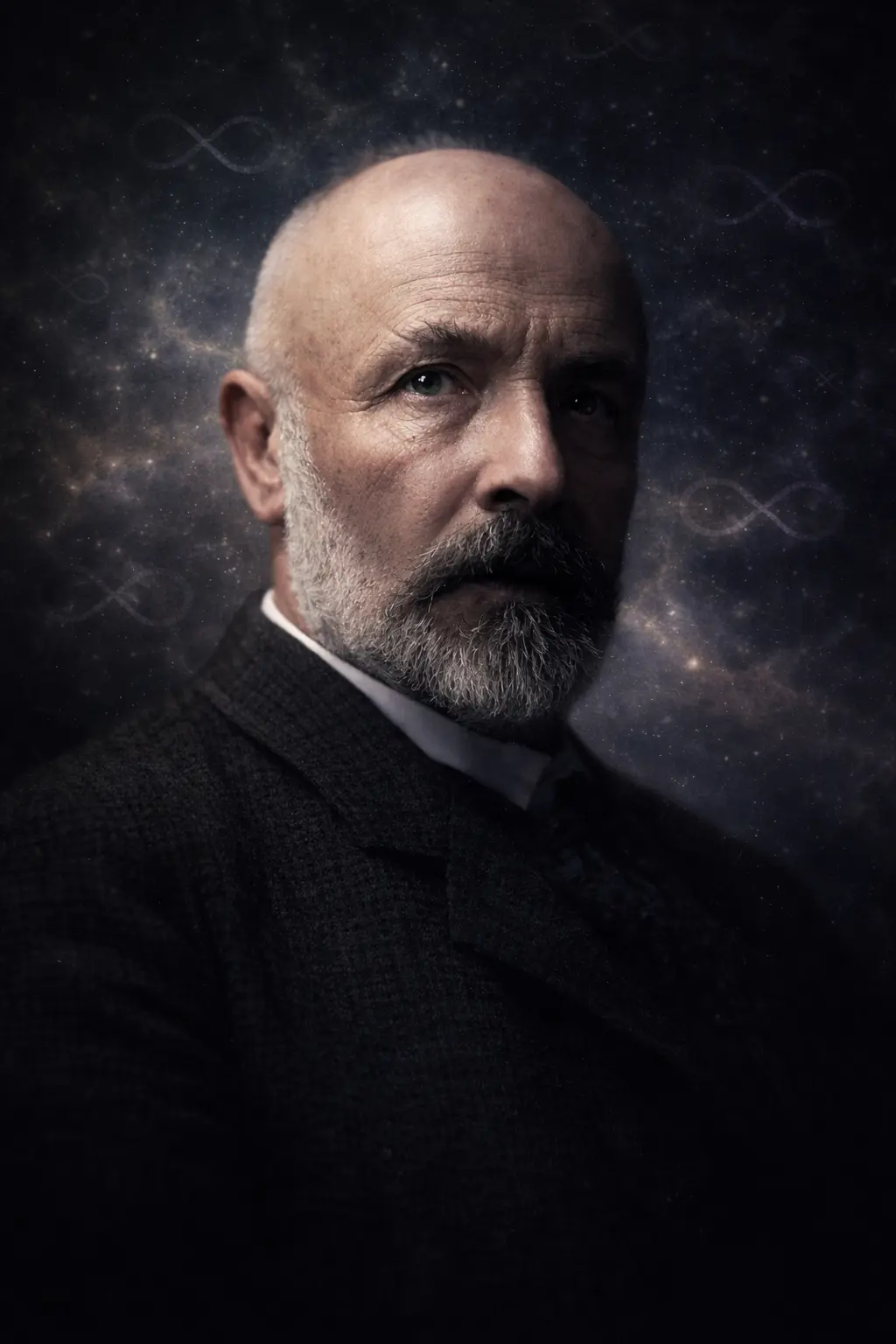
Georg Cantor: The Man Who Discovered That Some Infinities Are Larger Than Others
The mathematician who turned infinity into a hierarchy forever changed the foundations of mathematics.
For centuries, infinity had been a philosophical frontier: it could
be imagined as a process that never ended, but not as an object that
could be measured, compared, or subjected to calculation. Georg Cantor
then asserted something that appeared impossible: there is no single
infinity. Infinities come in different sizes, and after each one,
another, larger infinity can always be constructed.
The idea transformed mathematics, provoked fierce intellectual
resistance, and led Cantor toward a problem he could never solve. In his
later years, as his theories gained acceptance, he alternated
mathematical investigations with psychiatric hospitalizations, religious
reflection, and an unexpected obsession: proving that Francis Bacon had
written the works attributed to Shakespeare.
Cantor succeeded in ordering infinity, but spent much of his life
confronting everything he could not control.
Watch the story
The man who discovered that some infinities are larger than others
The story of Georg Cantor, the mathematician who learned how to compare the size of infinity.
▶YouTube video blockedAccept media content to play it.
title="The man who discovered that some infinities are larger than others" allow="accelerometer; autoplay; clipboard-write; encrypted-media; gyroscope; picture-in-picture; web-share" referrerpolicy="strict-origin-when-cross-origin" allowfullscreen
The 1874 paper preserves the proof with which Cantor first distinguished two sizes of infinity and opened a new era for set theory.
Ueber eine Eigenschaft des Inbegriffes aller reellen algebraischen ZahlenJournal für die reine und angewandte Mathematik1874Vol. 77, pp. 258–262
Collection
European Digital Mathematics Library
Institution
EuDML
Digital record of Cantor’s foundational paper.
A Violinist
Pressured to Study Engineering
AI-generated visual recreation.
Georg Ferdinand Ludwig Philipp Cantor was born on March 3, 1845, in
St. Petersburg, into a family of merchants and musicians. His father,
Georg Woldemar Cantor, was a successful broker; his mother, Maria Anna
Böhm, came from a musical family. Young Georg inherited this artistic
environment and became a skilled violinist (Dauben, 1979).
When he was eleven, the family moved to Germany because of his
father’s health. Cantor displayed exceptional mathematical ability, but
his father preferred that he study engineering, which he considered a
more secure profession. In 1862, after insisting on his true vocation,
Cantor obtained permission to devote himself to mathematics.
He studied at the University of Zurich and later in Berlin, where his
teachers included Karl Weierstrass, Ernst Kummer, and Leopold Kronecker.
In 1867, he received his doctorate for research in number theory. Two
years later, he began working at the University of Halle, where he would
remain for nearly his entire career (Dauben, 1979).
Cantor hoped eventually to obtain a professorship in Berlin, the
great center of German mathematics. He never succeeded. That frustration
became intertwined with his intellectual and personal conflict with
Kronecker.
The
Problem That Opened the Door to Infinity
AI-generated visual recreation.
Cantor’s earliest research did not directly concern infinite sets. He
studied trigonometric series and the problem of determining when a
function could be represented uniquely by such a series. His
investigation of exceptional points led him toward collections of
numbers and, eventually, toward a new way of thinking about infinite
totalities (Ferreirós, 2007).
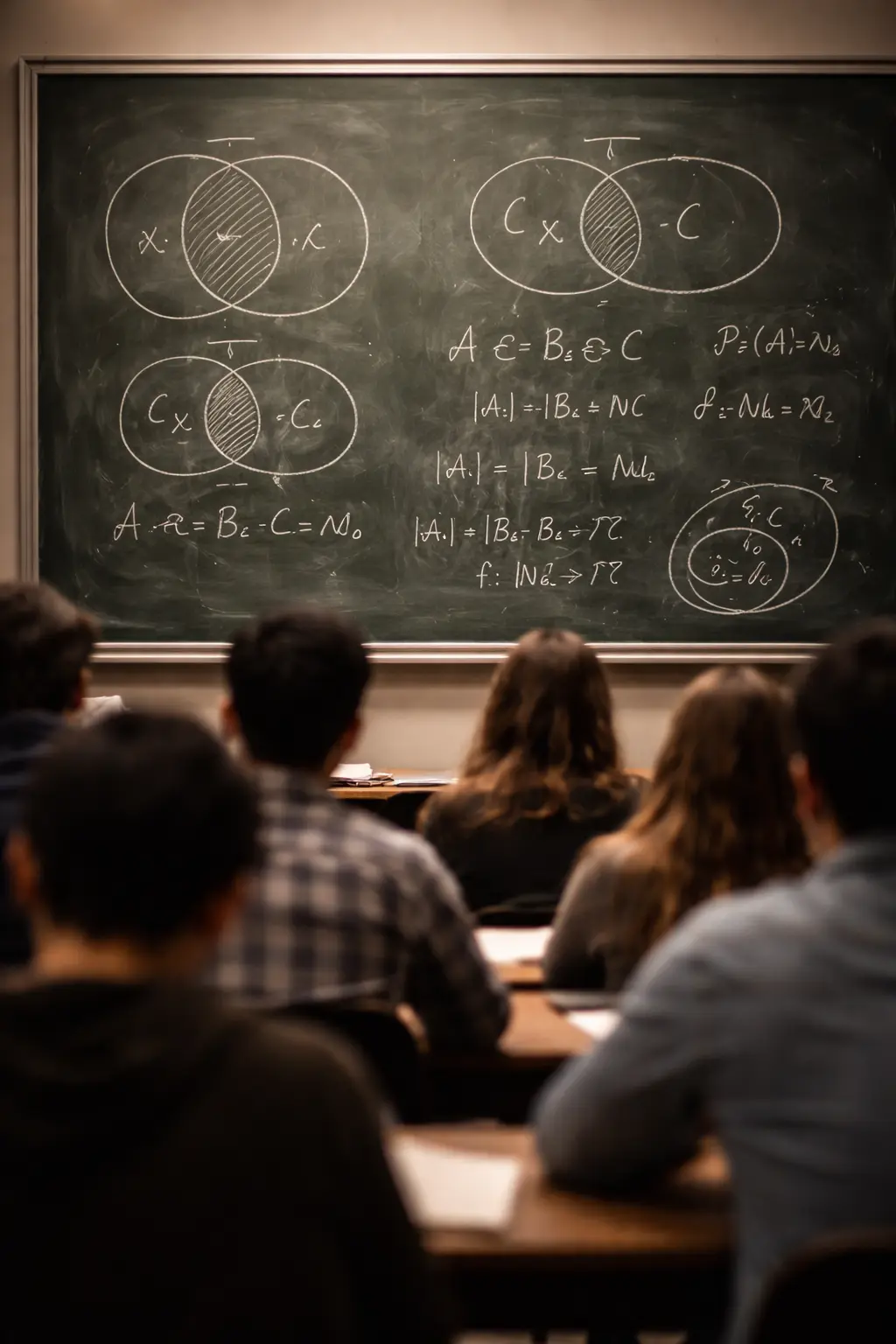
The decisive step was to compare sets without counting their members
one by one. Two sets have the same size—the same cardinality—when a
one-to-one correspondence can be established between their elements.
This produces unsettling results. The natural numbers—1, 2, 3, 4, and
so on—form an infinite set. The even numbers—2, 4, 6, 8, and so
on—appear to be only part of it. Yet each natural number can be paired
with an even number by multiplying it by two. The two sets therefore
have the same infinite size.
The idea had appeared in earlier discussions of infinity, but Cantor
transformed it into a systematic mathematical tool. The truly
revolutionary step came when he proved that not every infinite set could
be paired in this way.
In 1874, he published a proof that the algebraic numbers could be
enumerated while the real numbers could not be placed in a complete
list. He had discovered that the numerical continuum was a larger
infinity than the natural numbers (Cantor, 1874/1996).
Infinity was no longer a single undifferentiated immensity.
The Diagonal That
Always Escapes
AI-generated visual recreation.
In 1891, Cantor presented a particularly elegant demonstration that
the real numbers are uncountable. The proof, known as the diagonal
argument, assumes that every real number between zero and one has been
arranged in an infinite list.
Cantor then constructs a new number by altering the first decimal
digit of the first number, the second digit of the second number, the
third digit of the third, and so on. The resulting number differs from
the first entry in its first digit, from the second in its second digit,
and from every item on the list in at least one position.
The new number therefore does not appear on the list that supposedly
contained every real number.
No matter how the list is organized, a number can always be
constructed that escapes it. The real numbers are uncountable; the
natural numbers are countable. Both sets are infinite, but one is
strictly larger than the other (Ferreirós, 2007).
Diagonalization became one of the most powerful techniques in modern
thought. Variations of its structure later appeared in mathematical
logic, Kurt Gödel’s incompleteness theorems, and the theoretical
foundations of computing.
Cantor had not merely discovered a result. He had created a method
for exposing the limits of any system claiming to contain
everything.
Aleph: A
Staircase Without a Final Step
AI-generated visual recreation.
To represent infinite sizes, Cantor introduced transfinite cardinal
numbers and used the Hebrew letter aleph. The size of the set of natural
numbers received the symbol ℵ₀—aleph-null.
He also proved that for any set, the set of all its subsets has a
greater cardinality. This result, known as Cantor’s theorem, implies
that there is no greatest infinity. For every infinite size, a larger
one can be constructed (Cantor, 1891/1996).
The conclusion was dizzying: infinities did not form a chaos, but an
endless hierarchy.
Cantor also developed transfinite ordinal numbers to describe
positions and orders continuing beyond every finite sequence. To him,
these entities were not merely convenient symbols. They possessed
legitimate mathematical reality.
Many contemporaries believed that he had crossed a forbidden
boundary. Actual infinity—a completed infinite totality—had
traditionally been regarded with suspicion. Cantor instead brought it
inside mathematics and began operating upon it.
Kronecker
and the War Over What Could Exist
AI-generated visual recreation.
Leopold Kronecker accepted integers and procedures that could be
constructed through a finite number of steps. He distrusted abstract
mathematical entities that could not be obtained in this way. Cantor’s
ideas represented almost everything he rejected.
Kronecker served on the editorial board of Crelle’s Journal,
an essential publication for German mathematicians. When Cantor
submitted a paper in 1877 demonstrating a surprising correspondence
between spaces of different dimensions, Kronecker opposed his methods,
and publication was delayed until 1878 (Dauben, 1979).
The dispute was profound, but the popular image of Kronecker as
solely responsible for Cantor’s breakdowns oversimplifies the history.
Cantor perceived the criticism as a personal campaign and believed that
Kronecker was obstructing his move to Berlin. His professional, family,
and psychological difficulties, however, had multiple causes, and no
direct medical relationship can be established between a mathematical
dispute and his illness (Grattan-Guinness, 1971).
His first documented severe crisis occurred in 1884. Cantor
experienced recurring periods of depression, excitement, and exhaustion
for the remainder of his life. Some historians have suggested that he
may have had bipolar disorder, but a definitive retrospective diagnosis
is impossible.
His hospitalizations do not prove that studying infinity drove him
mad. That romantic interpretation confuses one man’s illness with the
content of his work.
The Problem He Could Not
Solve
AI-generated visual recreation.
After proving that the natural and real numbers have different
cardinalities, Cantor formulated an inevitable question: is there a set
whose size is greater than that of the natural numbers but smaller than
that of the real numbers?
Cantor believed that there was not. This statement became known as
the continuum hypothesis. He attempted to prove it for years and, at
different times, believed he had found a solution, only to discover
errors in his arguments (Dauben, 1979).
In 1900, David Hilbert placed the continuum hypothesis first on his
celebrated list of problems for twentieth-century mathematics. Cantor
died without knowing that the question could not be decided using the
axiomatic tools that would later become standard.
In 1940, Kurt Gödel showed that the hypothesis could not be disproved
from the usual axioms of set theory, assuming those axioms were
consistent. In 1963, Paul Cohen demonstrated that it could not be proved
within that system either. Together, their results established that the
continuum hypothesis is independent of the Zermelo–Fraenkel axioms with
the axiom of choice (Moore, 1982).
Cantor had tried to open a door that, within that mathematical
building, could neither be opened nor closed.
A
Little-Known Fact: He Searched for Shakespeare Inside Francis
BaconAI-generated visual recreation.
During periods of reduced mathematical productivity, Cantor devoted
considerable energy to the Shakespeare–Bacon question. He became
convinced that Francis Bacon had written the works attributed to William
Shakespeare and attempted to prove it through textual comparisons,
chronologies, and historical interpretations (Dauben, 1979).
The theory lacked support among specialists, yet Cantor repeatedly
returned to it. He also investigated possible connections between
Shakespeare’s plays and writers such as Christopher Marlowe.
This obsession should not be used to discredit his mathematics
automatically. His proofs concerning sets and cardinalities could be
verified independently of his literary convictions. The episode does,
however, reveal a persistent feature of his personality: the need to
find a hidden structure capable of explaining what others accepted
without question.
In infinity, he found a genuine mathematical hierarchy. In
Shakespeare, he believed he had found a secret identity that was not
there.
Between Mathematics and
God
AI-generated visual recreation.
Cantor was deeply religious. He distinguished between absolute
infinity, which he associated exclusively with God, and transfinite
infinities, which humans could study mathematically. He feared that his
ideas might be interpreted as an invasion of theological territory and
corresponded with Catholic thinkers and authorities to explain that
transfinite numbers did not compete with divine infinity (Dauben,
1977).
Although he was not Catholic, he found a more receptive audience
among some neo-Thomist theologians than among certain mathematicians.
Cantor came to regard the development of set theory as part of a mission
entrusted to him.
His religious beliefs influenced the philosophical interpretation he
gave his discoveries, but the validity of his results did not depend on
them. This distinction is essential: personal motivations can inspire a
theory; proofs determine whether it belongs to mathematics.
The Paradise
Built by a Tormented Man
By the beginning of the twentieth century, set theory had started to
occupy a central place in the foundations of mathematics. Paradoxes also
emerged, forcing mathematicians to reformulate it through more rigorous
axiomatic systems. Cantor had opened an immense territory, although
others would have to construct safe paths through it.
David Hilbert defended his legacy with a statement that became
famous: no one should expel mathematicians from the paradise Cantor had
created (Hilbert, 1926/1967).
Cantor spent his final years moving between his home and psychiatric
clinics. The First World War intensified deprivation and isolation. He
died on January 6, 1918, in an institution in Halle, at the age of
seventy-two.
He did not live to see the full extent to which his language would
transform mathematics, logic, and computer science. Concepts such as
sets, cardinality, correspondence, and diagonalization became essential
parts of modern thought.
Cantor approached the human limit because he attempted to measure
what appeared to admit no measurement. He discovered that infinity was
not the end of numbers, but the beginning of a new arithmetic.
And he demonstrated something even more unsettling: no matter how
vast a system may be, something can always exist outside it.
References
Cantor, G. (1996). On a property of the collection of all real
algebraic numbers. In W. Ewald (Ed.), From Kant to Hilbert: A source
book in the foundations of mathematics (Vol. 2, pp. 839–843).
Oxford University Press. (Original work published 1874).
Cantor, G. (1996). On an elementary question in the theory of
manifolds. In W. Ewald (Ed.), From Kant to Hilbert: A source book in
the foundations of mathematics (Vol. 2, pp. 920–922). Oxford
University Press. (Original work published 1891).
Dauben, J. W. (1977). Georg Cantor and Pope Leo XIII: Mathematics,
theology, and the infinite. Journal of the History of Ideas,
38(1), 85–108.
Dauben, J. W. (1979). Georg Cantor: His mathematics and
philosophy of the infinite. Harvard University Press.
Ferreirós, J. (2007). Labyrinth of thought: A history of set
theory and its role in modern mathematics (2nd ed.).
Birkhäuser.
Grattan-Guinness, I. (1971). Towards a biography of Georg Cantor. Annals of Science, 27(4), 345–391.
Hilbert, D. (1967). On the infinite. In J. van Heijenoort (Ed.), From Frege to Gödel: A source book in mathematical logic,
1879–1931 (pp. 367–392). Harvard University Press. (Original work
published 1926).
Moore, G. H. (1982). Zermelo’s axiom of choice: Its origins,
development, and influence. Springer-Verlag.
References
tudy-engineering”>A Violinist
Pressured to Study Engineering
Georg Ferdinand Ludwig Philipp Cantor was born on March 3, 1845, in
St. Petersburg, into a family of merchants and musicians. His father,
Georg Woldemar Cantor, was a successful broker; his mother, Maria Anna
Böhm, came from a musical family. Young Georg inherited this artistic
environment and became a skilled violinist (Dauben, 1979).
When he was eleven, the family moved to Germany because of his
father’s health. Cantor displayed exceptional mathematical ability, but
his father preferred that he study engineering, which he considered a
more secure profession. In 1862, after insisting on his true vocation,
Cantor obtained permission to devote himself to mathematics.
He studied at the University of Zurich and later in Berlin, where his
teachers included Karl Weierstrass, Ernst Kummer, and Leopold Kronecker.
In 1867, he received his doctorate for research in number theory. Two
years later, he began working at the University of Halle, where he would
remain for nearly his entire career (Dauben, 1979).
Cantor hoped eventually to obtain a professorship in Berlin, the
great center of German mathematics. He never succeeded. That frustration
became intertwined with his intellectual and personal conflict with
Kronecker.
The
Problem That Opened the Door to Infinity
Cantor’s earliest research did not directly concern infinite sets. He
studied trigonometric series and the problem of determining when a
function could be represented uniquely by such a series. His
investigation of exceptional points led him toward collections of
numbers and, eventually, toward a new way of thinking about infinite
totalities (Ferreirós, 2007).
The decisive step was to compare sets without counting their members
one by one. Two sets have the same size—the same cardinality—when a
one-to-one correspondence can be established between their elements.
This produces unsettling results. The natural numbers—1, 2, 3, 4, and
so on—form an infinite set. The even numbers—2, 4, 6, 8, and so
on—appear to be only part of it. Yet each natural number can be paired
with an even number by multiplying it by two. The two sets therefore
have the same infinite size.
The idea had appeared in earlier discussions of infinity, but Cantor
transformed it into a systematic mathematical tool. The truly
revolutionary step came when he proved that not every infinite set could
be paired in this way.
In 1874, he published a proof that the algebraic numbers could be
enumerated while the real numbers could not be placed in a complete
list. He had discovered that the numerical continuum was a larger
infinity than the natural numbers (Cantor, 1874/1996).
Infinity was no longer a single undifferentiated immensity.
The Diagonal That
Always Escapes
In 1891, Cantor presented a particularly elegant demonstration that
the real numbers are uncountable. The proof, known as the diagonal
argument, assumes that every real number between zero and one has been
arranged in an infinite list.
Cantor then constructs a new number by altering the first decimal
digit of the first number, the second digit of the second number, the
third digit of the third, and so on. The resulting number differs from
the first entry in its first digit, from the second in its second digit,
and from every item on the list in at least one position.
The new number therefore does not appear on the list that supposedly
contained every real number.
No matter how the list is organized, a number can always be
constructed that escapes it. The real numbers are uncountable; the
natural numbers are countable. Both sets are infinite, but one is
strictly larger than the other (Ferreirós, 2007).
Diagonalization became one of the most powerful techniques in modern
thought. Variations of its structure later appeared in mathematical
logic, Kurt Gödel’s incompleteness theorems, and the theoretical
foundations of computing.
Cantor had not merely discovered a result. He had created a method
for exposing the limits of any system claiming to contain
everything.
Aleph: A
Staircase Without a Final Step
To represent infinite sizes, Cantor introduced transfinite cardinal
numbers and used the Hebrew letter aleph. The size of the set of natural
numbers received the symbol ℵ₀—aleph-null.
He also proved that for any set, the set of all its subsets has a
greater cardinality. This result, known as Cantor’s theorem, implies
that there is no greatest infinity. For every infinite size, a larger
one can be constructed (Cantor, 1891/1996).
The conclusion was dizzying: infinities did not form a chaos, but an
endless hierarchy.
Cantor also developed transfinite ordinal numbers to describe
positions and orders continuing beyond every finite sequence. To him,
these entities were not merely convenient symbols. They possessed
legitimate mathematical reality.
Many contemporaries believed that he had crossed a forbidden
boundary. Actual infinity—a completed infinite totality—had
traditionally been regarded with suspicion. Cantor instead brought it
inside mathematics and began operating upon it.
Kronecker
and the War Over What Could Exist
Leopold Kronecker accepted integers and procedures that could be
constructed through a finite number of steps. He distrusted abstract
mathematical entities that could not be obtained in this way. Cantor’s
ideas represented almost everything he rejected.
Kronecker served on the editorial board of Crelle’s Journal,
an essential publication for German mathematicians. When Cantor
submitted a paper in 1877 demonstrating a surprising correspondence
between spaces of different dimensions, Kronecker opposed his methods,
and publication was delayed until 1878 (Dauben, 1979).
The dispute was profound, but the popular image of Kronecker as
solely responsible for Cantor’s breakdowns oversimplifies the history.
Cantor perceived the criticism as a personal campaign and believed that
Kronecker was obstructing his move to Berlin. His professional, family,
and psychological difficulties, however, had multiple causes, and no
direct medical relationship can be established between a mathematical
dispute and his illness (Grattan-Guinness, 1971).
His first documented severe crisis occurred in 1884. Cantor
experienced recurring periods of depression, excitement, and exhaustion
for the remainder of his life. Some historians have suggested that he
may have had bipolar disorder, but a definitive retrospective diagnosis
is impossible.
His hospitalizations do not prove that studying infinity drove him
mad. That romantic interpretation confuses one man’s illness with the
content of his work.
The Problem He Could Not
Solve
After proving that the natural and real numbers have different
cardinalities, Cantor formulated an inevitable question: is there a set
whose size is greater than that of the natural numbers but smaller than
that of the real numbers?
Cantor believed that there was not. This statement became known as
the continuum hypothesis. He attempted to prove it for years and, at
different times, believed he had found a solution, only to discover
errors in his arguments (Dauben, 1979).
In 1900, David Hilbert placed the continuum hypothesis first on his
celebrated list of problems for twentieth-century mathematics. Cantor
died without knowing that the question could not be decided using the
axiomatic tools that would later become standard.
In 1940, Kurt Gödel showed that the hypothesis could not be disproved
from the usual axioms of set theory, assuming those axioms were
consistent. In 1963, Paul Cohen demonstrated that it could not be proved
within that system either. Together, their results established that the
continuum hypothesis is independent of the Zermelo–Fraenkel axioms with
the axiom of choice (Moore, 1982).
Cantor had tried to open a door that, within that mathematical
building, could neither be opened nor closed.
A
Little-Known Fact: He Searched for Shakespeare Inside Francis
Bacon
During periods of reduced mathematical productivity, Cantor devoted
considerable energy to the Shakespeare–Bacon question. He became
convinced that Francis Bacon had written the works attributed to William
Shakespeare and attempted to prove it through textual comparisons,
chronologies, and historical interpretations (Dauben, 1979).
The theory lacked support among specialists, yet Cantor repeatedly
returned to it. He also investigated possible connections between
Shakespeare’s plays and writers such as Christopher Marlowe.
This obsession should not be used to discredit his mathematics
automatically. His proofs concerning sets and cardinalities could be
verified independently of his literary convictions. The episode does,
however, reveal a persistent feature of his personality: the need to
find a hidden structure capable of explaining what others accepted
without question.
In infinity, he found a genuine mathematical hierarchy. In
Shakespeare, he believed he had found a secret identity that was not
there.
Between Mathematics and
God
Cantor was deeply religious. He distinguished between absolute
infinity, which he associated exclusively with God, and transfinite
infinities, which humans could study mathematically. He feared that his
ideas might be interpreted as an invasion of theological territory and
corresponded with Catholic thinkers and authorities to explain that
transfinite numbers did not compete with divine infinity (Dauben,
1977).
Although he was not Catholic, he found a more receptive audience
among some neo-Thomist theologians than among certain mathematicians.
Cantor came to regard the development of set theory as part of a mission
entrusted to him.
His religious beliefs influenced the philosophical interpretation he
gave his discoveries, but the validity of his results did not depend on
them. This distinction is essential: personal motivations can inspire a
theory; proofs determine whether it belongs to mathematics.
The Paradise
Built by a Tormented Man
By the beginning of the twentieth century, set theory had started to
occupy a central place in the foundations of mathematics. Paradoxes also
emerged, forcing mathematicians to reformulate it through more rigorous
axiomatic systems. Cantor had opened an immense territory, although
others would have to construct safe paths through it.
David Hilbert defended his legacy with a statement that became
famous: no one should expel mathematicians from the paradise Cantor had
created (Hilbert, 1926/1967).
Cantor spent his final years moving between his home and psychiatric
clinics. The First World War intensified deprivation and isolation. He
died on January 6, 1918, in an institution in Halle, at the age of
seventy-two.
He did not live to see the full extent to which his language would
transform mathematics, logic, and computer science. Concepts such as
sets, cardinality, correspondence, and diagonalization became essential
parts of modern thought.
Cantor approached the human limit because he attempted to measure
what appeared to admit no measurement. He discovered that infinity was
not the end of numbers, but the beginning of a new arithmetic.
And he demonstrated something even more unsettling: no matter how
vast a system may be, something can always exist outside it.
References
Cantor, G. (1996). On a property of the collection of all real
algebraic numbers. In W. Ewald (Ed.), From Kant to Hilbert: A source
book in the foundations of mathematics (Vol. 2, pp. 839–843).
Oxford University Press. (Original work published 1874).
Cantor, G. (1996). On an elementary question in the theory of
manifolds. In W. Ewald (Ed.), From Kant to Hilbert: A source book in
the foundations of mathematics (Vol. 2, pp. 920–922). Oxford
University Press. (Original work published 1891).
Dauben, J. W. (1977). Georg Cantor and Pope Leo XIII: Mathematics,
theology, and the infinite. Journal of the History of Ideas,
38(1), 85–108.
Dauben, J. W. (1979). Georg Cantor: His mathematics and
philosophy of the infinite. Harvard University Press.
Ferreirós, J. (2007). Labyrinth of thought: A history of set
theory and its role in modern mathematics (2nd ed.).
Birkhäuser.
Grattan-Guinness, I. (1971). Towards a biography of Georg Cantor. Annals of Science, 27(4), 345–391.
Hilbert, D. (1967). On the infinite. In J. van Heijenoort (Ed.), From Frege to Gödel: A source book in mathematical logic,
1879–1931 (pp. 367–392). Harvard University Press. (Original work
published 1926).
Moore, G. H. (1982). Zermelo’s axiom of choice: Its origins,
development, and influence. Springer-Verlag.
✦
A letter for curious minds
History, without the noise.
Receive new documented stories, cultural discoveries, and remarkable lives. A thoughtful edition, only when there is something worth reading.